Paraguay Adipic Acid Market Growth Rate Analysis (2025 - 2031)
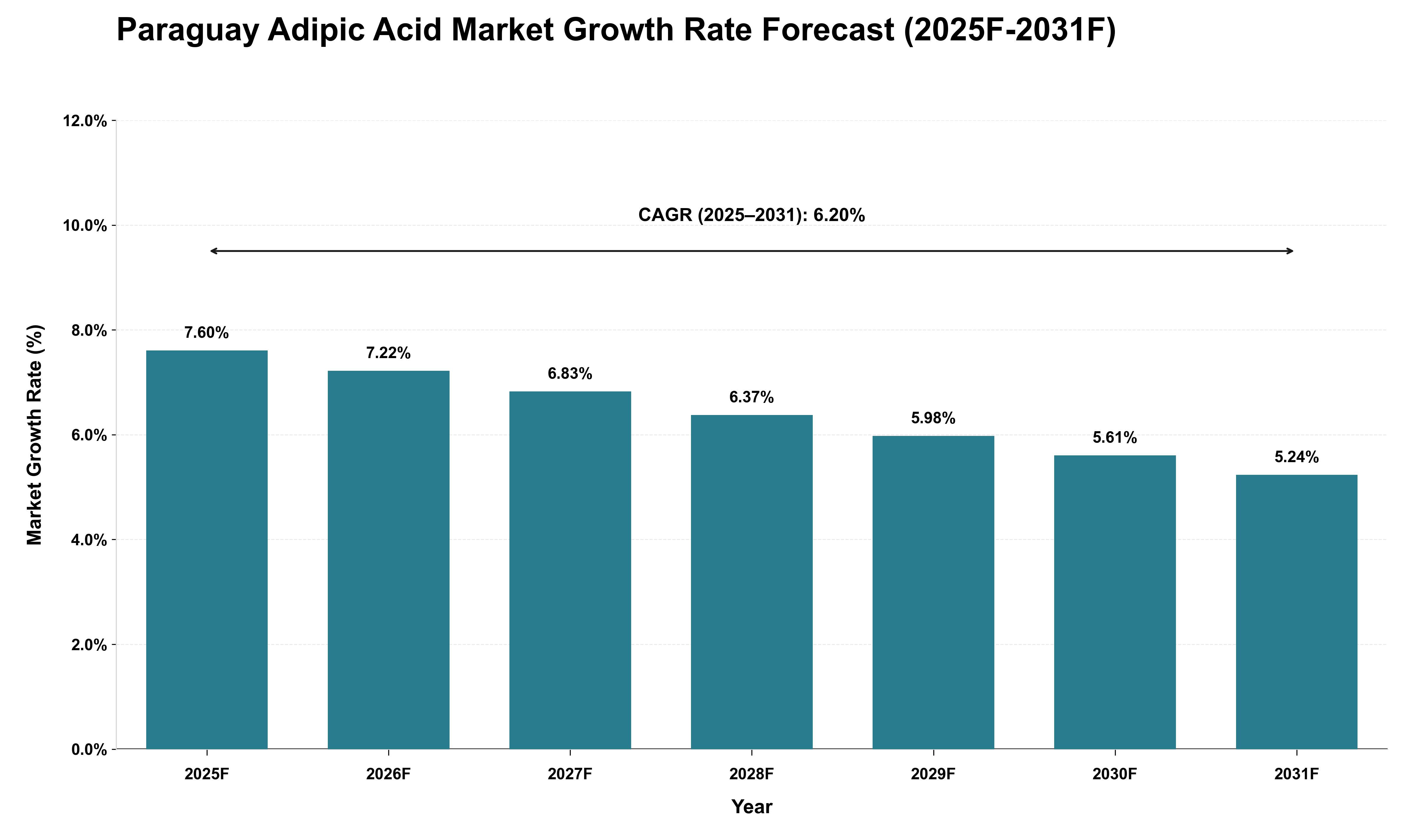
The Paraguayan adipic acid market will experience a notable transformation driven by evolving import dependencies and global trade dynamics. As the forecast period progresses, the compound annual growth rate (CAGR) of 6.20% will reflect a robust demand for adipic acid, primarily fueled by its applications in the production of nylon and other polymers. The initial years, particularly 2025 with a growth rate of 7.60%, will likely see heightened import activity as local production capabilities adapt to meet increasing domestic consumption. However, as the market matures through 2031, growth rates are expected to gradually decline, indicating a shift towards stabilization in trade flows. This trend may be influenced by global supply chain adjustments and potential shifts in sourcing strategies among manufacturers seeking cost efficiencies. Overall, Paraguay's adipic acid sector will align with broader regional trends in chemical imports while responding to fluctuating international demand patterns.
Key Highlights of the Report:
- Paraguay Adipic acid Market Outlook
- Market Size of Paraguay Adipic acid Market, 2024
- Forecast of Paraguay Adipic acid Market, 2031
- Historical Data and Forecast of Paraguay Adipic acid Revenues & Volume for the Period 2021-2031
- Paraguay Adipic acid Market Trend Evolution
- Paraguay Adipic acid Market Drivers and Challenges
- Paraguay Adipic acid Price Trends
- Paraguay Adipic acid Porter`s Five Forces
- Paraguay Adipic acid Industry Life Cycle
- Historical Data and Forecast of Paraguay Adipic acid Market Revenues & Volume By Application for the Period 2021-2031
- Historical Data and Forecast of Paraguay Adipic acid Market Revenues & Volume By Nylon 6,6 Fiber for the Period 2021-2031
- Historical Data and Forecast of Paraguay Adipic acid Market Revenues & Volume By Nylon 6,6 Resin for the Period 2021-2031
- Historical Data and Forecast of Paraguay Adipic acid Market Revenues & Volume By Polyurethane for the Period 2021-2031
- Historical Data and Forecast of Paraguay Adipic acid Market Revenues & Volume By Adipate Esters for the Period 2021-2031
- Historical Data and Forecast of Paraguay Adipic acid Market Revenues & Volume By Others for the Period 2021-2031
- Historical Data and Forecast of Paraguay Adipic acid Market Revenues & Volume By Raw Material for the Period 2021-2031
- Historical Data and Forecast of Paraguay Adipic acid Market Revenues & Volume By Cyclohexanol for the Period 2021-2031
- Historical Data and Forecast of Paraguay Adipic acid Market Revenues & Volume By Cyclohexanone for the Period 2021-2031
- Paraguay Adipic acid Import Export Trade Statistics
- Market Opportunity Assessment By Application
- Market Opportunity Assessment By Raw Material
- Paraguay Adipic acid Top Companies Market Share
- Paraguay Adipic acid Competitive Benchmarking By Technical and Operational Parameters
- Paraguay Adipic acid Company Profiles
- Paraguay Adipic acid Key Strategic Recommendations






































