Peru Auto Parts And Accessories Market Size, Share & Growth Rate
The Peru Auto Parts And Accessories Market was estimated at USD 390 Million in 2025 and is projected to reach USD 521 Million by 2032, growing at a CAGR of 4.2% from 2026 to 2032. This upward trajectory is fueled by a significant increase in vehicle ownership as more Peruvians invest in personal and commercial transportation. Additionally, the burgeoning aftermarket is responding to a heightened interest in vehicle customization, compelling manufacturers and retailers to innovate their product offerings.
Peru Auto Parts And Accessories Market Year-wise Growth Rate and Key Drivers
This graph highlights how the Peru Auto Parts And Accessories Market has steadily grown over the years, supported by major growth factors.
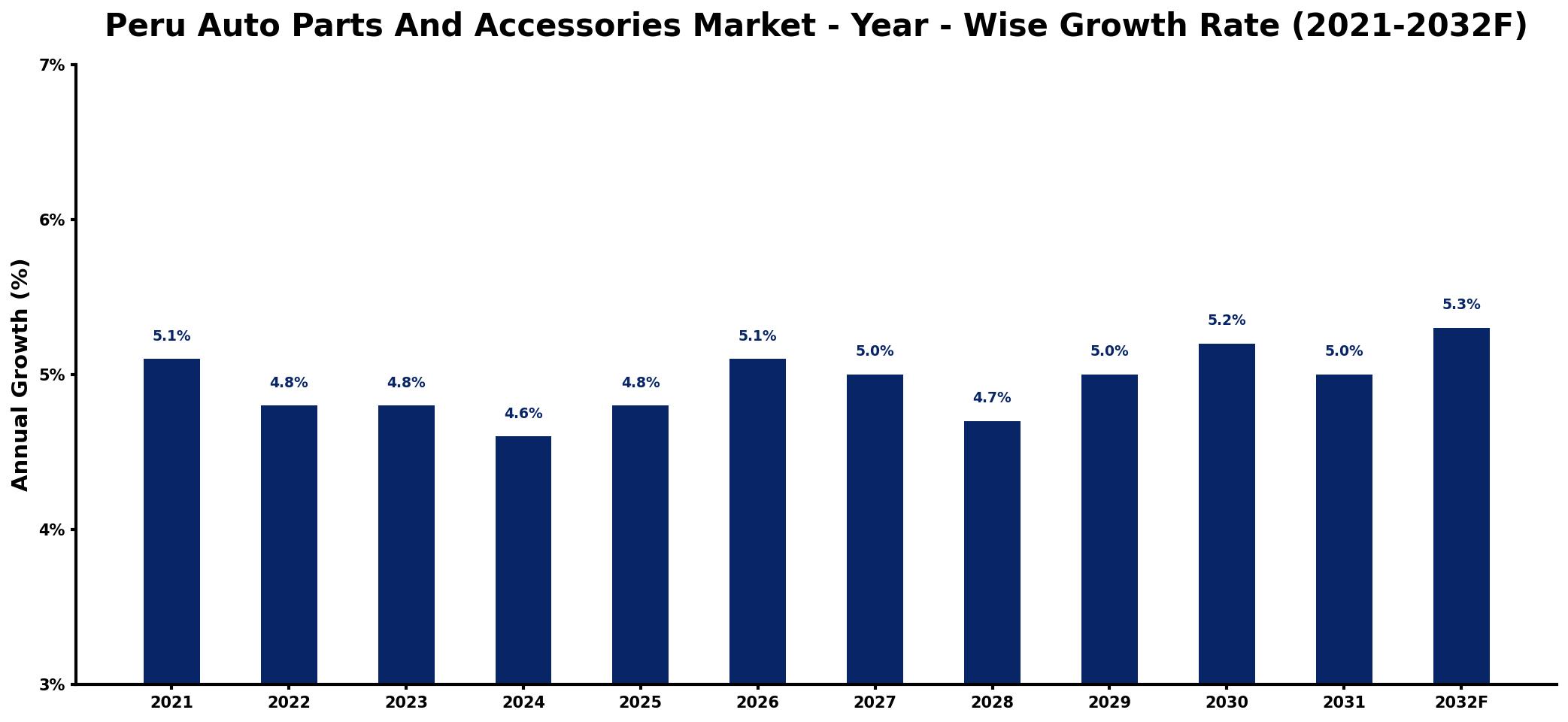
The table below presents the year‑wise growth rates along with the key drivers influencing the market
| Year | Growth Rate | Major Drivers |
| 2021 | 5.1% | Rising consumer vehicle ownership rates |
| 2022 | 4.8% | Expansion of e-commerce platforms |
| 2023 | 4.8% | Increased investment in infrastructure |
| 2024 | 4.6% | Growth in ride-sharing services |
| 2025 | 4.8% | Surge in electric vehicle adoption |
| 2026 | 5.1% | Higher disposable income levels |
| 2027 | 5.0% | Booming tourism sector demand |
| 2028 | 4.7% | growing regional consumption patterns |
| 2029 | 5.0% | Strengthened supply chain networks |
| 2030 | 5.2% | Growing environmental awareness initiatives |
| 2031 | 5.0% | increased overall sector activity |
| 2032 | 5.3% | Rising demand for sustainable solutions |
Note: Market size estimations and growth projections presented in this report are based on 6Wresearch's proprietary forecasting methodology, utilizing the latest available industry data, government publications, and primary research inputs.
Peru Auto Parts And Accessories Market Synopsis
As vehicle sales continue to surge in Peru, a parallel growth in demand for high-quality auto parts is evident. Customers are increasingly seeking both OEM and aftermarket products that deliver reliability without compromising affordability. This trend is bolstered by a diverse range of available products, spanning from engine components to innovative accessories designed for performance enhancement.
The market is witnessing a notable shift towards sustainability, as consumers express a growing preference for eco-friendly products. This rising environmental consciousness aligns with the expansion of e-commerce platforms, which are becoming the preferred shopping channels for auto parts and accessories, offering convenience and accessibility to a wider audience.
Peru Auto Parts And Accessories Market Key Takeaways
- The market is benefitting from increased vehicle ownership and a growing automotive aftermarket.
- Eco-friendly product offerings are gaining traction amid rising consumer environmental awareness.
- Online sales channels are rapidly expanding, providing an alternative for traditional retail.
- Customization and performance enhancement are leading trends influencing consumer purchases.
- The market is characterized by a competitive landscape, with both local and international players striving for market share.
Evaluation of Restraints in Peru Auto Parts And Accessories Market
Despite its promising growth, the Peru Auto Parts and Accessories Market faces significant constraints. The high level of competition introduces price sensitivity that can erode profit margins, especially for smaller firms. Furthermore, the market's fragmentation complicates efforts to establish brand loyalty, while the variability in product quality contributes to customer skepticism. The sector's reliance on skilled labor also poses a risk, as the limited workforce can hinder innovation and operational efficiency, affecting overall growth potential.
Peru Auto Parts And Accessories Market Trends
Key trends shaping the Peru Auto Parts and Accessories Market include the increasing demand for personalized vehicle features and accessories, which speaks to a broader cultural shift towards individuality in consumer choices. Online retail is becoming increasingly prominent as consumers seek the convenience of shopping from home. The adoption of advanced technologies is also on the rise, enabling smarter inventory management and improved customer service, while sustainability initiatives are becoming integral to many brands' strategies.
Peru Auto Parts And Accessories Market Opportunities
Investment opportunities in the Peru Auto Parts and Accessories Market are plentiful, particularly in sectors focused on high-demand products such as batteries, tires, and lighting components. The trend towards vehicle customization also opens avenues for specialized aftermarket products. Moreover, integrating technology in logistics and e-commerce could yield substantial returns as the market adapts to consumer preferences for fast, convenient purchasing experiences.
Government Initiatives in the Peru Auto Parts And Accessories Market
The Peruvian government plays a pivotal role in regulating the auto parts and accessories market, emphasizing safety, quality, and environmental standards. The Ministry of Production oversees compliance with technical regulations, fostering an environment conducive to fair competition. Initiatives aimed at boosting local production through investment incentives are also in place, promoting innovation and ensuring that the market remains responsive to consumer demands.
Future Insights of the Peru Auto Parts And Accessories Market
Looking ahead to 2026-2032, the Peru Auto Parts and Accessories Market is anticipated to flourish, driven by a combination of rising disposable incomes and the increasing prevalence of electric vehicles. As consumers continue to prioritize vehicle maintenance and customization, the demand for diverse auto parts will only intensify. However, stakeholders will need to navigate potential supply chain disruptions and fluctuating raw material prices to sustain growth momentum in this vibrant sector.
Peru Auto Parts And Accessories Market Latest Developments (2025 - 2026)
In recent months, the Peru Auto Parts and Accessories Market has seen a surge in technology-driven solutions aimed at enhancing customer experiences. E-commerce platforms are rapidly evolving, with new players entering the space to capitalize on the growing trend towards online shopping. Furthermore, the demand for environmentally friendly products has prompted several manufacturers to innovate and offer sustainable options that meet regulatory standards and consumer expectations.
Peru Auto Parts And Accessories Market - Key Attractiveness of the Report
- 10 Years of Market Numbers
- Historical Data Starting from 2022 to 2025
- Base Year: 2025
- Forecast Data until 2032
- Key Performance Indicators Impacting the Market
- Major Upcoming Developments and Projects
Key Highlights of the Report:
- Peru Auto Parts And Accessories Market Outlook
- Market Size of Peru Auto Parts And Accessories Market, 2025
- Forecast of Peru Auto Parts And Accessories Market, 2032
- Historical Data and Forecast of Peru Auto Parts And Accessories Revenues & Volume for the Period 2022-2032F
- Peru Auto Parts And Accessories Market Trend Evolution
- Peru Auto Parts And Accessories Market Drivers and Challenges
- Peru Auto Parts And Accessories Price Trends
- Peru Auto Parts And Accessories Porter's Five Forces
- Peru Auto Parts And Accessories Industry Life Cycle
- Historical Data and Forecast of Peru Auto Parts And Accessories Market Revenues & Volume By Product for the Period 2022-2032F
- Historical Data and Forecast of Peru Auto Parts And Accessories Market Revenues & Volume By Driveline & Powertrain for the Period 2022-2032F
- Historical Data and Forecast of Peru Auto Parts And Accessories Market Revenues & Volume By Interiors & Exteriors for the Period 2022-2032F
- Historical Data and Forecast of Peru Auto Parts And Accessories Market Revenues & Volume By Electronics for the Period 2022-2032F
- Historical Data and Forecast of Peru Auto Parts And Accessories Market Revenues & Volume By Bodies & Chassis for the Period 2022-2032F
- Historical Data and Forecast of Peru Auto Parts And Accessories Market Revenues & Volume By Wheel & Tires for the Period 2022-2032F
- Historical Data and Forecast of Peru Auto Parts And Accessories Market Revenues & Volume By Others for the Period 2022-2032F
- Historical Data and Forecast of Peru Auto Parts And Accessories Market Revenues & Volume By Application for the Period 2022-2032F
- Historical Data and Forecast of Peru Auto Parts And Accessories Market Revenues & Volume By OEMs for the Period 2022-2032F
- Historical Data and Forecast of Peru Auto Parts And Accessories Market Revenues & Volume By Aftermarket for the Period 2022-2032F
- Peru Auto Parts And Accessories Import Export Trade Statistics
- Market Opportunity Assessment By Product
- Market Opportunity Assessment By Application
- Peru Auto Parts And Accessories Top Companies Market Share
- Peru Auto Parts And Accessories Competitive Benchmarking By Technical and Operational Parameters
- Peru Auto Parts And Accessories Company Profiles
- Peru Auto Parts And Accessories Key Strategic Recommendations






































