Peru Energy Efficient Lighting Market Size, Share & Growth Rate
The Peru Energy Efficient Lighting Market was estimated at USD 407 Million in 2025 and is projected to reach USD 561 Million by 2032, growing at a CAGR of 4.7% from 2026 to 2032. This growth trajectory is propelled by increasing consumer awareness around energy conservation and a governmental push toward more sustainable practices. The residential sector plays a pivotal role in this trend, as households seek cost-effective and environmentally friendly lighting solutions, while commercial and industrial segments steadily embrace LED technology to optimize operational costs.
Peru Energy Efficient Lighting Market Year-wise Growth Rate and Key Drivers
This graph highlights how the Peru Energy Efficient Lighting Market has steadily grown over the years, supported by major growth factors.
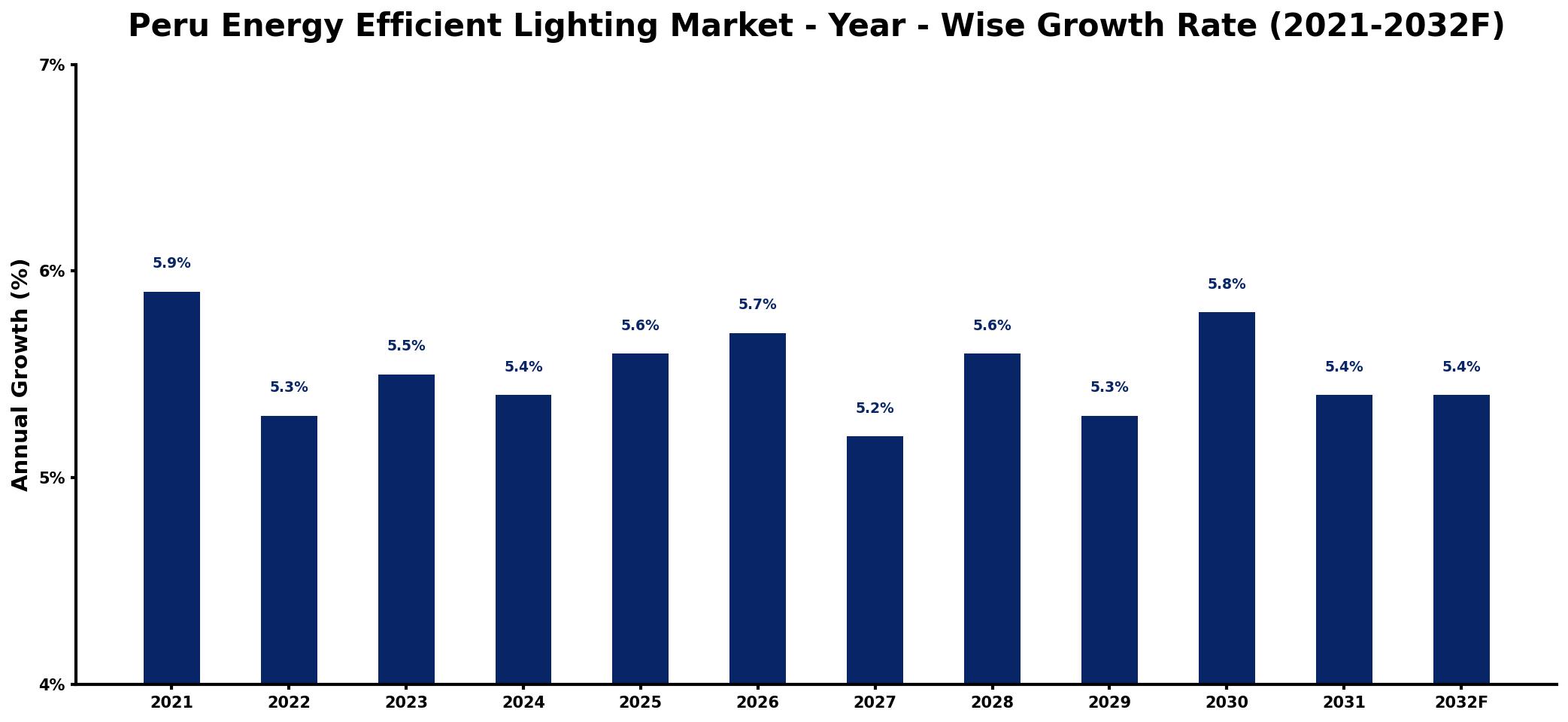
The table below presents the year‑wise growth rates along with the key drivers influencing the market
| Year | Growth Rate | Major Drivers |
| 2021 | 5.9% | Increasing consumer environmental awareness |
| 2022 | 5.3% | Government incentives for sustainability |
| 2023 | 5.5% | Technological advancements in innovation |
| 2024 | 5.4% | Growing urbanization and infrastructure projects |
| 2025 | 5.6% | Rising disposable income levels |
| 2026 | 5.7% | Strengthened regulatory frameworks promoting |
| 2027 | 5.2% | increased pharmaceutical industry usage |
| 2028 | 5.6% | Increased focus on smart technology |
| 2029 | 5.3% | Higher corporate sustainability commitments |
| 2030 | 5.8% | Surge in residential retrofitting projects |
| 2031 | 5.4% | Broadening of financing options available |
| 2032 | 5.4% | Enhanced public-private partnerships initiatives |
Note: Market size estimations and growth projections presented in this report are based on 6Wresearch's proprietary forecasting methodology, utilizing the latest available industry data, government publications, and primary research inputs.
Peru Energy Efficient Lighting Market Synopsis
A notable shift toward LED products characterizes the Peru Energy Efficient Lighting Market. As consumers recognize the long-term savings associated with these technologies, their adoption is skyrocketing. Furthermore, the trend is not isolated to households; businesses are increasingly transitioning to energy-efficient lighting to enhance their sustainability profiles.
Government initiatives play a critical role in shaping this market. Policies and incentives designed to promote energy efficiency and awareness are facilitating the transition from traditional lighting to more advanced, eco-friendly solutions. This environment of support is expected to foster further growth and innovation in the coming years.
Peru Energy Efficient Lighting Market Key Takeaways
- The shift towards LED lighting is fundamentally altering the lighting landscape in Peru.
- Government initiatives are pivotal, providing incentives and regulatory frameworks that encourage adoption.
- The residential sector remains a vital component of market growth, closely followed by commercial applications.
- Consumer education on energy efficiency is crucial for overcoming barriers to adoption.
- Technological advancements, including the rise of smart lighting systems, present new opportunities in the market.
Evaluation of Restraints in Peru Energy Efficient Lighting Market
Despite the positive growth trajectory, several factors limit the expansion of the Peru Energy Efficient Lighting Market. A prevalent lack of awareness among consumers regarding the benefits of energy-efficient lighting hampers broader adoption. The initial cost of LED products can also deter price-sensitive buyers, who may be more inclined to stick with traditional lighting solutions. Furthermore, the absence of robust government incentives and supportive policies can slow down market penetration, particularly in regions struggling with infrastructure challenges and inconsistent electricity supply.
Peru Energy Efficient Lighting Market Trends
Current trends indicate a pronounced movement towards smart lighting solutions, which offer enhanced control and integration with IoT devices. This shift is driven by rising consumer demand for convenience and energy management. Additionally, as sustainability becomes a central theme across industries, energy-efficient lighting products are increasingly viewed not just as alternatives, but essential components of modern, eco-friendly business practices.
Peru Energy Efficient Lighting Market Opportunities
The market is ripe for investment, particularly in areas such as LED product supply and retrofitting existing systems. Companies specializing in energy efficiency consulting are also finding a growing market, as businesses and households seek expert guidance to navigate energy-saving opportunities. Forming strategic partnerships with local distributors and contractors can significantly enhance market penetration and capitalize on the increasing demand for sustainable lighting solutions.
Government Initiatives in the Peru Energy Efficient Lighting Market
The Peruvian government has launched several key initiatives to stimulate the energy-efficient lighting market. The National Energy Efficiency Plan aims to curtail energy consumption while promoting sustainable practices across various sectors. This includes providing tax incentives for purchasing energy-efficient lighting solutions and enforcing regulations mandating the use of such technologies in public infrastructure. Awareness campaigns designed to educate consumers about the benefits of energy-efficient lighting are also in motion, reinforcing the governments commitment to fostering market growth.
Future Insights of the Peru Energy Efficient Lighting Market
Looking ahead to 2026-2032, the Peru Energy Efficient Lighting Market is positioned for robust expansion. Increasing awareness regarding energy efficiency and sustainability will continue to drive demand, complemented by technological advancements in LED lighting. The anticipated growth in smart lighting solutions and compliance with evolving regulations is expected to further bolster market development. In essence, as consumers and businesses become more conscious of their energy footprints, the transition to energy-efficient lighting solutions is set to gain momentum.
Peru Energy Efficient Lighting Market Latest Developments (2025 - 2026)
Recent developments in the Peru Energy Efficient Lighting Market have shown a marked increase in partnerships between technology providers and local distributors, aimed at enhancing market accessibility. Additionally, there have been updates in government policy focusing on further subsidies for energy-efficient lighting, encouraging broader implementation. The growth of smart technologies within lighting solutions has also garnered attention, leading to innovative product launches that cater to the increasingly tech-savvy consumer base.
Peru Energy Efficient Lighting Market - Key Attractiveness of the Report
- 10 Years of Market Numbers
- Historical Data Starting from 2022 to 2025
- Base Year: 2025
- Forecast Data until 2032
- Key Performance Indicators Impacting the Market
- Major Upcoming Developments and Projects
Key Highlights of the Report:
- Peru Energy Efficient Lighting Market Outlook
- Market Size of Peru Energy Efficient Lighting Market, 2025
- Forecast of Peru Energy Efficient Lighting Market, 2032
- Historical Data and Forecast of Peru Energy Efficient Lighting Revenues & Volume for the Period 2022-2032F
- Peru Energy Efficient Lighting Market Trend Evolution
- Peru Energy Efficient Lighting Market Drivers and Challenges
- Peru Energy Efficient Lighting Price Trends
- Peru Energy Efficient Lighting Porter's Five Forces
- Peru Energy Efficient Lighting Industry Life Cycle
- Historical Data and Forecast of Peru Energy Efficient Lighting Market Revenues & Volume By Product Type for the Period 2022-2032F
- Historical Data and Forecast of Peru Energy Efficient Lighting Market Revenues & Volume By Incandescent Lamp for the Period 2022-2032F
- Historical Data and Forecast of Peru Energy Efficient Lighting Market Revenues & Volume By Light Emitting Diode for the Period 2022-2032F
- Historical Data and Forecast of Peru Energy Efficient Lighting Market Revenues & Volume By Arc Lamp for the Period 2022-2032F
- Historical Data and Forecast of Peru Energy Efficient Lighting Market Revenues & Volume By Gas Discharge Lamps for the Period 2022-2032F
- Historical Data and Forecast of Peru Energy Efficient Lighting Market Revenues & Volume By Application for the Period 2022-2032F
- Historical Data and Forecast of Peru Energy Efficient Lighting Market Revenues & Volume By Commercial for the Period 2022-2032F
- Historical Data and Forecast of Peru Energy Efficient Lighting Market Revenues & Volume By Residential for the Period 2022-2032F
- Historical Data and Forecast of Peru Energy Efficient Lighting Market Revenues & Volume By Government for the Period 2022-2032F
- Historical Data and Forecast of Peru Energy Efficient Lighting Market Revenues & Volume By Correlated Color Temperature for the Period 2022-2032F
- Historical Data and Forecast of Peru Energy Efficient Lighting Market Revenues & Volume By 2700K-3000K for the Period 2022-2032F
- Historical Data and Forecast of Peru Energy Efficient Lighting Market Revenues & Volume By 3500K??4000K for the Period 2022-2032F
- Historical Data and Forecast of Peru Energy Efficient Lighting Market Revenues & Volume By 4000K-5000K for the Period 2022-2032F
- Historical Data and Forecast of Peru Energy Efficient Lighting Market Revenues & Volume By 5000K-6500K for the Period 2022-2032F
- Historical Data and Forecast of Peru Energy Efficient Lighting Market Revenues & Volume By More Than 6500K for the Period 2022-2032F
- Peru Energy Efficient Lighting Import Export Trade Statistics
- Market Opportunity Assessment By Product Type
- Market Opportunity Assessment By Application
- Market Opportunity Assessment By Correlated Color Temperature
- Peru Energy Efficient Lighting Top Companies Market Share
- Peru Energy Efficient Lighting Competitive Benchmarking By Technical and Operational Parameters
- Peru Energy Efficient Lighting Company Profiles
- Peru Energy Efficient Lighting Key Strategic Recommendations






































