Peru MLOps Market Size & Growth Rate (2026-2032)
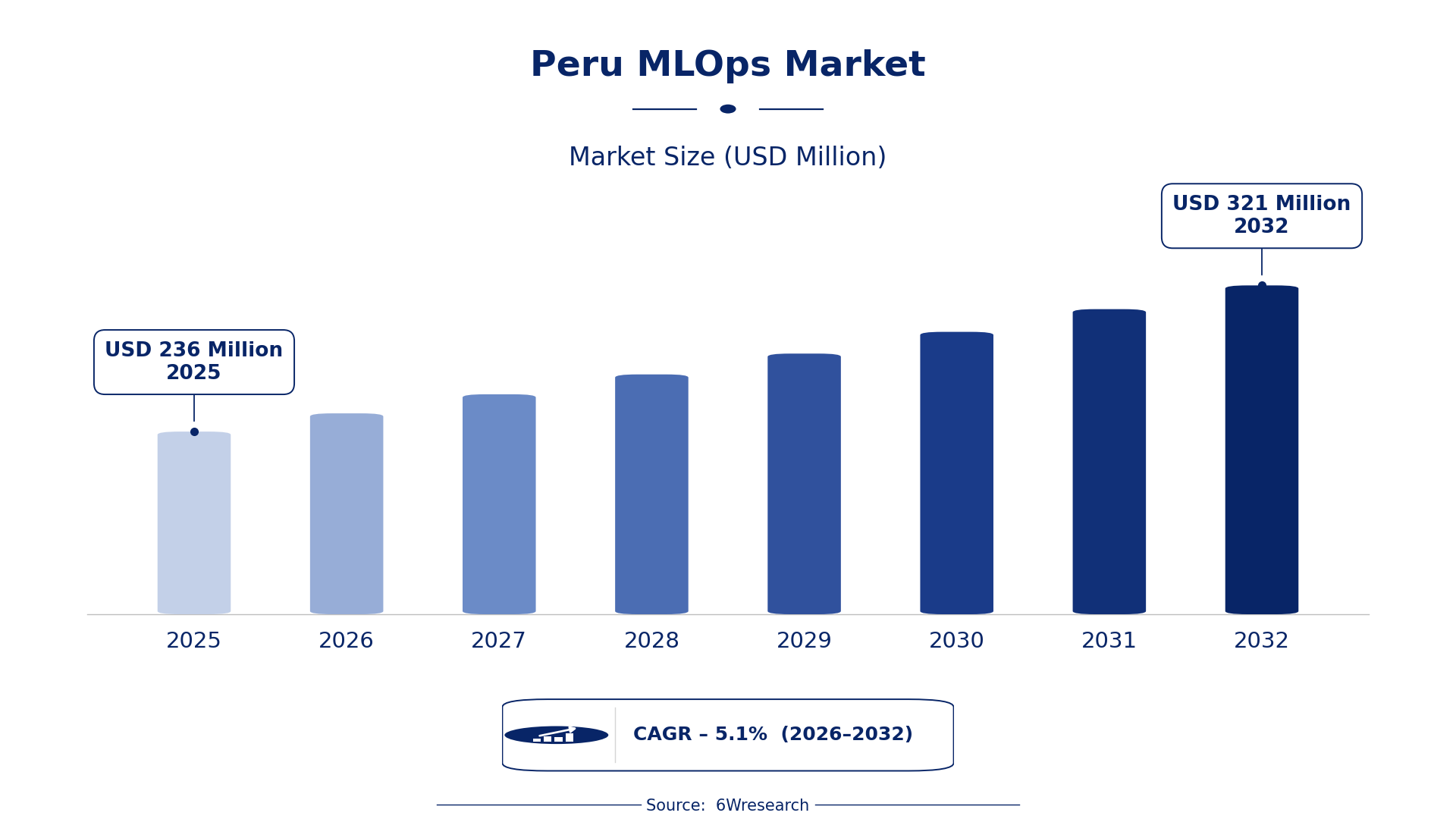
The Peru MLOps Market was estimated at USD 236 Million in 2025 and is projected to reach USD 321 Million by 2032, growing at a CAGR of 5.1% from 2026 to 2032.
Peru MLOps Market Synopsis
The Peru MLOps market is rapidly gaining traction as organizations across finance, healthcare, and retail sectors increasingly recognize the importance of effective machine learning operations. MLOps, which streamlines the deployment and management of machine learning models, is becoming a cornerstone for companies aiming to harness AI technologies for competitive advantage.
This market's growth is underpinned by a pressing need for automation and efficiency in machine learning workflows. As businesses seek to operationalize AI capabilities, the demand for MLOps solutions that facilitate quicker deployment and monitoring of models is on the rise, indicating a strong future ahead for this sector in Peru.
Peru MLOps Market Year-wise Growth Rate and Key Drivers
This graph illustrates the annual growth rates of the Peru MLOps Market from 2021 to 2032, highlighting a steady upward trajectory and projected expansion over the forecast period.
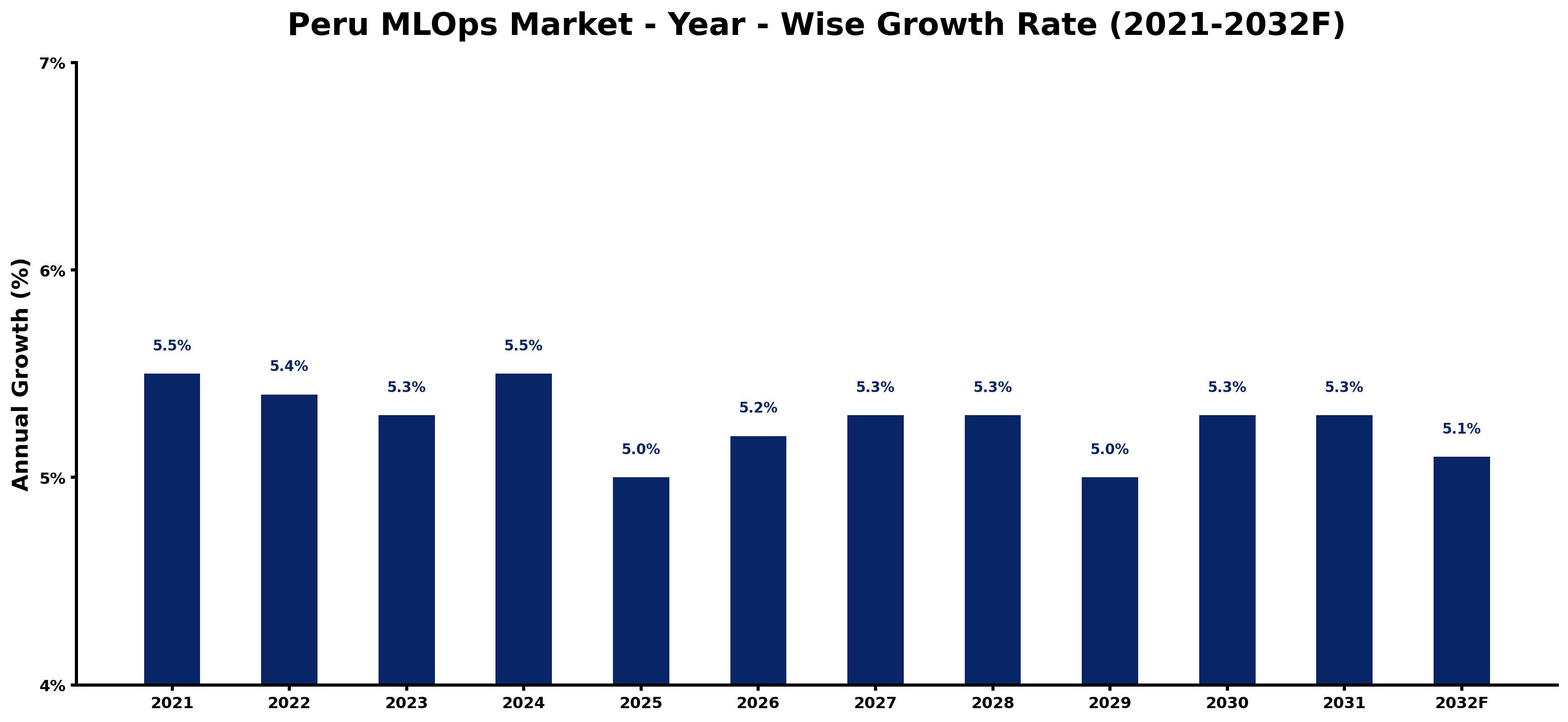
The table below presents the year‑wise growth rates along with the key drivers influencing the market
| Year | Growth Rate | Major Drivers |
| 2021 | 5.5% | Increased investment in AI startups by local businesses. |
| 2022 | 5.4% | Demand for scalable machine learning solutions from enterprises. |
| 2023 | 5.3% | Growing interest in upskilling workforce in AI technologies. |
| 2024 | 5.5% | Partnerships between universities and tech firms for AI research. |
| 2025 | 5.0% | Regulatory push for data-driven decision-making in industries. |
| 2026 | 5.2% | Rising adoption of data analytics in retail sector. |
| 2027 | 5.3% | Local tech conferences showcasing MLOps advancements. |
| 2028 | 5.3% | Increase in government grants for AI innovation projects. |
| 2029 | 5.0% | Heightened focus on AI ethics and data governance. |
| 2030 | 5.3% | Growing popularity of AI-driven customer service solutions. |
| 2031 | 5.3% | Demand for real-time analytics in financial services. |
| 2032 | 5.1% | Increased awareness of MLOps benefits among SMEs. |
Note: Market size estimations and growth projections presented in this report are based on 6Wresearch's proprietary forecasting methodology, utilizing the latest available industry data, government publications, and primary research inputs.
Peru MLOps Market Key Takeaways
Below are some of the specific key takeaways from the market, including:
- Increasing adoption of AI and machine learning technologies is a primary driver of market growth.
- Organizations are focusing on automating the machine learning lifecycle to enhance operational efficiencies.
- The lack of skilled professionals in MLOps presents a significant barrier to widespread adoption.
- Government initiatives are fostering innovation and creating a favorable environment for MLOps development.
- Cloud-based MLOps platforms are gaining traction as cost-effective solutions for scalability.
Evaluation of Restraints in Peru MLOps Market
A critical challenge for the Peru MLOps market is the shortage of skilled professionals with expertise in machine learning operations. This talent gap hampers organizations' ability to implement MLOps practices effectively, resulting in delayed model deployment and management inefficiencies. on top of that, many stakeholders lack a clear understanding of MLOps principles, which can complicate integration efforts. Addressing these issues requires a concerted effort towards training and educational initiatives, alongside collaborations between academia and industry to cultivate the necessary skill sets.
Peru MLOps Market Trends
Several trends are shaping the Peru MLOps market. One notable trend is the emphasis on automating the machine learning lifecycle, which improves efficiency and reduces time-to-market for AI applications. Companies are increasingly investing in MLOps tools that offer integrated solutions for model training, deployment, and monitoring.
Additionally, there is a growing preference for cloud-based MLOps platforms. These solutions provide scalability and flexibility, enabling organizations to adapt quickly to changing business demands. Collaborative efforts between technology vendors and local enterprises are also on the rise, fostering innovation and expanding the MLOps ecosystem.
Peru MLOps Market Opportunities
The Peru MLOps market presents numerous opportunities for growth and investment. Businesses are actively seeking MLOps solutions that streamline operations, which opens doors for technology providers to deliver tailored offerings. There is also a strong demand for platforms that support the automation of machine learning processes, indicating a ripe environment for new entrants.
on top of that, as organizations strive for better data management and compliance, MLOps solutions that emphasize security and governance are increasingly sought after. Partnerships between local startups and established technology firms could further accelerate market growth and innovation.
Government Initiatives in the Peru MLOps Market
The Peruvian government is playing an active role in shaping the MLOps market through strategic policies and initiatives. By prioritizing technology infrastructure development and fostering an environment conducive to innovation, the government aims to bolster the local tech ecosystem. This approach not only supports the growth of MLOps but also enhances the overall digital landscape in Peru.
- A national digital infrastructure upgrade programme launched in early 2023 aims to enhance connectivity and support tech development.
- Current efforts include funding for artificial intelligence research and development initiatives, encouraging local startups to explore MLOps solutions.
- A planned public-private initiative is expected to establish training programs in data science and machine learning by 2026.
- Tax incentives for tech startups have been implemented to stimulate investment in the MLOps sector.
- Ongoing partnerships with private sector companies focus on driving digital transformation across industries.
Future Insights of the Peru MLOps Market
Looking ahead to 2026-2032, the Peru MLOps market is set for considerable expansion. As organizations increasingly adopt machine learning and AI technologies, the need for efficient model management will become more pronounced. The combination of rising data availability, advancements in AI technology, and a growing emphasis on operational efficiency will drive the adoption of MLOps practices.
Government support for digital transformation, coupled with heightened awareness of the advantages MLOps offers, will further propel market growth. As businesses prioritize automation and effective model deployment, the Peru MLOps market is expected to thrive, creating a wealth of opportunities for service providers and technology innovators.
Peru MLOps Market Latest Developments
In the past year, the Peru MLOps market has seen a flurry of activity as companies ramp up their AI initiatives. Organizations are increasingly recognizing the importance of MLOps in achieving operational efficiency and extracting value from machine learning models. This trend is accompanied by significant investment in relevant technologies and partnerships.
- A major technology vendor launched a new model monitoring solution in Q1 2023, aimed at improving performance tracking for deployed models.
- An initiative to develop a comprehensive MLOps training program began in mid-2023 and is currently underway in collaboration with local universities.
- A regional operator is planning to introduce a cloud-based MLOps platform expected to roll out in late 2024, targeting small to mid-sized enterprises.
- A partnership between a prominent analytics firm and a Peruvian startup was finalized in early 2023, focusing on AI-driven solutions for the retail sector.
- Recent funding rounds for several local MLOps startups indicate a growing investor interest in this sector, with potential partnerships to be announced soon.
Peru MLOps Market - Key Attractiveness of the Report
- 10 Years of Market Numbers
- Historical Data Starting from 2022 to 2025
- Base Year: 2025
- Forecast Data until 2032
- Key Performance Indicators Impacting the Market
- Major Upcoming Developments and Projects
Key Highlights of the Report:
- Peru MLOps Market Outlook
- Market Size of Peru MLOps Market, 2025
- Forecast of Peru MLOps Market, 2032
- Historical Data and Forecast of Peru MLOps Revenues & Volume for the Period 2022-2032F
- Peru MLOps Market Trend Evolution
- Peru MLOps Market Drivers and Challenges
- Peru MLOps Price Trends
- Peru MLOps Porter's Five Forces
- Peru MLOps Industry Life Cycle
- Historical Data and Forecast of Peru MLOps Market Revenues & Volume By Component for the Period 2022-2032F
- Historical Data and Forecast of Peru MLOps Market Revenues & Volume By Platform for the Period 2022-2032F
- Historical Data and Forecast of Peru MLOps Market Revenues & Volume By Services for the Period 2022-2032F
- Historical Data and Forecast of Peru MLOps Market Revenues & Volume By Deployment Mode for the Period 2022-2032F
- Historical Data and Forecast of Peru MLOps Market Revenues & Volume By Cloud for the Period 2022-2032F
- Historical Data and Forecast of Peru MLOps Market Revenues & Volume By On-premises for the Period 2022-2032F
- Historical Data and Forecast of Peru MLOps Market Revenues & Volume By Organization Size for the Period 2022-2032F
- Historical Data and Forecast of Peru MLOps Market Revenues & Volume By Large Enterprises for the Period 2022-2032F
- Historical Data and Forecast of Peru MLOps Market Revenues & Volume By SMEs for the Period 2022-2032F
- Historical Data and Forecast of Peru MLOps Market Revenues & Volume By Vertical for the Period 2022-2032F
- Historical Data and Forecast of Peru MLOps Market Revenues & Volume By BFSI for the Period 2022-2032F
- Historical Data and Forecast of Peru MLOps Market Revenues & Volume By Healthcare and Life Sciences for the Period 2022-2032F
- Historical Data and Forecast of Peru MLOps Market Revenues & Volume By Retail and eCommerce for the Period 2022-2032F
- Historical Data and Forecast of Peru MLOps Market Revenues & Volume By Telecom for the Period 2022-2032F
- Peru MLOps Import Export Trade Statistics
- Market Opportunity Assessment By Component
- Market Opportunity Assessment By Deployment Mode
- Market Opportunity Assessment By Organization Size
- Market Opportunity Assessment By Vertical
- Peru MLOps Top Companies Market Share
- Peru MLOps Competitive Benchmarking By Technical and Operational Parameters
- Peru MLOps Company Profiles
- Peru MLOps Key Strategic Recommendations






































