Philippines Electrical Equipment Market Summary
The philippines electrical equipment market was estimated at USD 359 Million in 2025 and is projected to reach USD 486 Million by 2032, growing at a CAGR of 5.1% from 2026 to 2032.
Philippines Electrical Equipment Market Year-wise Growth Rate and Key Drivers
This graph highlights how the Philippines Electrical Equipment Market has steadily grown over the past five years, supported by major growth factors.
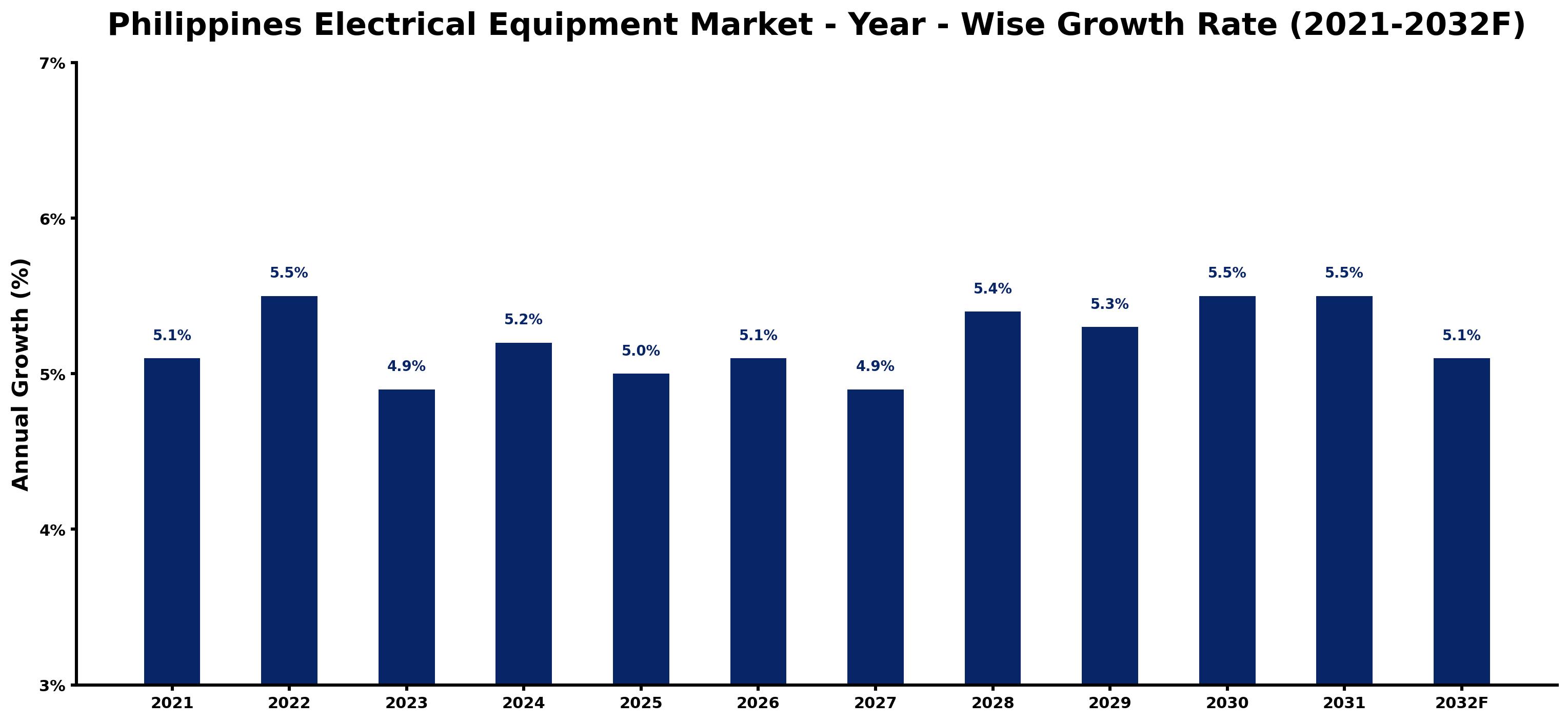
The table below presents the year wise growth rates along with the key drivers influencing the market
| Year | Growth Rate | Major Drivers |
| 2021 | 5.1% | Consumer reliance on electronics increased demand for electrical equipment across households. |
| 2022 | 5.5% | Infrastructure projects resumed post-lockdown, boosting electrical equipment demand in construction. |
| 2023 | 4.9% | The rising middle class in urban areas heightened demand for power solutions. |
| 2024 | 5.2% | Local manufacturing adaptations aimed at mitigating supply chain disruptions became essential. |
| 2025 | 5.0% | Sustainable energy initiatives prompted investment in renewable electrical technologies and equipment. |
| 2026 | 5.1% | Smart city developments necessitated advanced electrical systems and integrated technology solutions. |
| 2027 | 4.9% | Increased foreign investments targeted the burgeoning renewable energy sector in the Philippines. |
| 2028 | 5.4% | Urbanization trends propelled the need for updated electrical infrastructure in major cities. |
| 2029 | 5.3% | Technological innovations led to the growth of smart home electrical devices and systems. |
| 2030 | 5.5% | Regulatory frameworks began focusing on energy efficiency, driving equipment upgrades and replacements. |
| 2031 | 5.5% | Collaborative ventures between local firms and foreign companies enhanced market competitiveness. |
| 2032 | 5.1% | Digitalization trends promoted the integration of IoT in electrical equipment solutions. |
Note - Market size estimations and growth projections presented in this report are based on 6Wresearch's advanced forecasting approach, validated with industry datasets as of June 2026.
Philippines Electrical Equipment Market Synopsis
The Philippines Electrical Equipment Market is projected to reach 5.1% and witness significant growth during the forecast period (2026-2032). This growth trajectory is primarily fueled by escalating investments in infrastructure projects complemented by an increasing demand for electricity across the archipelago. Initiatives such as the Mindanao's Grid Interconnection Project and the Luzon Grid Interconnection Project are further expected to catalyze the demand for electrical equipment in the Philippines.
Philippines Electrical Equipment Market Growth Drivers
Several factors are propelling the growth of the Philippines Electrical Equipment Market. These include:
- A growing population is contributing to a heightened demand for electricity, which in turn necessitates increased provision of electrical infrastructure.
- Rising disposable income levels are enabling consumers to invest in electrical equipment, further stimulating market growth.
- Rapid industrialization in previously non-electrified regions is creating new opportunities for electrical equipment manufacturers.
- An increase in foreign direct investment (FDI) inflows, particularly into the manufacturing and power generation sectors, is providing additional impetus for market expansion.
- Improvements to existing transmission networks have led to enhanced utilization rates of available capacity, fostering a more efficient electrical distribution system.
Philippines Electrical Equipment Market Key Challenges
Despite the promising outlook, the Philippines Electrical Equipment Market faces several challenges that could impede growth. These include:
- The high cost of installation for electrical systems and equipment poses a significant barrier for both consumers and businesses, particularly given the challenges associated with purchasing power in certain demographics.
- Inadequate access to financing options restricts potential buyers from investing in high-end electrical products, thereby limiting market penetration.
- The fluctuating costs of raw materials can lead to unpredictable pricing for electrical equipment, impacting purchasing decisions.
- Lagging technological advancements in some regions may contribute to inefficiencies, further complicating market development.
- Regulatory hurdles and lengthy approval processes can delay project timelines and deter investment in electrical infrastructure.
Philippines Electrical Equipment Market Government Investment and Initiatives
The Philippine government has been proactive in spearheading initiatives that bolster the electrical equipment market. Key investments and policies include:
- The initiation of various infrastructure projects aimed at enhancing the electric grid and improving access to electricity in underserved regions.
- Government-led initiatives to promote renewable energy sources, creating additional demand for innovative electrical equipment.
- Public-private partnerships aimed at upgrading existing electrical infrastructure to support sustainable economic growth.
- Incentives for foreign and local investors to participate in the modernization of the electrical sector.
- Regulatory reforms that simplify the processes involved in setting up electrical projects, thereby fostering a more conducive business environment.
Philippines Electrical Equipment Market Latest Developments (May 2025 - June 2026)
In the period from May 2025 to June 2026, the Philippines Electrical Equipment Market has experienced a series of developments that reflect its dynamic nature. Recent trends indicate a gradual recovery from the disruptions caused by the COVID-19 pandemic, with several manufacturers resuming operations under stringent safety protocols. A noted increase in local production capacity has aimed to meet the rebounding demand in both residential and commercial sectors. Moreover, the government's focus on infrastructure development has led to the announcement of numerous public projects, thus enhancing the market potential for electrical equipment. Collaborative efforts between the government and private sector entities have also been emphasized, aimed at fostering innovation and improving overall market efficiency.
Philippines Electrical Equipment Market - Key Attractiveness of the Report
- 10 Years of Market Numbers
- Historical Data Starting from 2022 to 2025
- Base Year: 2025
- Forecast Data until 2032
- Key Performance Indicators Impacting the Market
- Major Upcoming Developments and Projects
Key Highlights of the Report:
- Philippines Electrical Equipment Market Outlook
- Market Size of Philippines Electrical Equipment Market, 2025
- Forecast of Philippines Electrical Equipment Market, 2032
- Historical Data and Forecast of Philippines Electrical Equipment Revenues & Volume for the Period 2022-2032F
- Philippines Electrical Equipment Market Trend Evolution
- Philippines Electrical Equipment Market Drivers and Challenges
- Philippines Electrical Equipment Price Trends
- Philippines Electrical Equipment Porter's Five Forces
- Philippines Electrical Equipment Industry Life Cycle
- Historical Data and Forecast of Philippines Electrical Equipment Market Revenues & Volume By Types for the Period 2022-2032F
- Historical Data and Forecast of Philippines Electrical Equipment Market Revenues & Volume By Electronic and electrical wires and cables for the Period 2022-2032F
- Historical Data and Forecast of Philippines Electrical Equipment Market Revenues & Volume By Batteries and accumulators for the Period 2022-2032F
- Historical Data and Forecast of Philippines Electrical Equipment Market Revenues & Volume By Wiring devices for the Period 2022-2032F
- Historical Data and Forecast of Philippines Electrical Equipment Market Revenues & Volume By Electric lighting equipment for the Period 2022-2032F
- Historical Data and Forecast of Philippines Electrical Equipment Market Revenues & Volume By Others for the Period 2022-2032F
- Historical Data and Forecast of Philippines Electrical Equipment Market Revenues & Volume By Applications for the Period 2022-2032F
- Historical Data and Forecast of Philippines Electrical Equipment Market Revenues & Volume By Residential end-users for the Period 2022-2032F
- Historical Data and Forecast of Philippines Electrical Equipment Market Revenues & Volume By Non-residential end-users for the Period 2022-2032F
- Philippines Electrical Equipment Import Export Trade Statistics
- Market Opportunity Assessment By Types
- Market Opportunity Assessment By Applications
- Philippines Electrical Equipment Top Companies Market Share
- Philippines Electrical Equipment Competitive Benchmarking By Technical and Operational Parameters
- Philippines Electrical Equipment Company Profiles
- Philippines Electrical Equipment Key Strategic Recommendations






































