Philippines Leather Market Summary
The philippines leather market was estimated at USD 468 Million in 2025 and is projected to reach USD 625 Million by 2032, growing at a CAGR of 5.1% from 2026 to 2032.
Philippines Leather Market Year-wise Growth Rate and Key Drivers
This graph highlights how the Philippines Leather Market has steadily grown over the past five years, supported by major growth factors.
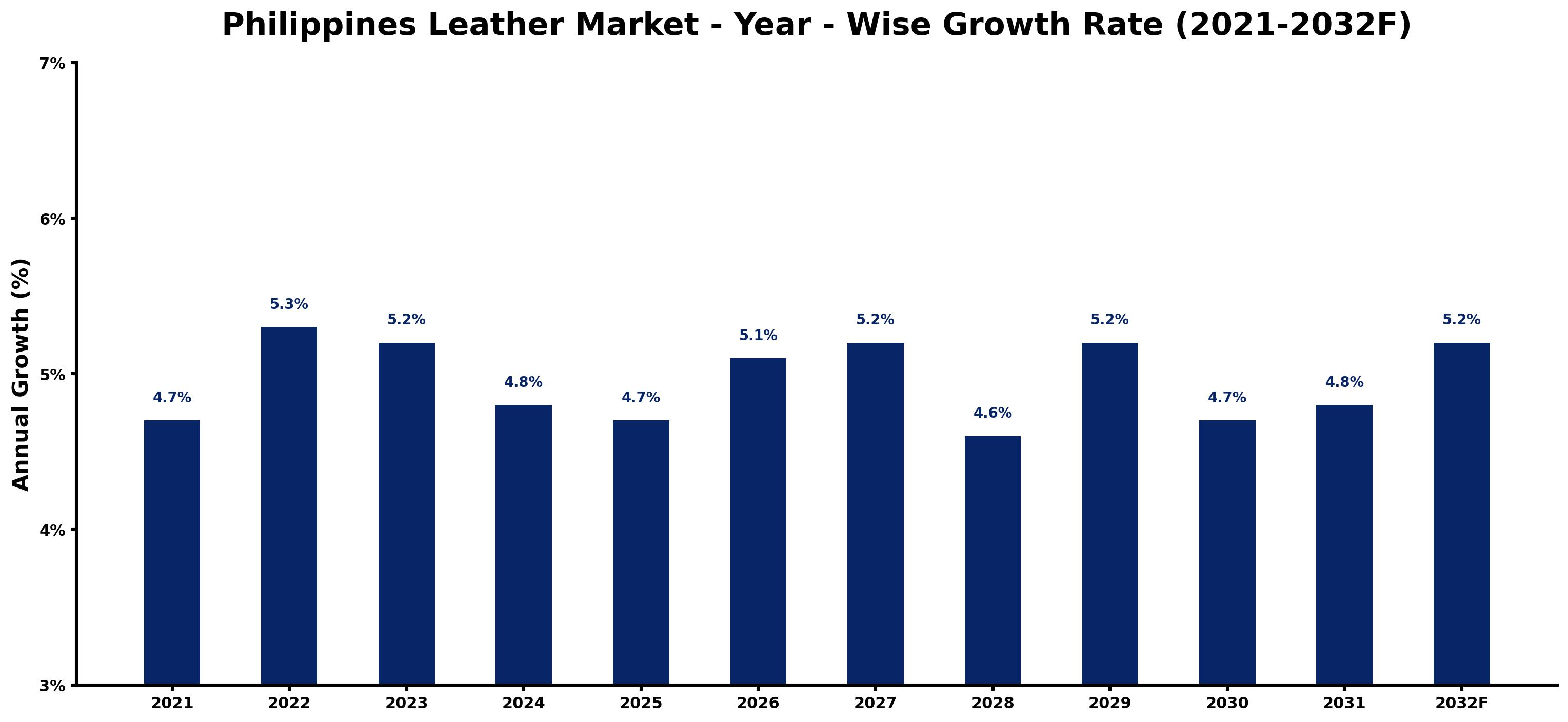
The table below presents the year wise growth rates along with the key drivers influencing the market
| Year | Growth Rate | Major Drivers |
| 2021 | 4.7% | The local artisans' revival underscores a shift towards sustainable, handcrafted leather products. |
| 2022 | 5.3% | Emergence of e-commerce platforms expanded consumer access to diverse leather goods. |
| 2023 | 5.2% | Increased disposable income among middle-class families supports premium leather purchases. |
| 2024 | 4.8% | Young professionals prioritize stylish, durable leather items for long-term investment. |
| 2025 | 4.7% | Regional tourism rebounds, boosting demand for locally produced leather souvenirs. |
| 2026 | 5.1% | Brand collaborations with local designers enhance product visibility and market appeal. |
| 2027 | 5.2% | Eco-conscious consumers drive interest in sustainable leather alternatives and practices. |
| 2028 | 4.6% | Rising customization trends encourage brands to offer personalized leather products. |
| 2029 | 5.2% | Emerging tech in tanning processes improves quality and reduces environmental impact. |
| 2030 | 4.7% | Traditional craftsmanship gains appreciation, attracting both domestic and export markets. |
| 2031 | 4.8% | Shifts in fashion trends incorporate leather as a staple in casual wardrobes. |
| 2032 | 5.2% | Overall market consolidation allows for stronger branding and consumer loyalty initiatives. |
Note - Market size estimations and growth projections presented in this report are based on 6Wresearch's advanced forecasting approach, validated with industry datasets as of June 2026.
Philippines Leather Market Synopsis
The Philippines Leather Market is projected to reach 5.1% and witness significant growth during the forecast period (2026-2032). This anticipated expansion is driven by various factors, including the increasing demand for eco-friendly and sustainable fashion apparel. As consumers become more conscious of environmental impacts and animal welfare, the inclination towards ethically produced leather goods has surged. Coupled with rising disposable incomes, this trend reveals changing consumer preferences towards high-quality products that align with their values.
Philippines Leather Market Growth Drivers
Several key drivers are propelling the growth of the Philippines leather market. Firstly, the evolving lifestyle trends emphasize comfort, durability, and style, thereby increasing the popularity of leather items in apparel and accessories. Secondly, the expanding middle-class population in the Philippines has more disposable income, creating a strong demand for high-quality leather goods. Additionally, the focus on international trade with countries such as India and China has facilitated better access to markets and supply chains for raw and finished leather products.
- The demand for sustainable fashion influences both manufacturers and consumers, leading to innovative approaches in leather production.
- Rising disposable incomes allow consumers to invest in high-quality leather goods, enhancing their purchasing power.
- The middle class, which is rapidly growing, is more inclined to seek products that offer a combination of quality and affordability.
- Government policies promoting domestic production and exports are providing a favorable climate for the leather industry to thrive.
- Technological advancements in leather processing are improving efficiency and reducing waste, further enhancing market growth opportunities.
Philippines Leather Market Trends and Opportunities
The Philippines leather market is witnessing a multitude of trends that signal noteworthy opportunities for growth. Sustainability remains at the forefront, with consumers actively seeking brands that prioritize eco-friendly practices. The market is also seeing a trend towards the use of synthetic materials as an alternative to traditional leather, fueled by concerns regarding cost and environmental sustainability. This shift presents a unique opportunity for manufacturers to innovate, creating synthetic leather that meets consumer expectations for quality while being more sustainable.
- Adoption of advanced technologies for leather production is paving the way for sustainable innovations that meet market demand.
- Growing awareness of animal welfare is steering consumers towards ethical fashion choices, influencing traditional leather manufacturers.
- The trend towards customization in fashion allows brands to cater to individual preferences, enhancing customer satisfaction.
- Increased online retail presence for leather products has created broader market access, appealing to tech-savvy consumers.
- Collaborations with eco-conscious organizations may help brands enhance their credibility and attract environmentally aware customers.
Philippines Leather Market Government Investment and Initiatives
The Philippine government plays a pivotal role in shaping the leather market through various initiatives aimed at promoting domestic production and supporting exports. Strategic public spending on infrastructure improvements in logistics and transportation enhances the overall efficiency of the leather industry. Government policies that encourage foreign investments provide tax incentives and simplify regulatory processes, creating an attractive business environment for both local and foreign companies.
- Investment in local production facilities is being prioritized to reduce reliance on imports and boost job creation.
- Regulatory frameworks aimed at ensuring quality standards are in place to protect both consumers and the reputation of domestic products.
- Government-backed training programs for workers in the leather sector are enhancing skill levels and competitiveness in the market.
- Promotion of trade fairs and exhibitions helps local manufacturers gain exposure and connect with potential international buyers.
- Environmental initiatives aimed at sustainable practices support the transition towards eco-friendly leather production methods.
Philippines Leather Market Latest Developments (May 2025 - June 2026)
Recent developments in the Philippines leather market from May 2025 to June 2026 indicate a robust trajectory towards sustainable practices and technological advancements. The market is seeing an increasing number of initiatives focusing on eco-friendly leather production, with several manufacturers investing in research and development to enhance sustainability. Furthermore, collaboration with environmental organizations has gained traction as companies strive to align their operations with international sustainability standards. The emphasis on digital retail strategies has also grown, allowing for more streamlined operations and improved customer engagement.
Philippines Leather Market - Key Attractiveness of the Report
- 10 Years of Market Numbers
- Historical Data Starting from 2022 to 2025
- Base Year: 2025
- Forecast Data until 2032
- Key Performance Indicators Impacting the Market
- Major Upcoming Developments and Projects
Key Highlights of the Report:
- Philippines Leather Market Outlook
- Market Size of Philippines Leather Market, 2025
- Forecast of Philippines Leather Market, 2032F
- Historical Data and Forecast of Philippines Leather Revenues & Volume for the Period 2022-2032F
- Philippines Leather Market Trend Evolution
- Philippines Leather Market Drivers and Challenges
- Philippines Leather Price Trends
- Philippines Leather Porter's Five Forces
- Philippines Leather Industry Life Cycle
- Historical Data and Forecast of Philippines Leather Market Revenues & Volume By Type for the Period 2022-2032F
- Historical Data and Forecast of Philippines Leather Market Revenues & Volume By Luggage for the Period 2022-2032F
- Historical Data and Forecast of Philippines Leather Market Revenues & Volume By Footwear for the Period 2022-2032F
- Historical Data and Forecast of Philippines Leather Market Revenues & Volume By Accessories for the Period 2022-2032F
- Historical Data and Forecast of Philippines Leather Market Revenues & Volume By Distribution Channel for the Period 2022-2032F
- Historical Data and Forecast of Philippines Leather Market Revenues & Volume By Online for the Period 2022-2032F
- Historical Data and Forecast of Philippines Leather Market Revenues & Volume By Offline for the Period 2022-2032F
- Philippines Leather Import Export Trade Statistics
- Market Opportunity Assessment By Type
- Market Opportunity Assessment By Distribution Channel
- Philippines Leather Top Companies Market Share
- Philippines Leather Competitive Benchmarking By Technical and Operational Parameters
- Philippines Leather Company Profiles
- Philippines Leather Key Strategic Recommendations






































