Philippines Traffic Management AI Market Size & Growth Rate
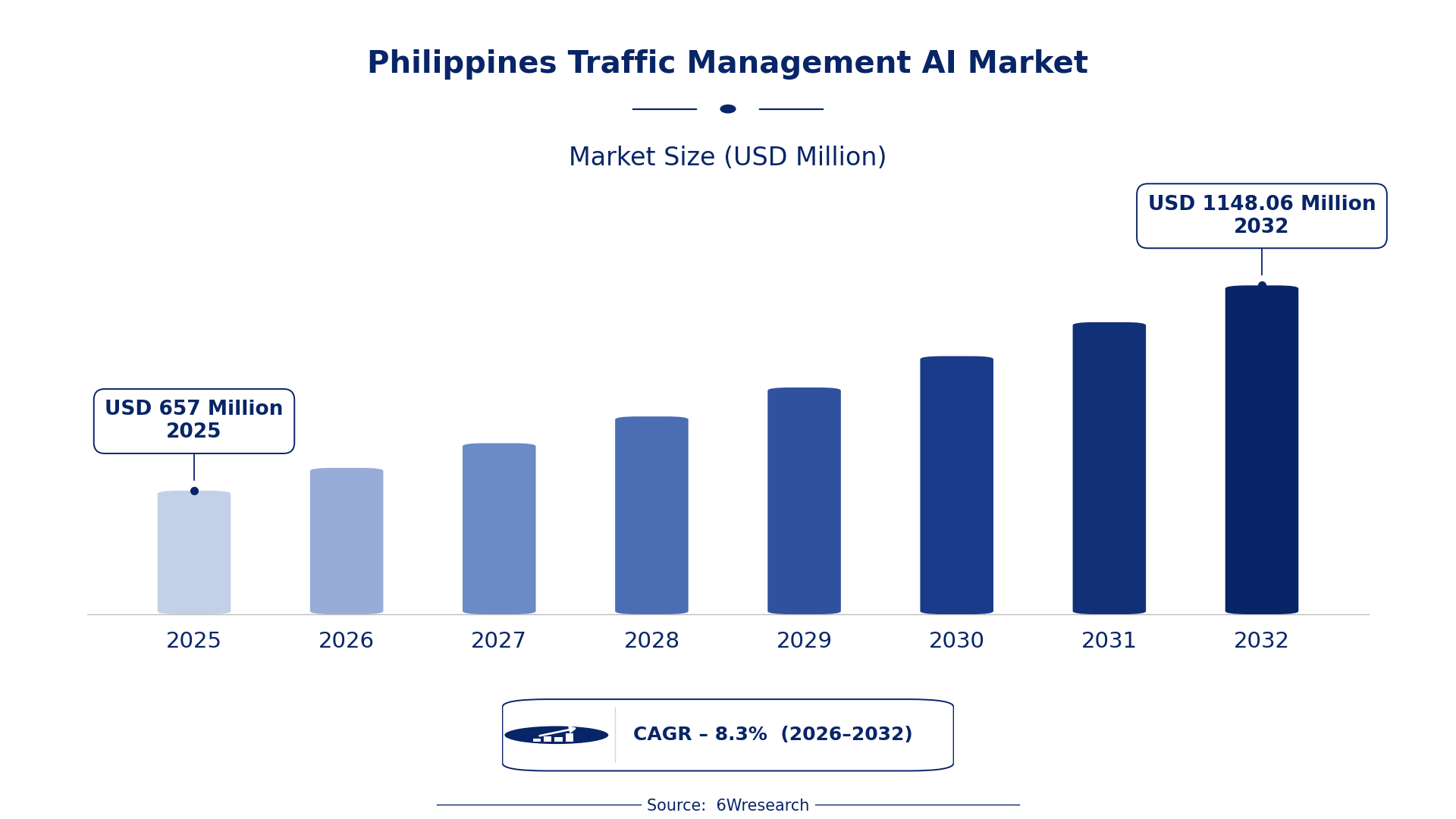
According to 6Wresearch internal database and industry insights, the Philippines Traffic Management AI Market was valued at USD 657.0 million in 2025 and is projected to reach USD 1,148.06 million by 2032, growing at a CAGR of approximately 8.3% during 2026–2032.
Philippines Traffic Management AI Market Highlights
| Report Metric | Details |
| Report Name | Philippines Traffic Management AI Market |
| Market Size 2025 | USD 657.0 million |
| Market Size 2032 | USD 1,148.06 million |
| Absolute Growth 2025–2032 | USD 491.06 million |
| CAGR 2026–2032 | 8.3% |
| Peak Annual Growth | 10.2% in 2030 |
| Forecast Period | 2026–2032 |
| Historical Data | 2022–2025 |
| Base Year | 2025 |
| Leading Traffic Management AI, 2025 | Predictive Traffic Tools (41% share) |
| Leading Solution Type, 2025 | Traffic Flow AI (40% share) |
| Leading AI Capability, 2025 | Real-Time Forecasting (38% share) |
| Leading Distribution Channel, 2025 | SaaS Vendors (40% share) |
| Leading End User Industry, 2025 | City Traffic Control (48% share) |
| Fastest-Growing Traffic Management AI | Incident Detection AI (10.8% CAGR) |
| Fastest-Growing Solution Type | Video Analytics (9.4% CAGR) |
| Fastest-Growing AI Capability | ML-Based Optimization (10.6% CAGR) |
| Fastest-Growing End User Industry | Municipal Agencies (9.5% CAGR) |
| Growing Sector | Municipal Agencies |
| Key End Users | City Traffic Control, Municipal Agencies, Highway Authorities, Urban Transport Bureaus |
Philippines Traffic Management AI Market Year-wise Growth Rate and Key Drivers (2022–2032)
This graph illustrates the annual growth rates of the market from 2022 to 2032, highlighting a steady upward trajectory and projected market expansion over the forecast period.
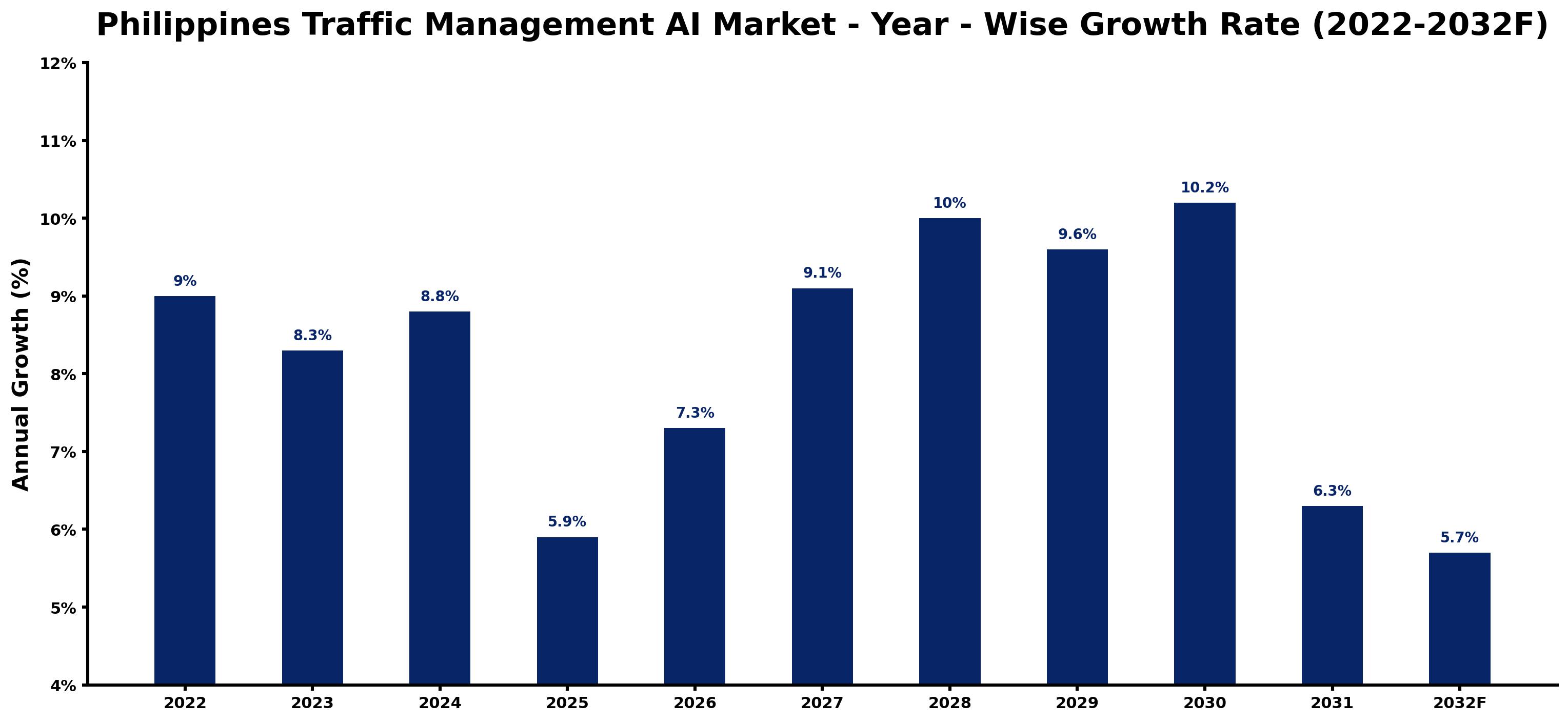
Annual growth estimates for each year appear below with the principal reason behind them, explaining the shifts that set the pace of the market.
| Year | Estimated Annual Growth (%) | Market Rationale |
| 2022 | 9.0 | Traffic congestion in Metro Manila was severe, driving demand for AI solutions. |
| 2023 | 8.3 | The implementation of the 'Intelligent Transport System' program began, supporting growth. |
| 2024 | 8.8 | Urban transport agencies increased investments in AI technologies for traffic management. |
| 2025 | 5.9 | Growth slowed as initial implementations faced integration challenges in urban areas. |
| 2026 | 7.3 | The government is expected to allocate further funding for AI traffic management improvements, boosting demand. |
| 2027 | 9.1 | Municipal agencies will expand their AI capabilities, improving traffic control measures. |
| 2028 | 10.0 | The 'Smart Cities' initiative will gain traction, promoting AI adoption in urban planning. |
| 2029 | 9.6 | Demand is projected to stabilise as the implementation of AI systems matures, maintaining growth momentum. |
| 2030 | 10.2 | The peak growth rate is expected as AI technologies become integral to urban traffic management. |
| 2031 | 6.3 | Growth will slow due to market saturation and increased competition among AI solutions. |
| 2032 | 5.7 | The market is projected to continue growing as urban populations demand smarter traffic solutions. |
Note: Market size estimations and growth projections presented in this report are based on 6Wresearch's proprietary forecasting methodology, utilizing the latest available industry data, government publications, and primary research inputs.
Philippines Traffic Management AI Market Synopsis
Traffic Management AI in the Philippines refers to advanced technologies that optimise traffic flow and improve transportation efficiency. Developed through machine learning and real-time data collection, it includes predictive traffic modeling and smart signaling. The market is growing due to urban congestion, with Metro Manila's population of approximately 13 million creating high demand. Key drivers include the government's 'Intelligent Transport System' program and the 'Smart Cities' initiative, which promote AI integration in urban planning.
Market Dynamics Impact Analysis (2026–2032)
| Factor | Type | Impact | Primary Segment Affected |
| Increased urbanisation and population density in Metro Manila drive demand for efficient traffic management solutions. | Driver | High | Traffic Flow AI |
| The rise of smart city initiatives encourages municipalities to invest in AI technologies for traffic management. | Driver | High | Smart Signaling Systems |
| The need for improved urban mobility creates opportunities for AI-based traffic solutions in city planning. | Opportunity | High | Incident Detection AI |
| The government funding for traffic management improvements opens avenues for new AI solutions. | Opportunity | High | Parking & Congestion AI |
| Integration challenges with existing infrastructure can hinder the adoption of new AI technologies. | Restraint | Medium | Predictive Traffic Tools |
| Limited awareness and understanding of AI capabilities among municipal agencies may slow market growth. | Restraint | Medium | Adaptive Signals |
| High initial investment costs for AI systems can deter smaller municipalities from adopting these technologies. | Challenge | Medium | Incident Detection AI |
| The rapid pace of technological advancements may lead to obsolescence of existing systems. | Challenge | Medium | Traffic Flow AI |
Evaluation of Drivers in Philippines Traffic Management AI Market (2026–2032)
Key forces behind demand, with the segment each one moves most, are listed below.
| Drivers | Primary Segment Affected | Why It Matters (Evidence) |
| Growing urban population increases the need for efficient traffic management. | Traffic Flow AI | In Metro Manila, the population of approximately 13 million intensifies traffic congestion, driving demand for AI solutions. |
| Government initiatives promote the adoption of AI technologies in urban planning. | Smart Signaling Systems | The 'Smart Cities' initiative launched in 2022 encourages municipalities to integrate AI for traffic management. |
| Rising traffic congestion costs the economy, pushing for AI solutions. | Incident Detection AI | Traffic congestion in Metro Manila costs PHP 3.5 billion daily, highlighting the urgent need for AI interventions. |
| Increased funding for traffic management improvements supports AI technology deployment. | Parking & Congestion AI | The Philippine government allocated PHP 1 billion for traffic management enhancements in 2023, facilitating AI adoption. |
| Technological advancements in AI improve traffic management capabilities. | Predictive Traffic Tools | Machine learning algorithms improve predictive modeling, making traffic management more efficient. |
The Traffic Management AI market in the Philippines is expanding due to a rising urban population, government initiatives, and increasing costs associated with traffic congestion. The growing population exacerbates traffic issues, leading to a heightened demand for AI solutions. In 2023, the government allocated PHP 1 billion for traffic management improvements, facilitating the deployment of AI systems. Daily congestion costs highlight the need for effective traffic solutions. Municipal agencies are increasingly adopting AI technologies to improve urban mobility and traffic management efficiency.
Evaluation of Restraints in Philippines Traffic Management AI Market
The main factors holding the market back are set out below.
| Market Restraint | Primary Segment Affected | Why It Matters (Evidence) |
| Integration challenges with existing infrastructure can hinder AI adoption. | Predictive Traffic Tools | Many municipalities struggle to integrate new AI systems with outdated traffic management infrastructure. |
| Limited awareness of AI capabilities slows market growth among municipal agencies. | Adaptive Signals | Some agencies lack understanding of how AI can improve traffic management, delaying implementation. |
| High initial investment costs deter smaller municipalities from adopting AI technologies. | Incident Detection AI | Smaller agencies may find it difficult to allocate budgets for advanced AI systems. |
| Rapid technological advancements may lead to obsolescence of existing systems. | Traffic Flow AI | As AI technologies evolve quickly, older systems may become outdated and ineffective. |
| Regulatory hurdles can complicate the approval process for new AI implementations. | Smart Signaling Systems | Municipalities face challenges in navigating the regulatory requirements for AI traffic solutions. |
Philippines Traffic Management AI Market Challenges
The Philippines Traffic Management AI market still has to solve a few problems, and the first is supply chain disruptions. Many producers rely on imported components for AI systems, which delays project timelines for municipal agencies by an average of three months. Regulatory hurdles complicate implementation; for instance, compliance with the Philippine National Standards established in 2020 can extend project approval times by six months for urban transport agencies. Technology limitations also pose challenges, as over 1,000 traffic signals lack the necessary infrastructure for AI integration, resulting in inefficiencies that cost buyers in lost productivity. Skills shortages in AI expertise further hinder effective deployment, leaving buyers with underutilised technologies and limited operational improvements.
Trends in the Philippines Traffic Management AI Market
The trends below show where the Philippines Traffic Management AI Market is heading.
- Shift towards Smart Signalling Systems: Municipal agencies are increasingly adopting smart signalling systems to optimise traffic flow in Metro Manila. As of 2023, over 1,000 traffic signals are equipped with AI capabilities, improving urban mobility.
- Growing focus on Incident Detection AI: The demand for incident detection AI is rising as municipalities seek to respond quickly to traffic incidents. The Philippine National Standards for Intelligent Transport Systems, established in 2020, guide this implementation.
- Expansion of Predictive Traffic Tools: Predictive traffic tools are gaining traction among urban transport agencies to forecast traffic patterns. The 'Intelligent Transport System' programme, launched in 2021, supports this trend with funding and resources.
- Increased investment in Parking & Congestion AI: Municipal agencies are investing in parking and congestion AI to alleviate urban traffic issues. The Philippine government allocated PHP 1 billion for traffic management improvements in 2023.
Investment Opportunities in the Philippines Traffic Management AI Market
Some of the investment opportunities in the Philippines Traffic Management AI Market are mentioned below.
- Partnerships with municipal agencies: Now is the time for technology providers to partner with municipal agencies to implement AI solutions. With PHP 1 billion allocated in 2023 for traffic management, there is funding available for collaboration.
- Investment in Smart Cities initiative: The Smart Cities initiative presents opportunities for investment in AI technologies. Urban transport bureaus are seeking solutions to improve traffic management, creating a demand for advanced systems.
- Focus on Incident Detection AI: The need for rapid incident response creates opportunities for AI developers. Municipal agencies are looking to improve their incident detection capabilities, driving demand for new technologies.
- Expansion of AI capabilities in Traffic Flow AI: With the growing population in urban areas, there is a need for advanced traffic flow management solutions. The increase in traffic congestion in Metro Manila highlights the demand for innovative AI tools.
Government Initiatives in the Philippines Traffic Management AI Market
The 'Philippine Road Safety Action Plan 2021-2030' approved by the National Economic and Development Authority in 2021 focuses on integrating AI technologies in traffic management. This plan aims to improve road safety and traffic flow across urban areas. The 'Intelligent Transport System' programme launched by the Department of Transportation in 2021 further supports these goals by providing a framework for AI implementation. Additionally, the 'Digital Transformation Roadmap' initiated by the Department of Information and Communications Technology in 2022 aims to improve urban transport systems using AI and IoT technologies.
In 2023, PHP 1 billion was allocated by the Department of Transportation for the implementation of AI-based traffic management systems nationwide. This funding supports various projects aimed at improving traffic conditions in urban areas. The Department of Transportation collaborates with international agencies to improve traffic management systems using AI, ensuring that best practices are adopted. The focus on integrating AI technologies is important for urban transport agencies looking to modernise their traffic management systems.
Future Insight of the Philippines Traffic Management AI Market
By 2032, buyers and suppliers in the Philippines Traffic Management AI market can expect substantial advancements driven by key initiatives. The government's 'Intelligent Transport System' programme and the 'Smart Cities' initiative will enhance AI integration in urban planning. An estimated PHP 1 billion allocated for traffic management improvements will facilitate crucial infrastructure upgrades. Collaborations with international agencies will provide access to advanced technologies, enabling more effective traffic solutions for municipal agencies and improving overall transportation efficiency.
Market Segmentation Analysis
The analysis below covers each segmentation, its leading category in 2025 and its fastest-growing category through 2032.
By Traffic Management AI – Predictive Traffic Tools Dominated, Incident Detection AI Expected to Grow Fastest
According to Vasudha, AM at 6Wresearch, Predictive Traffic Tools accounted for a 41% market share by traffic management ai in 2025. Predictive Traffic Tools hold the largest market share as they are essential for forecasting traffic patterns, which urban transport agencies rely on to manage congestion. The implementation of over 1,000 traffic signals equipped with these tools in the Philippines demonstrates their critical role in enhancing traffic flow. The quickest growth will come from Incident Detection AI, forecast to expand at a CAGR of 10.8% between 2026 and 2032. Incident Detection AI is experiencing rapid growth due to its ability to monitor traffic conditions and quickly identify incidents, which is vital for improving urban mobility. The Philippine government's aim to reduce traffic congestion by 25% by 2025 further fuels this demand for effective incident management solutions. Suppliers should enhance their offerings in predictive tools to better serve the growing needs of urban transport agencies.
By Solution Type – Traffic Flow AI Dominated, Video Analytics Expected to Grow Fastest
With a 40% revenue share in 2025, Traffic Flow AI was the largest solution type category. Traffic Flow AI commands the largest share because it significantly enhances traffic management by effectively predicting and controlling vehicle flow. Its application in areas like Metro Manila, where traffic congestion is a major challenge, highlights its importance in urban planning efforts. Video Analytics is projected to grow fastest, at a CAGR of 9.4% during 2026–2032. Video Analytics is the fastest-growing solution type, leveraging video feeds to analyse traffic patterns and incidents, which is increasingly essential for city planners. The push for smarter urban environments, as seen in the 'Smart Cities' initiative, drives this growth. Buyers should consider investing in advanced video analytics solutions to improve their traffic management strategies.
By AI Capability – Real-Time Forecasting Dominated, ML-Based Optimization Expected to Grow Fastest
In 2025, Real-Time Forecasting led the ai capability split with a 38% share. Real-Time Forecasting captures the largest share as it provides immediate traffic forecasts, which are crucial for urban transport agencies managing congestion. This capability is particularly valuable in densely populated regions like Metro Manila, where timely information can significantly impact traffic flow. ML-Based Optimization is set to record the highest CAGR in this split, 10.6% over 2026–2032. ML-Based Optimization is rapidly growing as it utilises machine learning to continuously enhance traffic management systems, improving their efficiency over time. This adaptability is essential as cities strive to implement more advanced traffic solutions. Suppliers must focus on developing machine learning capabilities to remain competitive in the evolving traffic management market.
By Distribution Channel – SaaS Vendors Dominated and Is Expected to Record the Fastest Growth
SaaS Vendors took a 40% share of distribution channel in 2025, more than any other category. SaaS Vendors dominate the distribution channel by offering essential software solutions for traffic management without directly managing traffic. Their flexibility and scalability make them a preferred option for numerous municipal agencies across the Philippines. SaaS Vendors are also forecast to expand faster than any other category, at a CAGR of 9.7% over 2026–2032. SaaS Vendors are also the fastest-growing channel, as the increasing demand for cloud-based solutions supports more efficient traffic management. This trend aligns with government initiatives aimed at modernising traffic systems. Suppliers should enhance their SaaS offerings to meet the rising demand for scalable traffic management solutions.
By End User Industry – City Traffic Control Dominated, Municipal Agencies Expected to Grow Fastest
The largest end user industry category in 2025 was City Traffic Control, with a 48% share of total revenue. City Traffic Control is the leading end user as it is directly responsible for managing urban traffic systems and implementing AI solutions. With a focus on improving traffic conditions, these agencies are key players in the adoption of traffic management AI. The quickest growth will come from Municipal Agencies, forecast to expand at a CAGR of 9.5% between 2026 and 2032. Municipal Agencies are the fastest-growing end user, utilising traffic management AI for effective city planning and traffic control. Their increasing involvement reflects the urgent need for improved urban mobility solutions in densely populated areas. Suppliers should tailor their solutions to meet the specific needs of municipal agencies to capture this growing market.
Key Attractiveness of the Report
- 10 Years of Market Numbers
- Historical Data Starting from 2022 to 2025
- Base Year 2025
- Forecast Data until 2032
- Key Performance Indicators Impacting the Market
- Major Upcoming Developments and Projects
Key Highlights of the Report:
- Philippines Traffic Management AI Market Outlook
- Market Size of Philippines Traffic Management AI Market, 2025
- Forecast of Philippines Traffic Management AI Market, 2032
- Historical Data and Forecast of Philippines Traffic Management AI Revenues & Volume for the Period 2022 - 2032F
- Philippines Traffic Management AI Market Trend Evolution
- Philippines Traffic Management AI Market Drivers and Challenges
- Philippines Traffic Management AI Price Trends
- Philippines Traffic Management AI Porter's Five Forces
- Philippines Traffic Management AI Industry Life Cycle
- Historical Data and Forecast of Philippines Traffic Management AI Market Revenues & Volume By Traffic Management AI for the Period 2022 - 2032F
- Historical Data and Forecast of Philippines Traffic Management AI Market Revenues & Volume By Predictive Traffic Tools for the Period 2022 - 2032F
- Historical Data and Forecast of Philippines Traffic Management AI Market Revenues & Volume By Smart Signaling Systems for the Period 2022 - 2032F
- Historical Data and Forecast of Philippines Traffic Management AI Market Revenues & Volume By Incident Detection AI for the Period 2022 - 2032F
- Historical Data and Forecast of Philippines Traffic Management AI Market Revenues & Volume By Parking & Congestion AI for the Period 2022 - 2032F
- Historical Data and Forecast of Philippines Traffic Management AI Market Revenues & Volume By Solution Type for the Period 2022 - 2032F
- Historical Data and Forecast of Philippines Traffic Management AI Market Revenues & Volume By Traffic Flow AI for the Period 2022 - 2032F
- Historical Data and Forecast of Philippines Traffic Management AI Market Revenues & Volume By Adaptive Signals for the Period 2022 - 2032F
- Historical Data and Forecast of Philippines Traffic Management AI Market Revenues & Volume By Video Analytics for the Period 2022 - 2032F
- Historical Data and Forecast of Philippines Traffic Management AI Market Revenues & Volume By Parking Prediction for the Period 2022 - 2032F
- Historical Data and Forecast of Philippines Traffic Management AI Market Revenues & Volume By AI Capability for the Period 2022 - 2032F
- Historical Data and Forecast of Philippines Traffic Management AI Market Revenues & Volume By Real-Time Forecasting for the Period 2022 - 2032F
- Historical Data and Forecast of Philippines Traffic Management AI Market Revenues & Volume By ML-Based Optimization for the Period 2022 - 2032F
- Historical Data and Forecast of Philippines Traffic Management AI Market Revenues & Volume By Deep Learning Vision for the Period 2022 - 2032F
- Historical Data and Forecast of Philippines Traffic Management AI Market Revenues & Volume By IoT + AI Integration for the Period 2022 - 2032F
- Historical Data and Forecast of Philippines Traffic Management AI Market Revenues & Volume By Distribution Channel for the Period 2022 - 2032F
- Historical Data and Forecast of Philippines Traffic Management AI Market Revenues & Volume By SaaS Vendors for the Period 2022 - 2032F
- Historical Data and Forecast of Philippines Traffic Management AI Market Revenues & Volume By ITS Integrators for the Period 2022 - 2032F
- Historical Data and Forecast of Philippines Traffic Management AI Market Revenues & Volume By AV System Vendors for the Period 2022 - 2032F
- Historical Data and Forecast of Philippines Traffic Management AI Market Revenues & Volume By Cloud Platform Vendors for the Period 2022 - 2032F
- Historical Data and Forecast of Philippines Traffic Management AI Market Revenues & Volume By End User Industry for the Period 2022 - 2032F
- Historical Data and Forecast of Philippines Traffic Management AI Market Revenues & Volume By City Traffic Control for the Period 2022 - 2032F
- Historical Data and Forecast of Philippines Traffic Management AI Market Revenues & Volume By Municipal Agencies for the Period 2022 - 2032F
- Historical Data and Forecast of Philippines Traffic Management AI Market Revenues & Volume By Highway Authorities for the Period 2022 - 2032F
- Historical Data and Forecast of Philippines Traffic Management AI Market Revenues & Volume By Urban Transport Bureaus for the Period 2022 - 2032F
- Philippines Traffic Management AI Import Export Trade Statistics
- Market Opportunity Assessment By Traffic Management AI
- Market Opportunity Assessment By Solution Type
- Market Opportunity Assessment By AI Capability
- Market Opportunity Assessment By Distribution Channel
- Market Opportunity Assessment By End User Industry
- Philippines Traffic Management AI Top Companies Market Share
- Philippines Traffic Management AI Competitive Benchmarking By Technical and Operational Parameters
- Philippines Traffic Management AI Company Profiles
- Philippines Traffic Management AI Key Strategic Recommendations
Market Covered
Segments analysed in this report are listed below.
By Traffic Management AI
- Predictive Traffic Tools
- Smart Signaling Systems
- Incident Detection AI
- Parking & Congestion AI
By Solution Type
- Traffic Flow AI
- Adaptive Signals
- Video Analytics
- Parking Prediction
By AI Capability
- Real-Time Forecasting
- ML-Based Optimization
- Deep Learning Vision
- IoT + AI Integration
By Distribution Channel
- SaaS Vendors
- ITS Integrators
- AV System Vendors
- Cloud Platform Vendors
By End User Industry
- City Traffic Control
- Municipal Agencies
- Highway Authorities
- Urban Transport Bureaus































