Japan Traffic Management AI Market Size & Growth Rate
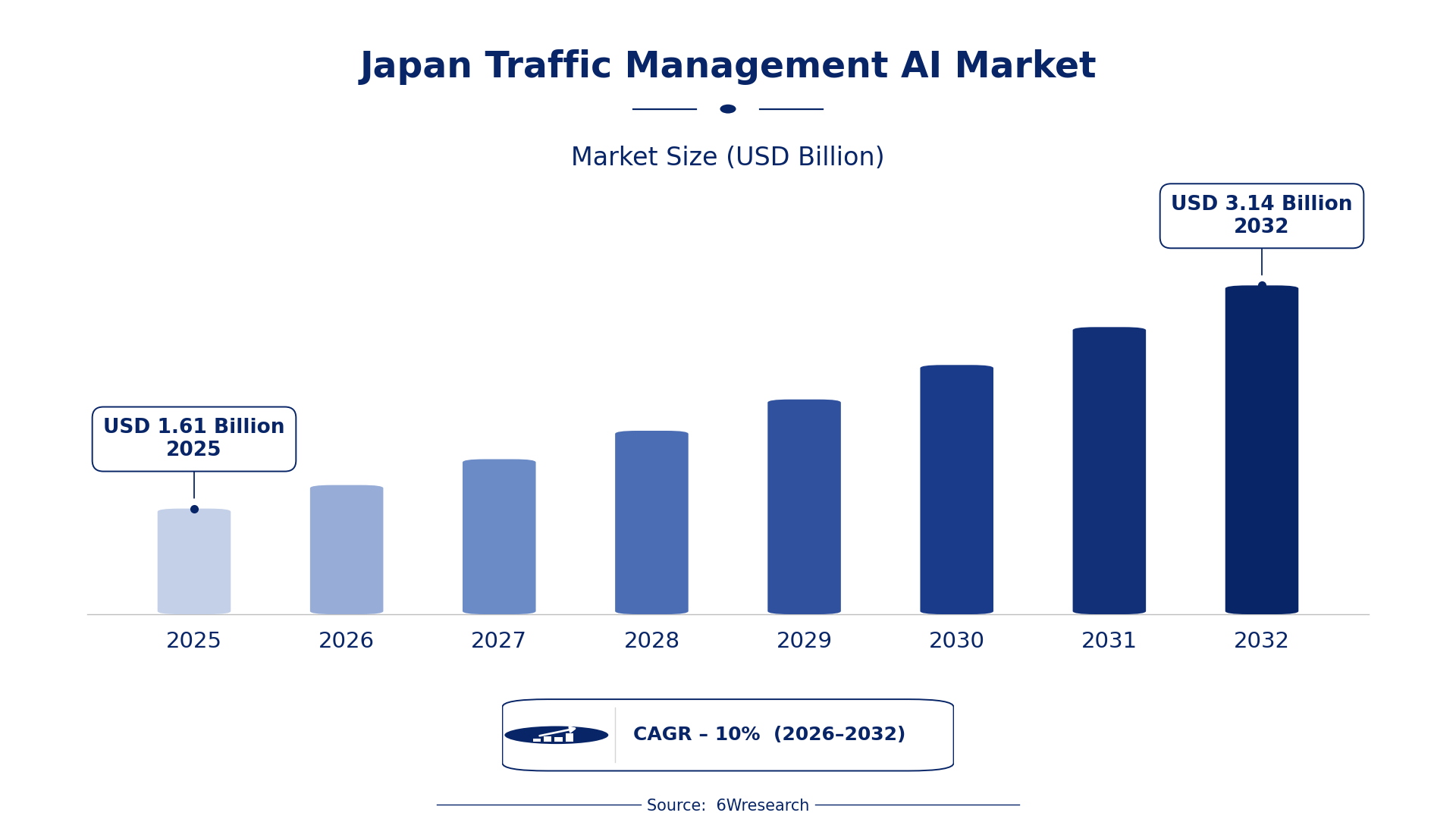
According to 6Wresearch internal database and industry insights, the Japan Traffic Management AI Market was valued at USD 1.61 billion in 2025 and is projected to reach USD 3.14 billion by 2032, growing at a CAGR of approximately 10% during 2026–2032.
Japan Traffic Management AI Market Highlights
| Report Metric | Details |
| Report Name | Japan Traffic Management AI Market |
| Market Size 2025 | USD 1.61 billion |
| Market Size 2032 | USD 3.14 billion |
| Absolute Growth 2025–2032 | USD 1.53 billion |
| CAGR 2026–2032 | 10% |
| Peak Annual Growth | 12.0% in 2026 |
| Forecast Period | 2026–2032 |
| Historical Data | 2022–2025 |
| Base Year | 2025 |
| Leading Traffic Management AI, 2025 | Predictive Traffic Tools (45% share) |
| Leading Solution Type, 2025 | Traffic Flow AI (43% share) |
| Leading AI Capability, 2025 | Real-Time Forecasting (41% share) |
| Leading Distribution Channel, 2025 | SaaS Vendors (50% share) |
| Leading End User Industry, 2025 | City Traffic Control (41% share) |
| Fastest-Growing Traffic Management AI | Parking & Congestion AI (11.4% CAGR) |
| Fastest-Growing Solution Type | Video Analytics (11.8% CAGR) |
| Fastest-Growing AI Capability | ML-Based Optimization (12.5% CAGR) |
| Fastest-Growing End User Industry | Urban Transport Bureaus (11.1% CAGR) |
| Growing Sector | City Traffic Control |
| Key End Users | Municipal Agencies, Urban Transport Bureaus, Highway Authorities |
Japan Traffic Management AI Market Year-wise Growth Rate and Key Drivers (2022–2032)
This graph illustrates the annual growth rates of the market from 2022 to 2032, highlighting a steady upward trajectory and projected market expansion over the forecast period.
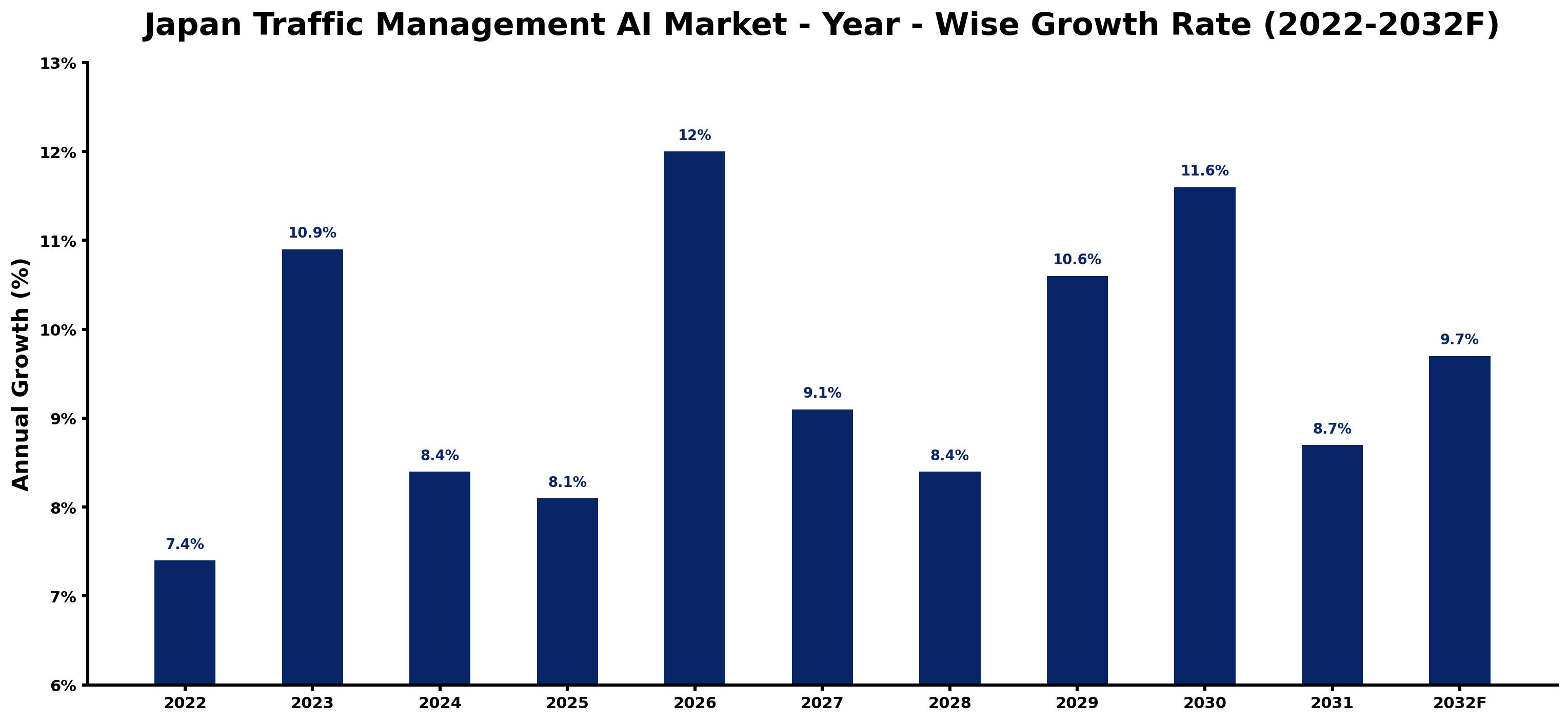
The following table presents the estimated annual growth rate for each year together with the principal factor influencing market performance.
| Year | Estimated Annual Growth (%) | Market Rationale |
| 2022 | 7.4 | The market experienced steady growth due to urban municipalities investing in smart city initiatives. |
| 2023 | 10.9 | Demand surged as the Tokyo Metropolitan Government launched the 'Smart City Tokyo' program. |
| 2024 | 8.4 | Growth slowed as the market adjusted to the implementation of new technologies. |
| 2025 | 8.1 | Investment in smart traffic systems continued, but growth began to decelerate due to project assessments. |
| 2026 | 12.0 | The peak growth year is driven by increased adoption of AI technologies in traffic management, particularly through the 'Smart Mobility Challenge' program. |
| 2027 | 9.1 | A slowdown occurred as cities began to evaluate the effectiveness of implemented systems and technologies. |
| 2028 | 8.4 | Growth continued to slow as the market matured and cities focused on optimising existing systems. |
| 2029 | 10.6 | Demand accelerated again as urban transport bureaus adopted AI for efficiency improvements, enhancing public transport. |
| 2030 | 11.6 | Growth rose with further investments in traffic incident detection technologies, improving urban safety. |
| 2031 | 8.7 | The market saw a slowdown as cities prioritised optimising existing systems and assessing their performance. |
| 2032 | 9.7 | Growth picked up again due to renewed interest in improving urban mobility through advanced AI solutions. |
Note: Market size estimations and growth projections presented in this report are based on 6Wresearch's proprietary forecasting methodology, utilizing the latest available industry data, government publications, and primary research inputs.
Japan Traffic Management AI Market Synopsis
Traffic Management AI in Japan involves advanced technologies aimed at optimising traffic flow and enhancing urban mobility. Through machine learning and real-time data analysis, this sector focuses on reducing congestion and improving public transportation efficiency. The Japan Traffic Management AI Market is growing as urban municipalities and government agencies invest in smart city initiatives. Major programmes like 'Smart City Tokyo' and substantial investments in smart traffic systems are propelling this growth. The outlook for this sector remains bright as demand continues to increase.
Market Dynamics Impact Analysis (2026–2032)
| Factor | Type | Impact | Primary Segment Affected |
| Growing urban population and traffic congestion drive demand for efficient traffic management solutions. | Driver | High | Traffic Flow AI |
| Investment in smart city initiatives creates opportunities for advanced traffic management technologies. | Driver | High | Smart Signaling Systems |
| Increasing focus on public transport efficiency presents opportunities for AI integration. | Opportunity | High | Urban Transport Bureaus |
| The need for real-time traffic data management opens avenues for SaaS solutions. | Opportunity | Medium | SaaS Vendors |
| High initial investment costs can deter municipalities from adopting new technologies. | Restraint | High | Predictive Traffic Tools |
| Limited awareness of AI benefits among smaller municipalities restricts market growth. | Restraint | Medium | Incident Detection AI |
| Challenges in integrating new technologies with existing systems can delay implementation. | Challenge | High | Adaptive Signals |
| Regulatory compliance can slow down the approval process for new traffic management solutions. | Challenge | Medium | Parking & Congestion AI |
Evaluation of Drivers in Japan Traffic Management AI Market (2026–2032)
Below mentioned are some major drivers and their influence on market dynamics.
| Drivers | Primary Segment Affected | Why It Matters (Evidence) |
| Urban municipalities are investing heavily in smart city initiatives. | Traffic Flow AI | Tokyo's population of approximately 14 million drives demand for efficient traffic management solutions. |
| Government programs promote the integration of AI in traffic systems. | Smart Signaling Systems | The 'Smart Mobility Challenge' program aims to improve urban transport using AI technologies. |
| Increased focus on public transport efficiency leads to higher demand for AI solutions. | Urban Transport Bureaus | The Urban Transport Bureau of Osaka has adopted AI for improving public transport efficiency. |
| Real-time data analysis is becoming essential for effective traffic management. | Incident Detection AI | The Tokyo Traffic Control Center utilises advanced AI technologies for real-time traffic management. |
| Investment in smart traffic systems is rising significantly. | Predictive Traffic Tools | In 2022, Japan invested ¥10 billion in smart traffic systems as part of its urban development plan. |
Demand for efficient traffic management solutions is driven by Tokyo's population of approximately 14 million. In 2022, Japan invested ¥10 billion in smart traffic systems, reflecting a commitment to improving urban mobility. The Urban Transport Bureau of Osaka has adopted AI for improving public transport efficiency, further driving demand for innovative traffic management solutions. The Tokyo Traffic Control Center utilises advanced AI technologies for real-time traffic management, enhancing overall system effectiveness.
Evaluation of Restraints in Japan Traffic Management AI Market
The following restraints limit how fast demand can grow.
| Market Restraint | Primary Segment Affected | Why It Matters (Evidence) |
| High initial investment costs can deter municipalities from adopting new technologies. | Predictive Traffic Tools | The need for substantial funding can limit the implementation of advanced systems in smaller cities. |
| Limited awareness of AI benefits among smaller municipalities restricts market growth. | Incident Detection AI | Many smaller municipalities lack the knowledge to invest in AI-driven traffic solutions. |
| Integration challenges with existing systems can delay the adoption of new technologies. | Adaptive Signals | Compatibility issues may arise when trying to implement new AI systems alongside older infrastructure. |
| Regulatory compliance can slow down the approval process for new traffic management solutions. | Parking & Congestion AI | Navigating regulatory requirements can prolong the time it takes to implement new technologies. |
| Concerns about data privacy may hinder the adoption of AI technologies. | Smart Signaling Systems | Municipalities may hesitate to deploy AI solutions due to fears about data security. |
Japan Traffic Management AI Market Challenges
Japan's Traffic Management AI market encounters high implementation costs, as urban municipalities must allocate considerable budgets for technology integration, often delaying projects by up to 12 months. A shortage of skilled professionals hampers progress, as government agencies struggle to recruit qualified personnel for AI system maintenance, extending project timelines by several months. Compliance with standards such as ISO 37120:2018 poses challenges, as suppliers face lengthy approval processes that can postpone technology rollouts by an average of 6 months. Outdated infrastructure in various regions restricts technology adoption, limiting the effectiveness of AI solutions for end users and impacting overall urban mobility.
Trends in the Japan Traffic Management AI Market
Several trends are reshaping the Japan Traffic Management AI Market; the most important are set out below.
- Shift towards AI-Driven Traffic Solutions: Japan is increasingly adopting AI technologies for traffic management, as seen in the Tokyo Traffic Control Center's implementation of advanced AI systems. In 2022, the government invested ¥10 billion in smart traffic systems, showcasing this trend.
- Transition from Traditional to Smart Signaling Systems: Since 2021, cities have begun replacing traditional traffic signals with smart systems that adapt to real-time data. The 'Smart City Tokyo' program aims to improve urban mobility and efficiency.
- Emergence of Real-Time Traffic Forecasting: Real-time forecasting has gained traction in Japan, particularly with the adoption of AI technologies. The Urban Transport Bureau of Osaka has implemented AI for improved public transport efficiency, reflecting this growing trend.
- Focus on Sustainable Urban Mobility: Japan is prioritising sustainable urban mobility solutions, driven by government initiatives like the 'Smart Mobility Challenge'. This program aims to improve urban transport using AI technologies, aligning with global sustainability goals.
Investment Opportunities in the Japan Traffic Management AI Market
Investors looking at the Japan Traffic Management AI Market should consider the following areas.
- Investment in Smart Traffic Management Solutions: With Japan's urban population driving demand, there is an opportunity to supply advanced traffic management systems. The Tokyo Metropolitan Government's initiatives create pathways for local partnerships in this sector.
- Supply of AI-Driven Incident Detection Technologies: As the government invests in enhancing traffic incident detection, suppliers can enter the market with innovative AI solutions. The 'Connected Intelligent Transport Systems' initiative offers a framework for collaboration.
- Development of Real-Time Traffic Analytics Tools: The increasing need for real-time data management presents opportunities for software developers. Urban Transport Bureaus are actively seeking solutions to optimise traffic flow and public transport efficiency.
- Provision of Adaptive Traffic Signal Systems: With over 50 cities implementing adaptive signals, there is a demand for suppliers to provide these technologies. Collaborating with municipal agencies can facilitate market entry.
Government Initiatives in the Japan Traffic Management AI Market
The Electrical Appliance and Material Safety Act (1961) ensures that traffic management technologies meet safety standards, impacting producers by requiring compliance testing and certification before products can be marketed. Additionally, the Industrial Standardization Act (1949, amended in 2019) governs product and test standards, influencing the quality assurance processes for traffic management AI solutions. These measures improve the reliability of traffic management technologies in Japan.
The Digital Agency, established in September 2021, spearheads government digital transformation efforts, including the integration of AI in traffic management. This agency approves projects that align with national digital strategies, providing funding for smart city initiatives. The 'Smart City Tokyo' programme benefits from this agency's support, facilitating the deployment of AI technologies in urban traffic systems. Such funding enables municipalities to implement advanced solutions that improve traffic management efficiency.
Future Insight of the Japan Traffic Management AI Market
The Japan Traffic Management AI market is set for significant advancements by 2032, driven by initiatives like the 'Smart City Tokyo' program and a planned increase in government investment in smart traffic systems to ¥20 billion. Collaborations between urban municipalities and technology providers will lead to more effective traffic management solutions. The rollout of adaptive traffic signal systems across additional cities will enhance urban mobility. Developments in AI incident detection technologies will also improve safety and efficiency in urban transport networks.
Market Segmentation Analysis
The report offers a comprehensive study of the following market segments and their leading categories in the market.
By Traffic Management AI – Predictive Traffic Tools Dominated, Parking & Congestion AI Expected to Grow Fastest
According to Vasudha, AM at 6Wresearch, Predictive Traffic Tools held a 45% share of the Japan Traffic Management AI Market by traffic management ai in 2025. Predictive Traffic Tools command the largest share due to their essential role in forecasting traffic patterns, particularly in densely populated areas like Tokyo, which has a population of approximately 14 million. This segment is crucial for city planners aiming to mitigate urban congestion effectively. The quickest growth will come from Parking & Congestion AI, forecast to expand at a CAGR of 11.4% between 2026 and 2032. Parking & Congestion AI is experiencing rapid growth as urban areas increasingly require solutions to manage parking availability and reduce congestion. The Tokyo Metropolitan Government's 'Smart City Tokyo' program exemplifies this trend, driving the adoption of these technologies. Suppliers should focus on developing predictive tools to meet the escalating demand from urban municipalities.
By Solution Type – Traffic Flow AI Dominated, Video Analytics Expected to Grow Fastest
With a 43% revenue share in 2025, Traffic Flow AI was the largest solution type category. Traffic Flow AI leads the market as it is essential for optimising traffic movement in complex urban areas like Tokyo. Its widespread implementation across cities underscores its critical role in effective traffic management strategies. Over 2026–2032, Video Analytics is expected to post the fastest growth, at a CAGR of 11.8%. Video Analytics is experiencing swift growth because it provides real-time insights from traffic footage, improving decision-making processes. The substantial ¥10 billion investment in smart traffic systems in 2022 further accelerates this trend. Suppliers should prioritise developing video analytics solutions to meet the increasing demand for real-time traffic insights.
By AI Capability – Real-Time Forecasting Dominated, ML-Based Optimization Expected to Grow Fastest
Real-Time Forecasting accounted for a 41% market share by ai capability in 2025. Real-Time Forecasting leads the market by providing immediate traffic predictions, which are vital for managing the bustling traffic of urban environments. Its integration into systems like the Tokyo Traffic Control Center underscores its importance in enhancing urban mobility. ML-Based Optimization is set to record the highest CAGR in this split, 12.5% over 2026–2032. ML-Based Optimization is set for swift growth as cities seek to improve traffic systems through machine learning applications. The government's commitment to AI technologies in urban traffic systems further supports this trend. This suggests that suppliers should invest in machine learning capabilities to align with the market's shift towards optimisation solutions.
By Distribution Channel – SaaS Vendors Dominated and Is Expected to Record the Fastest Growth
In 2025, SaaS Vendors led the distribution channel split with a 50% share. SaaS Vendors dominate the distribution channel, offering essential software solutions that facilitate efficient traffic management across urban settings. Their ability to provide scalable and flexible solutions is particularly appealing to city planners and traffic control authorities. SaaS Vendors are also forecast to expand faster than any other category, at a CAGR of 12.2% over 2026–2032. SaaS Vendors are also the fastest-growing channel as cities increasingly adopt cloud-based solutions for traffic management. This trend is driven by the rising demand for integrated systems that are easily updated and maintained. Suppliers must enhance their SaaS offerings to meet the growing expectations for flexible and scalable traffic management solutions.
By End User Industry – City Traffic Control Dominated, Urban Transport Bureaus Expected to Grow Fastest
The largest end user industry category in 2025 was City Traffic Control, with a 41% share of total revenue. City Traffic Control holds the largest share as it effectively manages urban traffic systems, addressing the complexities of cities like Tokyo. The focus on smart city initiatives significantly drives the demand for advanced traffic management solutions in this sector. The quickest growth will come from Urban Transport Bureaus, forecast to expand at a CAGR of 11.1% between 2026 and 2032. Urban Transport Bureaus are experiencing rapid growth due to their emphasis on integrating public transport and traffic systems. Initiatives such as the 'Smart Mobility Challenge' highlight the increasing focus on improving urban transport efficiency through advanced technologies. This indicates that suppliers should tailor their solutions to meet the specific needs of urban transport bureaus, enhancing public transport efficiency.
Key Attractiveness of the Report
- 10 Years of Market Numbers
- Historical Data Starting from 2022 to 2025
- Base Year 2025
- Forecast Data until 2032
- Key Performance Indicators Impacting the Market
- Major Upcoming Developments and Projects
Key Highlights of the Report:
- Japan Traffic Management AI Market Outlook
- Market Size of Japan Traffic Management AI Market, 2025
- Forecast of Japan Traffic Management AI Market, 2032
- Historical Data and Forecast of Japan Traffic Management AI Revenues & Volume for the Period 2022 - 2032F
- Japan Traffic Management AI Market Trend Evolution
- Japan Traffic Management AI Market Drivers and Challenges
- Japan Traffic Management AI Price Trends
- Japan Traffic Management AI Porter's Five Forces
- Japan Traffic Management AI Industry Life Cycle
- Historical Data and Forecast of Japan Traffic Management AI Market Revenues & Volume By Traffic Management AI for the Period 2022 - 2032F
- Historical Data and Forecast of Japan Traffic Management AI Market Revenues & Volume By Predictive Traffic Tools for the Period 2022 - 2032F
- Historical Data and Forecast of Japan Traffic Management AI Market Revenues & Volume By Smart Signaling Systems for the Period 2022 - 2032F
- Historical Data and Forecast of Japan Traffic Management AI Market Revenues & Volume By Incident Detection AI for the Period 2022 - 2032F
- Historical Data and Forecast of Japan Traffic Management AI Market Revenues & Volume By Parking & Congestion AI for the Period 2022 - 2032F
- Historical Data and Forecast of Japan Traffic Management AI Market Revenues & Volume By Solution Type for the Period 2022 - 2032F
- Historical Data and Forecast of Japan Traffic Management AI Market Revenues & Volume By Traffic Flow AI for the Period 2022 - 2032F
- Historical Data and Forecast of Japan Traffic Management AI Market Revenues & Volume By Adaptive Signals for the Period 2022 - 2032F
- Historical Data and Forecast of Japan Traffic Management AI Market Revenues & Volume By Video Analytics for the Period 2022 - 2032F
- Historical Data and Forecast of Japan Traffic Management AI Market Revenues & Volume By Parking Prediction for the Period 2022 - 2032F
- Historical Data and Forecast of Japan Traffic Management AI Market Revenues & Volume By AI Capability for the Period 2022 - 2032F
- Historical Data and Forecast of Japan Traffic Management AI Market Revenues & Volume By Real-Time Forecasting for the Period 2022 - 2032F
- Historical Data and Forecast of Japan Traffic Management AI Market Revenues & Volume By ML-Based Optimization for the Period 2022 - 2032F
- Historical Data and Forecast of Japan Traffic Management AI Market Revenues & Volume By Deep Learning Vision for the Period 2022 - 2032F
- Historical Data and Forecast of Japan Traffic Management AI Market Revenues & Volume By IoT + AI Integration for the Period 2022 - 2032F
- Historical Data and Forecast of Japan Traffic Management AI Market Revenues & Volume By Distribution Channel for the Period 2022 - 2032F
- Historical Data and Forecast of Japan Traffic Management AI Market Revenues & Volume By SaaS Vendors for the Period 2022 - 2032F
- Historical Data and Forecast of Japan Traffic Management AI Market Revenues & Volume By ITS Integrators for the Period 2022 - 2032F
- Historical Data and Forecast of Japan Traffic Management AI Market Revenues & Volume By AV System Vendors for the Period 2022 - 2032F
- Historical Data and Forecast of Japan Traffic Management AI Market Revenues & Volume By Cloud Platform Vendors for the Period 2022 - 2032F
- Historical Data and Forecast of Japan Traffic Management AI Market Revenues & Volume By End User Industry for the Period 2022 - 2032F
- Historical Data and Forecast of Japan Traffic Management AI Market Revenues & Volume By City Traffic Control for the Period 2022 - 2032F
- Historical Data and Forecast of Japan Traffic Management AI Market Revenues & Volume By Municipal Agencies for the Period 2022 - 2032F
- Historical Data and Forecast of Japan Traffic Management AI Market Revenues & Volume By Highway Authorities for the Period 2022 - 2032F
- Historical Data and Forecast of Japan Traffic Management AI Market Revenues & Volume By Urban Transport Bureaus for the Period 2022 - 2032F
- Japan Traffic Management AI Import Export Trade Statistics
- Market Opportunity Assessment By Traffic Management AI
- Market Opportunity Assessment By Solution Type
- Market Opportunity Assessment By AI Capability
- Market Opportunity Assessment By Distribution Channel
- Market Opportunity Assessment By End User Industry
- Japan Traffic Management AI Top Companies Market Share
- Japan Traffic Management AI Competitive Benchmarking By Technical and Operational Parameters
- Japan Traffic Management AI Company Profiles
- Japan Traffic Management AI Key Strategic Recommendations
Market Covered
This report examines the market across the segments below.
By Traffic Management AI
- Predictive Traffic Tools
- Smart Signaling Systems
- Incident Detection AI
- Parking & Congestion AI
By Solution Type
- Traffic Flow AI
- Adaptive Signals
- Video Analytics
- Parking Prediction
By AI Capability
- Real-Time Forecasting
- ML-Based Optimization
- Deep Learning Vision
- IoT + AI Integration
By Distribution Channel
- SaaS Vendors
- ITS Integrators
- AV System Vendors
- Cloud Platform Vendors
By End User Industry
- City Traffic Control
- Municipal Agencies
- Highway Authorities
- Urban Transport Bureaus































