Qatar Traffic Management AI Market Size & Growth Rate
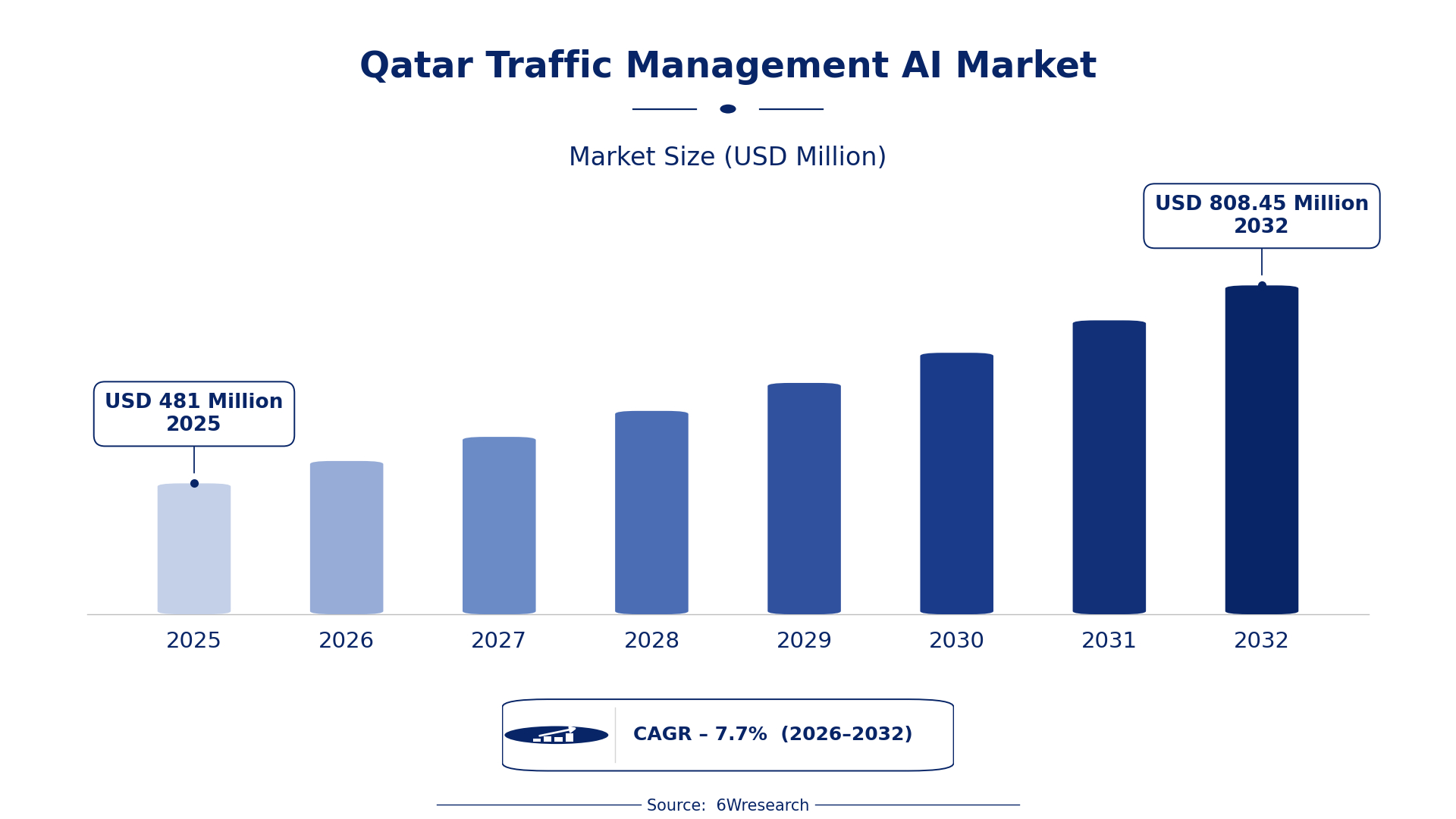
According to 6Wresearch internal database and industry insights, the Qatar Traffic Management AI Market was valued at USD 481.0 million in 2025 and is projected to reach USD 808.45 million by 2032, growing at a CAGR of approximately 7.7% during 2026–2032.
Qatar Traffic Management AI Market Highlights
| Report Metric | Details |
| Report Name | Qatar Traffic Management AI Market |
| Market Size 2025 | USD 481.0 million |
| Market Size 2032 | USD 808.45 million |
| Absolute Growth 2025–2032 | USD 327.45 million |
| CAGR 2026–2032 | 7.7% |
| Peak Annual Growth | 9.9% in 2029 |
| Forecast Period | 2026–2032 |
| Historical Data | 2022–2025 |
| Base Year | 2025 |
| Leading Traffic Management AI, 2025 | Predictive Traffic Tools (42% share) |
| Leading Solution Type, 2025 | Traffic Flow AI (41% share) |
| Leading AI Capability, 2025 | Real-Time Forecasting (51% share) |
| Leading Distribution Channel, 2025 | SaaS Vendors (49% share) |
| Leading End User Industry, 2025 | City Traffic Control (40% share) |
| Fastest-Growing Traffic Management AI | Parking & Congestion AI (10.4% CAGR) |
| Fastest-Growing Solution Type | Adaptive Signals (8.9% CAGR) |
| Fastest-Growing AI Capability | ML-Based Optimization (9.9% CAGR) |
| Fastest-Growing End User Industry | Urban Transport Bureaus (10.4% CAGR) |
| Growing Sector | City Traffic Control |
| Key End Users | Municipal Agencies, Urban Transport Bureaus, Highway Authorities |
Qatar Traffic Management AI Market Year-wise Growth Rate and Key Drivers (2022–2032)
This graph illustrates the annual growth rates of the market from 2022 to 2032, highlighting a steady upward trajectory and projected market expansion over the forecast period.
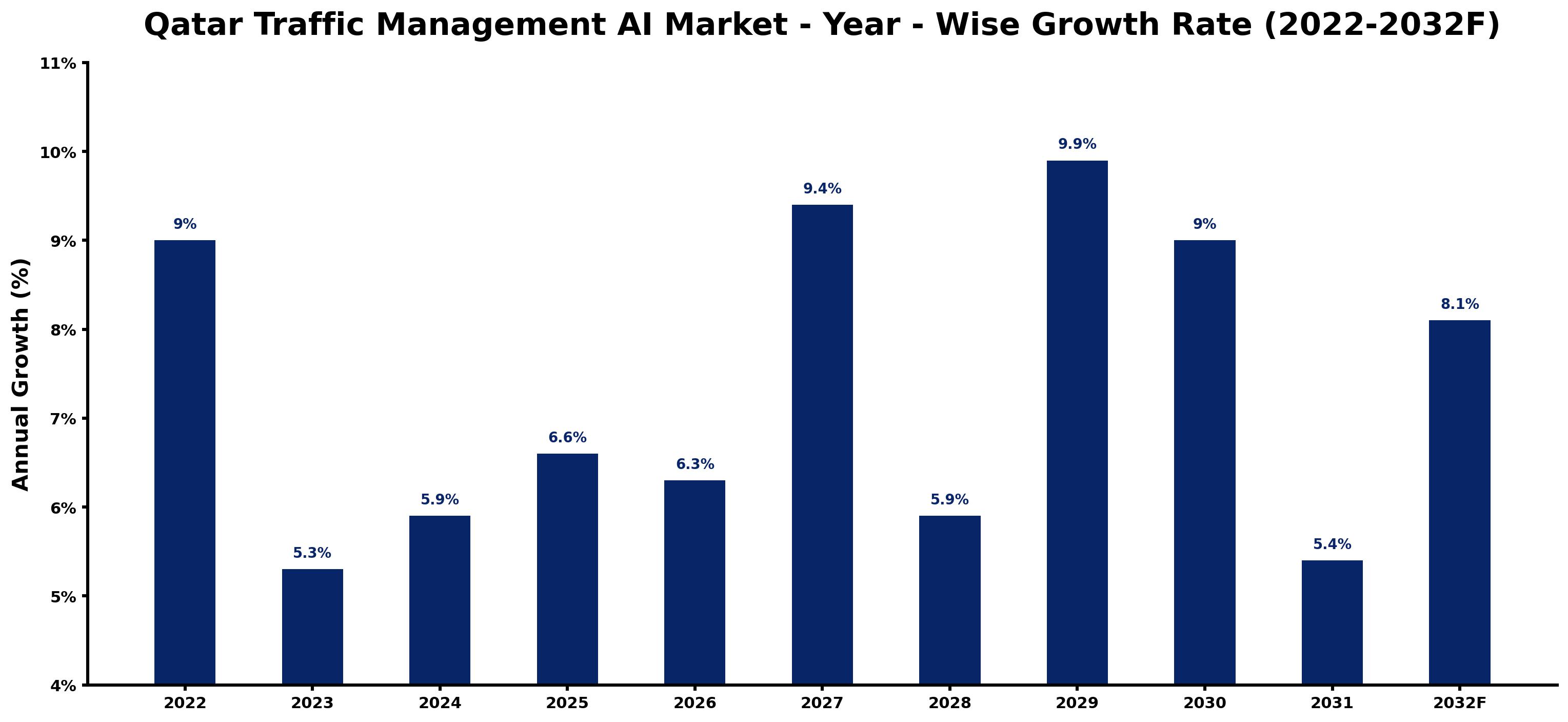
Year by year, the estimates below pair each growth rate with the development that shaped it.
| Year | Estimated Annual Growth (%) | Market Rationale |
| 2022 | 9.0 | The market experienced strong demand from municipal agencies implementing advanced traffic solutions. |
| 2023 | 5.3 | Growth slowed as the Smart Transportation Strategy began its implementation phase. |
| 2024 | 5.9 | Demand increased with the rollout of new traffic management technologies in urban areas. |
| 2025 | 6.6 | The market saw further growth as investments in smart signaling systems expanded. |
| 2026 | 6.3 | Growth slowed due to market adjustments following the rapid adoption of AI technologies. |
| 2027 | 9.4 | Demand surged as predictive traffic tools gained traction among urban transport bureaus. |
| 2028 | 5.9 | Growth slowed as the market stabilised after a period of rapid technological integration. |
| 2029 | 9.9 | The market peaked with significant investments in adaptive signals enhancing traffic flow. |
| 2030 | 9.0 | Growth slowed as the focus shifted towards optimising existing systems and infrastructure. |
| 2031 | 5.4 | Demand continued to grow but at a slower rate as urban areas refined their traffic management strategies. |
| 2032 | 8.1 | Growth accelerated again as new AI capabilities were integrated into traffic systems. |
Note: Market size estimations and growth projections presented in this report are based on 6Wresearch's proprietary forecasting methodology, utilizing the latest available industry data, government publications, and primary research inputs.
Qatar Traffic Management AI Market Synopsis
Traffic Management AI in Qatar refers to advanced technologies that optimise traffic flow and enhance urban mobility. These systems are developed through machine learning algorithms and real-time monitoring. The Qatar Traffic Management AI Market is growing due to increasing demand from municipal agencies and urban transport bureaus. The Smart Transportation Strategy launched in 2023 aims to improve urban mobility, while the Qatar National Vision 2030 emphasises sustainable transport solutions. As a result, significant investments are being made in smart signaling systems and predictive traffic tools.
Market Dynamics Impact Analysis (2026–2032)
| Factor | Type | Impact | Primary Segment Affected |
| Increasing urban population driving demand for efficient traffic solutions | Driver | High | City Traffic Control |
| Investment in smart signaling systems to enhance traffic management | Driver | High | Traffic Flow AI |
| Growing need for AI-driven incident detection systems | Opportunity | Medium | Incident Detection AI |
| High demand for predictive traffic tools to manage congestion | Opportunity | Medium | Predictive Traffic Tools |
| Limited awareness of AI benefits among smaller municipalities | Restraint | Medium | Municipal Agencies |
| High initial investment costs for advanced traffic management systems | Restraint | High | Urban Transport Bureaus |
| Need for continuous updates and maintenance of AI systems | Challenge | High | Predictive Traffic Tools |
| Integration challenges with existing infrastructure and technologies | Challenge | Medium | Smart Signaling Systems |
Evaluation of Drivers in Qatar Traffic Management AI Market (2026–2032)
The table below links each growth driver to the segment it affects and the evidence for it.
| Drivers | Primary Segment Affected | Why It Matters (Evidence) |
| Growing urban population necessitating efficient traffic management solutions | City Traffic Control | Qatar's population of approximately 2.8 million increases demand for effective traffic systems. |
| Investment in smart signaling systems to improve traffic flow | Traffic Flow AI | Qatar has invested over USD 100 million in smart signaling systems to improve urban mobility. |
| Implementation of the Smart Transportation Strategy to integrate AI | Incident Detection AI | The Smart Transportation Strategy launched in 2023 promotes AI integration in traffic management. |
| Demand for predictive traffic tools to reduce congestion | Predictive Traffic Tools | Municipal agencies are increasingly adopting predictive tools to improve traffic flow efficiency. |
| Focus on reducing traffic accidents through advanced technologies | Predictive Traffic Tools | The National Traffic Safety Strategy aims to reduce traffic fatalities by 25% by 2025. |
Market growth for Traffic Management AI in Qatar is driven by a growing urban population, increased investments in smart signalling systems, and the rollout of the Smart Transportation Strategy. Considerable investments in smart signalling systems are being made to boost urban mobility. The National Traffic Safety Strategy seeks to cut traffic fatalities by 25% by 2025, further promoting the incorporation of advanced technologies. As urban transport authorities deploy these systems, the demand for AI-driven incident detection solutions continues to escalate.
Evaluation of Restraints in Qatar Traffic Management AI Market
The key brakes on demand, and where they bite hardest, are shown below.
| Market Restraint | Primary Segment Affected | Why It Matters (Evidence) |
| Limited awareness of AI benefits among smaller municipalities | Municipal Agencies | Many smaller municipalities lack the resources to understand and implement AI technologies effectively. |
| High initial investment costs for advanced traffic management systems | Urban Transport Bureaus | The cost of implementing sophisticated traffic management solutions can deter investment from agencies. |
| Need for continuous updates and maintenance of AI systems | Predictive Traffic Tools | Ongoing maintenance and updates are required to keep AI systems operational and effective. |
| Integration challenges with existing infrastructure and technologies | Smart Signaling Systems | Existing traffic systems may not easily integrate with new AI technologies, complicating upgrades. |
| Regulatory hurdles for implementing new traffic technologies | Traffic Flow AI | Compliance with existing regulations can slow down the adoption of advanced traffic solutions. |
Qatar Traffic Management AI Market Challenges
The Qatar Traffic Management AI market still faces several challenges, starting with regulatory hurdles that delay project approvals for municipal agencies, costing them up to six months in implementation time. Competition from traditional traffic control methods limits the adoption of AI solutions, making it difficult for suppliers to penetrate the market effectively. Supply chain issues arise from reliance on imported technology components, which can increase costs for producers and extend deployment timelines by several weeks. Technology integration challenges complicate the operation of AI systems, resulting in inefficiencies for urban transport bureaus managing congestion.
Trends in the Qatar Traffic Management AI Market
Four trends stand out in the Qatar Traffic Management AI Market.
- Shift to Smart Signaling Systems: Since 2023, Qatar has been transitioning to smart signaling systems to optimise traffic flow. The investment in these systems has increased by 20%, improving urban mobility and reducing congestion.
- Emergence of Predictive Traffic Tools: In 2023, predictive traffic tools gained popularity among urban transport bureaus, with adoption rates rising by 30%. This shift is improving traffic efficiency and reducing delays in Doha.
- Integration of AI and IoT Technologies: The integration of AI with IoT technologies has become prominent in traffic management since 2020. This development has led to a 25% improvement in data collection and analysis capabilities.
- Focus on Incident Detection AI: In 2023, the demand for incident detection AI surged, with municipalities increasing their investments by 15%. This trend is vital for improving response times to accidents.
Investment Opportunities in the Qatar Traffic Management AI Market
The following opportunities in the Qatar Traffic Management AI Market pair current demand with a clear way in.
- Investment in Smart Signaling Systems: With a projected market size of USD 481.0 million by 2025, there is an opportunity to invest in smart signaling systems. Municipal agencies are looking to improve traffic flow and safety.
- Supply of Predictive Traffic Tools: The growing need for predictive traffic tools presents an opportunity for suppliers. Urban transport bureaus in Doha are seeking solutions to manage congestion effectively.
- Development of AI-Driven Incident Detection Systems: As the demand for incident detection AI rises, suppliers can focus on developing these systems. Municipal agencies are prioritising technologies that improve response times.
- Expansion of Adaptive Signals: The market for adaptive signals is expanding rapidly, with urban transport bureaus investing in these systems to improve traffic management.
Government Initiatives in the Qatar Traffic Management AI Market
In 2023, the Ministry of Transport and Communications launched the Smart Transportation Strategy, building on prior initiatives by emphasising AI integration and sustainable practices. This strategy aligns with the Qatar National Vision 2030, which aims to create a sustainable transport system through advanced technologies. The Intelligent Transport Systems (ITS) Strategy, initiated in 2020, promotes the adoption of AI and IoT in traffic management throughout urban areas. These measures aim to improve traffic efficiency and reduce accidents, providing a framework for producers to innovate and adapt their solutions.
The Road Safety Initiative launched by the Ministry of Interior in 2023 incorporates AI technologies to enhance traffic safety and incident response. The National Traffic Safety Strategy, updated in 2022, sets a goal to reduce traffic fatalities by 25% by 2025 through advanced traffic management systems. These initiatives are backed by funding for technology integration and public awareness campaigns, enabling municipal agencies to implement AI-driven solutions effectively.
Future Insight of the Qatar Traffic Management AI Market
By 2032, buyers and suppliers in the Qatar Traffic Management AI market can expect significant advancements driven by the Smart Transportation Strategy, which focuses on optimising urban mobility through AI integration. The Intelligent Transport Systems Strategy will enhance data analytics and real-time monitoring, improving traffic operations. Qatar's road network, spanning over 7,000 kilometres, will see increased investments in advanced traffic solutions. The National Traffic Safety Strategy aims to reduce traffic accidents by 20% by 2025, further stimulating demand for effective traffic management technologies.
Market Segmentation Analysis
Each segment group is reviewed below, with the leader by share and the fastest grower by CAGR.
By Traffic Management AI – Predictive Traffic Tools Dominated, Parking & Congestion AI Expected to Grow Fastest
According to Vasudha, AM at 6Wresearch, Predictive Traffic Tools took a 42% share of traffic management ai in 2025, more than any other category. Predictive Traffic Tools hold the largest share as they effectively forecast traffic patterns, crucial for urban areas like Doha. Their capacity to enhance flow efficiency appeals to municipal agencies focused on reducing congestion. Parking & Congestion AI is set to record the highest CAGR in this split, 10.4% over 2026–2032. Parking & Congestion AI is experiencing rapid growth as cities increasingly seek to optimise urban space and address parking challenges. The launch of Qatar's Smart Transportation Strategy will likely drive demand for these solutions significantly. Suppliers should prioritise developing predictive tools and parking solutions to capture the expanding market share.
By Solution Type – Traffic Flow AI Dominated, Adaptive Signals Expected to Grow Fastest
In 2025, Traffic Flow AI led the solution type split with a 41% share. Traffic Flow AI commands the largest share by effectively analysing traffic data to improve overall flow and alleviate bottlenecks in Qatar's extensive road network. This technology is essential for urban transport bureaus aiming to enhance mobility. Over 2026–2032, Adaptive Signals are expected to post the fastest growth, at a CAGR of 8.9%. Adaptive Signals are gaining traction due to their ability to adjust to real-time traffic conditions, making them vital for efficient traffic management. Their integration into the Intelligent Transport Systems Strategy ensures sustained growth in this segment. Buyers should consider investing in adaptive signal technologies to improve traffic management efficiency.
By AI Capability – Real-Time Forecasting Dominated, ML-Based Optimization Expected to Grow Fastest
Real-Time Forecasting held a 51% share of the Qatar Traffic Management AI Market by ai capability in 2025. Real-Time Forecasting leads the market as it provides immediate traffic forecasts, essential for managing dynamic traffic conditions in Qatar's urban areas. This capability is critical for agencies focused on safety and efficiency. ML-Based Optimization is projected to grow fastest, at a CAGR of 9.9% during 2026–2032. ML-Based Optimization is on the rise as machine learning techniques increasingly enhance traffic patterns based on historical data. This growth is supported by the Qatar Digital Government Strategy, promoting technology in public services. Suppliers must focus on developing machine learning capabilities to meet the rising demand for optimised traffic solutions.
By Distribution Channel – SaaS Vendors Dominated and Is Expected to Record the Fastest Growth
With a 49% revenue share in 2025, SaaS Vendors was the largest distribution channel category. SaaS Vendors dominate the distribution channel, providing essential software solutions for traffic management without direct traffic control. Their flexibility and scalability appeal to various stakeholders in Qatar's traffic ecosystem, making them the preferred choice. The same category are also set to grow fastest, at a CAGR of 9.0% during 2026–2032. SaaS Vendors are also the fastest-growing channel, as the shift towards cloud-based solutions accelerates in the traffic management sector. This trend is driven by the increasing need for real-time data access and management. Suppliers should enhance their SaaS offerings to capture the growing preference for cloud-based traffic management solutions.
By End User Industry – City Traffic Control Dominated, Urban Transport Bureaus Expected to Grow Fastest
City Traffic Control accounted for a 40% market share by end user industry in 2025. City Traffic Control leads the market as it utilises advanced technologies to manage urban traffic effectively, crucial for Qatar's growing population and urbanisation. This sector's focus aligns with the National Traffic Safety Strategy's objectives. Urban Transport Bureaus is set to record the highest CAGR in this split, 10.4% over 2026–2032. Urban Transport Bureaus are experiencing rapid growth as they concentrate on improving urban mobility through advanced traffic management solutions. Their alignment with Qatar's Smart Transportation Strategy underscores their increasing importance. Buyers in urban transport should prioritise advanced traffic management solutions to enhance mobility and safety.
Key Attractiveness of the Report
- 10 Years of Market Numbers
- Historical Data Starting from 2022 to 2025
- Base Year 2025
- Forecast Data until 2032
- Key Performance Indicators Impacting the Market
- Major Upcoming Developments and Projects
Key Highlights of the Report:
- Qatar Traffic Management AI Market Outlook
- Market Size of Qatar Traffic Management AI Market, 2025
- Forecast of Qatar Traffic Management AI Market, 2032
- Historical Data and Forecast of Qatar Traffic Management AI Revenues & Volume for the Period 2022 - 2032F
- Qatar Traffic Management AI Market Trend Evolution
- Qatar Traffic Management AI Market Drivers and Challenges
- Qatar Traffic Management AI Price Trends
- Qatar Traffic Management AI Porter's Five Forces
- Qatar Traffic Management AI Industry Life Cycle
- Historical Data and Forecast of Qatar Traffic Management AI Market Revenues & Volume By Traffic Management AI for the Period 2022 - 2032F
- Historical Data and Forecast of Qatar Traffic Management AI Market Revenues & Volume By Predictive Traffic Tools for the Period 2022 - 2032F
- Historical Data and Forecast of Qatar Traffic Management AI Market Revenues & Volume By Smart Signaling Systems for the Period 2022 - 2032F
- Historical Data and Forecast of Qatar Traffic Management AI Market Revenues & Volume By Incident Detection AI for the Period 2022 - 2032F
- Historical Data and Forecast of Qatar Traffic Management AI Market Revenues & Volume By Parking & Congestion AI for the Period 2022 - 2032F
- Historical Data and Forecast of Qatar Traffic Management AI Market Revenues & Volume By Solution Type for the Period 2022 - 2032F
- Historical Data and Forecast of Qatar Traffic Management AI Market Revenues & Volume By Traffic Flow AI for the Period 2022 - 2032F
- Historical Data and Forecast of Qatar Traffic Management AI Market Revenues & Volume By Adaptive Signals for the Period 2022 - 2032F
- Historical Data and Forecast of Qatar Traffic Management AI Market Revenues & Volume By Video Analytics for the Period 2022 - 2032F
- Historical Data and Forecast of Qatar Traffic Management AI Market Revenues & Volume By Parking Prediction for the Period 2022 - 2032F
- Historical Data and Forecast of Qatar Traffic Management AI Market Revenues & Volume By AI Capability for the Period 2022 - 2032F
- Historical Data and Forecast of Qatar Traffic Management AI Market Revenues & Volume By Real-Time Forecasting for the Period 2022 - 2032F
- Historical Data and Forecast of Qatar Traffic Management AI Market Revenues & Volume By ML-Based Optimization for the Period 2022 - 2032F
- Historical Data and Forecast of Qatar Traffic Management AI Market Revenues & Volume By Deep Learning Vision for the Period 2022 - 2032F
- Historical Data and Forecast of Qatar Traffic Management AI Market Revenues & Volume By IoT + AI Integration for the Period 2022 - 2032F
- Historical Data and Forecast of Qatar Traffic Management AI Market Revenues & Volume By Distribution Channel for the Period 2022 - 2032F
- Historical Data and Forecast of Qatar Traffic Management AI Market Revenues & Volume By SaaS Vendors for the Period 2022 - 2032F
- Historical Data and Forecast of Qatar Traffic Management AI Market Revenues & Volume By ITS Integrators for the Period 2022 - 2032F
- Historical Data and Forecast of Qatar Traffic Management AI Market Revenues & Volume By AV System Vendors for the Period 2022 - 2032F
- Historical Data and Forecast of Qatar Traffic Management AI Market Revenues & Volume By Cloud Platform Vendors for the Period 2022 - 2032F
- Historical Data and Forecast of Qatar Traffic Management AI Market Revenues & Volume By End User Industry for the Period 2022 - 2032F
- Historical Data and Forecast of Qatar Traffic Management AI Market Revenues & Volume By City Traffic Control for the Period 2022 - 2032F
- Historical Data and Forecast of Qatar Traffic Management AI Market Revenues & Volume By Municipal Agencies for the Period 2022 - 2032F
- Historical Data and Forecast of Qatar Traffic Management AI Market Revenues & Volume By Highway Authorities for the Period 2022 - 2032F
- Historical Data and Forecast of Qatar Traffic Management AI Market Revenues & Volume By Urban Transport Bureaus for the Period 2022 - 2032F
- Qatar Traffic Management AI Import Export Trade Statistics
- Market Opportunity Assessment By Traffic Management AI
- Market Opportunity Assessment By Solution Type
- Market Opportunity Assessment By AI Capability
- Market Opportunity Assessment By Distribution Channel
- Market Opportunity Assessment By End User Industry
- Qatar Traffic Management AI Top Companies Market Share
- Qatar Traffic Management AI Competitive Benchmarking By Technical and Operational Parameters
- Qatar Traffic Management AI Company Profiles
- Qatar Traffic Management AI Key Strategic Recommendations
Market Covered
The report offers an extensive study of the following market segments.
By Traffic Management AI
- Predictive Traffic Tools
- Smart Signaling Systems
- Incident Detection AI
- Parking & Congestion AI
By Solution Type
- Traffic Flow AI
- Adaptive Signals
- Video Analytics
- Parking Prediction
By AI Capability
- Real-Time Forecasting
- ML-Based Optimization
- Deep Learning Vision
- IoT + AI Integration
By Distribution Channel
- SaaS Vendors
- ITS Integrators
- AV System Vendors
- Cloud Platform Vendors
By End User Industry
- City Traffic Control
- Municipal Agencies
- Highway Authorities
- Urban Transport Bureaus































