Poland Food Enzymes Market: Import Trend Analysis
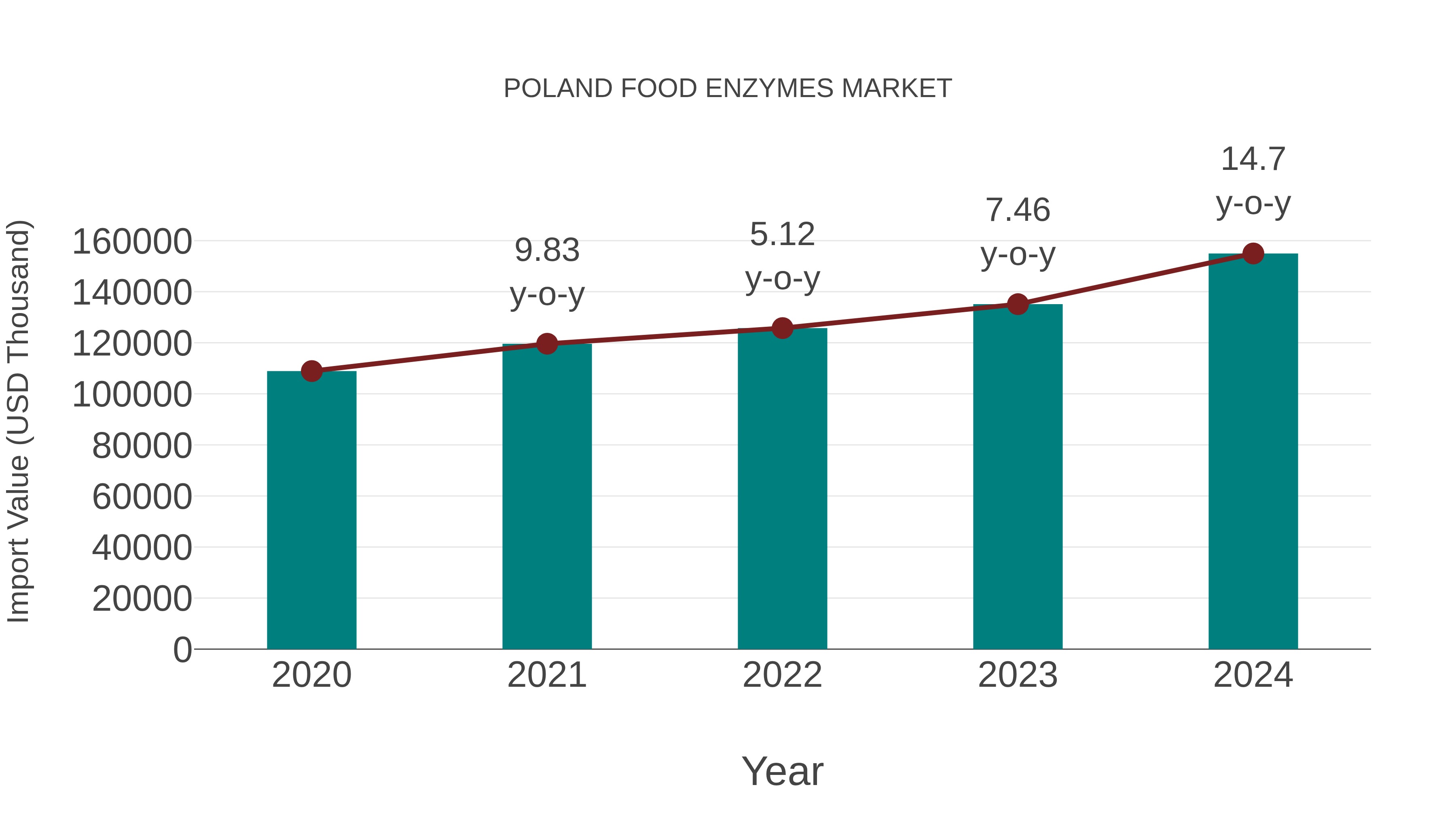
In the Poland food enzymes market, import trends showed a growth rate of 14.7% from 2023 to 2024, with a compound annual growth rate (CAGR) of 9.22% from 2020 to 2024. This import momentum can be attributed to increasing demand for food processing technologies and the country`s stable market conditions.
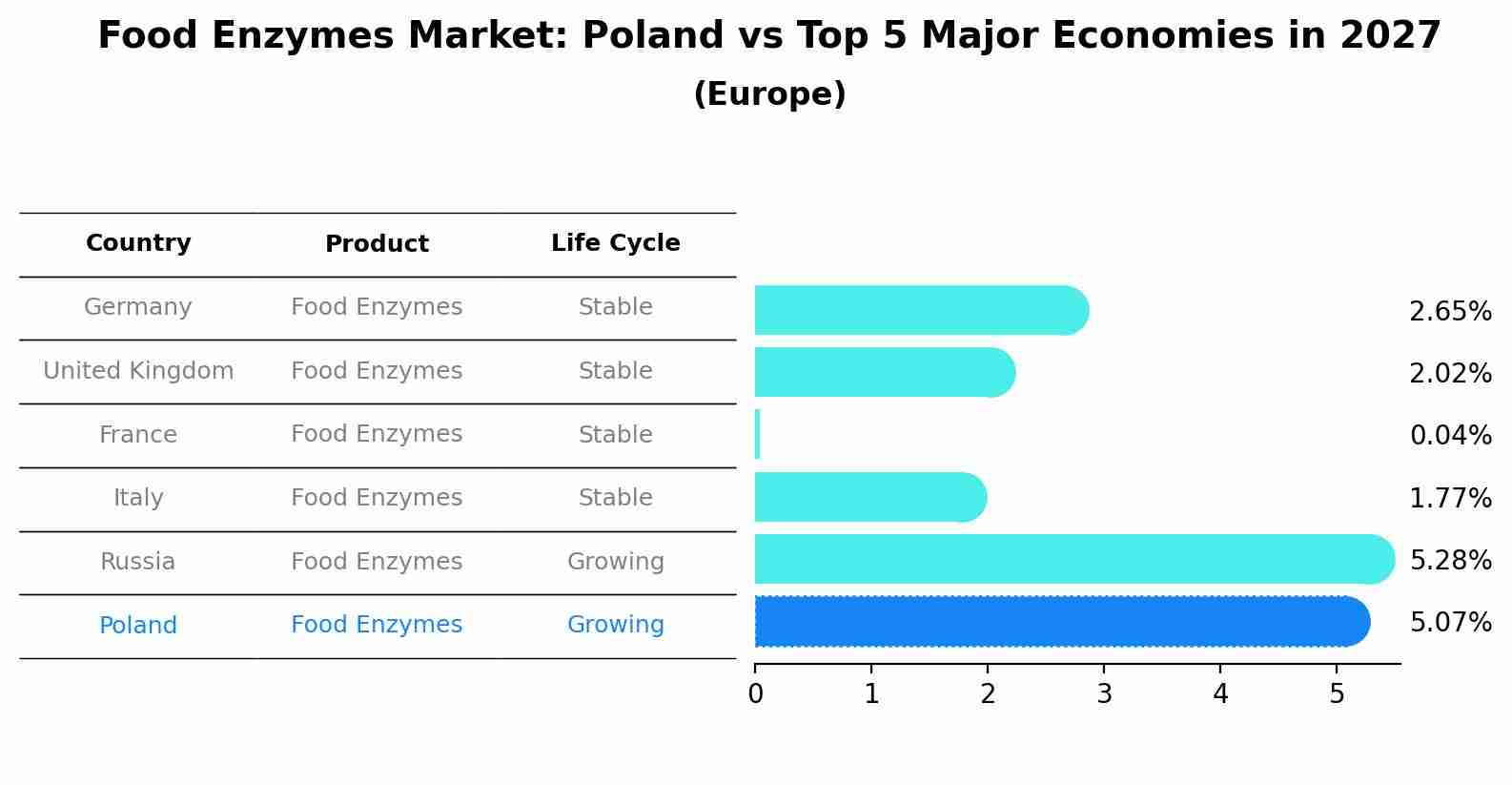
Food Enzymes Market: Poland vs Top 5 Major Economies in 2027 (Europe)
By 2027, the Food Enzymes market in Poland is anticipated to reach a growth rate of 5.07%, as part of an increasingly competitive Europe region, where Germany remains at the forefront, supported by United Kingdom, France, Italy and Russia, driving innovations and market adoption across sectors.
Poland Food Enzymes Market Overview
The Poland Food Enzymes Market is experiencing steady growth driven by the increasing demand for processed food products and the emphasis on enhancing food quality and production efficiency. Enzymes are widely used in the food industry for various applications such as bakery, dairy, beverages, and meat processing to improve texture, flavor, and shelf-life of products. Key players in the market are focusing on developing innovative enzyme solutions to cater to the evolving consumer preferences for clean-label and natural ingredients. Moreover, the growing awareness about the benefits of enzymes in food production, such as cost-effectiveness and sustainability, is further fueling market growth. Regulatory support for the use of enzymes in the food industry also plays a significant role in driving market expansion in Poland.
Poland Food Enzymes Market Trends
The Poland Food Enzymes Market is experiencing growth driven by increasing consumer demand for natural and clean label food products. Enzymes are being used more frequently in food and beverage formulations to improve product quality, extend shelf life, and enhance nutritional value. There is a rising awareness among consumers about the benefits of enzymes in food processing, leading to a shift towards enzyme-based solutions in the industry. Manufacturers are also investing in research and development to innovate new enzyme technologies that cater to specific food applications, such as bakery, dairy, and beverages. Additionally, the market is witnessing a surge in demand for plant-based enzymes as consumers seek sustainable and eco-friendly alternatives. Overall, the Poland Food Enzymes Market is expected to continue its growth trajectory driven by these key trends.
Poland Food Enzymes Market Challenges
In the Poland Food Enzymes Market, several challenges are prevalent. One major challenge is the lack of awareness among consumers and food manufacturers regarding the benefits and applications of food enzymes. This hinders the widespread adoption of food enzymes in various food products. Additionally, the regulatory environment in Poland can be complex and stringent, leading to delays in product approvals and market entry for food enzyme manufacturers. Another challenge is the increasing competition in the market, as more companies are entering the food enzymes segment, intensifying the competitive landscape and putting pressure on existing players to innovate and differentiate their products. Furthermore, the cost of production and sourcing high-quality raw materials for food enzymes can also pose challenges for companies operating in the Poland Food Enzymes Market.
Poland Food Enzymes Market Investment Opportunities
The Poland Food Enzymes Market presents promising investment opportunities due to the growing demand for food enzymes in various sectors such as bakery, dairy, and beverages. With increasing consumer awareness about the benefits of enzymes in food production, there is a significant market potential for enzyme manufacturers and suppliers to expand their presence in Poland. Key areas for investment include research and development to create innovative enzyme solutions tailored to the specific needs of the Polish market, strategic partnerships with local food manufacturers to integrate enzymes into their production processes, and marketing efforts to educate consumers about the role of enzymes in enhancing food quality and sustainability. Overall, investing in the Poland Food Enzymes Market offers the potential for long-term growth and profitability in a rapidly evolving industry landscape.
Poland Food Enzymes Market Government Policy
In Poland, the Food Enzymes Market is governed by regulations set forth by the European Union, as Poland is a member state. The European Food Safety Authority (EFSA) evaluates and approves the use of food enzymes within the EU, ensuring their safety for consumers. Additionally, Poland`s own food safety authority, the Chief Sanitary Inspectorate (GIS), enforces compliance with EU regulations and monitors the use of food enzymes in the market. Companies operating in the Poland Food Enzymes Market must adhere to labeling requirements and maximum residue limits established by these regulatory bodies. Overall, the regulatory framework aims to guarantee the safety and quality of food enzymes used in Poland while promoting innovation and competitiveness in the industry.
Poland Food Enzymes Market Future Outlook
The Poland Food Enzymes Market is expected to show steady growth in the coming years due to increasing consumer demand for natural and clean label ingredients in food products. The trend towards healthy eating and sustainability is driving the adoption of food enzymes as they help improve the nutritional profile of processed foods and enable manufacturers to reduce the use of artificial additives. Additionally, the growing awareness about food intolerances and allergies is leading to the incorporation of enzymes to make products more digestible and allergen-friendly. With advancements in enzyme technology and research, the market is likely to witness innovations in enzyme formulations tailored for specific applications, further fueling market growth. Overall, the Poland Food Enzymes Market is poised for expansion as the food industry continues to prioritize health, wellness, and sustainability.
Key Highlights of the Report:
- Poland Food Enzymes Market Outlook
- Market Size of Poland Food Enzymes Market, 2021
- Forecast of Poland Food Enzymes Market, 2031
- Historical Data and Forecast of Poland Food Enzymes Revenues & Volume for the Period 2018 - 2031
- Poland Food Enzymes Market Trend Evolution
- Poland Food Enzymes Market Drivers and Challenges
- Poland Food Enzymes Price Trends
- Poland Food Enzymes Porter's Five Forces
- Poland Food Enzymes Industry Life Cycle
- Historical Data and Forecast of Poland Food Enzymes Market Revenues & Volume By Source for the Period 2018 - 2031
- Historical Data and Forecast of Poland Food Enzymes Market Revenues & Volume By Microorganisms for the Period 2018 - 2031
- Historical Data and Forecast of Poland Food Enzymes Market Revenues & Volume By Animal for the Period 2018 - 2031
- Historical Data and Forecast of Poland Food Enzymes Market Revenues & Volume By Plant for the Period 2018 - 2031
- Historical Data and Forecast of Poland Food Enzymes Market Revenues & Volume By Type for the Period 2018 - 2031
- Historical Data and Forecast of Poland Food Enzymes Market Revenues & Volume By Carbohydarse for the Period 2018 - 2031
- Historical Data and Forecast of Poland Food Enzymes Market Revenues & Volume By Protease for the Period 2018 - 2031
- Historical Data and Forecast of Poland Food Enzymes Market Revenues & Volume By Lipase for the Period 2018 - 2031
- Historical Data and Forecast of Poland Food Enzymes Market Revenues & Volume By Others for the Period 2018 - 2031
- Historical Data and Forecast of Poland Food Enzymes Market Revenues & Volume By Form for the Period 2018 - 2031
- Historical Data and Forecast of Poland Food Enzymes Market Revenues & Volume By Liquid for the Period 2018 - 2031
- Historical Data and Forecast of Poland Food Enzymes Market Revenues & Volume By Solid for the Period 2018 - 2031
- Historical Data and Forecast of Poland Food Enzymes Market Revenues & Volume By Application for the Period 2018 - 2031
- Historical Data and Forecast of Poland Food Enzymes Market Revenues & Volume By Bakery for the Period 2018 - 2031
- Historical Data and Forecast of Poland Food Enzymes Market Revenues & Volume By Dairy for the Period 2018 - 2031
- Historical Data and Forecast of Poland Food Enzymes Market Revenues & Volume By Beverage for the Period 2018 - 2031
- Historical Data and Forecast of Poland Food Enzymes Market Revenues & Volume By Meat, Fish, and Egg Processing for the Period 2018 - 2031
- Historical Data and Forecast of Poland Food Enzymes Market Revenues & Volume By Grain and Oilseed Processing for the Period 2018 - 2031
- Historical Data and Forecast of Poland Food Enzymes Market Revenues & Volume By Others for the Period 2018 - 2031
- Poland Food Enzymes Import Export Trade Statistics
- Market Opportunity Assessment By Source
- Market Opportunity Assessment By Type
- Market Opportunity Assessment By Form
- Market Opportunity Assessment By Application
- Poland Food Enzymes Top Companies Market Share
- Poland Food Enzymes Competitive Benchmarking By Technical and Operational Parameters
- Poland Food Enzymes Company Profiles
- Poland Food Enzymes Key Strategic Recommendations






































