Qatar 5G Femtocell Market (2026-2032) | Revenue, Strategy, Investment Trends, Industry, Size, Pricing Analysis, Value, Forecast, Drivers, Strategic Insights, Competitive, Companies, Competition, Segments, Opportunities, Supply, Demand, Consumer Insights, Restraints, Share, Challenges, Analysis, Outlook, Growth, Trends, Segmentation
Market Forecast By Femtocell Type (Residential Femtocell, Enterprise Femtocell, Outdoor Femtocell, Industrial Femtocell), By Frequency (Sub-6 GHz, mmWave, 26-39 GHz, Above 39 GHz), By Application (Smart Homes, Corporate Offices, Public Venues, Smart Manufacturing), By End User (Households, Businesses, Government, Factories) And Competitive Landscape
| Product Code: ETC11646243 | Publication Date: Apr 2025 | Updated Date: Jun 2026 | Product Type: Market Research Report | |
| Publisher: 6Wresearch | Author: Bhawna Singh | No. of Pages: 65 | No. of Figures: 34 | No. of Tables: 19 |
Qatar 5G Femtocell Market Growth Rate
According to 6Wresearch internal databases and industry insights, the Qatar 5G Femtocell Market is projected to grow at a compound annual growth rate (CAGR) of 6.18% during the forecast period 2026–2032.
Qatar 5G Femtocell Market Year-wise Growth Rate and Key Drivers
The graph below illustrates the year-on-year growth of the Qatar 5G Femtocell Market from 2021 to 2032, reflecting gradual adoption across households, corporate offices, public venues, and factories.
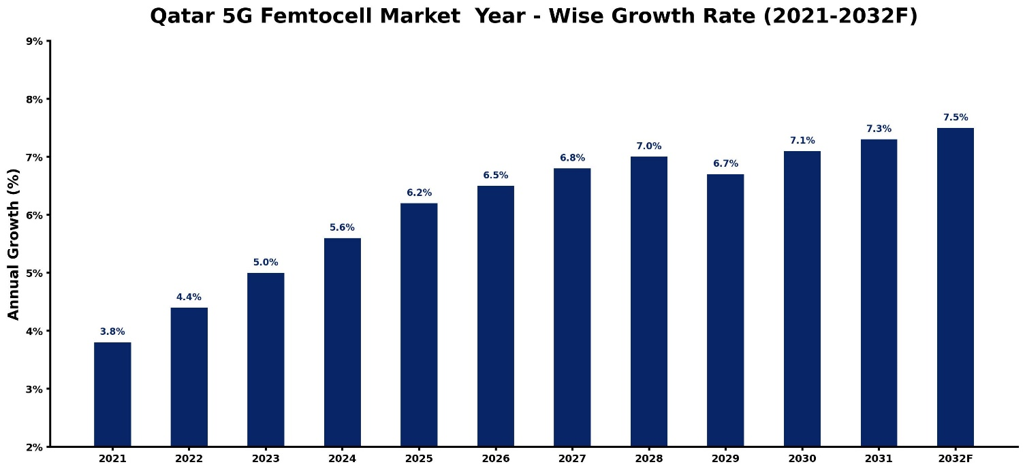
The following table summarizes the historical and forecasted growth rates of the Qatar 5G Femtocell Market, along with the rationale behind each year’s performance.
| Year | Estimated Growth (%) | Market Rationale |
| 2021 | 3.8% | Early Pilot programs in urban areas. |
| 2022 | 4.4% | Growth of enterprise femtocell trials in office complexes |
| 2023 | 55 | For factory automation, there is increase in small-scale industrial femtocell deployment. |
| 2024 | 5.6% | Government supported 5G spectrum investment which enable network rollout. |
| 2025 | 6.2% | Rising need for campus-specific high-speed connectivity. |
| 2026 | 6.5% | Rising incorporation of femtocells with smart homes. |
| 2027 | 6.8% | Adoption in large-scale public venues. |
| 2028 | 7% | Industrial femtocells are highly being used for smart manufacturing operations. |
| 2029 | 6.7% | A slight increase in moderation owing to early deployment saturation. |
| 2030 | 7.1% | Increase in business campuses. |
| 2031 | 7.3% | Multi-band femtocells adopted for mixed-use urban environments. |
| 2032 | 7.5% | Increased deployment in factories. |
Topics Covered in the Qatar 5G Femtocell Market Report
The Qatar 5G Femtocell Market report thoroughly covers the market by femtocell type, frequency, application, and end user. The report provides a detailed analysis of market trends, technology developments, investment opportunities, competitive landscape, regulatory framework, key growth drivers, and challenges influencing the deployment of 5G femtocell solutions across residential, commercial, and industrial environments. It offers valuable insights for stakeholders seeking to capitalize on the growing demand for enhanced indoor wireless connectivity.
Qatar 5G Femtocell Market Highlights
| Report Name | Qatar 5G Femtocell Market |
| Forecast period | 2026-2032 |
| CAGR | 6.18% |
| Growing Sector | Enterprise Femtocell Segment |
Qatar 5G Femtocell Market Synopsis
The Qatar 5G Femtocell Market comprises small, low-power base stations crafted to augment indoor and localized 5G coverage. Femtocells are broadly adopted in residential complexes, corporate offices, factories, and public venues. This is to augment signal strength, reduce network congestion, and enable ultra-reliable low-latency communication (URLLC) for IoT and automation applications. Enterprises can get advantage from private 5G femtocells for secure communications and industrial automation. Whereas residential users experience uninterrupted high-speed connectivity for smart home devices.
Evaluation of Growth Drivers in Qatar 5G Femtocell Market (2026–2032)
Below are some major drivers and their influence on the market dynamics:
| Drivers | Primary Segment Affected | Why It Matters (Evidence) |
| Smart building adoption | Residential & Corporate | Rising deployment of smart homes and connected office buildings increases demand for indoor 5G coverage. |
| Industry 4.0 initiatives | Factories & Industrial | Femtocells give low-latency connections for IoT-enabled automation. |
| Spectrum allocation by government | Enterprises & Public Venues | National 5G plans helps in enabling deployment of multi-band femtocell. |
| Increased mobile data consumption | Households & Businesses | High-speed 5G coverage is needed to promote video streaming. |
| Integration with enterprise IoT | Industrial & Corporate | Femtocells make sure dependable connectivity for sensors. |
The Qatar 5G Femtocell Market is projected to grow at a CAGR of 6.18% during 2026–2032. It is owing to rising need for localized 5G coverage and enterprise-grade private networks. Qatar 5G Femtocell Market Growth is further encouraged by rising adoption of private enterprise networks, smart manufacturing automation, IoT-enabled devices, and smart home connectivity. This is alongside government supported 5G initiatives that enable spectrum allocation, pilot projects, and regulatory support. The market expansion is also accelerated by rising need for low-latency, high-bandwidth applications in public venues, factories, and office campuses.
Evaluation of Restraints in Qatar 5G Femtocell Market
Below are some major restraints and their influence on the market dynamics:
| Restraints | Primary Segment Affected | What This Means (Evidence) |
| High initial deployment cost | Households & Businesses | Multi-unit installations increase upfront CapEx. |
| Limited multi-band compatibility | Enterprises | Older femtocells may not support mmWave or higher-frequency bands, reducing flexibility. |
| Technical expertise shortage | IT & Telecom | Skilled engineers needed for deployment, less in numbers. |
| Interference with macro networks | Public Venues | Signal interference can be created through dense deployment. |
| Regulatory complexity | Government & Businesses | Compliance requirements may postpone installations. |
Qatar 5G Femtocell Market Challenges:
The Qatar 5G Femtocell Market Industry go through challenges. Deploying femtocells needs careful planning for interference mitigation, frequency management, and integration with existing 5G infrastructure and incorporation with existing 5G infrastructure is another major challenge. It is needing compatibility with network cores, edge computing platforms, and enterprise IT systems. Furthermore, high upfront capital expenditures for multi-unit deployments, is a leading obstruction. Lack availability of skilled engineers for installation and optimization, can decrease the rate of adoption. This is hampering the Qatar 5G Femtocell Market.
Qatar 5G Femtocell Market Trends
Major trends responsible for Qatar 5G Femtocell Market Growth includes:
- Multi-Band Femtocells: For versatile coverage, operators are adopting femtocells encouraging Sub-6 GHz, mmWave, and high-frequency bands.
- Enterprise-Centric Deployment: For high-speed connectivity, there is rising deployment in corporate campuses and factories.
- Smart Home Integration: Residential femtocells along with IoT devices are used for augmented AR/VR applications.
- Industrial Automation: To connect sensors and robotics in smart manufacturing, there is rising use of femtocells.
Investment Opportunities in Qatar 5G Femtocell Market
Below are the investment opportunities available in Qatar 5G Femtocell Market:
- Smart Homes: Increasing deployment of IoT devices creates requirement for indoor 5G coverage, which is beneficial for consumers.
- Public Venue Networks: For dense user connectivity, stadiums, airports, and malls need strong femtocell networks.
- Industrial IoT: Factories are launching Industry 4.0 benefit from dedicated femtocell solutions, which are highly essential.
Top 5 Leading Players in the Qatar 5G Femtocell Market
Below is a list of prominent companies dominating the Qatar 5G Femtocell Market Share:
• Huawei Technologies Co., Ltd.
| Company Name | Huawei Technologies Co., Ltd. |
| Established Year | 1987 |
| Headquarters | Shenzhen, China |
| Official Website | Click Here |
Huawei is a leading global provider of 5G infrastructure and wireless connectivity solutions. The company offers advanced femtocell technologies designed to enhance indoor coverage and network performance.
• Nokia Corporation
| Company Name | Nokia Corporation |
| Established Year | 1865 |
| Headquarters | Espoo, Finland |
| Official Website | Click Here |
Nokia delivers comprehensive 5G network solutions, including small-cell and femtocell systems. Its technologies help operators improve capacity, coverage, and connectivity in dense environments.
• Samsung Electronics Co., Ltd.
| Company Name | Samsung Electronics Co., Ltd. |
| Established Year | 1969 |
| Headquarters | Suwon, South Korea |
| Official Website | Click Here |
Samsung Electronics is a major supplier of 5G radio access network equipment and small-cell solutions. The company focuses on high-performance wireless infrastructure for enterprise and residential deployments.
• ZTE Corporation
| Company Name | ZTE Corporation |
| Established Year | 1985 |
| Headquarters | Shenzhen, China |
| Official Website | Click Here |
ZTE provides innovative 5G small-cell and femtocell solutions that support enhanced indoor and enterprise connectivity. The company serves telecom operators and businesses with scalable network technologies.
• Cisco Systems, Inc.
| Company Name | Cisco Systems, Inc. |
| Established Year | 1984 |
| Headquarters | California, USA |
| Official Website | Click Here |
Cisco Systems offers advanced networking, edge computing, and cellular connectivity solutions. The company supports enterprise-grade 5G deployments through cloud-managed networking and wireless infrastructure platforms.
Government Initiatives Being Implemented in Qatar 5G Femtocell Market
According to Qatar’s government data, they support femtocell deployment via National 5G Strategy and industrial innovation programs at Hamad Port and Ras Laffan. These initiatives help in enabling enterprise-grade 5G femtocells via spectrum allocation, pilot funding, and regulatory guidance and also supporting both telecom operators and private enterprises to deploy localized 5G networks. Furthermore, government partnership with technology providers and industrial stakeholders proliferates deployment timelines. Hence, they are encouraging multi-band femtocell integration. They will help in the development of Qatar 5G Femtocell Market.
Future Insights of Qatar 5G Femtocell Market
The Qatar 5G Femtocell Market is expected to grow steadily as residential, enterprise, and industrial users adopt femtocells for improved coverage, network reliability, and IoT connectivity. Multi-band and industrial femtocells will gain traction, particularly in smart manufacturing, corporate campuses, and smart homes, strengthening Qatar’s position as a regional hub for next-generation private 5G networks. Corporate campuses and public venues such as stadiums, airports, and malls will increasingly rely on femtocells to manage high-density user connectivity and enhance service reliability. In the residential segment, smart home growth and AR/VR applications will continue to drive demand for seamless indoor 5G coverage.
Market Segmentation Analysis
Below are some of the leading companies in the Qatar 5G Connector Market:
By Femtocell Type
According to Rishil, Senior Research Analyst, 6Wresearch, Enterprise Femtocells dominated in 2025 with 43.2% Qatar 5G Femtocell Market Share. It is serving offices, campuses, and public venues. Also, Industrial Femtocells are estimated to grow at 7.0% CAGR through 2032. It is due to increasing Industry 4.0 adoption.
By Frequency
Sub-6 GHz femtocells accounted for 59.5% of 2025 adoption. It is favoured for indoor coverage and building penetration. mmWave and 26–39 GHz bands are forecast to expand at 6.8% CAGR. They help to support high-capacity venues.
By Application
Corporate Offices led with 41.7% market share in 2025. Smart Manufacturing is predicted to grow at 6.9% CAGR. It is owing connected factory deployments and industrial automation.
By End User
Businesses lead the market in 2025 with 45.3% share. They are leveraging femtocells for secure campus networks. Factories are estimated to grow at 7.1% CAGR with Industry 4.0 adoption.
Note: Market size estimations and growth projections presented in this report are based on 6Wresearch’s advanced forecasting approach, validated with industry datasets as of June 2026.
Key Attractiveness of the Report:
- 10 Years of Market Numbers
- Historical Data Starting from 2022 to 2025
- Base Year: 2025
- Forecast Data until 2032
- Key Performance Indicators Impacting the Market
- Major Upcoming Developments and Projects
Key Highlights of the Report:
- Qatar 5G Femtocell Market Outlook
- Market Size of Qatar 5G Femtocell Market, 2025
- Forecast of Qatar 5G Femtocell Market, 2032
- Historical Data and Forecast of Qatar 5G Femtocell Revenues & Volume for the Period 2022-2032
- Qatar 5G Femtocell Market Trend Evolution
- Qatar 5G Femtocell Market Drivers and Challenges
- Qatar 5G Femtocell Price Trends
- Qatar 5G Femtocell Porter's Five Forces
- Qatar 5G Femtocell Industry Life Cycle
- Historical Data and Forecast of Qatar 5G Femtocell Market Revenues & Volume By Femtocell Type for the Period 2022-2032
- Historical Data and Forecast of Qatar 5G Femtocell Market Revenues & Volume By Residential Femtocell for the Period 2022-2032
- Historical Data and Forecast of Qatar 5G Femtocell Market Revenues & Volume By Enterprise Femtocell for the Period 2022-2032
- Historical Data and Forecast of Qatar 5G Femtocell Market Revenues & Volume By Outdoor Femtocell for the Period 2022-2032
- Historical Data and Forecast of Qatar 5G Femtocell Market Revenues & Volume By Industrial Femtocell for the Period 2022-2032
- Historical Data and Forecast of Qatar 5G Femtocell Market Revenues & Volume By Frequency for the Period 2022-2032
- Historical Data and Forecast of Qatar 5G Femtocell Market Revenues & Volume By Sub-6 GHz for the Period 2022-2032
- Historical Data and Forecast of Qatar 5G Femtocell Market Revenues & Volume By mmWave for the Period 2022-2032
- Historical Data and Forecast of Qatar 5G Femtocell Market Revenues & Volume By 26-39 GHz for the Period 2022-2032
- Historical Data and Forecast of Qatar 5G Femtocell Market Revenues & Volume By Above 39 GHz for the Period 2022-2032
- Historical Data and Forecast of Qatar 5G Femtocell Market Revenues & Volume By Application for the Period 2022-2032
- Historical Data and Forecast of Qatar 5G Femtocell Market Revenues & Volume By Smart Homes for the Period 2022-2032
- Historical Data and Forecast of Qatar 5G Femtocell Market Revenues & Volume By Corporate Offices for the Period 2022-2032
- Historical Data and Forecast of Qatar 5G Femtocell Market Revenues & Volume By Public Venues for the Period 2022-2032
- Historical Data and Forecast of Qatar 5G Femtocell Market Revenues & Volume By Smart Manufacturing for the Period 2022-2032
- Historical Data and Forecast of Qatar 5G Femtocell Market Revenues & Volume By End User for the Period 2022-2032
- Historical Data and Forecast of Qatar 5G Femtocell Market Revenues & Volume By Households for the Period 2022-2032
- Historical Data and Forecast of Qatar 5G Femtocell Market Revenues & Volume By Businesses for the Period 2022-2032
- Historical Data and Forecast of Qatar 5G Femtocell Market Revenues & Volume By Government for the Period 2022-2032
- Historical Data and Forecast of Qatar 5G Femtocell Market Revenues & Volume By Factories for the Period 2022-2032
- Qatar 5G Femtocell Import Export Trade Statistics
- Market Opportunity Assessment By Femtocell Type
- Market Opportunity Assessment By Frequency
- Market Opportunity Assessment By Application
- Market Opportunity Assessment By End User
- Qatar 5G Femtocell Top Companies Market Share
- Qatar 5G Femtocell Competitive Benchmarking By Technical and Operational Parameters
- Qatar 5G Femtocell Company Profiles
- Qatar 5G Femtocell Key Strategic Recommendations
Market Covered
The report offers a comprehensive study of the following Qatar 5G Femtocell Market segments:
By Femtocell Type
- Residential Femtocell
- Enterprise Femtocell
- Outdoor Femtocell
- Industrial Femtocell
By Frequency
- Sub-6 GHz
- mmWave
- 26–39 GHz
- Above 39 GHz
By Application
- Smart Homes
- Corporate Offices
- Public Venues
- Smart Manufacturing
By End User
- Households
- Businesses
- Government
- Factories
Qatar 5G Femtocell Market (2026-2032) : FAQs
The Qatar 5G Femtocell Market is projected to grow at 6.18% CAGR over the forecast period.
Rising enterprise adoption for secure private networks and growing demand for smart home are major investment drivers.
Spectrum licensing complexities remain the leading barrier in swifter adoption.
Businesses are deploying femtocells to launch secure private networks and make sure low-latency connectivity.
6Wresearch actively monitors the Qatar 5G Femtocell Market and publishes its comprehensive annual report, highlighting emerging trends, growth drivers, revenue analysis, and forecast outlook. Our insights help businesses to make data-backed strategic decisions with ongoing market dynamics. Our analysts track relevent industries related to the Qatar 5G Femtocell Market, allowing our clients with actionable intelligence and reliable forecasts tailored to emerging regional needs.
Yes, we provide customisation as per your requirements. To learn more, feel free to contact us on sales@6wresearch.com
| 1 Executive Summary |
| 2 Introduction |
| 2.1 Key Highlights of the Report |
| 2.2 Report Description |
| 2.3 Market Scope & Segmentation |
| 2.4 Research Methodology |
| 2.5 Assumptions |
| 3 Qatar 5G Femtocell Market Overview |
| 3.1 Qatar Country Macro Economic Indicators |
| 3.2 Qatar 5G Femtocell Market Revenues & Volume, 2022 & 2032F |
| 3.3 Qatar 5G Femtocell Market - Industry Life Cycle |
| 3.4 Qatar 5G Femtocell Market - Porter's Five Forces |
| 3.5 Qatar 5G Femtocell Market Revenues & Volume Share, By Femtocell Type, 2022 & 2032F |
| 3.6 Qatar 5G Femtocell Market Revenues & Volume Share, By Frequency, 2022 & 2032F |
| 3.7 Qatar 5G Femtocell Market Revenues & Volume Share, By Application, 2022 & 2032F |
| 3.8 Qatar 5G Femtocell Market Revenues & Volume Share, By End User, 2022 & 2032F |
| 4 Qatar 5G Femtocell Market Dynamics |
| 4.1 Impact Analysis |
| 4.2 Market Drivers |
| 4.2.1 Increasing demand for high-speed mobile data services |
| 4.2.2 Growing adoption of Internet of Things (IoT) devices |
| 4.2.3 Government initiatives to boost 5G infrastructure development |
| 4.3 Market Restraints |
| 4.3.1 High initial investment costs for deploying 5G femtocell technology |
| 4.3.2 Regulatory challenges and spectrum allocation issues |
| 4.3.3 Security and privacy concerns related to 5G network deployment |
| 5 Qatar 5G Femtocell Market Trends |
| 6 Qatar 5G Femtocell Market, By Types |
| 6.1 Qatar 5G Femtocell Market, By Femtocell Type |
| 6.1.1 Overview and Analysis |
| 6.1.2 Qatar 5G Femtocell Market Revenues & Volume, By Femtocell Type, 2022 - 2032F |
| 6.1.3 Qatar 5G Femtocell Market Revenues & Volume, By Residential Femtocell, 2022 - 2032F |
| 6.1.4 Qatar 5G Femtocell Market Revenues & Volume, By Enterprise Femtocell, 2022 - 2032F |
| 6.1.5 Qatar 5G Femtocell Market Revenues & Volume, By Outdoor Femtocell, 2022 - 2032F |
| 6.1.6 Qatar 5G Femtocell Market Revenues & Volume, By Industrial Femtocell, 2022 - 2032F |
| 6.2 Qatar 5G Femtocell Market, By Frequency |
| 6.2.1 Overview and Analysis |
| 6.2.2 Qatar 5G Femtocell Market Revenues & Volume, By Sub-6 GHz, 2022 - 2032F |
| 6.2.3 Qatar 5G Femtocell Market Revenues & Volume, By mmWave, 2022 - 2032F |
| 6.2.4 Qatar 5G Femtocell Market Revenues & Volume, By 26-39 GHz, 2022 - 2032F |
| 6.2.5 Qatar 5G Femtocell Market Revenues & Volume, By Above 39 GHz, 2022 - 2032F |
| 6.3 Qatar 5G Femtocell Market, By Application |
| 6.3.1 Overview and Analysis |
| 6.3.2 Qatar 5G Femtocell Market Revenues & Volume, By Smart Homes, 2022 - 2032F |
| 6.3.3 Qatar 5G Femtocell Market Revenues & Volume, By Corporate Offices, 2022 - 2032F |
| 6.3.4 Qatar 5G Femtocell Market Revenues & Volume, By Public Venues, 2022 - 2032F |
| 6.3.5 Qatar 5G Femtocell Market Revenues & Volume, By Smart Manufacturing, 2022 - 2032F |
| 6.4 Qatar 5G Femtocell Market, By End User |
| 6.4.1 Overview and Analysis |
| 6.4.2 Qatar 5G Femtocell Market Revenues & Volume, By Households, 2022 - 2032F |
| 6.4.3 Qatar 5G Femtocell Market Revenues & Volume, By Businesses, 2022 - 2032F |
| 6.4.4 Qatar 5G Femtocell Market Revenues & Volume, By Government, 2022 - 2032F |
| 6.4.5 Qatar 5G Femtocell Market Revenues & Volume, By Factories, 2022 - 2032F |
| 7 Qatar 5G Femtocell Market Import-Export Trade Statistics |
| 7.1 Qatar 5G Femtocell Market Export to Major Countries |
| 7.2 Qatar 5G Femtocell Market Imports from Major Countries |
| 8 Qatar 5G Femtocell Market Key Performance Indicators |
| 8.1 Average data speed improvement in 5G femtocell coverage areas |
| 8.2 Number of IoT devices connected to 5G femtocell networks |
| 8.3 Percentage increase in network coverage and reliability |
| 8.4 Average latency reduction in 5G femtocell networks |
| 8.5 Energy efficiency improvements in 5G femtocell deployments |
| 9 Qatar 5G Femtocell Market - Opportunity Assessment |
| 9.1 Qatar 5G Femtocell Market Opportunity Assessment, By Femtocell Type, 2022 & 2032F |
| 9.2 Qatar 5G Femtocell Market Opportunity Assessment, By Frequency, 2022 & 2032F |
| 9.3 Qatar 5G Femtocell Market Opportunity Assessment, By Application, 2022 & 2032F |
| 9.4 Qatar 5G Femtocell Market Opportunity Assessment, By End User, 2022 & 2032F |
| 10 Qatar 5G Femtocell Market - Competitive Landscape |
| 10.1 Qatar 5G Femtocell Market Revenue Share, By Companies, 2025 |
| 10.2 Qatar 5G Femtocell Market Competitive Benchmarking, By Operating and Technical Parameters |
| 11 Company Profiles |
| 12 Recommendations |
| 13 Disclaimer |
Global Go To Market Strategy - 2030
Export potential enables firms to identify high-growth global markets with greater confidence by combining advanced trade intelligence with a structured quantitative methodology. The framework analyzes emerging demand trends and country-level import patterns while integrating macroeconomic and trade datasets such as GDP and population forecasts, bilateral import–export flows, tariff structures, elasticity differentials between developed and developing economies, geographic distance, and import demand projections. Using weighted trade values from 2020–2024 as the base period to project country-to-country export potential for 2030, these inputs are operationalized through calculated drivers such as gravity model parameters, tariff impact factors, and projected GDP per-capita growth. Through an analysis of hidden potentials, demand hotspots, and market conditions that are most favorable to success, this method enables firms to focus on target countries, maximize returns, and global expansion with data, backed by accuracy.
By factoring in the projected importer demand gap that is currently unmet and could be potential opportunity, it identifies the potential for the Exporter (Country) among 190 countries, against the general trade analysis, which identifies the biggest importer or exporter.
To discover high-growth global markets and optimize your business strategy:
Click Here
Pricing
- Single User License$ 1,995
- Department License$ 2,400
- Site License$ 3,120
- Global License$ 3,795

Leadership Perspectives from Industry Events
Search
Thought Leadership and Analyst Meet





Our Clients








6WResearch In News
- India Air Conditioner Market Set for Strong Rebound in 2026 After Weather-Led Correction and GST-Driven Recovery: 6Wresearch
- ADAS in India: How Automatic Emergency Braking, Blind Spot Detection & Driver Monitoring are Transforming Road Safety
- Doha a strategic location for EV manufacturing hub: IPA Qatar
- Demand for luxury TVs surging in the GCC, says Samsung
- Empowering Growth: The Thriving Journey of Bangladesh’s Cable Industry
- Demand for luxury TVs surging in the GCC, says Samsung
Latest Reports
- Poland Fire Protection Systems Market (2026-2032)
- Cape Verde Portable Hand-Thrown Extinguisher Market (2026-2032)
- Canada Portable Hand-Thrown Extinguisher Market (2026-2032)
- Cameroon Portable Hand-Thrown Extinguisher Market (2026-2032)
- Burundi Portable Hand-Thrown Extinguisher Market (2026-2032)
- Burkina Faso Portable Hand-Thrown Extinguisher Market (2026-2032)
- Bulgaria Portable Hand-Thrown Extinguisher Market (2026-2032)
- Brunei Portable Hand-Thrown Extinguisher Market (2026-2032)
- Botswana Portable Hand-Thrown Extinguisher Market (2026-2032)
- Bosnia and Herzegovina Portable Hand-Thrown Extinguisher Market (2026-2032)
Industry Events and Analyst Meet

HIMTEX 2026

India Refining Summit 2026

India EV Show 2026

EV tech India Expo 2026

Auto Tech Asia 2026
Whitepaper
- Middle East & Africa Commercial Security Market Click here to view more.
- Middle East & Africa Fire Safety Systems & Equipment Market Click here to view more.
- GCC Drone Market Click here to view more.
- Middle East Lighting Fixture Market Click here to view more.
- GCC Physical & Perimeter Security Market Click here to view more.


