Qatar Advanced Persistent Threat Market Growth Rate
According to 6Wresearch internal databases and industry insights, the Qatar Advanced Persistent Threat Market is estimated to register a compound annual growth rate (CAGR) of approximately 8.7% during 2026–2032.
Qatar Advanced Persistent Threat Market Year-wise Growth Rate and Key Drivers (2022–2032)
This graph illustrates the annual growth rates of the Qatar Advanced Persistent Threat Market from 2022 to 2032, highlighting a steady upward trajectory and projected market expansion over the forecast period.
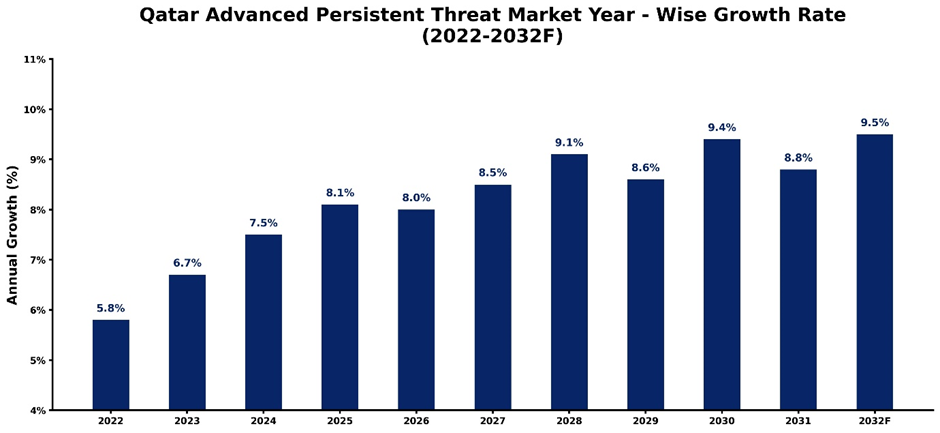
The following table presents the estimated annual growth rates of the market for each year, along with the key factors influencing market performance during the respective period. The values are intended to highlight year-wise drivers rather than provide a direct comparison between individual years.
| Year | Estimated Growth (%) | Market Rationale |
| 2022 | 5.8% | Expansion of remote connectivity and increasing investment in enterprise security monitoring. |
| 2023 | 6.7% | Greater adoption of endpoint detection, managed security services and identity-focused controls. |
| 2024 | 7.5% | Implementation of stronger national cybersecurity governance and increasing awareness of sophisticated intrusion campaigns. |
| 2025 | 8.1% | Increased demand for threat intelligence, extended detection and response, and advanced security analytics. |
| 2026 | 8% | Broader deployment of continuous monitoring and behavioral threat detection across critical organizations. |
| 2027 | 8.5% | Expansion of AI-assisted detection, security orchestration and managed detection capabilities. |
| 2028 | 9.1% | Rising digital infrastructure exposure and growing demand for proactive APT hunting. |
| 2029 | 8.6% | Increasing integration of identity, endpoint, cloud and network telemetry. |
| 2030 | 9.4% | Greater adoption of autonomous security analytics and intelligence-led threat prevention. |
| 2031 | 8.8% | Expansion of cyber resilience programs and modernization of security operations centers. |
| 2032 | 9.5% | Wider adoption of integrated APT defense platforms across government, enterprises and critical industries. |
Topics Covered in the Qatar Advanced Persistent Threat Market Report
The Qatar Advanced Persistent Threat Market Report provides a comprehensive analysis based on threat type and industry. It offers detailed insights into key industry trends, growth drivers, emerging opportunities, competitive developments, and high-growth segments. The report presents an objective assessment of current dynamics and future prospects, enabling stakeholders to make informed business decisions and develop effective strategies aligned with the evolving industry landscape.
Qatar Advanced Persistent Threat Market Highlights
| Report Name | Qatar Advanced Persistent Threat Market |
| Forecast period | 2026-2032 |
| CAGR | 8.7% |
| Growing Sector | Government |
Qatar Advanced Persistent Threat Market Synopsis
The Qatar Advanced Persistent Threat Market is expected to maintain a strong expansion trajectory through 2032. APT defense typically combines endpoint detection and response, network detection, threat intelligence, identity analytics, security information and event management, behavioral analytics, email security and incident-response capabilities. Demand is particularly relevant for organizations handling sensitive government information, financial assets, critical infrastructure, healthcare data and telecommunications networks. Qatar's National Cyber Security Agency was launched in 2021 to coordinate national cybersecurity efforts, while the National Cyber Security Strategy 202 caters a formal framework focussing on cyber resilience, regulation, innovation and cooperation.
Evaluation of Growth Drivers in Qatar Advanced Persistent Threat Market (2026–2032)
Below are some major drivers and their influence on market dynamics:
| Drivers | Primary Segment Affected | Why It Matters (Evidence) |
| Increasing sophistication of targeted cyberattacks | Enterprises / Government | APT campaigns can combine credential compromise, malware, lateral movement and data theft, encouraging organizations to adopt multi-layered detection rather than relying solely on traditional antivirus tools. |
| Growth of cloud and hybrid environments | Enterprises / SMEs | Hybrid infrastructure increases the number of identities, endpoints and workloads requiring monitoring. |
| Strengthening cybersecurity governance | Government / Regulated Industries | Qatar's National Cyber Security Strategy 2024–2030 places higher focus on cyber resilience. |
| Increasing demand for managed security operations | Enterprises / SMEs | Organizations without large internal security teams highly need external monitoring. |
| Expansion of 5G and connected infrastructure | IT & Telecom | Greater dependence on high-speed connected networks increases the importance of network visibility, anomaly detection and security monitoring across telecom environments. |
The Qatar Advanced Persistent Threat Market is projected to grow at a CAGR of approximately 8.7% during 2026–2032. Industry growth is expected to benefit from expanding digital infrastructure, stronger national cyber governance, growing cloud adoption, increasing security operations requirements and the need to detect sophisticated multi-stage attacks. Government and large enterprise organizations are expected to remain major purchasers as they operate sensitive systems and high-value information assets. Qatar's cybersecurity ecosystem is also being supported by programs intended to strengthen national capabilities and cybersecurity innovation. The National Cyber Security Agency's Cybersecurity Research, Innovation and Development program, for example, is designed to encourage cybersecurity R&D, investment and development of a national cybersecurity industry.
Evaluation of Restraints in Qatar Advanced Persistent Threat Market
Below are some major restraints and their influence on market dynamics:
| Restraints | Primary Segment Affected | What This Means (Evidence) |
| High cost of advanced security platforms | Government / Large Enterprises | APT defense can require multiple integrated technologies, specialist personnel and continuous monitoring, increasing total ownership costs. |
| Shortage of specialized cybersecurity professionals | Government / Enterprises | Advanced threat hunting requires experienced analysts capable of interpreting behavioral indicators, intelligence and complex attack chains. |
| Integration complexity | Enterprises | Security teams may need to integrate endpoint, network, identity, cloud and SIEM technologies, creating implementation and interoperability challenges. |
| High volume of security alerts | All Segments | Large security environments can generate significant alert volumes, increasing the need for automation, prioritization and skilled analysis. |
| Budget limitations among SMEs | SMEs | Large security environments can generate major alert volumes. |
Qatar Advanced Persistent Threat Market Challenges
The Qatar Advanced Persistent Threat Industry faces various challenges related to the complexity of detecting low-and-slow intrusions, requirement for specialized security personnel and the integration of multiple cybersecurity technologies. One of the principal challenges is that APT defense cannot generally be addressed through a single security product. Organizations require coordinated visibility across endpoints, identities, applications, networks, cloud workloads and user behavior. Another challenge is the increasing sophistication of legitimate administrative tools being abused during attacks. Security teams therefore need behavioral analytics and threat intelligence rather than relying exclusively on known malware signatures.
Qatar Advanced Persistent Threat Market Trends
Significant trends driving the Qatar Advanced Persistent Threat Market Growth are presented below:
- Increasing adoption of Extended Detection and Response (XDR): XDR integrates telemetry from multiple security layers, enabling organizations to correlate endpoint, email, identity, cloud and network events rather than investigating each security system independently.
- Greater emphasis on identity-based defense: Compromised credentials can provide attackers with legitimate-looking access. Organizations are therefore increasing investments in privileged-access controls, identity analytics, multifactor authentication and abnormal-login detection.
- Expansion of managed detection and response: Managed security providers can supply continuous monitoring and specialist threat-hunting capabilities for organizations that lack sufficient internal cybersecurity resources.
Investment Opportunities in the Qatar Advanced Persistent Threat Market
Strategic investment opportunities in the Qatar Advanced Persistent Threat Market include the following:
- Managed detection and response services: MDR represents an opportunity for organizations seeking continuous monitoring without building a large internal security operations team.
- Identity threat detection and response: Increasing reliance on cloud applications and remote access creates demand for technologies capable of identifying suspicious authentication behavior and privilege escalation.
- Critical-infrastructure cybersecurity: Energy, telecommunications, government systems and other strategically important infrastructure require advanced monitoring as disruption or compromise can have wider operational consequences.
Top Players in Qatar Advanced Persistent Threat Market
Below is a curated list of leading companies in the Qatar Advanced Persistent Threat Market:
1. Palo Alto Networks
| Company Name | Palo Alto Networks |
|---|---|
| Established Year | 2005 |
| Headquarters | Santa Clara, California, USA |
| Official Website | Click Here |
Palo Alto Networks caters cybersecurity platforms spanning network security, cloud security, endpoint protection, threat intelligence, and advanced malware analysis.
2. CrowdStrike
| Company Name | CrowdStrike |
|---|---|
| Established Year | 2011 |
| Headquarters | Austin, Texas, USA |
| Official Website | Click Here |
CrowdStrike specializes in cloud-native cybersecurity solutions covering endpoint protection, identity security, threat intelligence, and security operations.
3. Microsoft
| Company Name | Microsoft |
|---|---|
| Established Year | 1975 |
| Headquarters | Redmond, Washington, USA |
| Official Website | Click Here |
Microsoft caters enterprise cybersecurity capabilities through its security portfolio covering identity protection, endpoint security, cloud security, security analytics, and threat intelligence.
4. Fortinet
| Company Name | Fortinet |
|---|---|
| Established Year | 2000 |
| Headquarters | Sunnyvale, California, USA |
| Official Website | Click Here |
Fortinet caters cybersecurity technologies across network security, endpoint protection, cloud security, and security operations.
5. IBM
| Company Name | IBM |
|---|---|
| Established Year | 1911 |
| Headquarters | Armonk, New York, USA |
| Official Website | Click Here |
IBM offers cybersecurity solutions covering threat intelligence, security information and event management, incident response, identity security, and security orchestration.
Government Initiatives being implemented in the Qatar Advanced Persistent Threat Market
According to Qatar’s government data, Qatar launched its National Cyber Security Strategy 2024–2030 in September 2024. The strategy coordinates national cybersecurity efforts and is responsible for developing and updating the national cybersecurity strategy. Therefore, it helps in establishing cyber-risk frameworks, supporting cybersecurity assessments and strengthening national incident response and recovery capabilities. Furthermore, these measures help augment national cyber resilience, solidify preparedness against sophisticated cyber threats, and support the growth and advancement of the Qatar Advanced Persistent Threat Market.
Future Insights of the Qatar Advanced Persistent Threat Market
The Qatar Advanced Persistent Threat Market is expected to transition toward integrated security operations rather than standalone threat-prevention products. Organizations are likely to increasingly combine endpoint telemetry, identity analytics, threat intelligence, network monitoring, cloud security and automated response. Government organizations are expected to remain an important demand center as national digital services and sensitive information require continuous cyber resilience. Large enterprises in financial services, telecommunications and other data-intensive industries are also expected to increase spending on proactive detection.
Market Segmentation Analysis
This report presents a detailed analysis of the market segments along with their leading categories.
By Threat Type – Malware Segment Dominates, While Phishing Records Strong Expansion
According to Sumit Sagar, Senior Research Analyst, 6Wresearch, By threat type, malware accounted for approximately 43.7% of the Qatar Advanced Persistent Threat Market Share in 2025, supported by its continued role in multi-stage intrusions, credential compromise and endpoint exploitation. Meanwhile, phishing-related APT protection is projected to expand at a CAGR of approximately 9.4% during 2026–2032, driven by increasing targeted social-engineering attacks and credential theft.
By End User – Government Segment Dominates, While Enterprises Register Strong Growth
By end user, government organizations represented approximately 37.8% of market share in 2025, owing to the sensitivity of public-sector systems and national digital infrastructure. Meanwhile, enterprise need is projected to expand at a CAGR of approximately 9.1% during 2026 - 2032, owing to cloud migration and expanding digital attack surfaces.
By Industry – IT & Telecom Segment Dominates, While BFSI Shows Strong Growth
By industry, IT & Telecom captured approximately 31.6% of the industry share in 2025, driven by extensive network infrastructure and rising data traffic. At the same time, BFSI security spending is projected to grow at a CAGR of approximately 9.6% during 2026–2032, spurred by financial-data protection and highly sophisticated credential-based attacks.
Note: Market size estimations and growth projections presented in this report are based on 6Wresearch's proprietary forecasting methodology, utilizing the latest available industry data, government publications, and primary research inputs.
Key Attractiveness of the Report:
- 10 Years of Market Numbers
- Historical Data Starting from 2022 to 2025
- Base Year: 2025
- Forecast Data until 2032
- Key Performance Indicators Impacting the Market
- Major Upcoming Developments and Projects
Key Highlights of the Report:
- Qatar Advanced Persistent Threat Market Outlook
- Market Size of Qatar Advanced Persistent Threat Market, 2025
- Forecast of Qatar Advanced Persistent Threat Market, 2032
- Historical Data and Forecast of Qatar Advanced Persistent Threat Revenues & Volume for the Period 2022-2032
- Qatar Advanced Persistent Threat Market Trend Evolution
- Qatar Advanced Persistent Threat Market Drivers and Challenges
- Qatar Advanced Persistent Threat Price Trends
- Qatar Advanced Persistent Threat Porter's Five Forces
- Qatar Advanced Persistent Threat Industry Life Cycle
- Historical Data and Forecast of Qatar Advanced Persistent Threat Market Revenues & Volume By Threat Type for the Period 2022-2032
- Historical Data and Forecast of Qatar Advanced Persistent Threat Market Revenues & Volume By Malware for the Period 2022-2032
- Historical Data and Forecast of Qatar Advanced Persistent Threat Market Revenues & Volume By Phishing for the Period 2022-2032
- Historical Data and Forecast of Qatar Advanced Persistent Threat Market Revenues & Volume By Denial-of-Service for the Period 2022-2032
- Historical Data and Forecast of Qatar Advanced Persistent Threat Market Revenues & Volume By Others for the Period 2022-2032
- Historical Data and Forecast of Qatar Advanced Persistent Threat Market Revenues & Volume By End User for the Period 2022-2032
- Historical Data and Forecast of Qatar Advanced Persistent Threat Market Revenues & Volume By Government for the Period 2022-2032
- Historical Data and Forecast of Qatar Advanced Persistent Threat Market Revenues & Volume By Enterprises for the Period 2022-2032
- Historical Data and Forecast of Qatar Advanced Persistent Threat Market Revenues & Volume By SMEs for the Period 2022-2032
- Historical Data and Forecast of Qatar Advanced Persistent Threat Market Revenues & Volume By Others for the Period 2022-2032
- Historical Data and Forecast of Qatar Advanced Persistent Threat Market Revenues & Volume By Industry for the Period 2022-2032
- Historical Data and Forecast of Qatar Advanced Persistent Threat Market Revenues & Volume By BFSI for the Period 2022-2032
- Historical Data and Forecast of Qatar Advanced Persistent Threat Market Revenues & Volume By Healthcare for the Period 2022-2032
- Historical Data and Forecast of Qatar Advanced Persistent Threat Market Revenues & Volume By IT & Telecom for the Period 2022-2032
- Historical Data and Forecast of Qatar Advanced Persistent Threat Market Revenues & Volume By Others for the Period 2022-2032
- Qatar Advanced Persistent Threat Import Export Trade Statistics
- Market Opportunity Assessment By Threat Type
- Market Opportunity Assessment By End User
- Market Opportunity Assessment By Industry
- Qatar Advanced Persistent Threat Top Companies Market Share
- Qatar Advanced Persistent Threat Competitive Benchmarking By Technical and Operational Parameters
- Qatar Advanced Persistent Threat Company Profiles
- Qatar Advanced Persistent Threat Key Strategic Recommendations
Market Covered
The report offers an extensive study of the following market segments:
By Threat Type
- Malware
- Phishing
- Denial-of-Service
- Others
By End User
- Government
- Enterprises
- SMEs
- Others
By Industry
- BFSI
- Healthcare
- IT & Telecom
- Others































