Qatar Copper Forged Market Summary
The qatar copper forged market was estimated at USD 728 Million in 2025 and is projected to reach USD 1045 Million by 2032, growing at a CAGR of 6.1% from 2026 to 2032.
Qatar Copper Forged Market Year-wise Growth Rate and Key Drivers
This graph highlights how the Qatar Copper Forged Market has steadily grown over the past five years, supported by major growth factors.
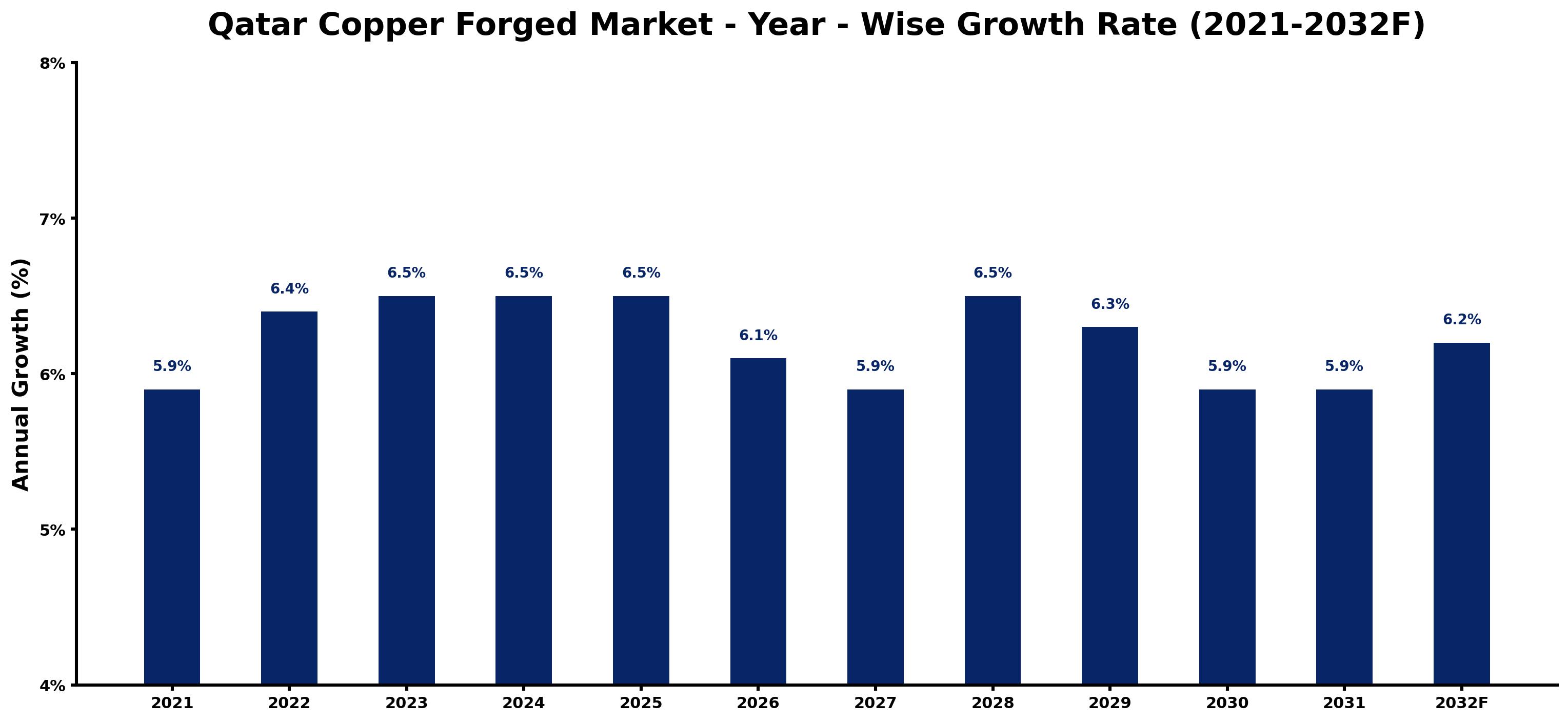
The table below presents the year wise growth rates along with the key drivers influencing the market
| Year | Growth Rate | Major Drivers |
| 2021 | 5.9% | Post-lockdown retail projects triggered renewed construction momentum across Qatar's urban landscape. |
| 2022 | 6.4% | Localized manufacturing initiatives began attracting international partnerships within the copper forging sector. |
| 2023 | 6.5% | Qatar's infrastructure expansion plans demanded high-quality copper components for robust performance. |
| 2024 | 6.5% | Increased investments in NEOM stimulated interest in advanced copper forging technology applications. |
| 2025 | 6.5% | Sustainable building materials became a focal point for enhancing copper's industry relevance. |
| 2026 | 6.1% | Demand for customized copper solutions emerged, catering to specific architectural needs. |
| 2027 | 5.9% | Economic diversification strategies positioned copper forging as critical for non-oil sector growth. |
| 2028 | 6.5% | Technological innovations in metallurgy started reshaping copper production efficiency and quality assurance. |
| 2029 | 6.3% | Expanding logistics capabilities improved supply chain dynamics, enhancing market responsiveness. |
| 2030 | 5.9% | Collaborative ventures with GCC countries led to enhanced knowledge sharing in forging techniques. |
| 2031 | 5.9% | Rising focus on energy efficiency encouraged copper usage in green building projects. |
| 2032 | 6.2% | Market players began exploring digital transformation, boosting overall operational efficiency. |
Note - Market size estimations and growth projections presented in this report are based on 6Wresearch's advanced forecasting approach, validated with industry datasets as of June 2026.
Qatar Copper Forged Market Synopsis
The Qatar Copper Forged Market is projected to reach 6.1% and witness significant growth during the forecast period (2026-2032). This anticipated growth is driven by a surge in demand for copper forged components across various end-use industries, including automotive, electrical, and construction sectors. With a rising population and increasing disposable income, the demand for copper forged products in Qatar is escalating. Additionally, the establishment of substantial manufacturing facilities within Qatar presents a considerable opportunity for local manufacturers to satisfy the needs of domestic customers.
Qatar Copper Forged Market Growth Drivers
Several key factors are propelling the growth of the Qatar Copper Forged Market. Firstly, the urbanization rate in the country is soaring, leading to heightened demand for construction materials, including copper forged products. Secondly, the Qatari government's initiatives to position the nation as an attractive destination for foreign investments are fostering a conducive business environment. Furthermore, rising per capita income is contributing to increased purchasing power among consumers, stimulating market growth. The integration of advanced technologies, such as automation and robotics, into production processes is enhancing efficiency and product quality. Lastly, ongoing infrastructure development projects across Qatar are significantly impacting the demand for forged copper components.
Qatar Copper Forged Market Trends and Opportunities
The Qatar Copper Forged Market is witnessing notable trends that indicate future growth opportunities. The shift towards energy-efficient solutions and sustainable practices is prompting manufacturers to innovate in terms of product offerings. Additionally, the increase in recycling and reuse of materials, including aluminum, opens avenues for diversification within the market. There is also a growing emphasis on collaborations and partnerships among manufacturers to enhance product portfolios and gain competitive advantages. Moreover, the rise of smart city initiatives in Qatar is expected to stimulate demand for innovative copper forged solutions tailored to modern urban needs.
Qatar Copper Forged Market Challenges and Restraints
Despite the optimistic outlook for the Qatar Copper Forged Market, several challenges may impede industry expansion. Fluctuating raw material prices, driven by an unstable global economy, can lead to volatile cost structures. Currency exchange rate fluctuations further complicate pricing strategies for manufacturers. Increased competition among vendors, particularly due to surplus production capacity, has resulted in pricing pressures, which can negatively impact profit margins, especially for smaller firms. Additionally, the need for continuous investment in technology and innovation to stay competitive is a significant factor that companies must navigate.
Qatar Copper Forged Market Government Investment and Initiatives
The Qatari government is actively investing in various initiatives that aim to bolster the copper forged market. Strategic public spending on infrastructure development projects has created a favorable environment for the industry. Government policies designed to attract foreign direct investments are being implemented, encouraging international companies to establish operations in Qatar. Such initiatives not only promote economic growth but also enhance local job creation. Furthermore, regulatory frameworks are being refined to facilitate smoother business operations, while tax incentives are being considered to encourage local manufacturing of copper forged products.
Qatar Copper Forged Market Latest Developments (May 2025 - June 2026)
Recent developments in the Qatar Copper Forged Market indicate a dynamic shift towards innovation and sustainability. The industry has experienced a resurgence as construction and electrical sectors recovered from the impacts of the pandemic. There has been a marked increase in collaborative efforts among manufacturers to enhance product offerings and adopt advanced technologies. Additionally, local manufacturers are focusing on expanding their market reach by investing in research and development to create energy-efficient copper forged solutions. As Qatar continues to develop its infrastructure, the demand for copper forged components is expected to grow significantly, highlighting the market's potential.
Qatar Copper Forged Market - Key Attractiveness of the Report
- 10 Years of Market Numbers
- Historical Data Starting from 2022 to 2025
- Base Year: 2025
- Forecast Data until 2032
- Key Performance Indicators Impacting the Market
- Major Upcoming Developments and Projects
Key Highlights of the Report:
- Qatar Copper Forged Market Outlook
- Market Size of Qatar Copper Forged Market, 2025
- Forecast of Qatar Copper Forged Market, 2032
- Historical Data and Forecast of Qatar Copper Forged Revenues & Volume for the Period 2022-2032F
- Qatar Copper Forged Market Trend Evolution
- Qatar Copper Forged Market Drivers and Challenges
- Qatar Copper Forged Price Trends
- Qatar Copper Forged Porter's Five Forces
- Qatar Copper Forged Industry Life Cycle
- Historical Data and Forecast of Qatar Copper Forged Market Revenues & Volume By Product Types for the Period 2022-2032F
- Historical Data and Forecast of Qatar Copper Forged Market Revenues & Volume By Closed Die Forging for the Period 2022-2032F
- Historical Data and Forecast of Qatar Copper Forged Market Revenues & Volume By Open Die Forging for the Period 2022-2032F
- Historical Data and Forecast of Qatar Copper Forged Market Revenues & Volume By Rolled Ring Forging for the Period 2022-2032F
- Historical Data and Forecast of Qatar Copper Forged Market Revenues & Volume By Applications for the Period 2022-2032F
- Historical Data and Forecast of Qatar Copper Forged Market Revenues & Volume By Automotive for the Period 2022-2032F
- Historical Data and Forecast of Qatar Copper Forged Market Revenues & Volume By Aerospace for the Period 2022-2032F
- Historical Data and Forecast of Qatar Copper Forged Market Revenues & Volume By Oil & Gas for the Period 2022-2032F
- Historical Data and Forecast of Qatar Copper Forged Market Revenues & Volume By Construction for the Period 2022-2032F
- Historical Data and Forecast of Qatar Copper Forged Market Revenues & Volume By Agriculture for the Period 2022-2032F
- Historical Data and Forecast of Qatar Copper Forged Market Revenues & Volume By Others for the Period 2022-2032F
- Qatar Copper Forged Import Export Trade Statistics
- Market Opportunity Assessment By Product Types
- Market Opportunity Assessment By Applications
- Qatar Copper Forged Top Companies Market Share
- Qatar Copper Forged Competitive Benchmarking By Technical and Operational Parameters
- Qatar Copper Forged Company Profiles
- Qatar Copper Forged Key Strategic Recommendations






































