Qatar High Strength Steel Market Size, Share & Growth Rate
The Qatar High Strength Steel Market was estimated at USD 416 Million in 2025 and is projected to reach USD 574 Million by 2032, growing at a CAGR of 4.7% from 2026 to 2032. This upward trajectory is primarily fueled by the increasing demand for robust materials in industries such as automotive, aerospace, and construction, where performance and durability are paramount. Qatar's strategic initiatives aimed at diversifying its industrial landscape and enhancing manufacturing capabilities further bolster the market's growth potential.
Qatar High Strength Steel Market Year-wise Growth Rate and Key Drivers
This graph highlights how the Qatar High Strength Steel Market has steadily grown over the years, supported by major growth factors.
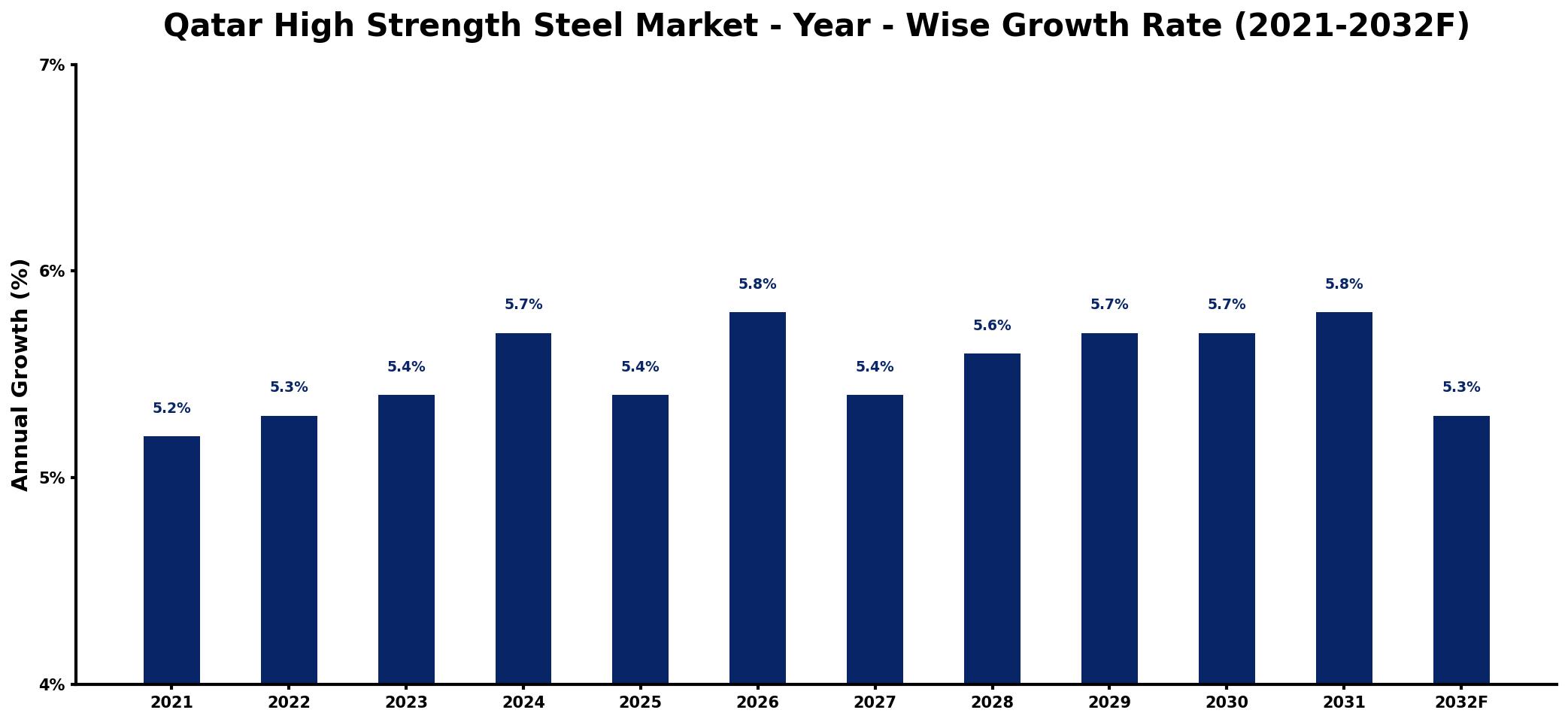
The table below presents the year‑wise growth rates along with the key drivers influencing the market
| Year | Growth Rate | Major Drivers |
| 2021 | 5.2% | Infrastructure projects driving demand |
| 2022 | 5.3% | Construction sector expansion ongoing |
| 2023 | 5.4% | Increased automotive manufacturing needs |
| 2024 | 5.7% | Energy sector investments rising |
| 2025 | 5.4% | Rapid urbanization boosting consumption |
| 2026 | 5.8% | Technological advancements enhancing applications |
| 2027 | 5.4% | Government initiatives promoting growth |
| 2028 | 5.6% | Sustainability trends influencing usage |
| 2029 | 5.7% | Export opportunities expanding globally |
| 2030 | 5.7% | Research and development investments increasing |
| 2031 | 5.8% | Innovative applications in construction |
| 2032 | 5.3% | Market diversification strategies implemented |
Note: Market size estimations and growth projections presented in this report are based on 6Wresearch's proprietary forecasting methodology, utilizing the latest available industry data, government publications, and primary research inputs.
Qatar High Strength Steel Market Synopsis
At the core of the Qatar High Strength Steel Market's current dynamics is the substantial demand from key industries requiring materials with outstanding mechanical properties. High-strength steel's applications are expanding rapidly, especially in sectors where weight reduction and performance optimization are essential, such as automotive and construction.
Ongoing research and development endeavors play a crucial role in the market's evolution. Innovations in advanced alloys and production methods, coupled with strategic collaborations between manufacturers and end-users, are driving the adoption of high-strength steel, thereby shaping a promising landscape for the market in Qatar.
Qatar High Strength Steel Market Key Takeaways
- The market is experiencing robust growth due to heightened demand in the automotive, aerospace, and construction sectors.
- Collaborations between manufacturers and end-users are key to driving innovation and market expansion.
- Advanced alloys and production techniques are paving the way for enhanced material performance.
- Qatar's focus on industrial diversification is significantly impacting the high-strength steel demand.
- The market is well-positioned to benefit from ongoing technological advancements and engineering solutions.
Evaluation of Restraints in Qatar High Strength Steel Market
Despite its positive trajectory, the Qatar High Strength Steel Market grapples with notable restraints that could impede growth. The high production and processing costs associated with advanced high-strength steel alloys pose significant challenges for manufacturers. Additionally, the necessity for stringent quality control and adherence to rigorous industry standards can be financially burdensome. Furthermore, a lack of awareness among end-users regarding the benefits of high-strength steel often leads to hesitance in material adoption, creating an additional hurdle for market expansion.
Qatar High Strength Steel Market Trends
The Qatar High Strength Steel Market is currently influenced by several key trends. The move towards lightweight materials to enhance fuel efficiency and reduce emissions in the automotive sector is driving increased usage of high-strength steel. Additionally, the construction industry is progressively adopting innovative designs and building practices, where the durability and strength characteristics of high-strength steel are invaluable. Furthermore, the trend of sustainable manufacturing processes is gaining traction, leading to advancements in the production of eco-friendly high-strength steel alloys.
Qatar High Strength Steel Market Opportunities
Significant growth opportunities exist in the Qatar High Strength Steel Market, particularly in sectors that prioritize innovation and performance. The automotive industry's push for advanced materials that improve safety and efficiency presents a promising avenue for high-strength steel adoption. Moreover, as Qatar continues to diversify its economy, industries like renewable energy and infrastructure development will likely seek durable materials, positioning high-strength steel as a key component in future projects. Strategic investments in research and development will further unlock new applications, enhancing the market's overall potential.
Government Initiatives in the Qatar High Strength Steel Market
The Qatari government is actively promoting initiatives that support the growth of the high-strength steel market. Policies aimed at enhancing manufacturing capabilities and promoting technological advancements are gaining momentum. Additionally, public spending on infrastructure projects and initiatives that encourage private sector participation in advanced manufacturing are likely to create a more conducive environment for high-strength steel production and utilization. This governmental backing provides a strong foundation for market expansion and innovation.
Future Insights of the Qatar High Strength Steel Market
Looking ahead to 2026-2032, the Qatar High Strength Steel Market is set to experience dynamic growth, fueled by evolving industry needs and advancements in material science. The emphasis on lightweight, high-performance materials in key sectors will continue to drive demand. As local industries adopt more sophisticated engineering solutions, high-strength steel will likely become a critical component in achieving operational efficiencies. Moreover, with ongoing collaborations and a focus on innovation, the market is well-positioned to leverage emerging opportunities, ensuring its relevance in Qatar's evolving industrial landscape.
Qatar High Strength Steel Market Latest Developments (2025 - 2026)
In recent months, the Qatar High Strength Steel Market has seen significant developments as companies focus on innovation and sustainability. Efforts to introduce new advanced alloys have gained traction, aiming to meet the increasing demand for performance-driven materials. Furthermore, strategic partnerships are being formed between local manufacturers and international firms to foster knowledge exchange and technological advancements. Additionally, new projects in infrastructure development are underway, further stimulating the market and reinforcing high-strength steel's pivotal role in Qatar's industrial future.
Qatar High Strength Steel Market - Key Attractiveness of the Report
- 10 Years of Market Numbers
- Historical Data Starting from 2022 to 2025
- Base Year: 2025
- Forecast Data until 2032
- Key Performance Indicators Impacting the Market
- Major Upcoming Developments and Projects
Key Highlights of the Report:
- Qatar High Strength Steel Market Outlook
- Market Size of Qatar High Strength Steel Market, 2025
- Forecast of Qatar High Strength Steel Market, 2032
- Historical Data and Forecast of Qatar High Strength Steel Revenues & Volume for the Period 2022-2032F
- Qatar High Strength Steel Market Trend Evolution
- Qatar High Strength Steel Market Drivers and Challenges
- Qatar High Strength Steel Price Trends
- Qatar High Strength Steel Porter's Five Forces
- Qatar High Strength Steel Industry Life Cycle
- Historical Data and Forecast of Qatar High Strength Steel Market Revenues & Volume By Product Type for the Period 2022-2032F
- Historical Data and Forecast of Qatar High Strength Steel Market Revenues & Volume By Dual Phase Steel for the Period 2022-2032F
- Historical Data and Forecast of Qatar High Strength Steel Market Revenues & Volume By Bake Hardenable Steel for the Period 2022-2032F
- Historical Data and Forecast of Qatar High Strength Steel Market Revenues & Volume By Carbon Manganese Steel for the Period 2022-2032F
- Historical Data and Forecast of Qatar High Strength Steel Market Revenues & Volume By Other Product Types for the Period 2022-2032F
- Historical Data and Forecast of Qatar High Strength Steel Market Revenues & Volume By Application for the Period 2022-2032F
- Historical Data and Forecast of Qatar High Strength Steel Market Revenues & Volume By Automotive for the Period 2022-2032F
- Historical Data and Forecast of Qatar High Strength Steel Market Revenues & Volume By Construction for the Period 2022-2032F
- Historical Data and Forecast of Qatar High Strength Steel Market Revenues & Volume By Yellow Goods and Mining Equipment for the Period 2022-2032F
- Historical Data and Forecast of Qatar High Strength Steel Market Revenues & Volume By Aviation and Marine for the Period 2022-2032F
- Historical Data and Forecast of Qatar High Strength Steel Market Revenues & Volume By Other Applications for the Period 2022-2032F
- Qatar High Strength Steel Import Export Trade Statistics
- Market Opportunity Assessment By Product Type
- Market Opportunity Assessment By Application
- Qatar High Strength Steel Top Companies Market Share
- Qatar High Strength Steel Competitive Benchmarking By Technical and Operational Parameters
- Qatar High Strength Steel Company Profiles
- Qatar High Strength Steel Key Strategic Recommendations






































