Qatar IoT(Internet of Things) in Oil and Gas Market Size, Share & Growth Rate
The Qatar IoT(Internet of Things) in Oil and Gas Market was estimated at USD 212 Million in 2025 and is projected to reach USD 289 Million by 2032, growing at a CAGR of 4.5% from 2026 to 2032. This growth trajectory is predominantly fueled by the increasing digitization and automation efforts undertaken by oil and gas companies in Qatar. As the sector evolves, there is a heightened focus on enhancing operational efficiencies and reducing operational risks through the deployment of IoT solutions.
Qatar IoT(Internet of Things) in Oil and Gas Market Year-wise Growth Rate and Key Drivers
This graph highlights how the Qatar IoT(Internet of Things) in Oil and Gas Market has steadily grown over the years, supported by major growth factors.
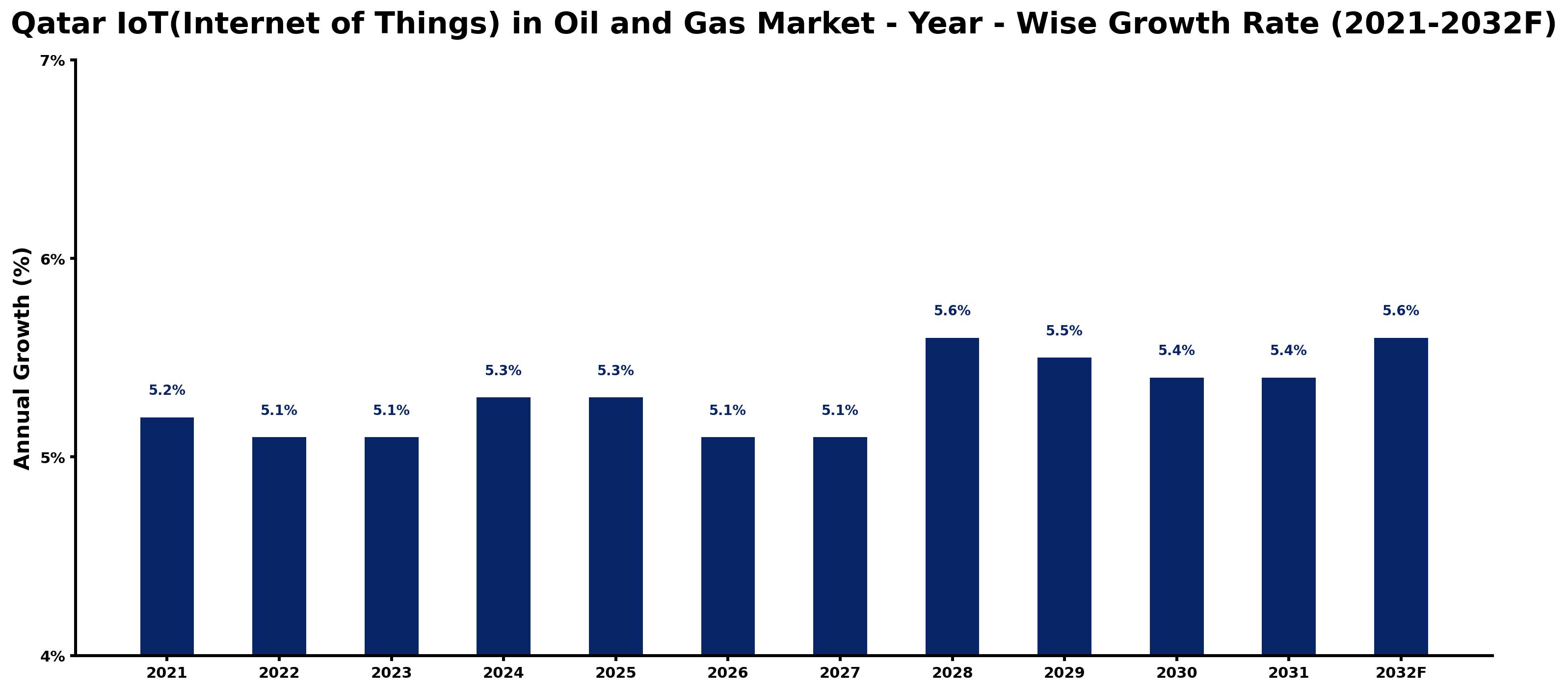
The table below presents the year‑wise growth rates along with the key drivers influencing the market
| Year | Growth Rate | Major Drivers |
| 2021 | 5.2% | Expansion of transportation and logistics networks |
| 2022 | 5.1% | Expansion of commercial construction activities |
| 2023 | 5.1% | Increasing adoption of advanced technologies |
| 2024 | 5.3% | Growing renewable energy integration projects |
| 2025 | 5.3% | Growing urbanization and commercial development |
| 2026 | 5.1% | Increasing industrial infrastructure investments |
| 2027 | 5.1% | Expansion of commercial construction activities |
| 2028 | 5.6% | Growing renewable energy integration projects |
| 2029 | 5.5% | Increasing industrial automation investments |
| 2030 | 5.4% | Expansion of manufacturing activities |
| 2031 | 5.4% | Increasing industrial automation investments |
| 2032 | 5.6% | Increasing adoption of advanced technologies |
Note - Market size estimations and growth projections presented in this report are based on 6Wresearch’s advanced forecasting approach, validated with industry datasets as of June 2026.
Qatar IoT(Internet of Things) in Oil and Gas Market Synopsis
A significant driver shaping the Qatar IoT in Oil and Gas Market is the industry's urgent need for real-time monitoring and predictive analytics. Companies are increasingly leveraging IoT technologies to enhance decision-making processes, optimize production, and implement predictive maintenance strategies.
Moreover, the Covid-19 pandemic catalyzed the rapid adoption of IoT systems, emphasizing the necessity for remote operational management. This shift has underscored the value of IoT in maintaining continuity during challenging times and ensuring the safety of personnel.
Qatar IoT(Internet of Things) in Oil and Gas Market Key Takeaways
- IoT integration is becoming essential for enhancing operational efficiency in Qatar's oil and gas sector.
- Investments in IoT technologies are expected to be driven by the country's substantial energy reserves.
- The Covid-19 pandemic has accelerated the shift toward remote monitoring solutions within the industry.
- Cybersecurity remains a critical concern for the implementation of IoT devices and networks.
- Predictive analytics are increasingly vital for anticipating market fluctuations and optimizing asset performance.
Evaluation of Restraints in Qatar IoT(Internet of Things) in Oil and Gas Market
While the Qatar IoT in Oil and Gas Market shows promising growth prospects, several constraints hinder its full potential. Chief among these is the increasing need for robust cybersecurity measures, as the interconnectivity of devices raises the vulnerability to cyber threats. Companies face the challenge of safeguarding their critical infrastructures against potential data breaches. Additionally, the requirement for substantial investments in technology, infrastructure, and employee training complicates the decision-making process for firms looking to implement IoT solutions effectively. As they navigate these challenges, organizations must strike a balance between investment and anticipated returns to maximize the advantages of digital transformation.
Qatar IoT(Internet of Things) in Oil and Gas Market Trends
Current trends indicate an increasing reliance on cloud-based IoT solutions and data analytics platforms within the oil and gas sector. Companies are moving towards integrating Artificial Intelligence (AI) capabilities to enhance predictive maintenance and operational decision-making. Furthermore, there is a growing focus on sustainability, prompting firms to explore IoT applications that monitor environmental impact and reduce carbon footprints. As regulatory frameworks evolve, aligning IoT strategies with sustainability goals is becoming paramount.
Qatar IoT(Internet of Things) in Oil and Gas Market Opportunities
The future landscape of the Qatar IoT in Oil and Gas Market presents abundant opportunities for growth and investment. Companies that prioritize digital transformation can achieve significant operational efficiencies and reduce costs through optimized asset management. Furthermore, the development of new IoT solutions tailored to specific operational challenges, such as predictive maintenance and real-time monitoring, is likely to attract substantial interest from industry stakeholders. As the technology continues to evolve, innovative startups and established firms alike will find niches that foster competitive advantages.
Government Initiatives in the Qatar IoT(Internet of Things) in Oil and Gas Market
The Qatari government is actively supporting the adoption of IoT technologies within the oil and gas sector through a variety of initiatives. These include fostering partnerships between public institutions and private companies, as well as encouraging research and development in IoT solutions. Investment in infrastructure and digital capabilities is a priority, with policies being implemented to enhance the overall technological landscape in the industry. Such government backing is pivotal in facilitating the seamless integration of IoT across oil and gas operations.
Future Insights of the Qatar IoT(Internet of Things) in Oil and Gas Market
Looking ahead to 2026-2032, the Qatar IoT in Oil and Gas Market is poised for significant advancement, driven by technological innovation and the urgent need for efficient resource management. As companies increasingly adopt integrated digital solutions, the emphasis will be on harnessing data analytics for improved decision-making processes. Furthermore, enhanced remote monitoring capabilities will continue to evolve, ensuring business continuity and operational resilience. The trajectory suggests a robust alignment with global energy trends, establishing Qatar as a leading player in the digital transformation of the oil and gas industry.
Qatar IoT(Internet of Things) in Oil and Gas Market Latest Developments (May 2025 - June 2026)
In recent months, the Qatar IoT in Oil and Gas Market has seen a heightened focus on developing advanced predictive maintenance solutions enabled by IoT technologies. Companies are increasingly exploring collaborations with tech firms to leverage machine learning and AI for asset performance optimization. Additionally, ongoing government initiatives are aiming to enhance the regulatory framework surrounding IoT technologies, which may further stimulate investments in this sector. As companies adapt to these changing dynamics, a more data-driven approach is becoming integral to operational strategies.
Qatar IoT(Internet of Things) in Oil and Gas Market - Key Attractiveness of the Report
- 10 Years of Market Numbers
- Historical Data Starting from 2022 to 2025
- Base Year: 2025
- Forecast Data until 2032
- Key Performance Indicators Impacting the Market
- Major Upcoming Developments and Projects
Key Highlights of the Report:
- Qatar IoT(Internet of Things) in Oil and Gas Market Outlook
- Market Size of Qatar IoT(Internet of Things) in Oil and Gas Market, 2025
- Forecast of Qatar IoT(Internet of Things) in Oil and Gas Market, 2032
- Historical Data and Forecast of Qatar IoT(Internet of Things) in Oil and Gas Revenues & Volume for the Period 2022-2032F
- Qatar IoT(Internet of Things) in Oil and Gas Market Trend Evolution
- Qatar IoT(Internet of Things) in Oil and Gas Market Drivers and Challenges
- Qatar IoT(Internet of Things) in Oil and Gas Price Trends
- Qatar IoT(Internet of Things) in Oil and Gas Porter's Five Forces
- Qatar IoT(Internet of Things) in Oil and Gas Industry Life Cycle
- Historical Data and Forecast of Qatar IoT(Internet of Things) in Oil and Gas Market Revenues & Volume By Solution for the Period 2022-2032F
- Historical Data and Forecast of Qatar IoT(Internet of Things) in Oil and Gas Market Revenues & Volume By Sensing for the Period 2022-2032F
- Historical Data and Forecast of Qatar IoT(Internet of Things) in Oil and Gas Market Revenues & Volume By Communication for the Period 2022-2032F
- Historical Data and Forecast of Qatar IoT(Internet of Things) in Oil and Gas Market Revenues & Volume By Cloud and Edge Computing for the Period 2022-2032F
- Historical Data and Forecast of Qatar IoT(Internet of Things) in Oil and Gas Market Revenues & Volume By Data Management for the Period 2022-2032F
- Historical Data and Forecast of Qatar IoT(Internet of Things) in Oil and Gas Market Revenues & Volume By Application for the Period 2022-2032F
- Historical Data and Forecast of Qatar IoT(Internet of Things) in Oil and Gas Market Revenues & Volume By Fleet and Asset Management for the Period 2022-2032F
- Historical Data and Forecast of Qatar IoT(Internet of Things) in Oil and Gas Market Revenues & Volume By Preventive Maintenance for the Period 2022-2032F
- Historical Data and Forecast of Qatar IoT(Internet of Things) in Oil and Gas Market Revenues & Volume By Security Management for the Period 2022-2032F
- Historical Data and Forecast of Qatar IoT(Internet of Things) in Oil and Gas Market Revenues & Volume By Pipeline Monitoring for the Period 2022-2032F
- Historical Data and Forecast of Qatar IoT(Internet of Things) in Oil and Gas Market Revenues & Volume By Others for the Period 2022-2032F
- Historical Data and Forecast of Qatar IoT(Internet of Things) in Oil and Gas Market Revenues & Volume By Industry Stream for the Period 2022-2032F
- Historical Data and Forecast of Qatar IoT(Internet of Things) in Oil and Gas Market Revenues & Volume By Upstream for the Period 2022-2032F
- Historical Data and Forecast of Qatar IoT(Internet of Things) in Oil and Gas Market Revenues & Volume By Midstream for the Period 2022-2032F
- Historical Data and Forecast of Qatar IoT(Internet of Things) in Oil and Gas Market Revenues & Volume By Downstream for the Period 2022-2032F
- Qatar IoT(Internet of Things) in Oil and Gas Import Export Trade Statistics
- Market Opportunity Assessment By Solution
- Market Opportunity Assessment By Application
- Market Opportunity Assessment By Industry Stream
- Qatar IoT(Internet of Things) in Oil and Gas Top Companies Market Share
- Qatar IoT(Internet of Things) in Oil and Gas Competitive Benchmarking By Technical and Operational Parameters
- Qatar IoT(Internet of Things) in Oil and Gas Company Profiles
- Qatar IoT(Internet of Things) in Oil and Gas Key Strategic Recommendations






































