Qatar Ladders Market Size, Share & Growth Rate
The Qatar Ladders Market was estimated at USD 220 Million in 2025 and is projected to reach USD 303 Million by 2032, growing at a CAGR of 4.7% from 2026 to 2032. This growth trajectory is largely fueled by the ongoing expansion of the construction sector, which remains a cornerstone of Qatars economic development. As more infrastructure projects are launched, the necessity for reliable and safe access solutions such as ladders is becoming increasingly critical.
Qatar Ladders Market Year-wise Growth Rate and Key Drivers
This graph highlights how the Qatar Ladders Market has steadily grown over the years, supported by major growth factors.
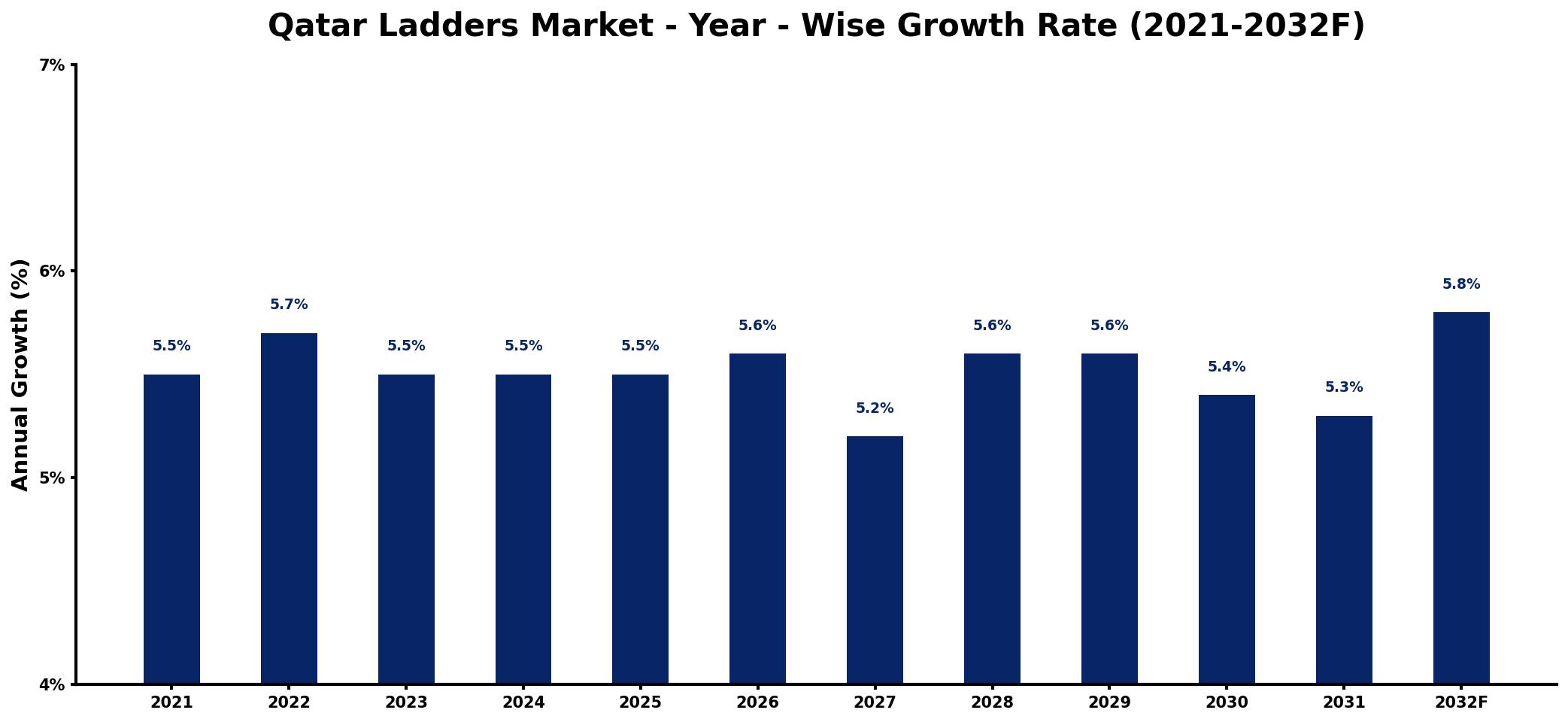
The table below presents the year‑wise growth rates along with the key drivers influencing the market
| Year | Growth Rate | Major Drivers |
| 2021 | 5.5% | Construction sector investment increase |
| 2022 | 5.7% | Home renovation projects rise |
| 2023 | 5.5% | Retail expansion in urban areas |
| 2024 | 5.5% | Infrastructure development funding boosts |
| 2025 | 5.5% | Safety regulations drive compliance |
| 2026 | 5.6% | Technological advancements enhance efficiency |
| 2027 | 5.2% | Sustainable building practices adoption |
| 2028 | 5.6% | DIY culture gains popularity |
| 2029 | 5.6% | Government initiatives promote construction |
| 2030 | 5.4% | Commercial real estate growth |
| 2031 | 5.3% | Urbanization trends increase demand |
| 2032 | 5.8% | Export opportunities in regional markets |
Note: Market size estimations and growth projections presented in this report are based on 6Wresearch's proprietary forecasting methodology, utilizing the latest available industry data, government publications, and primary research inputs.
Qatar Ladders Market Synopsis
In Qatar, ladders are vital tools in both the construction and industrial sectors, where safety and accessibility are non-negotiable. The ongoing construction boom, coupled with strict adherence to safety standards, is driving a consistent demand for high-quality ladders.
With a growing population and rising residential development, the need for household ladders is also on the rise. Commercial enterprises further amplify this demand, as they require ladders for various operational tasks, creating a robust market environment.
Qatar Ladders Market Key Takeaways
- The continuous growth in Qatars construction sector is a primary driver for the ladders market.
- Safety regulations compel companies to invest in high-quality ladders, ensuring compliance.
- Household ladder demand is surging due to increasing residential construction projects.
- Market players must innovate to adapt to Qatars challenging environmental conditions.
- Recovery from the COVID-19 pandemic has reignited growth in construction and maintenance activities.
Evaluation of Restraints in Qatar Ladders Market
While the market for ladders in Qatar is showing promising growth, several restraints impact its full potential. The stringent safety regulations necessitate that manufacturers comply with various standards, which can be both costly and time-consuming. Additionally, the extreme climatic conditions, characterized by high temperatures and sandstorms, pose significant challenges for ladder design and material selection. These factors complicate the balance between maintaining product quality and ensuring competitive pricing in the market.
Qatar Ladders Market Trends
Current trends indicate a shift towards more innovative ladder designs that prioritize safety features and ergonomic advantages. Manufacturers are increasingly focusing on lightweight materials and advanced designs that allow for greater mobility and ease of use. Furthermore, there is a growing trend of using ladders made from corrosion-resistant materials, catering to the unique demands of the Qatari environment.
Qatar Ladders Market Opportunities
As the construction landscape evolves, numerous opportunities arise for growth and investment in the Qatar ladders market. Companies can capitalize on the ongoing infrastructural projects by offering customized ladder solutions that meet specific safety standards. Additionally, engaging in strategic partnerships with construction firms can enhance market presence and drive sales. The rising emphasis on sustainability also opens avenues for manufacturers to develop eco-friendly ladder options, aligning with global sustainability goals.
Government Initiatives in the Qatar Ladders Market
The Qatari government is committed to enhancing its construction sector through various initiatives aimed at improving safety and efficiency. Public spending on infrastructure development remains strong, supported by policies encouraging foreign investment and technology transfer. This supportive environment fosters growth in the ladders market, as government standards and regulations increasingly focus on ensuring safety compliance across all construction activities.
Future Insights of the Qatar Ladders Market
Looking ahead to 2026-2032, the Qatar ladders market is poised for sustained growth. The continued development of major infrastructure projects, such as those linked to the World Cup 2022 and beyond, will fuel demand for access solutions. As safety standards tighten and the focus on worker protection intensifies, manufacturers that innovate and prioritize compliance will likely gain a competitive edge. The evolving landscape of construction in Qatar indicates a promising horizon for ladder manufacturers.
Qatar Ladders Market Latest Developments (2025 - 2026)
Recent developments in the Qatar ladders market reflect a strong recovery in construction and maintenance activities post-COVID-19. Increased investments in infrastructure projects have spurred demand for advanced ladder solutions, while companies are exploring strategic collaborations to enhance product offerings. Additionally, a notable emphasis on sustainable practices has led to an increase in the availability of eco-friendly ladder options that appeal to environmentally conscious consumers.
Qatar Ladders Market - Key Attractiveness of the Report
- 10 Years of Market Numbers
- Historical Data Starting from 2022 to 2025
- Base Year: 2025
- Forecast Data until 2032
- Key Performance Indicators Impacting the Market
- Major Upcoming Developments and Projects
Key Highlights of the Report:
- Qatar Ladders Market Outlook
- Market Size of Qatar Ladders Market, 2025
- Forecast of Qatar Ladders Market, 2032
- Historical Data and Forecast of Qatar Ladders Revenues & Volume for the Period 2022-2032F
- Qatar Ladders Market Trend Evolution
- Qatar Ladders Market Drivers and Challenges
- Qatar Ladders Price Trends
- Qatar Ladders Porter's Five Forces
- Qatar Ladders Industry Life Cycle
- Historical Data and Forecast of Qatar Ladders Market Revenues & Volume By Application for the Period 2022-2032F
- Historical Data and Forecast of Qatar Ladders Market Revenues & Volume By Industrial for the Period 2022-2032F
- Historical Data and Forecast of Qatar Ladders Market Revenues & Volume By Domestic for the Period 2022-2032F
- Historical Data and Forecast of Qatar Ladders Market Revenues & Volume By Commercial for the Period 2022-2032F
- Qatar Ladders Import Export Trade Statistics
- Market Opportunity Assessment By Application
- Qatar Ladders Top Companies Market Share
- Qatar Ladders Competitive Benchmarking By Technical and Operational Parameters
- Qatar Ladders Company Profiles
- Qatar Ladders Key Strategic Recommendations






































