Qatar Mirrors Market Summary
The qatar mirrors market was estimated at USD 476 Million in 2025 and is projected to reach USD 682 Million by 2032, growing at a CAGR of 6.3% from 2026 to 2032.
Qatar Mirrors Market Year-wise Growth Rate and Key Drivers
This graph highlights how the Qatar Mirrors Market has steadily grown over the past five years, supported by major growth factors.
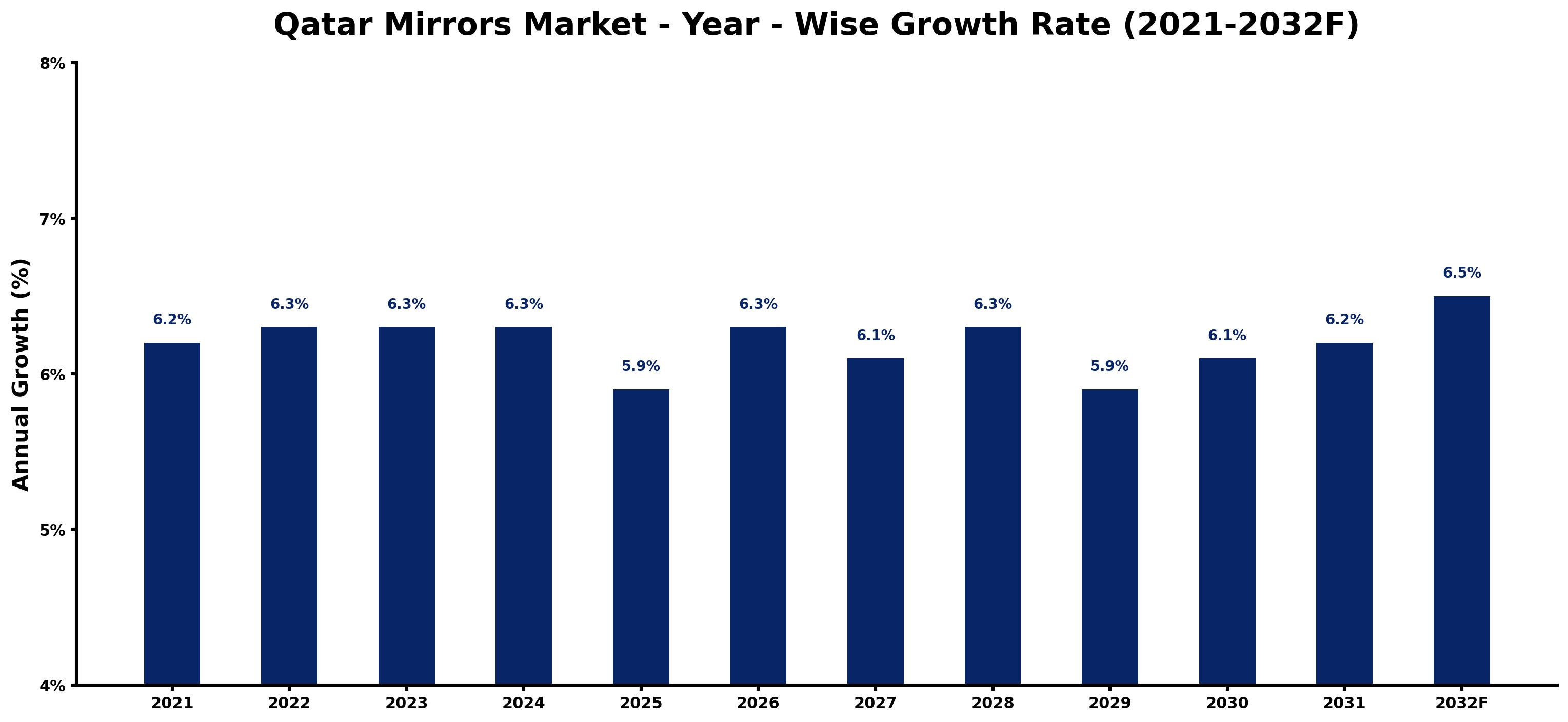
The table below presents the year wise growth rates along with the key drivers influencing the market
| Year | Growth Rate | Major Drivers |
| 2021 | 6.2% | Post-lockdown retail projects stimulated demand for decorative mirrors in commercial spaces. |
| 2022 | 6.3% | Increased focus on luxury interior designs created a niche for high-end mirrors. |
| 2023 | 6.3% | Rapid urban developments in Doha fueled construction-related mirror requirements and supply. |
| 2024 | 6.3% | Enhanced interest in home renovations drove sales of specialized mirrors for personalizing spaces. |
| 2025 | 5.9% | Emerging tourism sector in Qatar emphasized hospitality aesthetics, boosting mirror market growth. |
| 2026 | 6.3% | Local manufacturers capitalizing on raw material accessibility improved production efficiency significantly. |
| 2027 | 6.1% | Sustainability trends prompted demand for eco-friendly mirror materials and manufacturing processes. |
| 2028 | 6.3% | Smart mirror technologies started attracting attention, integrating functionality with typical usage. |
| 2029 | 5.9% | Cultural shifts towards wellness and self-care influenced mirror styles and usage frequency. |
| 2030 | 6.1% | E-commerce platforms increasingly became significant channels for mirror sales and distribution. |
| 2031 | 6.2% | Interior designers began prioritizing innovative mirror designs in residential and commercial projects. |
| 2032 | 6.5% | Regional architectural projects underlined the importance of mirrors in public and private spaces. |
Note - Market size estimations and growth projections presented in this report are based on 6Wresearch's advanced forecasting approach, validated with industry datasets as of June 2026.
Qatar Mirrors Market Synopsis
The Qatar Mirrors Market is projected to reach 6.3% and witness significant growth during the forecast period (2026-2032). This growth trajectory is primarily attributed to the increasing consumer demand for interior décor products, shifts in lifestyle preferences, and a steady improvement in the region's economic landscape. Additionally, innovations in technology and supportive government initiatives are anticipated to provide further momentum to the market.
Qatar Mirrors Market Growth Drivers
A number of key drivers are propelling the expansion of the Qatar Mirrors Market. These include:
- The rising demand for aesthetically pleasing interior décor items, which enhances the visual appeal of residential and commercial spaces.
- Changing lifestyles among consumers, who are increasingly prioritizing home aesthetics and personalized living environments.
- Improving economic conditions in Qatar, which have led to greater disposable income and increased spending on home improvement products.
- Technological advancements, such as digital printing, allowing manufacturers to create customized mirrors tailored to varied consumer preferences regarding shapes, sizes, and designs.
- Government initiatives providing tax exemptions on certain building materials, translating into lower production costs and subsequently more affordable pricing for consumers.
Qatar Mirrors Market Challenges and Restraints
Despite the potential for growth, the Qatar Mirrors Market faces several challenges that could hinder progress:
- Rising raw material costs, influenced by increased import duties and tariffs on materials essential for mirror manufacturing.
- Environmental regulations surrounding waste management, which limit disposal options for manufacturers and can elevate operational expenses.
- A shortage of skilled labor, which could impact production capacity and the overall quality of products in the market.
- Inadequate infrastructure, affecting logistics and the distribution of products across the region.
- Market participants may experience squeezed profit margins due to escalating operational costs, creating challenges in pricing strategies.
Qatar Mirrors Market Impact of COVID-19
The COVID-19 pandemic has profoundly influenced the Qatar Mirrors Market, similar to global economic patterns. Several industries within the country have experienced sizable operational disruptions due to pandemic-related restrictions. The impact of COVID-19 has curtailed revenue opportunities, resulting in a reassessment of supply chain dynamics across the market. As the industry moves into 2026, it must navigate the residual effects of the pandemic while striving to regain growth momentum.
Qatar Mirrors Market Government Investment and Initiatives
The Qatari government has implemented several initiatives and policies aimed at bolstering the local mirrors market. These initiatives are designed to support economic diversification, promote the construction sector, and enhance the sustainability of manufacturing processes:
- Investment in infrastructure projects, which indirectly boosts demand for mirrors in construction and renovation activities.
- Implementation of incentives for manufacturers, including tax relief on certain production materials that facilitate lower operational costs.
- Encouragement of technology adoption through grants and funding for research and development, fostering innovation in mirror production.
- Support for sustainable practices through regulations that guide waste management and resource recycling in the manufacturing sector.
- Strategic plans aimed at enhancing the skills of the local workforce, directly addressing the shortage of skilled labor in the mirrors manufacturing industry.
Qatar Mirrors Market Latest Developments (May 2025 - June 2026)
Recent trends in the Qatar Mirrors Market reflect a proactive approach by industry stakeholders in response to the evolving economic landscape. Developments include increased collaboration between manufacturers and technological firms to integrate advanced manufacturing techniques. There is also a notable inclination towards sustainable production methods, as companies strive to meet regulatory requirements and consumer preferences for eco-friendly products. Furthermore, expanding retail channels are enhancing product accessibility for consumers, alongside innovative marketing strategies targeting emerging market segments.
Qatar Mirrors Market - Key Attractiveness of the Report
- 10 Years of Market Numbers
- Historical Data Starting from 2022 to 2025
- Base Year: 2025
- Forecast Data until 2032
- Key Performance Indicators Impacting the Market
- Major Upcoming Developments and Projects
Key Highlights of the Report:
- Qatar Mirrors Market Outlook
- Market Size of Qatar Mirrors Market, 2025
- Forecast of Qatar Mirrors Market, 2032
- Historical Data and Forecast of Qatar Mirrors Revenues & Volume for the Period 2022-2032F
- Qatar Mirrors Market Trend Evolution
- Qatar Mirrors Market Drivers and Challenges
- Qatar Mirrors Price Trends
- Qatar Mirrors Porter's Five Forces
- Qatar Mirrors Industry Life Cycle
- Historical Data and Forecast of Qatar Mirrors Market Revenues & Volume By Types for the Period 2022-2032F
- Historical Data and Forecast of Qatar Mirrors Market Revenues & Volume By Silver Mirror for the Period 2022-2032F
- Historical Data and Forecast of Qatar Mirrors Market Revenues & Volume By Plated Mirror for the Period 2022-2032F
- Historical Data and Forecast of Qatar Mirrors Market Revenues & Volume By Others for the Period 2022-2032F
- Historical Data and Forecast of Qatar Mirrors Market Revenues & Volume By End-users for the Period 2022-2032F
- Historical Data and Forecast of Qatar Mirrors Market Revenues & Volume By Bathroom for the Period 2022-2032F
- Historical Data and Forecast of Qatar Mirrors Market Revenues & Volume By Make-up for the Period 2022-2032F
- Historical Data and Forecast of Qatar Mirrors Market Revenues & Volume By Dressing for the Period 2022-2032F
- Historical Data and Forecast of Qatar Mirrors Market Revenues & Volume By Decorative for the Period 2022-2032F
- Historical Data and Forecast of Qatar Mirrors Market Revenues & Volume By Advertising for the Period 2022-2032F
- Historical Data and Forecast of Qatar Mirrors Market Revenues & Volume By Others for the Period 2022-2032F
- Qatar Mirrors Import Export Trade Statistics
- Market Opportunity Assessment By Types
- Market Opportunity Assessment By End-users
- Qatar Mirrors Top Companies Market Share
- Qatar Mirrors Competitive Benchmarking By Technical and Operational Parameters
- Qatar Mirrors Company Profiles
- Qatar Mirrors Key Strategic Recommendations






































