Qatar Piperonal Market Size, Share & Growth Rate
The Qatar Piperonal Market was estimated at USD 315 Million in 2025 and is projected to reach USD 443 Million by 2032, growing at a CAGR of 5.0% from 2026 to 2032. This growth trajectory is primarily driven by the rising demand for unique and natural fragrances in the fragrance and flavor sectors. Additionally, the expanding perfumery industry, coupled with an increasing consumer inclination towards botanical ingredients, underpins the robust market outlook.
Qatar Piperonal Market Year-wise Growth Rate and Key Drivers
This graph highlights how the Qatar Piperonal Market has steadily grown over the years, supported by major growth factors.
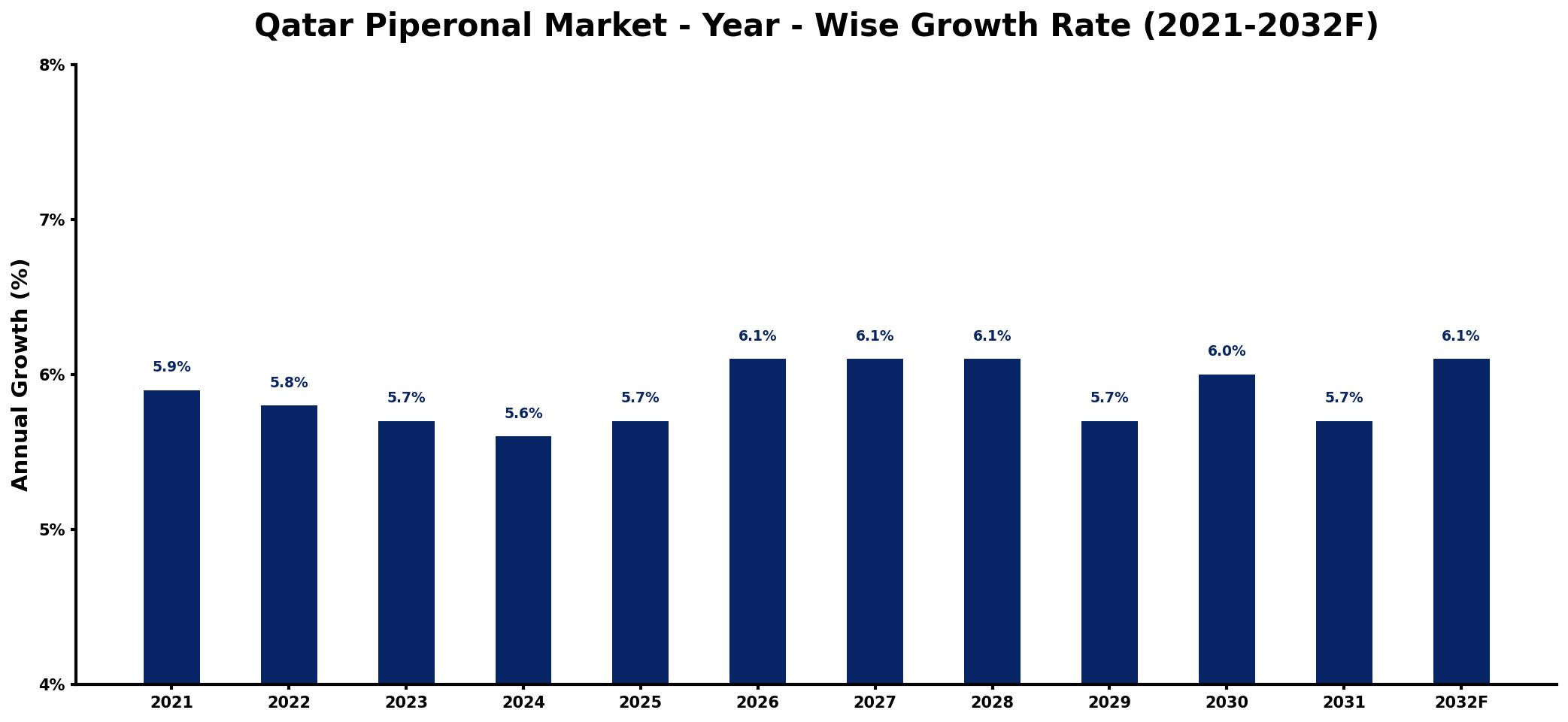
The table below presents the year‑wise growth rates along with the key drivers influencing the market
| Year | Growth Rate | Major Drivers |
| 2021 | 5.9% | increased demand from fragrance industry |
| 2022 | 5.8% | rising popularity in cosmetics applications |
| 2023 | 5.7% | expansion of food flavoring sector |
| 2024 | 5.6% | growing interest in natural ingredients |
| 2025 | 5.7% | increased investments in R&D |
| 2026 | 6.1% | surge in export opportunities |
| 2027 | 6.1% | enhanced production capabilities emerging |
| 2028 | 6.1% | broader applications in pharmaceuticals |
| 2029 | 5.7% | strengthened supply chain networks |
| 2030 | 6.0% | growing consumer preference for quality |
| 2031 | 5.7% | expanding market for organic products |
| 2032 | 6.1% | increased regulatory support for innovations |
Note: Market size estimations and growth projections presented in this report are based on 6Wresearch's proprietary forecasting methodology, utilizing the latest available industry data, government publications, and primary research inputs.
Qatar Piperonal Market Synopsis
The Qatar piperonal market is currently experiencing significant momentum, fueled by a heightened consumer awareness around fragrances and flavors. As piperonal gains traction due to its appealing vanilla-like scent, its applications are expanding across various domains including perfumery, cosmetics, and food flavoring.
This aromatic compound is not only celebrated for its sensory attributes but is also increasingly recognized for its role in the synthesis of pharmaceutical compounds. As Qatars pharmaceutical sector grows, piperonals versatility positions it as a key ingredient for innovation across industries.
Qatar Piperonal Market Key Takeaways
- The market is on a steady growth path driven by increased consumer interest in natural fragrances.
- Piperonal's unique scent profile is favored in luxury and artisanal perfumery segments.
- The pharmaceutical industry's expansion enhances the market's potential for piperonal applications.
- Consumer preference trends emphasize the shift towards botanical and organic ingredients.
- Robust growth in the confectionery sector further supports piperonal demand.
Evaluation of Restraints in Qatar Piperonal Market
While the Qatar piperonal market shows promising growth, there are notable constraints impacting its trajectory. Regulatory compliance poses significant challenges, particularly regarding the safe use of piperonal in various applications. Additionally, competition from synthetic alternatives may limit market expansion, as some manufacturers opt for cost-effective synthetic options over natural extracts. Understanding these dynamics is crucial for stakeholders aiming to navigate the complexities of the market.
Qatar Piperonal Market Trends
Several emerging trends are shaping the Qatar piperonal market. The movement towards sustainability is prompting manufacturers to focus on eco-friendly sourcing and production processes. Furthermore, the trend of personalization in fragrances has led to an increasing demand for unique scent profiles, making piperonal an attractive component in bespoke perfumery. This, combined with the growth of e-commerce platforms for fragrance sales, is creating new avenues for market engagement.
Qatar Piperonal Market Opportunities
The Qatar piperonal market presents genuine growth opportunities across various segments. With the ongoing investment in the luxury goods sector, including high-end perfumes and artisanal food products, market players have the chance to leverage piperonals distinct scent properties. Additionally, collaboration with the burgeoning wellness and natural products industry can unlock new consumer bases seeking holistic and organic solutions.
Government Initiatives in the Qatar Piperonal Market
The Qatari government is actively promoting initiatives aimed at enhancing the fragrance and flavor industries, which directly benefits the piperonal market. Public spending on the luxury sector, alongside initiatives to foster local manufacturing, is creating a more favorable environment for producers. These governmental efforts aim to position Qatar as a hub for high-quality fragrance production, encouraging innovation and sustainability in the market.
Future Insights of the Qatar Piperonal Market
Looking ahead to 2026-2032, the Qatar piperonal market is anticipated to continue its upward trajectory, driven by evolving consumer preferences and industry innovations. The increasing emphasis on organic and natural products will likely bolster the demand for piperonal, particularly as luxury brands emphasize authenticity in their offerings. As the market stabilizes post-COVID-19, a resurgence in consumer spending on non-essential goods will further enhance growth prospects, ensuring piperonal remains a vital ingredient in various applications.
Qatar Piperonal Market Latest Developments (2025 - 2026)
Recent developments in the Qatar piperonal market reflect a growing commitment to sustainability and innovation. There has been an increase in partnerships between local manufacturers and international suppliers to enhance the quality and sourcing of piperonal. Additionally, as Qatari consumers become more discerning, brands are responding with new product launches that highlight piperonal's unique characteristics and applications across different sectors.
Qatar Piperonal Market - Key Attractiveness of the Report
- 10 Years of Market Numbers
- Historical Data Starting from 2022 to 2025
- Base Year: 2025
- Forecast Data until 2032
- Key Performance Indicators Impacting the Market
- Major Upcoming Developments and Projects
Key Highlights of the Report:
- Qatar Piperonal Market Outlook
- Market Size of Qatar Piperonal Market, 2025
- Forecast of Qatar Piperonal Market, 2032
- Historical Data and Forecast of Qatar Piperonal Revenues & Volume for the Period 2022-2032F
- Qatar Piperonal Market Trend Evolution
- Qatar Piperonal Market Drivers and Challenges
- Qatar Piperonal Price Trends
- Qatar Piperonal Porter's Five Forces
- Qatar Piperonal Industry Life Cycle
- Historical Data and Forecast of Qatar Piperonal Market Revenues & Volume By Type for the Period 2022-2032F
- Historical Data and Forecast of Qatar Piperonal Market Revenues & Volume By Natural Piperonal for the Period 2022-2032F
- Historical Data and Forecast of Qatar Piperonal Market Revenues & Volume By Synthetic Piperonal for the Period 2022-2032F
- Historical Data and Forecast of Qatar Piperonal Market Revenues & Volume By Application for the Period 2022-2032F
- Historical Data and Forecast of Qatar Piperonal Market Revenues & Volume By Flavors and Fragrances for the Period 2022-2032F
- Historical Data and Forecast of Qatar Piperonal Market Revenues & Volume By Food Industry for the Period 2022-2032F
- Historical Data and Forecast of Qatar Piperonal Market Revenues & Volume By Others for the Period 2022-2032F
- Qatar Piperonal Import Export Trade Statistics
- Market Opportunity Assessment By Type
- Market Opportunity Assessment By Application
- Qatar Piperonal Top Companies Market Share
- Qatar Piperonal Competitive Benchmarking By Technical and Operational Parameters
- Qatar Piperonal Company Profiles
- Qatar Piperonal Key Strategic Recommendations






































