Qatar Tinned Fish & Seafood Market Size, Share & Growth Rate
The Qatar Tinned Fish & Seafood Market was estimated at USD 310 Million in 2025 and is projected to reach USD 420 Million by 2032, growing at a CAGR of 4.4% from 2026 to 2032. This growth trajectory is largely driven by a shift in consumer preferences towards convenient, ready-to-eat options that tinned fish products provide. Additionally, the increasing awareness of the health benefits associated with canned seafood, such as high omega-3 fatty acid content, further fuels demand in this market.
Qatar Tinned Fish & Seafood Market Year-wise Growth Rate and Key Drivers
This graph highlights how the Qatar Tinned Fish & Seafood Market has steadily grown over the years, supported by major growth factors.
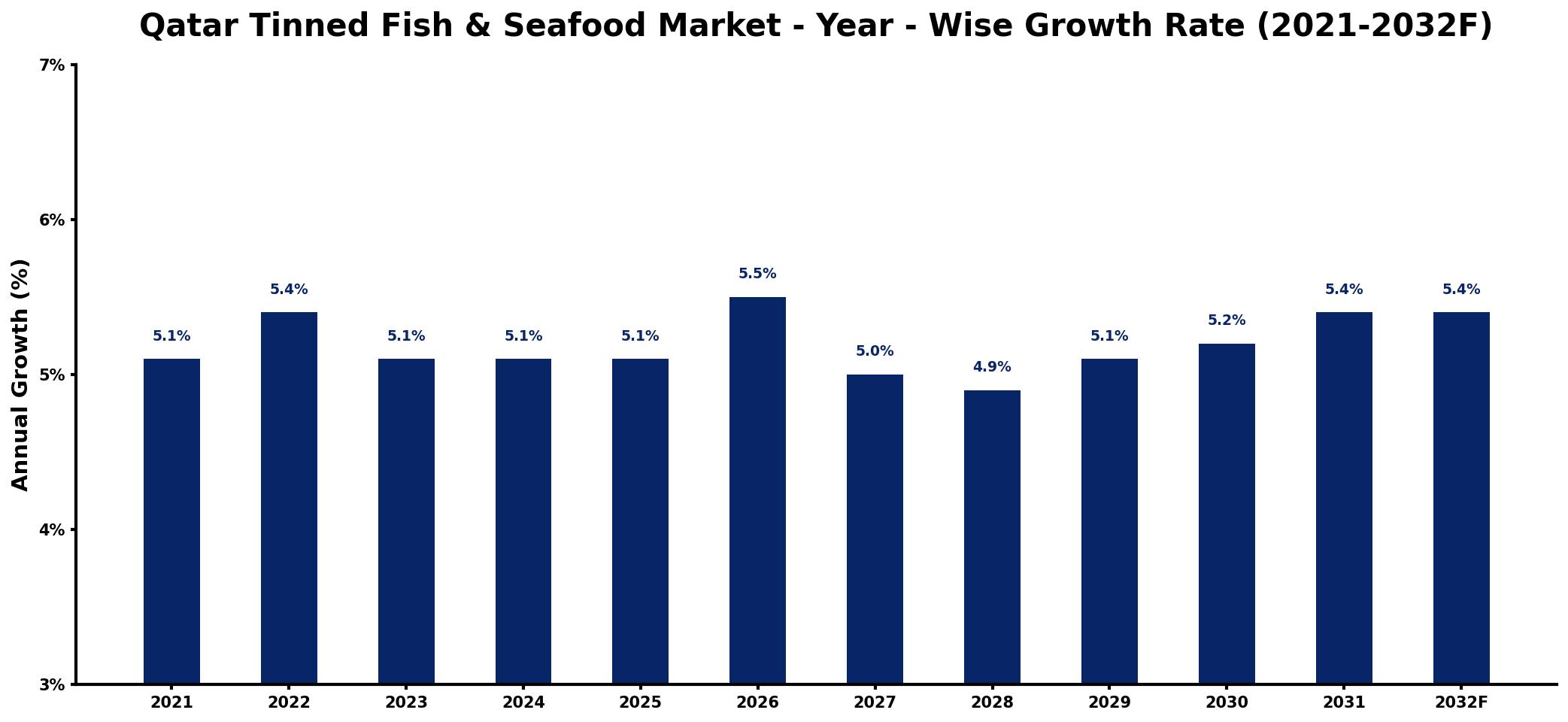
The table below presents the year‑wise growth rates along with the key drivers influencing the market
| Year | Growth Rate | Major Drivers |
| 2021 | 5.1% | Rising consumer health consciousness |
| 2022 | 5.4% | Growing preference for convenience foods |
| 2023 | 5.1% | Increased online shopping adoption |
| 2024 | 5.1% | Expansion of retail distribution channels |
| 2025 | 5.1% | Surge in sustainable packaging initiatives |
| 2026 | 5.5% | Investment in local production facilities |
| 2027 | 5.0% | Innovations in flavor profiles |
| 2028 | 4.9% | Emerging demand for premium products |
| 2029 | 5.1% | Strengthening of export markets |
| 2030 | 5.2% | Focus on nutritional enrichment trends |
| 2031 | 5.4% | Development of new product lines |
| 2032 | 5.4% | Enhanced marketing strategies implemented |
Note: Market size estimations and growth projections presented in this report are based on 6Wresearch's proprietary forecasting methodology, utilizing the latest available industry data, government publications, and primary research inputs.
Qatar Tinned Fish & Seafood Market Synopsis
The tinned fish seafood market in Qatar is thriving, reflecting a notable shift in consumer habits. With a growing population and rising disposable income, there is an increasing appetite for convenient meal solutions that cater to busy lifestyles.
Furthermore, Qatar's strategic position in the Gulf not only facilitates robust seafood trade but also enhances the variety of products available to consumers. The emphasis on food safety and quality assurance is prompting players to enhance their offerings, thus positioning the market for promising growth.
- The market is set for steady expansion due to increasing consumer demand for convenient meal options.
- Health-conscious consumers are driving interest in tinned fish as a source of essential nutrients.
- Qatar's geographical advantages bolster its role as a seafood trading hub in the region.
- Collaboration among local and international players enhances product diversity and availability.
- Growing expatriate communities are influencing demand with varied culinary preferences.
The Qatar tinned fish & seafood market faces several restraints that could limit its growth potential. As consumers become increasingly environmentally conscious, there is heightened scrutiny regarding the sustainability of fishing practices. This concern necessitates that manufacturers adhere to sustainable sourcing methods. Additionally, competition from fresh seafood options and the stringent requirements for labeling and certification can pose challenges for tinned fish products, making it imperative for companies to navigate these complexities carefully.
A noticeable trend within the Qatar tinned fish & seafood market is the rising interest in premium canned products that emphasize quality and sourcing. Consumers are showing a preference for gourmet offerings that provide unique flavors and textures. Furthermore, innovative packaging solutions that enhance convenience and preserve freshness are emerging as a key focus area for manufacturers.
Additionally, the integration of digital platforms for marketing and sales is gaining traction, with more brands utilizing e-commerce channels to reach a broader audience and enhance customer engagement.
The future of the Qatar tinned fish & seafood market presents several promising growth opportunities. One significant area lies in the development of value-added products that cater to health-conscious consumers, such as low-sodium options and those enriched with additional nutrients. Moreover, the expansion of distribution networks through online platforms could significantly increase market reach. Partnerships with local restaurants and chefs to create exclusive recipes can also drive interest and sales of tinned seafood products.
The Qatari government is actively promoting initiatives aimed at enhancing food security and sustainability within the seafood industry. Programs designed to ensure adherence to international food safety standards are being implemented, which not only bolster consumer confidence but also align with Qatars broader economic goals. Investment in local fisheries and incentives for sustainable practices are also part of ongoing efforts to strengthen the tinned fish market.
Looking ahead to 2026-2032, the Qatar tinned fish & seafood market is likely to continue its upward trajectory, spurred by evolving consumer preferences towards convenience and nutrition. The anticipated influx of expatriates and a growing local population will further fuel demand for ready-to-eat options. Additionally, as sustainability takes center stage, companies that successfully implement eco-friendly practices will gain a competitive edge, positioning themselves as leaders in this vibrant market.
Recent developments in the Qatar tinned fish & seafood market highlight an increased focus on product innovation and sustainability. Companies are exploring eco-friendly packaging solutions and sourcing practices that cater to environmentally conscious consumers. Furthermore, the rise of e-commerce platforms is reshaping how products are marketed and sold, allowing for direct-to-consumer engagement and expanding market reach.
- 10 Years of Market Numbers
- Historical Data Starting from 2022 to 2025
- Base Year: 2025
- Forecast Data until 2032
- Key Performance Indicators Impacting the Market
- Major Upcoming Developments and Projects
Key Highlights of the Report:
- Qatar Tinned Fish & Seafood Market Outlook
- Market Size of Qatar Tinned Fish & Seafood Market, 2025
- Forecast of Qatar Tinned Fish & Seafood Market, 2032
- Historical Data and Forecast of Qatar Tinned Fish & Seafood Revenues & Volume for the Period 2022-2032F
- Qatar Tinned Fish & Seafood Market Trend Evolution
- Qatar Tinned Fish & Seafood Market Drivers and Challenges
- Qatar Tinned Fish & Seafood Price Trends
- Qatar Tinned Fish & Seafood Porter's Five Forces
- Qatar Tinned Fish & Seafood Industry Life Cycle
- Historical Data and Forecast of Qatar Tinned Fish & Seafood Market Revenues & Volume By Type for the Period 2022-2032F
- Historical Data and Forecast of Qatar Tinned Fish & Seafood Market Revenues & Volume By Tuna for the Period 2022-2032F
- Historical Data and Forecast of Qatar Tinned Fish & Seafood Market Revenues & Volume By Salmon for the Period 2022-2032F
- Historical Data and Forecast of Qatar Tinned Fish & Seafood Market Revenues & Volume By Sardines for the Period 2022-2032F
- Historical Data and Forecast of Qatar Tinned Fish & Seafood Market Revenues & Volume By Other fish for the Period 2022-2032F
- Historical Data and Forecast of Qatar Tinned Fish & Seafood Market Revenues & Volume By Prawns for the Period 2022-2032F
- Historical Data and Forecast of Qatar Tinned Fish & Seafood Market Revenues & Volume By Shrimps for the Period 2022-2032F
- Historical Data and Forecast of Qatar Tinned Fish & Seafood Market Revenues & Volume By Others for the Period 2022-2032F
- Historical Data and Forecast of Qatar Tinned Fish & Seafood Market Revenues & Volume By Application for the Period 2022-2032F
- Historical Data and Forecast of Qatar Tinned Fish & Seafood Market Revenues & Volume By Residential for the Period 2022-2032F
- Historical Data and Forecast of Qatar Tinned Fish & Seafood Market Revenues & Volume By Commercial for the Period 2022-2032F
- Historical Data and Forecast of Qatar Tinned Fish & Seafood Market Revenues & Volume By Others for the Period 2022-2032F
- Qatar Tinned Fish & Seafood Import Export Trade Statistics
- Market Opportunity Assessment By Type
- Market Opportunity Assessment By Application
- Qatar Tinned Fish & Seafood Top Companies Market Share
- Qatar Tinned Fish & Seafood Competitive Benchmarking By Technical and Operational Parameters
- Qatar Tinned Fish & Seafood Company Profiles
- Qatar Tinned Fish & Seafood Key Strategic Recommendations






































