Romania Used Car Market Summary
The romania used car market was estimated at USD 246 Million in 2025 and is projected to reach USD 270 Million by 2032, growing at a CAGR of 1.4% from 2026 to 2032.
Romania Used Car Market Year-wise Growth Rate and Key Drivers
This graph highlights how the Romania Used Car Market has steadily grown over the past five years, supported by major growth factors.
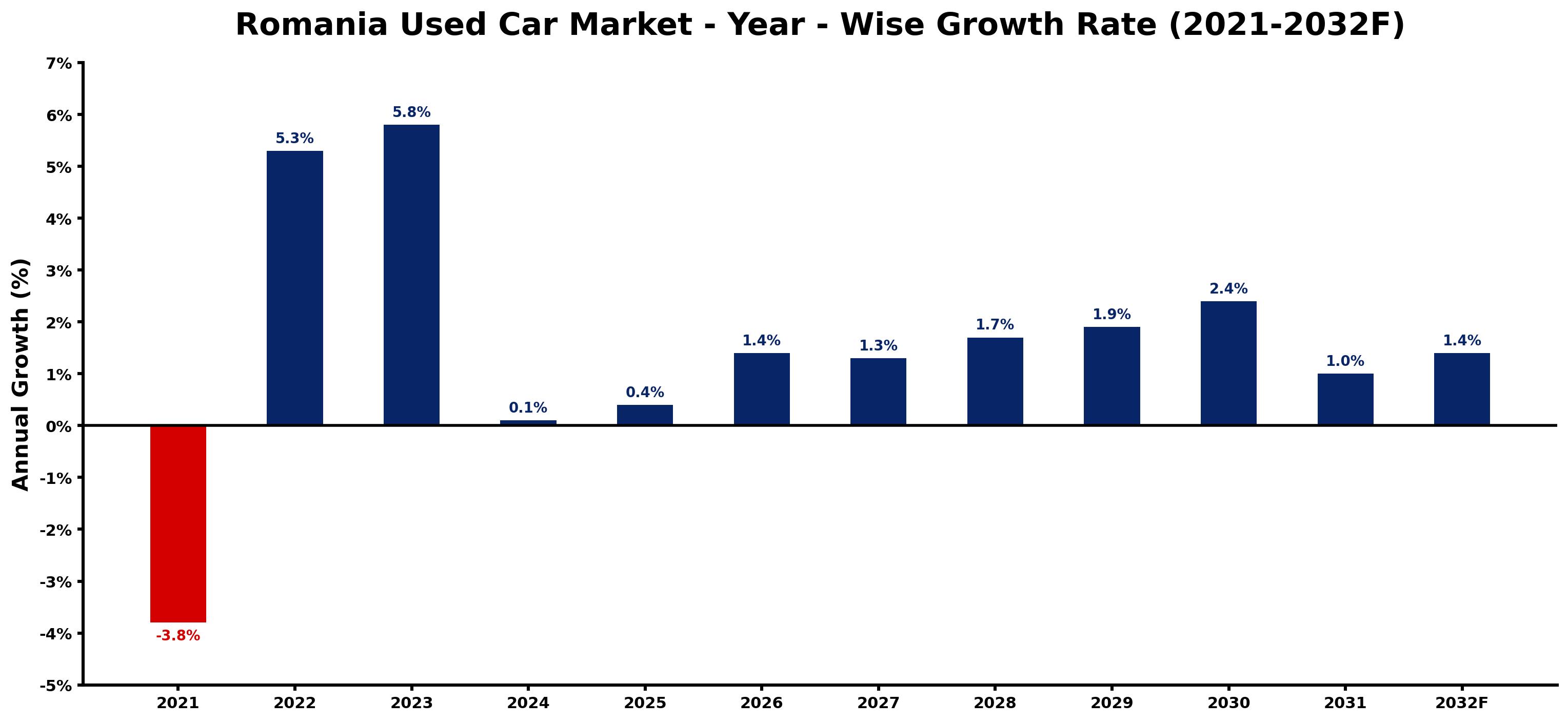
The table below presents the year wise growth rates along with the key drivers influencing the market
| Year | Growth Rate | Major Drivers |
| 2021 | -3.8% | Increased economic uncertainty prompted consumers to delay significant purchases, leading to reduced used car sales. |
| 2022 | 5.3% | Growing urbanization led to increased demand for compact and fuel-efficient models. |
| 2023 | 5.8% | Surge in online marketplaces transformed how used cars are bought and sold. |
| 2024 | 0.1% | Foreign investments in the automotive sector improved local supply chains significantly. |
| 2025 | 0.4% | Rising fuel prices prompted drivers to seek more economical vehicle options. |
| 2026 | 1.4% | Enhanced vehicle financing options attracted millennials entering the used car market. |
| 2027 | 1.3% | Local dealerships expanded offerings, creating a competitive environment for consumers. |
| 2028 | 1.7% | Increasing environmental awareness encouraged buyers to consider electric used vehicles. |
| 2029 | 1.9% | Technological integration in vehicles raised consumer interest in smart features. |
| 2030 | 2.4% | Improved infrastructure supported easier access to remote used car dealerships. |
| 2031 | 1.0% | Cultural shifts towards sustainability influenced preferences for second-hand purchases. |
| 2032 | 1.4% | Economic stability and rising disposable incomes bolstered overall market confidence. |
Note - Market size estimations and growth projections presented in this report are based on 6Wresearch's advanced forecasting approach, validated with industry datasets as of June 2026.
Romania Used Car Market Synopsis
The Romania Used Car Market is projected to reach 1.4% and witness significant growth during the forecast period (2026-2032). This market is increasingly characterized by the rising purchasing power of consumers, which is leading to a greater demand for affordable vehicles. Pre-owned cars are becoming the preferred choice for budget-conscious consumers, driving steady market expansion. The array of options available, from compact cars to SUVs, caters to diverse consumer needs, further enhancing market growth.
Romania Used Car Market Growth Drivers
Several factors are propelling the growth of the Romania Used Car Market. Firstly, the increasing economic stability and disposable income of the population are fueling demand for affordable pre-owned vehicles. Secondly, the trend of consumers favoring imported used cars, particularly from countries like Germany and the Netherlands, has led to a significant shift in purchasing behavior. These cars are often perceived as being of higher quality, which resonates well with buyers looking for reliability.
- Improving economic conditions are fostering a more robust purchasing environment for consumers.
- The preference for imported cars illustrates a shift towards quality and reliability among buyers.
- Rising awareness of eco-friendly vehicles is pushing demand for fuel-efficient used cars.
- Online platforms are facilitating smoother transactions and providing wider access to varied inventories.
- The growing inclination towards cost-effective solutions post-COVID-19 has heightened the appeal of used cars.
Romania Used Car Market Trends and Opportunities
Emerging trends are reshaping the Romania Used Car Market, presenting various opportunities for stakeholders. A notable trend is the increasing popularity of electric and hybrid used vehicles, driven by heightened environmental consciousness. Additionally, technological advancements are transforming the marketplace, with online platforms revolutionizing how transactions are conducted. These platforms not only enhance convenience but also provide extensive options for potential buyers.
- The transition toward eco-friendly vehicles is opening up new product categories for dealerships and buyers.
- Expansion of online marketplaces is reshaping consumer purchasing habits and increasing market accessibility.
- Increased investment in technology solutions can improve inventory management for dealerships.
- Promotional strategies focusing on budget-conscious consumers can yield fruitful returns in this landscape.
- Growth of a younger demographic seeking affordable transport options presents a lucrative market segment.
Romania Used Car Market Challenges and Restraints
While the prospects for the Romania Used Car Market are promising, several challenges persist. One significant obstacle is the prevalence of unauthorized dealers who may sell vehicles with dubious histories, undermining consumer trust. Moreover, the lack of standardized pricing exacerbates confusion, making it difficult for buyers to ascertain fair market values. High mileage on older vehicles often necessitates costly repairs shortly after purchase, further complicating the decision-making process for consumers.
- The presence of unauthorized dealers creates a challenging environment for legitimate businesses.
- Price inconsistencies can lead to consumer skepticism regarding the fairness of transactions.
- Older vehicles with high mileage may deter buyers due to potential maintenance concerns.
- Cumbersome ownership transfer processes can discourage potential buyers from making purchases.
- Regulatory changes could impact market dynamics and consumer confidence moving forward.
Romania Used Car Market Government Investment and Initiatives
The Romanian government has instituted a range of policies aimed at regulating the used car market, thereby promoting fair competition and consumer protection. Specific initiatives include mandatory vehicle inspections to ensure roadworthiness and safety standards, alongside stringent requirements for sellers to disclose accurate vehicle histories. These measures are complemented by efforts to combat fraud, including the need for written contracts during transactions.
In addition, the government encourages the purchase of eco-friendly vehicles through various incentives, supporting a broader agenda of sustainability. Collectively, these regulations and initiatives underline the government's commitment to fostering a transparent and secure environment for both buyers and sellers in the Romania Used Car Market.
Romania Used Car Market Latest Developments (May 2025 - June 2026)
Recent developments in the Romania Used Car Market illustrate a responsive landscape in terms of consumer preferences and industry practices. There has been a marked shift towards online platforms, which have increasingly become the primary venue for buying and selling used vehicles. These platforms have enabled a more streamlined process and enhanced accessibility for a wide range of consumers.
The focus on environmental sustainability has also intensified, with consumers showing a growing interest in hybrid and electric used cars. This trend is being met with governmental support through incentives aimed at promoting eco-friendly vehicle ownership. Furthermore, the market is witnessing an influx of financing options tailored to assist buyers in making budget-friendly choices in their used car purchases.
Romania Used Car Market - Key Attractiveness of the Report
- 10 Years of Market Numbers
- Historical Data Starting from 2022 to 2025
- Base Year: 2025
- Forecast Data until 2032
- Key Performance Indicators Impacting the Market
- Major Upcoming Developments and Projects
Key Highlights of the Report:
- Romania Used Car Market Outlook
- Market Size of Romania Used Car Market, 2025
- Forecast of Romania Used Car Market, 2032F
- Historical Data and Forecast of Romania Used Car Revenues & Volume for the Period 2022-2032F
- Romania Used Car Market Trend Evolution
- Romania Used Car Market Drivers and Challenges
- Romania Used Car Price Trends
- Romania Used Car Porter's Five Forces
- Romania Used Car Industry Life Cycle
- Historical Data and Forecast of Romania Used Car Market Revenues & Volume By Vehicle Type for the Period 2022-2032F
- Historical Data and Forecast of Romania Used Car Market Revenues & Volume By Hatchbacks for the Period 2022-2032F
- Historical Data and Forecast of Romania Used Car Market Revenues & Volume By Sedan for the Period 2022-2032F
- Historical Data and Forecast of Romania Used Car Market Revenues & Volume By Sports Utility Vehicle for the Period 2022-2032F
- Historical Data and Forecast of Romania Used Car Market Revenues & Volume By Others for the Period 2022-2032F
- Historical Data and Forecast of Romania Used Car Market Revenues & Volume By Vendor for the Period 2022-2032F
- Historical Data and Forecast of Romania Used Car Market Revenues & Volume By Organized for the Period 2022-2032F
- Historical Data and Forecast of Romania Used Car Market Revenues & Volume By Unorganized for the Period 2022-2032F
- Historical Data and Forecast of Romania Used Car Market Revenues & Volume By Fuel Type for the Period 2022-2032F
- Historical Data and Forecast of Romania Used Car Market Revenues & Volume By Gasoline for the Period 2022-2032F
- Historical Data and Forecast of Romania Used Car Market Revenues & Volume By Diesel for the Period 2022-2032F
- Historical Data and Forecast of Romania Used Car Market Revenues & Volume By Alternative Fuel Vehicles for the Period 2022-2032F
- Romania Used Car Import Export Trade Statistics
- Market Opportunity Assessment By Vehicle Type
- Market Opportunity Assessment By Vendor
- Market Opportunity Assessment By Fuel Type
- Romania Used Car Top Companies Market Share
- Romania Used Car Competitive Benchmarking By Technical and Operational Parameters
- Romania Used Car Company Profiles
- Romania Used Car Key Strategic Recommendations






































