Russia Outdoor LED Lighting Market Summary
The russia outdoor led lighting market was estimated at USD 247 Million in 2025 and is projected to reach USD 271 Million by 2032, growing at a CAGR of 1.0% from 2026 to 2032.
Russia Outdoor LED Lighting Market Year-wise Growth Rate and Key Drivers
This graph highlights how the Russia Outdoor LED Lighting Market has steadily grown over the past five years, supported by major growth factors.
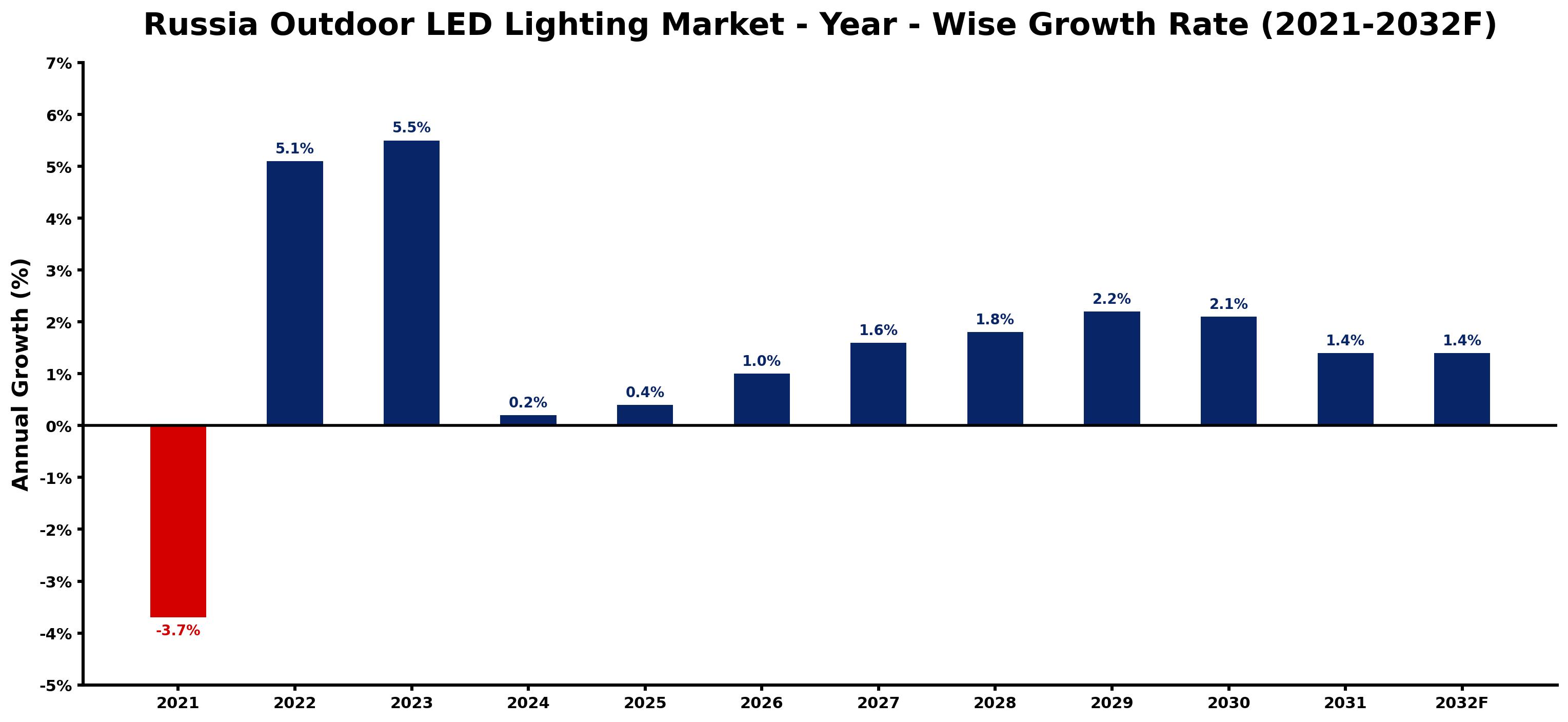
The table below presents the year wise growth rates along with the key drivers influencing the market
| Year | Growth Rate | Major Drivers |
| 2021 | -3.7% | Geopolitical tensions and economic sanctions diminished investment in infrastructure projects, hindering LED lighting market growth. |
| 2022 | 5.1% | Local manufacturers began enhancing production capabilities, reducing reliance on imports significantly. |
| 2023 | 5.5% | Corporate sustainability commitments highlighted the importance of eco-friendly lighting technologies. |
| 2024 | 0.2% | Major cities launched initiatives focusing on smart city infrastructure integration with LED systems. |
| 2025 | 0.4% | The hospitality sector increasingly adopted outdoor lighting for enhancing guest experiences. |
| 2026 | 1.0% | Investment in sports infrastructure led to higher demand for outdoor LED solutions in stadiums. |
| 2027 | 1.6% | Adoption of smart technologies in residential areas drove increased interest in LED lighting. |
| 2028 | 1.8% | Public spaces modernization projects began prioritizing efficient outdoor lighting for safety. |
| 2029 | 2.2% | Green building certifications gained traction, encouraging outdoor LED system installations. |
| 2030 | 2.1% | Urbanization trends fueled infrastructure developments requiring advanced outdoor illumination solutions. |
| 2031 | 1.4% | Technological innovations in energy storage systems complemented outdoor LED lighting efficiency. |
| 2032 | 1.4% | Growing consumer awareness about energy conservation further propelled outdoor LED market expansion. |
Note - Market size estimations and growth projections presented in this report are based on 6Wresearch's advanced forecasting approach, validated with industry datasets as of June 2026.
Russia Outdoor LED Lighting Market Synopsis
The Russia Outdoor LED Lighting Market is projected to reach 1.0% and witness significant growth during the forecast period (2026-2032). This growth trajectory is primarily driven by several factors, including the decreasing prices of LED technology and enhanced adoption rates in public spaces. The increasing deployment of LED lighting in streets, parks, and sidewalks is attributed to their superior energy efficiency and extended lifespan. Additionally, the emergence of smart outdoor lighting systems that leverage advanced technologies, such as wireless controls, is expected to propel the demand for LED lights across Russia in the coming years.
Russia Outdoor LED Lighting Market Growth Drivers
Key factors driving the growth of the Russia Outdoor LED Lighting Market include:
- Decreasing LED Prices: The continuous reduction in the cost of LED components is encouraging more installations across various sectors.
- Energy Efficiency: LEDs consume significantly less power compared to traditional lighting options, aligning with global sustainability goals and energy-saving initiatives.
- Public Infrastructure Modernization: Government initiatives aimed at upgrading public infrastructure are leading to an increased demand for modern outdoor lighting solutions.
- Smart Lighting Systems: Innovations such as sensors and wireless control capabilities are making LED installations more attractive to municipalities and urban planners.
- Urban Development Activities: Ongoing construction and development projects in residential and commercial sectors are further propelling the need for effective outdoor lighting solutions.
Russia Outdoor LED Lighting Market Trends and Opportunities
The Russia Outdoor LED Lighting Market is experiencing several notable trends that present abundant opportunities:
- Integration of IoT: The integration of the Internet of Things (IoT) with outdoor LED lighting is providing new functionalities, such as automated energy management systems.
- Customization: The demand for customized lighting solutions tailored to specific public or commercial needs is on the rise, signaling an opportunity for manufacturers to innovate further.
- Sustainability Initiatives: A growing emphasis on environmental sustainability is pushing entities to shift from traditional lighting to energy-efficient LED options.
- Increased Urbanization: As urban areas expand, the need for effective outdoor lighting in newly developed regions is becoming increasingly critical.
- Technological Advancements: Continuous research and development efforts are facilitating the advent of new, smarter lighting solutions, which is likely to amplify market growth.
Russia Outdoor LED Lighting Market Challenges and Restraints
While there are numerous growth drivers, the Russia Outdoor LED Lighting Market also faces certain challenges:
- Market Competition: The presence of numerous local and international players creates a highly competitive market environment, impacting pricing and profit margins.
- Regulatory Barriers: Compliance with varying governmental regulations can pose challenges for companies trying to enter or expand in the market.
- Technological Integration: The ongoing need to integrate advanced technologies with existing infrastructure can be daunting, particularly in older urban settings.
- Economic Factors: Fluctuations in economic stability can affect public spending on infrastructure projects, thereby impacting the lighting market.
- Consumer Awareness: Despite the benefits of LED technology, consumer awareness and adoption rates can be slow, affecting the overall market growth.
Russia Outdoor LED Lighting Market Government Investment and Initiatives
The Russian government is increasingly focusing on investments and initiatives aimed at modernizing the country's outdoor lighting infrastructure. Programs promoting energy-efficient technologies are being emphasized as part of broader sustainability goals. Substantial public spending is directed towards upgrading outdated outdoor lighting systems in urban areas, with an eye towards enhancing safety and accessibility for citizens. Additionally, government incentives are being introduced to encourage private sector participation in developing smart lighting solutions. These initiatives are vital in establishing a more sustainable and technologically advanced outdoor lighting landscape across Russia.
Russia Outdoor LED Lighting Market Latest Developments (May 2025 - June 2026)
During the period from May 2025 to June 2026, the Russia Outdoor LED Lighting Market is expected to witness several notable developments. The trend towards smart city initiatives continues to gain momentum, with more municipalities adopting advanced lighting systems that incorporate IoT technology. Investments in R&D are increasing, focusing on innovative lighting solutions that cater to specific urban challenges. Furthermore, collaborations between public and private sectors are enhancing the rollout of new outdoor lighting projects, aiming to improve both energy consumption and user experience. Overall, the market is set to evolve, driven by technological advancements and a supportive regulatory environment.
Russia Outdoor LED Lighting Market - Key Attractiveness of the Report
- 10 Years of Market Numbers
- Historical Data Starting from 2022 to 2025
- Base Year: 2025
- Forecast Data until 2032
- Key Performance Indicators Impacting the Market
- Major Upcoming Developments and Projects
Key Highlights of the Report:
- Russia Outdoor LED Lighting Market Outlook
- Market Size of Russia Outdoor LED Lighting Market, 2025
- Forecast of Russia Outdoor LED Lighting Market, 2032F
- Historical Data and Forecast of Russia Outdoor LED Lighting Revenues & Volume for the Period 2022-2032F
- Russia Outdoor LED Lighting Market Trend Evolution
- Russia Outdoor LED Lighting Market Drivers and Challenges
- Russia Outdoor LED Lighting Price Trends
- Russia Outdoor LED Lighting Porter's Five Forces
- Russia Outdoor LED Lighting Industry Life Cycle
- Historical Data and Forecast of Russia Outdoor LED Lighting Market Revenues & Volume By Installation Type for the Period 2022-2032F
- Historical Data and Forecast of Russia Outdoor LED Lighting Market Revenues & Volume By New for the Period 2022-2032F
- Historical Data and Forecast of Russia Outdoor LED Lighting Market Revenues & Volume By Retrofit for the Period 2022-2032F
- Historical Data and Forecast of Russia Outdoor LED Lighting Market Revenues & Volume By Wattage Type for the Period 2022-2032F
- Historical Data and Forecast of Russia Outdoor LED Lighting Market Revenues & Volume By Less than 50W for the Period 2022-2032F
- Historical Data and Forecast of Russia Outdoor LED Lighting Market Revenues & Volume By 50W to 100W for the Period 2022-2032F
- Historical Data and Forecast of Russia Outdoor LED Lighting Market Revenues & Volume By More than 100W for the Period 2022-2032F
- Russia Outdoor LED Lighting Import Export Trade Statistics
- Market Opportunity Assessment By Installation Type
- Market Opportunity Assessment By Wattage Type
- Russia Outdoor LED Lighting Top Companies Market Share
- Russia Outdoor LED Lighting Competitive Benchmarking By Technical and Operational Parameters
- Russia Outdoor LED Lighting Company Profiles
- Russia Outdoor LED Lighting Key Strategic Recommendations






































