Singapore Art and Sculpture Market Size, Share & Growth Rate
The Singapore Art and Sculpture Market was estimated at USD 206 Million in 2025 and is projected to reach USD 271 Million by 2032, growing at a CAGR of 4.0% from 2026 to 2032. This growth trajectory is primarily driven by an increasing appreciation for both traditional and contemporary art forms among local and international collectors. Additionally, government initiatives aimed at bolstering the arts sector and a rising luxury market are also propelling demand for unique artworks, enhancing the market's attractiveness.
Singapore Art and Sculpture Market Growth Rate Analysis (2021-2032)
The Singapore art and sculpture market is poised for steady growth, with projections indicating an increase of 4.6% in 2021, followed by 4.9% in both 2022 and 2023. This upward trend can be attributed to rising consumer interest in contemporary art, fueled by local cultural initiatives and growing tourism. As the market maintains a stable outlook, annual growth rates fluctuate slightly, evidenced by a 4.4% increase in 2025 and a notable rebound to 5.0% in 2028. Investments in digital platforms for art sales and enhanced infrastructure for exhibitions have significantly bolstered accessibility, thereby driving demand. Overall, Singapore's commitment to cultural vibrancy continues to solidify its position within the global art scene.
Singapore Art and Sculpture Market Year-wise Growth Rate and Key Drivers
This graph highlights how the Singapore Art and Sculpture Market has steadily grown over the past five years, supported by major growth factors.
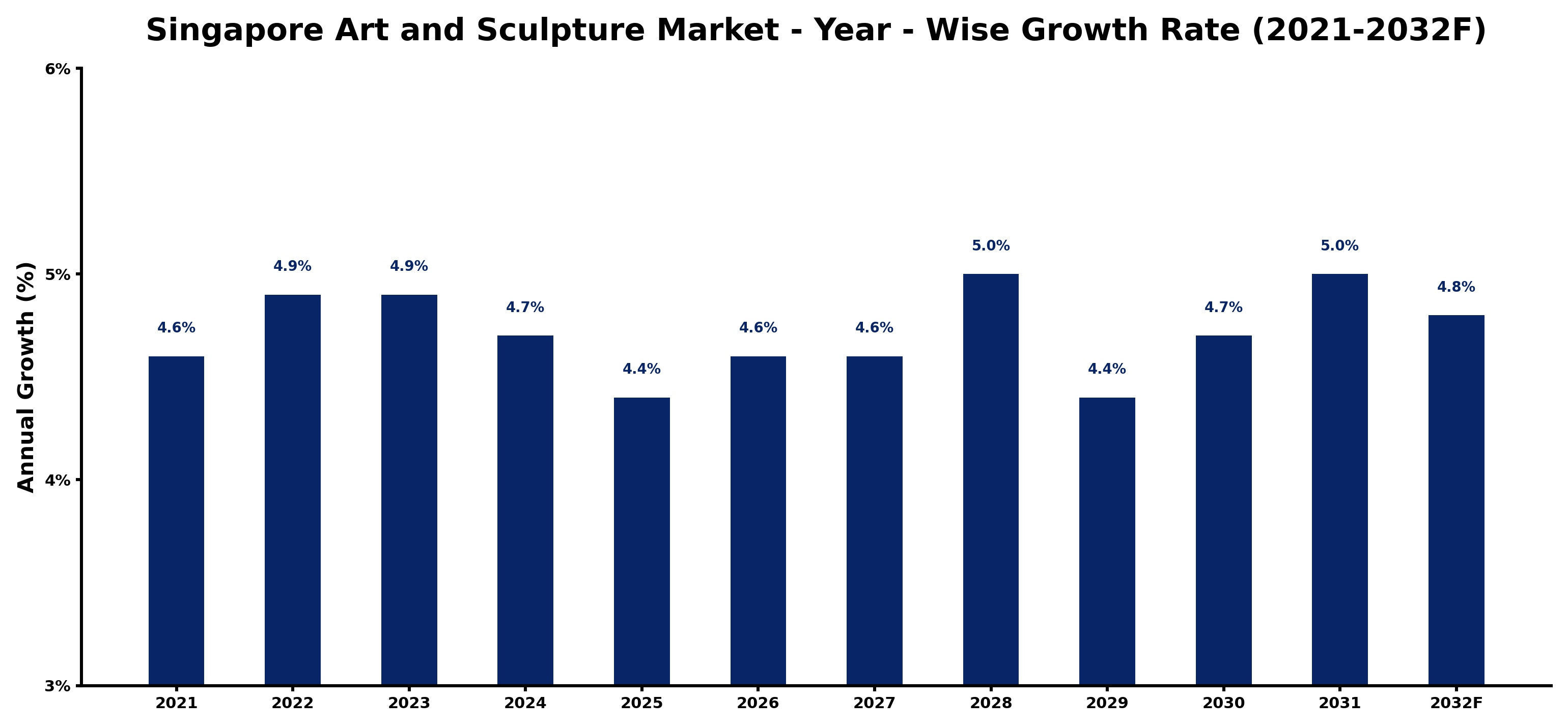
The table below presents the year‑wise growth rates along with the key drivers influencing the market
| Year | Growth Rate | Major Drivers |
| 2021 | 4.6% | Increasing adoption of advanced technologies |
| 2022 | 4.9% | Increasing adoption of advanced technologies |
| 2023 | 4.9% | Rapid growth in telecom and data center sectors |
| 2024 | 4.7% | Government infrastructure modernization initiatives |
| 2025 | 4.4% | Increasing industrial automation investments |
| 2026 | 4.6% | Increasing smart city development projects |
| 2027 | 4.6% | Increasing industrial infrastructure investments |
| 2028 | 5.0% | Expansion of manufacturing activities |
| 2029 | 4.4% | Expansion of commercial construction activities |
| 2030 | 4.7% | Expansion of commercial construction activities |
| 2031 | 5.0% | Expansion of manufacturing activities |
| 2032 | 4.8% | Growing urbanization and commercial development |
Note - Market size estimations and growth projections presented in this report are based on 6Wresearch's advanced forecasting approach, validated with industry datasets as of June 2026.
Singapore Art and Sculpture Market Synopsis
The Singapore art and sculpture market is a dynamic landscape characterized by a rich interplay of local talent and international influence. Galleries, museums, and art fairs create a vibrant ecosystem where both established and emerging artists can flourish, reflecting the nation's multicultural essence.
In recent years, public art initiatives have transformed urban spaces, making art more accessible to the community. As the city-state continues to embrace creativity, the intersection of art with tourism and luxury markets presents fertile ground for sustainable growth in the sector.
Singapore Art and Sculpture Market Key Takeaways
- Artistic expression in Singapore reflects the country's diverse cultural background, enhancing its appeal to collectors.
- The government's support for the arts fosters a conducive environment for the growth of local artists and galleries.
- There is a distinct increase in demand for both traditional and contemporary art, driven by affluent consumers.
- Public art initiatives play a crucial role in enhancing urban aesthetics and community engagement.
- The market is adapting to evolving trends, embracing technology and digital platforms for broader reach.
Evaluation of Restraints in Singapore Art and Sculpture Market
While the Singapore art and sculpture market shows considerable promise, certain restraints exist that may hinder its potential. Market saturation is a notable challenge; as more artists and galleries emerge, differentiation becomes crucial. Additionally, fluctuating economic conditions can impact discretionary spending on art, making it essential for stakeholders to remain agile. The rapid evolution of art preferences can also pose a challenge, necessitating constant innovation and engagement from artists and galleries to resonate with changing tastes.
Singapore Art and Sculpture Market Trends
A notable trend in the Singapore art and sculpture market is the growing integration of technology, with virtual exhibitions and online galleries gaining traction. This shift allows greater accessibility for collectors and enthusiasts, especially in a post-COVID world. Moreover, there is a burgeoning interest in sustainable and environmentally-conscious art practices, as artists seek to respond to global ecological concerns. The rise of art as an investment is another significant trend, with more individuals viewing art not just as decorative but also as a potential financial asset.
Singapore Art and Sculpture Market Opportunities
Opportunities abound within the Singapore art and sculpture market, particularly in the realm of experiential art. Interactive installations and community-engaged projects are gaining popularity, attracting a younger demographic. Moreover, collaborations with tech companies for augmented and virtual reality art experiences present innovative avenues for growth. Additionally, the increasing recognition of local artists on global platforms offers investment opportunities that can yield favorable returns for collectors and investors alike.
Government Initiatives in the Singapore Art and Sculpture Market
The Singapore government plays an instrumental role in nurturing the arts and culture sector. Through initiatives such as public funding for arts programs and festivals, the government seeks to elevate the profile of local artists and encourage international collaborations. Investment in cultural infrastructure, like museums and galleries, further supports the growth of the art market, creating spaces for exhibitions and public art installations. Such supportive policies aim to strengthen Singapore's position as a regional hub for the arts.
Future Insights of the Singapore Art and Sculpture Market
Looking ahead to 2026-2032, the Singapore art and sculpture market is poised for steady growth, driven by an ever-increasing demand for both traditional and contemporary works. As the luxury sector continues to expand, art is likely to gain prominence among high-net-worth individuals as an investment vehicle. Furthermore, continued government support and innovative approaches to art presentation will likely solidify Singapore's reputation as a key player in the global art scene, fostering a diverse marketplace that attracts both local and international interest.
Singapore Art and Sculpture Market Latest Developments (May 2025 - June 2026)
Recent developments in the Singapore art and sculpture market reflect a growing inclination towards innovation and community engagement. There has been a noticeable increase in hybrid art exhibitions, combining physical displays with virtual experiences, expanding audience reach. Additionally, new public art projects are underway, aimed at enriching urban spaces and encouraging local artists. Collaborations between galleries and tech firms are also on the rise, paving the way for exciting digital art initiatives that cater to a tech-savvy audience.
Singapore Art and Sculpture Market - Key Attractiveness of the Report
- 10 Years of Market Numbers
- Historical Data Starting from 2022 to 2025
- Base Year: 2025
- Forecast Data until 2032
- Key Performance Indicators Impacting the Market
- Major Upcoming Developments and Projects
Key Highlights of the Report:
- Singapore Art and Sculpture Market Outlook
- Market Size of Singapore Art and Sculpture Market, 2025
- Forecast of Singapore Art and Sculpture Market, 2032F
- Historical Data and Forecast of Singapore Art and Sculpture Revenues & Volume for the Period 2022-2032F
- Singapore Art and Sculpture Market Trend Evolution
- Singapore Art and Sculpture Market Drivers and Challenges
- Singapore Art and Sculpture Price Trends
- Singapore Art and Sculpture Porter's Five Forces
- Singapore Art and Sculpture Industry Life Cycle
- Historical Data and Forecast of Singapore Art and Sculpture Market Revenues & Volume By Types for the Period 2022-2032F
- Historical Data and Forecast of Singapore Art and Sculpture Market Revenues & Volume By Artifacts for the Period 2022-2032F
- Historical Data and Forecast of Singapore Art and Sculpture Market Revenues & Volume By Sculpture for the Period 2022-2032F
- Historical Data and Forecast of Singapore Art and Sculpture Market Revenues & Volume By Sales Channel for the Period 2022-2032F
- Historical Data and Forecast of Singapore Art and Sculpture Market Revenues & Volume By Auction Houses for the Period 2022-2032F
- Historical Data and Forecast of Singapore Art and Sculpture Market Revenues & Volume By Dealers for the Period 2022-2032F
- Historical Data and Forecast of Singapore Art and Sculpture Market Revenues & Volume By Galleries for the Period 2022-2032F
- Historical Data and Forecast of Singapore Art and Sculpture Market Revenues & Volume By Art Fairs for the Period 2022-2032F
- Historical Data and Forecast of Singapore Art and Sculpture Market Revenues & Volume By Online Sales for the Period 2022-2032F
- Historical Data and Forecast of Singapore Art and Sculpture Market Revenues & Volume By Retail Outlets for the Period 2022-2032F
- Historical Data and Forecast of Singapore Art and Sculpture Market Revenues & Volume By Artists Studios for the Period 2022-2032F
- Historical Data and Forecast of Singapore Art and Sculpture Market Revenues & Volume By Others for the Period 2022-2032F
- Historical Data and Forecast of Singapore Art and Sculpture Market Revenues & Volume By End-user for the Period 2022-2032F
- Historical Data and Forecast of Singapore Art and Sculpture Market Revenues & Volume By Private Collectors for the Period 2022-2032F
- Historical Data and Forecast of Singapore Art and Sculpture Market Revenues & Volume By Museums for the Period 2022-2032F
- Historical Data and Forecast of Singapore Art and Sculpture Market Revenues & Volume By Real Estate Developers for the Period 2022-2032F
- Historical Data and Forecast of Singapore Art and Sculpture Market Revenues & Volume By Interior Designers for the Period 2022-2032F
- Historical Data and Forecast of Singapore Art and Sculpture Market Revenues & Volume By Residential Individual Buyers for the Period 2022-2032F
- Historical Data and Forecast of Singapore Art and Sculpture Market Revenues & Volume By Other Professionals for the Period 2022-2032F
- Singapore Art and Sculpture Import Export Trade Statistics
- Market Opportunity Assessment By Types
- Market Opportunity Assessment By Sales Channel
- Market Opportunity Assessment By End-user
- Singapore Art and Sculpture Top Companies Market Share
- Singapore Art and Sculpture Competitive Benchmarking By Technical and Operational Parameters
- Singapore Art and Sculpture Company Profiles
- Singapore Art and Sculpture Key Strategic Recommendations






































