Singapore Bus Market Size, Share & Growth Rate
The Singapore Bus Market was estimated at USD 185 Million in 2025 and is projected to reach USD 201 Million by 2032, growing at a CAGR of 1.2% from 2026 to 2032. This steady growth trajectory reflects Singapore's unwavering commitment to enhancing public transport infrastructure and maintaining sustainable mobility solutions. As urbanization continues and the population grows, the demand for efficient bus services will only intensify, further solidifying buses as a cornerstone of the city-state's transportation network.
Singapore Bus Market Year-wise Growth Rate and Key Drivers
This graph highlights how the Singapore Bus Market has steadily grown over the years, supported by major growth factors.
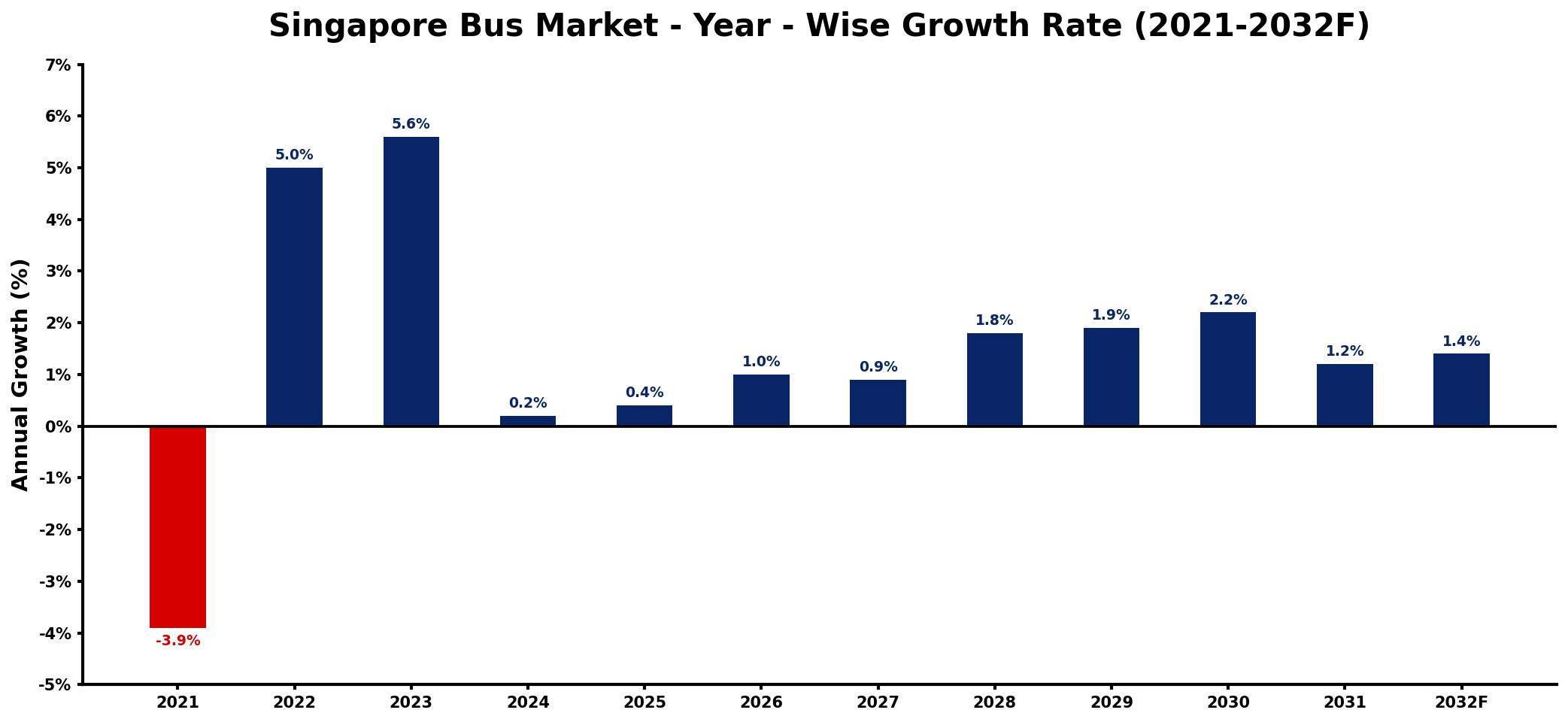
The table below presents the year‑wise growth rates along with the key drivers influencing the market
| Year | Growth Rate | Major Drivers |
| 2021 | -3.9% | decrease in public transport usage |
| 2022 | 5.0% | increased investment in infrastructure |
| 2023 | 5.6% | rising urban population density |
| 2024 | 0.2% | growing emphasis on sustainability |
| 2025 | 0.4% | expansion of digital payment systems |
| 2026 | 1.0% | enhanced public transport connectivity |
| 2027 | 0.9% | introduction of eco-friendly initiatives |
| 2028 | 1.8% | development of smart city projects |
| 2029 | 1.9% | increased tourism and travel demand |
| 2030 | 2.2% | government support for public mobility |
| 2031 | 1.2% | growth in private sector partnerships |
| 2032 | 1.4% | advancements in technology integration |
Note: Market size estimations and growth projections presented in this report are based on 6Wresearch's proprietary forecasting methodology, utilizing the latest available industry data, government publications, and primary research inputs.
Singapore Bus Market Synopsis
In recent years, the Singapore bus market has experienced a notable momentum fueled by increasing urban mobility needs and a dedication to sustainable transport. With various bus types and models readily available, public transport is evolving to accommodate both resident and tourist demands, setting the stage for future growth.
However, as the market matures, it faces the dual challenge of ensuring environmental sustainability while adapting to the changing dynamics of public transportation. Innovative technologies and eco-friendly designs are essential for meeting the expectations of a discerning public that values efficiency and sustainability in urban mobility.
Singapore Bus Market Key Takeaways
- The demand for buses is driven by Singapore's strong public transportation system and urbanization trends.
- Investment in eco-friendly and energy-efficient bus technologies is becoming a top priority among manufacturers.
- COVID-19 impacted bus usage, but the market is recovering with renewed focus on quality and sustainability.
- Government policies are increasingly supportive of green public transport solutions, enhancing future growth.
- Key players are adapting to evolving transportation needs through technological advancements and improved service offerings.
Evaluation of Restraints in Singapore Bus Market
While the Singapore bus market is poised for growth, several restraints could impede progress. High operational costs, including maintenance and fuel, place pressure on operators to maintain profitability. Additionally, strict regulations related to environmental standards require manufacturers to invest significantly in R&D for eco-friendly solutions. The challenge lies in balancing cost-effectiveness with sustainability, as the market increasingly demands greener transportation options. This dynamic necessitates ongoing innovation to align with government initiatives promoting sustainable public transit.
Singapore Bus Market Trends
Currently, the Singapore bus market is witnessing several transformative trends. The shift toward electric and hybrid bus models is gaining traction as sustainability becomes a focal point in urban transit. Moreover, the integration of smart technology into bus systems is enhancing operational efficiency and passenger experience, with real-time tracking and digital payment systems on the rise. This intersection of technology and eco-friendliness positions the bus market at the forefront of Singapore's transportation evolution.
Singapore Bus Market Opportunities
Opportunities abound in the Singapore bus market as it transitions toward sustainable transport solutions. Investment in electric bus infrastructure, including charging stations and maintenance facilities, is a significant area of growth. Additionally, collaborations between public transport authorities and private manufacturers can foster innovation and improve service delivery. As the government pushes for a greener future, companies capable of developing advanced, eco-friendly bus technologies will find themselves in a favorable position to capture market share.
Government Initiatives in the Singapore Bus Market
The Singapore government has been proactive in enhancing public transportation through a series of initiatives aimed at promoting sustainability. Funding for green technology in the bus sector is increasing, along with incentives for operators to upgrade their fleets to more energy-efficient models. Programs encouraging the adoption of electric buses and the integration of smart transport systems further underline the governments commitment to creating an efficient and eco-friendly public transit landscape.
Future Insights of the Singapore Bus Market
Looking ahead to 2026-2032, the Singapore bus market is set to evolve significantly. The anticipated growth will be largely driven by technological advancements and a more profound commitment to sustainability in public transport. As consumer expectations shift towards more environmentally friendly options, manufacturers that prioritize innovation will thrive. Additionally, the ongoing support from the government will facilitate this transition, ensuring that the bus market remains resilient and adaptive to future challenges.
Singapore Bus Market Latest Developments (2025 - 2026)
In recent months, the Singapore bus market has seen various developments aimed at enhancing service quality and sustainability. Manufacturers are increasingly launching electric and hybrid bus models, signaling a shift towards greener solutions. Public transport operators are also investing in smart technologies to improve user experience. Additionally, partnerships between government agencies and industry stakeholders are emerging to foster innovation, ensuring that Singapore's public transportation system remains at the cutting edge.
Singapore Bus Market - Key Attractiveness of the Report
- 10 Years of Market Numbers
- Historical Data Starting from 2022 to 2025
- Base Year: 2025
- Forecast Data until 2032
- Key Performance Indicators Impacting the Market
- Major Upcoming Developments and Projects
Key Highlights of the Report:
- Singapore Bus Market Outlook
- Market Size of Singapore Bus Market, 2025
- Forecast of Singapore Bus Market, 2032
- Historical Data and Forecast of Singapore Bus Revenues & Volume for the Period 2022-2032F
- Singapore Bus Market Trend Evolution
- Singapore Bus Market Drivers and Challenges
- Singapore Bus Price Trends
- Singapore Bus Porter's Five Forces
- Singapore Bus Industry Life Cycle
- Historical Data and Forecast of Singapore Bus Market Revenues & Volume By Type for the Period 2022-2032F
- Historical Data and Forecast of Singapore Bus Market Revenues & Volume By Single Deck for the Period 2022-2032F
- Historical Data and Forecast of Singapore Bus Market Revenues & Volume By Double Deck for the Period 2022-2032F
- Historical Data and Forecast of Singapore Bus Market Revenues & Volume By Application for the Period 2022-2032F
- Historical Data and Forecast of Singapore Bus Market Revenues & Volume By Transit for the Period 2022-2032F
- Historical Data and Forecast of Singapore Bus Market Revenues & Volume By Coaches for the Period 2022-2032F
- Historical Data and Forecast of Singapore Bus Market Revenues & Volume By Others for the Period 2022-2032F
- Historical Data and Forecast of Singapore Bus Market Revenues & Volume By Fuel Type for the Period 2022-2032F
- Historical Data and Forecast of Singapore Bus Market Revenues & Volume By Diesel for the Period 2022-2032F
- Historical Data and Forecast of Singapore Bus Market Revenues & Volume By Electric and Hybrid for the Period 2022-2032F
- Historical Data and Forecast of Singapore Bus Market Revenues & Volume By Others for the Period 2022-2032F
- Historical Data and Forecast of Singapore Bus Market Revenues & Volume By Seat Capacity for the Period 2022-2032F
- Historical Data and Forecast of Singapore Bus Market Revenues & Volume By 15-30 Seats for the Period 2022-2032F
- Historical Data and Forecast of Singapore Bus Market Revenues & Volume By 31-50 Seats for the Period 2022-2032F
- Historical Data and Forecast of Singapore Bus Market Revenues & Volume By More than 50 Seats for the Period 2022-2032F
- Singapore Bus Import Export Trade Statistics
- Market Opportunity Assessment By Type
- Market Opportunity Assessment By Application
- Market Opportunity Assessment By Fuel Type
- Market Opportunity Assessment By Seat Capacity
- Singapore Bus Top Companies Market Share
- Singapore Bus Competitive Benchmarking By Technical and Operational Parameters
- Singapore Bus Company Profiles
- Singapore Bus Key Strategic Recommendations






































