Singapore Gift Packaging Market Summary
The singapore gift packaging market was estimated at USD 402 Million in 2025 and is projected to reach USD 548 Million by 2032, growing at a CAGR of 5.4% from 2026 to 2032.
Singapore Gift Packaging Market Year-wise Growth Rate and Key Drivers
This graph highlights how the Singapore Gift Packaging Market has steadily grown over the past five years, supported by major growth factors.
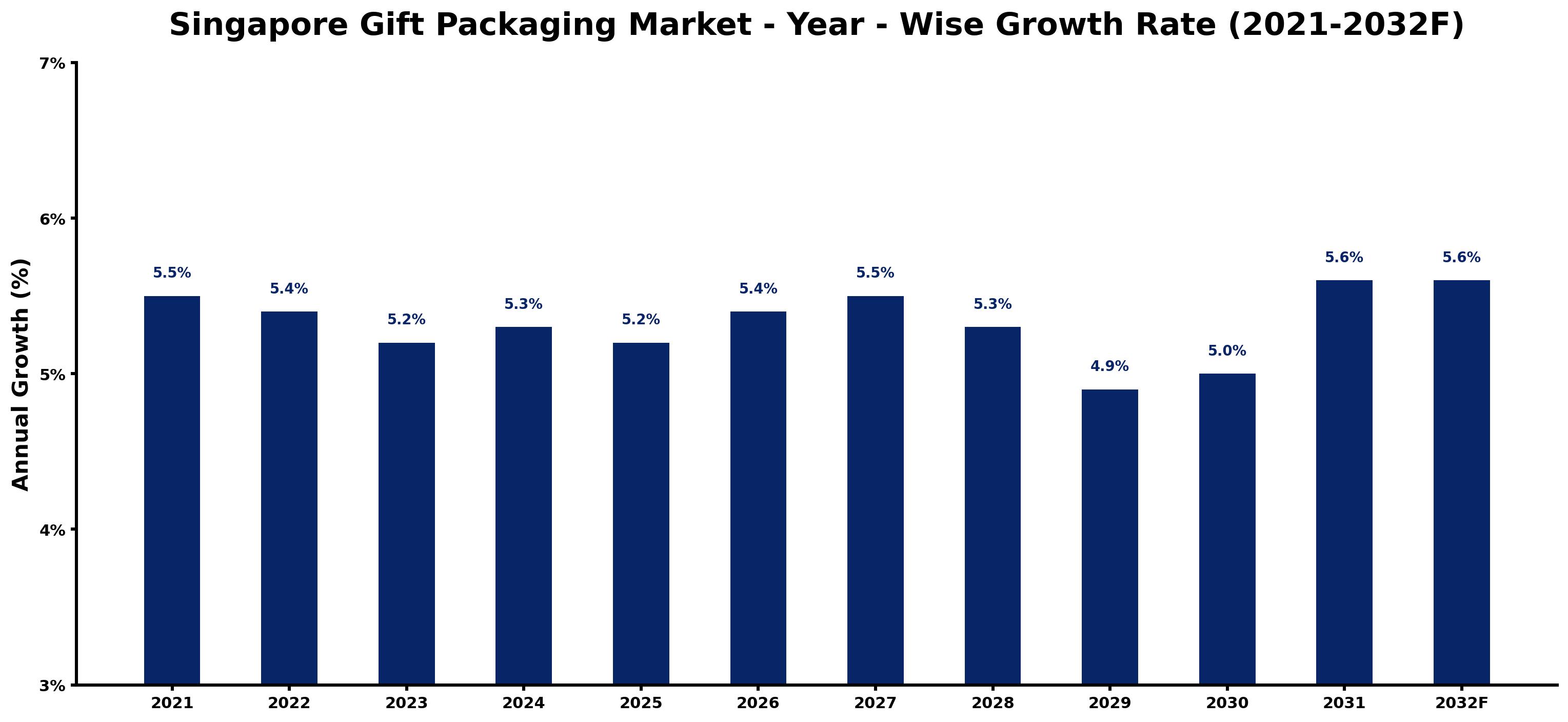
The table below presents the year wise growth rates along with the key drivers influencing the market
| Year | Growth Rate | Major Drivers |
| 2021 | 5.5% | Post-lockdown retail projects emphasize personalized and sustainable gift packaging solutions. |
| 2022 | 5.4% | Consumer preferences reflect a shift towards eco-friendly materials and design innovation. |
| 2023 | 5.2% | E-commerce growth prompts demand for efficient, attractive packaging for online sales. |
| 2024 | 5.3% | Corporate gifting trends highlight customized packaging as a branding strategy. |
| 2025 | 5.2% | Urbanization leads to increased gifting occasions, enhancing packaging market opportunities. |
| 2026 | 5.4% | Sustainable sourcing becomes critical as environmental consciousness influences purchase decisions. |
| 2027 | 5.5% | Technological innovations streamline production processes, reducing costs for packaging manufacturers. |
| 2028 | 5.3% | Collaborations with local artisans elevate the uniqueness of gift packaging offerings. |
| 2029 | 4.9% | Diversification into luxury packaging opens new market segments for suppliers. |
| 2030 | 5.0% | Consumer education on sustainable practices shifts focus toward reusable packaging solutions. |
| 2031 | 5.6% | Brand loyalty increasingly hinges on visual appeal and quality of packaging design. |
| 2032 | 5.6% | Integration of AR and VR into packaging enhances consumer engagement and experience. |
Note - Market size estimations and growth projections presented in this report are based on 6Wresearch's advanced forecasting approach, validated with industry datasets as of June 2026.
Singapore Gift Packaging Market Synopsis
The Singapore Gift Packaging Market is projected to reach 5.4% and witness significant growth during the forecast period (2026-2032). Over recent years, the demand for innovative packaging solutions that ensure the protection of special gifts has been on the rise. Increased expenditure on gifting occasions, coupled with promotional activities, has bolstered the growth of this market in Singapore. Furthermore, the combination of rising disposable incomes and evolving consumer lifestyles is significantly contributing to the overall expansion of the gift packaging sector.
Singapore Gift Packaging Market Growth Drivers
Several factors are fostering growth in the Singapore Gift Packaging Market, pivotal among them is the escalating demand for gifting occasions. Celebrations such as birthdays, weddings, and anniversaries necessitate the use of gift packaging, resulting in a marked increase in consumption. This trend is further amplified by the cultural significance attached to gifting in Singaporean society.
- The increasing frequency of special events and holidays is encouraging consumers to invest more in quality gift packaging, driving market demand.
- Promotional activities led by diverse companies, including discounts and special offers, are enhancing consumer spending on gift packaging items.
- Enhanced aesthetic preferences among consumers are motivating them to opt for unique and attractive packaging solutions.
- The growing trend of e-commerce is leading to a surge in online gifting options, necessitating effective packaging solutions.
- Corporate gifting practices are also on the rise, as businesses leverage gift packaging for branding and relationship-building purposes.
Singapore Gift Packaging Market Challenges and Restraints
Despite the positive outlook, the Singapore Gift Packaging Market faces certain challenges. High costs incurred due to rapid changes in packaging designs are a primary concern. Retailers often alter product designs and labeling, which complicates the manufacturing process and inflates costs for producers.
- Frequent updates in design specifications lead to increased production costs, which can affect profit margins.
- Inconsistent demand cycles can create inventory management challenges for manufacturers.
- Environmental regulations necessitate compliance, which can drive up the cost of materials and production.
- The need for customization can strain resources, particularly for smaller manufacturers.
- Competition with cheaper alternatives can pressure local businesses to lower prices, affecting overall market sustainability.
Singapore Gift Packaging Market Trends and Opportunities
The market is witnessing noteworthy trends that present potential opportunities for growth. One significant trend is the increasing consumer inclination towards sustainable packaging, driven by environmental awareness. Businesses focusing on eco-friendly materials are likely to capture a larger share of the market.
- Innovative packaging designs incorporating biodegradable materials are gaining traction among eco-conscious consumers.
- Personalization in gift packaging, allowing for unique consumer experiences, is becoming increasingly popular.
- The rise of digital platforms is facilitating easier access to diverse packaging solutions for consumers.
- Collaborations between gift packaging companies and local artisans can lead to unique products that appeal to niche markets.
- The integration of technology, including augmented reality, within packaging is an emerging trend that could redefine consumer interactions.
Singapore Gift Packaging Market Government Investment and Initiatives
The government of Singapore has been actively promoting the gift packaging sector through various initiatives. Strategic investments aimed at enhancing manufacturing capabilities and sustainability practices have been prioritized. These investments foster innovation within the industry, encouraging companies to adopt green technologies and practices.
- Government incentives for businesses that focus on sustainable practices are providing financial support for the development of eco-friendly packaging solutions.
- Public spending on infrastructure improvements is enhancing logistics and distribution networks, benefiting packaging companies.
- Initiatives aimed at supporting small and medium-sized enterprises (SMEs) are expected to boost competition and innovation in the gift packaging market.
- Collaborations with research institutions are facilitating the development of new materials and technologies that can improve packaging sustainability.
- Policies aimed at reducing waste and promoting recycling practices are encouraging consumers and businesses to rethink their packaging choices.
Singapore Gift Packaging Market Latest Developments (May 2025 - June 2026)
Recent developments in the Singapore Gift Packaging Market indicate a shift towards more sustainable and innovative solutions. Companies are increasingly focusing on eco-friendly materials, responding to the growing consumer demand for sustainability. Furthermore, digital transformation is reshaping the sector, with many businesses adopting e-commerce strategies to reach a wider audience.
- There has been a significant rise in partnerships between packaging firms and e-commerce platforms to enhance the delivery of gift packaging solutions.
- Innovative designs featuring biodegradable materials have been introduced, catering to environmentally conscious consumers.
- The market has observed greater consumer engagement through personalized packaging options, appealing to those seeking unique gifting experiences.
- Several companies have invested in R&D to explore smart packaging technologies, integrating QR codes and AR for interactive consumer experiences.
- Industry forums and trade shows have been established, providing platforms for stakeholders to collaborate and share insights on trends and innovations.
Singapore Gift Packaging Market - Key Attractiveness of the Report
- 10 Years of Market Numbers
- Historical Data Starting from 2022 to 2025
- Base Year: 2025
- Forecast Data until 2032
- Key Performance Indicators Impacting the Market
- Major Upcoming Developments and Projects
Key Highlights of the Report:
- Singapore Gift Packaging Market Outlook
- Market Size of Singapore Gift Packaging Market, 2025
- Forecast of Singapore Gift Packaging Market, 2032F
- Historical Data and Forecast of Singapore Gift Packaging Revenues & Volume for the Period 2022-2032F
- Singapore Gift Packaging Market Trend Evolution
- Singapore Gift Packaging Market Drivers and Challenges
- Singapore Gift Packaging Price Trends
- Singapore Gift Packaging Porter's Five Forces
- Singapore Gift Packaging Industry Life Cycle
- Historical Data and Forecast of Singapore Gift Packaging Market Revenues & Volume By Types for the Period 2022-2032F
- Historical Data and Forecast of Singapore Gift Packaging Market Revenues & Volume By Primary Gift Packaging for the Period 2022-2032F
- Historical Data and Forecast of Singapore Gift Packaging Market Revenues & Volume By Secondary Gift Packaging for the Period 2022-2032F
- Historical Data and Forecast of Singapore Gift Packaging Market Revenues & Volume By Applications for the Period 2022-2032F
- Historical Data and Forecast of Singapore Gift Packaging Market Revenues & Volume By Personal for the Period 2022-2032F
- Historical Data and Forecast of Singapore Gift Packaging Market Revenues & Volume By Commercial for the Period 2022-2032F
- Singapore Gift Packaging Import Export Trade Statistics
- Market Opportunity Assessment By Types
- Market Opportunity Assessment By Applications
- Singapore Gift Packaging Top Companies Market Share
- Singapore Gift Packaging Competitive Benchmarking By Technical and Operational Parameters
- Singapore Gift Packaging Company Profiles
- Singapore Gift Packaging Key Strategic Recommendations






































