South Korea 3D Cinema Screen Market (2026-2032) | Segmentation, Demand, Opportunities, Drivers, Consumer Insights, Outlook, Size, Trends, Competitive, Challenges, Companies, Investment Trends, Segments, Revenue, Growth, Share, Pricing Analysis, Strategic Insights, Industry, Strategy, Supply, Competition, Forecast, Analysis, Value, Restraints
Market Forecast By Type (Active 3D, Passive 3D), By Application (Commercial Cinemas, Home entertainment), By Technology (Polarized Glass, Dolby 3D, IMAX 3D, Active Shutter), By End User (Commercial Theaters, Home users, Event Organizers) And Competitive Landscape
| Product Code: ETC11484778 | Publication Date: Apr 2025 | Updated Date: May 2026 | Product Type: Market Research Report | |
| Publisher: 6Wresearch | Author: Bhawna Singh | No. of Pages: 65 | No. of Figures: 34 | No. of Tables: 19 |
South Korea 3D Cinema Screen Market Growth Rate
According to 6Wresearch internal database and industry insights, the South Korea 3D Cinema Screen Market is projected to grow at a compound annual growth rate (CAGR) of 12.4% during the forecast period (2026-2032).
South Korea 3D Cinema Screen Market Year-wise Growth Rate and Key Drivers
This graph highlights how the South Korea 3D Cinema Screen Market has steadily grown over the past five years, supported by major growth factors.
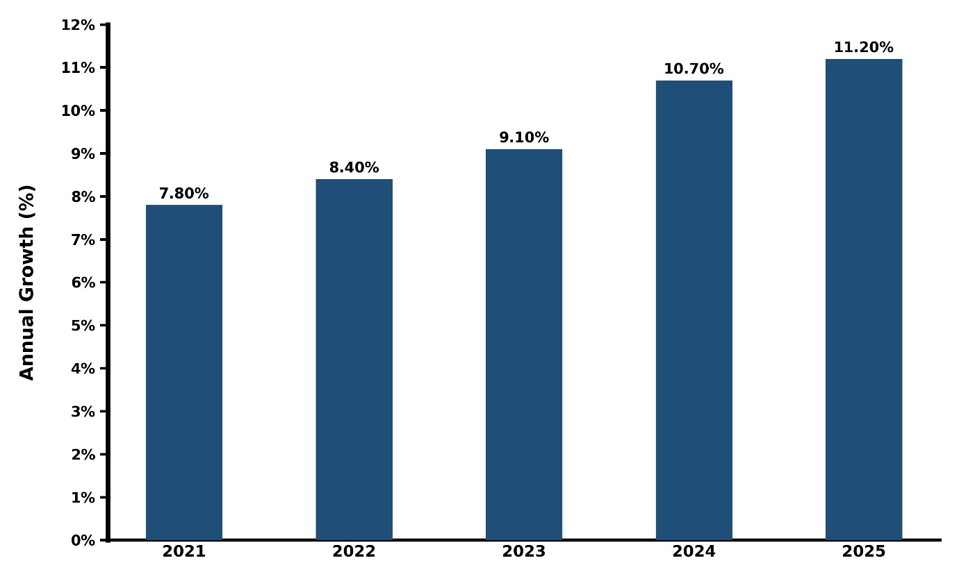
The table below presents the year-wise growth rates along with the key drivers influencing the market.
| Year | Est. Annual Growth (%) | Growth Drivers |
| 2021 | 7.8% | Resurgence of high-budget 3D film releases and premium theater upgrades |
| 2022 | 8.4% | Increasing consumer preference for immersive 4D and IMAX experiences |
| 2023 | 9.1% | Technological shift toward high-contrast laser projection 3D systems |
| 2024 | 10.7% | Expansion of luxury multiplex chains in emerging metropolitan zones |
| 2025 | 11.2% | Growing integration of high-frame-rate (HFR) 3D screening technology |
Topics Covered in the South Korea 3D Cinema Screen Market Report
The South Korea 3D Cinema Screen Market report thoroughly covers the market by End User, Technology, Application and Type. The market report provides an unbiased and detailed analysis of ongoing market trends, opportunities/high growth areas, and market drivers, which help stakeholders devise and align their market strategies according to the current and future market dynamics.
South Korea 3D Cinema Screen Market Highlights
| Report Name | South Korea 3D Cinema Screen Market |
| Forecast period | 2026-2032 |
| CAGR | 12.4% |
| Growing Sector | Commercial Cinemas & Premium Large Format (PLF) Theaters |
South Korea 3D Cinema Screen Market Synopsis
The South Korea 3D Cinema Screen Market is expected to grow considerably owing to the highly evolved cinema-going culture and quick adoption of next generation visual technologies by multiplex cinemas in urban areas. Usually, the local audience shows a high tendency for immersive movie experiences; therefore, the local theater operators are spending considerable sums of money on advanced systems such as polarized glasses and silver screen treatments for maximum brightness. The screens, in particular, feature highly gainful surfaces made up of silver that have been designed with special care to ensure that the light polarisation is retained without any reduction in brightness. Additionally, the presence of several large electronics companies in the country is helping create a constant supply of 3D movies.
Evaluation of Growth Drivers in the South Korea 3D Cinema Screen Market (2026-2032)
Below mentioned are some prominent drivers and their influence on the market dynamics:
| Drivers | Primary Segments Affected | Why it Matters (Evidence) |
| Demand for Immersive Visuals | Passive 3D, Commercial Cinemas | Audiences are increasingly willing to pay premium ticket prices for depth-enhanced viewing experiences. |
| Technological Innovation in Lasers | Active 3D, IMAX 3D | New RGB laser projectors offer superior 3D brightness, overcoming traditional light loss issues. |
| Expansion of Luxury Cinema Halls | Commercial Movie Theaters, Home Consumers | Luxury cinema halls are fitting in 3D screens to provide their customers with unique and high-quality environments. |
| Use of 3D Screen for E-Sport Events | Event Promoters, Commercial Cinemas | Broadcasting gaming events via 3D screens generates extra income for the movie theaters. |
| Strategic Content Partnerships | All Types, Commercial Cinemas | Direct partnerships between Korean theaters and Hollywood studios ensure optimized 3D format availability. |
South Korea 3D Cinema Screen Market is expected to grow at the CAGR of 12.4% during the forecast period of 2026-2032. Growth is driven by the continuous evolution of display technologies, the rising popularity of premium large-format screens, and the cultural shift toward "cinema-as-an-experience" rather than just viewing. Additional contributions come from the integration of 3D screens in non-traditional venues like theme parks and corporate experience centers, alongside a government-backed push to digitize and modernize the national cultural infrastructure to support the flourishing domestic media landscape.
Evaluation of Restraints in the South Korea 3D Cinema Screen Market
Below mentioned are some major restraints and their influence on the market dynamics:
| Restraints | Primary Segments Affected | What This Means (Evidence) |
| High Initial Installation Costs | Commercial Theaters, Event Organizers | The significant capital required for silver screens and 3D projectors deters smaller independent exhibitors. |
| Growth of High-End Home Media | Home Users, Passive 3D | Advanced 8K OLED televisions and VR headsets offer competing immersive experiences at home. |
| Maintenance of 3D Hardware | Polarized Glass, Active Shutter | Frequent replacement of 3D glasses and specialized screen cleaning increases operational overhead. |
| Content Production Bottlenecks | All Types, Commercial Cinemas | High costs of filming in native 3D limit the volume of available movies compared to 2D. |
| Sensitivity to Ticket Pricing | Commercial Theaters, Home Users | Economic fluctuations can lead consumers to choose standard 2D screenings to save on premium surcharges. |
South Korea 3D Cinema Screen Market Challenges
Irrespective of massive growth and development, the Market faces several challenges such as the high saturation of the traditional cinema market and the intensifying competition from advanced home streaming technologies. In addition to this, the logistical complexities of maintaining a vast inventory of 3D glasses and the technical requirements for periodic recalibration of polarized systems pose operational hurdles for theater chains. Furthermore, the fluctuating availability of native 3D content can lead to underutilization of expensive hardware, impacting the South Korea 3D Cinema Screen Market Growth.
South Korea 3D Cinema Screen Market Trends
Key trends in assessing the environment of the South Korea 3D Cinema Screen Market include:
- Integration of LED Cinema Screens: There is a noticeable shift towards LED cinema screens which allow for 3D display without projection and feature extremely high contrast and brightness levels.
- Use of 3D Screen in Private Cinemas: There is a rising trend among consumers to install premium 3D screens in luxury apartments and social hubs, allowing the use of their own screens to watch movies.
- Combination of HFR and 4K in 3D Display: High frame rates and 4K technology are being utilized together within the 3D format, creating a much more natural viewing experience free from motion blur.
- Green 3D Goggle Programs: Recyclable or durable multipurpose goggle sets are being employed by cinemas to ensure that they meet environmental standards set by the government.
Investment Opportunities in the South Korea 3D Cinema Screen Market
Some significant investment areas in the South Korea 3D Cinema Screen Market are as follows:
- Next Generation Silver Screen Surface: Development of screens which have improved gain and viewing angles to display polarized 3D movies in multiplexes.
- 3D Game Live Event Arenas: Constructing event-type arenas fitted with 3D screens that will be used to broadcast live video gaming events via virtual realities.
- Local Cinemas Dedicated to Cinephiles: Transforming special cinemas into small venues that will attract cinephiles who appreciate the technology of 3D movies.
- Local AI-powered 2D to 3D Conversion Studios: Establishing local 3D movie conversion centers that will employ artificial intelligence technology to convert old 2D films into 3D films.
Top 5 Leading Players in the South Korea 3D Cinema Screen Market
Some leading players operating in the South Korea 3D Cinema Screen Market include:
1. Samsung Electronics Co., Ltd.
| Company Name | Samsung Electronics Co., Ltd. |
| Established Year | 1969 |
| Headquarters | Suwon, South Korea |
| Official Website | Click Here |
Samsung leads in 3D-capable LED cinema screen technology, providing high-contrast Onyx displays that revolutionize the immersive theater experience without traditional projectors.
2. LG Electronics Inc.
| Company Name | LG Electronics Inc. |
| Established Year | 1958 |
| Headquarters | Seoul, South Korea |
| Official Website | Click Here |
LG provides advanced display solutions and 3D technologies used in both commercial cinema settings and high-end professional home entertainment systems across the country.
3. RealD Inc.
| Company Name | RealD Inc. |
| Established Year | 2003 |
| Headquarters | Beverly Hills, USA |
| Official Website | Click Here |
RealD is a global leader in visual technology, licensing its widely used polarized 3D cinema systems to major South Korean multiplex chains like CGV.
4. Sony Corporation
| Company Name | Sony Corporation |
| Established Year | 1946 |
| Headquarters | Tokyo, Japan |
| Official Website | Click Here |
Sony manufactures professional 4K 3D projection systems and digital cinema hardware that are essential for high-fidelity 3D screenings in South Korean theaters.
5. CJ 4DPLEX (ScreenX)
| Company Name | CJ 4DPLEX (ScreenX) |
| Established Year | 2002 |
| Headquarters | Seoul, South Korea |
| Official Website | - |
As a subsidiary of CJ CGV, they specialize in multi-projection and 3D immersive technologies, expanding the boundaries of traditional cinema through sensory-rich environments.
Government Regulations Introduced in the South Korea 3D Cinema Screen Market
According to South Korean Government Data, the Digital Cinema Advancement Plan was revised by the Ministry of Culture, Sports and Tourism to encourage technological advancement within the sector. Several incentives have been provided to ensure that theaters embrace the high-tech equipment through tax exemptions and low-interest loans aimed at modernizing theaters. Through such strategies, the local film sector will continue to maintain its competitiveness and dominance within the technology domain. Furthermore, the government has established strict technical standards for digital cinema to ensure visual safety and quality, protecting consumers from eye strain while promoting the rapid expansion of high-quality 3D infrastructure across all provinces.
Future Insights of the South Korea 3D Cinema Screen Market
The outlook for the South Korea 3D Cinema Screen Industry is promising due to the impact of improved digital infrastructure, increasing international support for the media market through investments in holographic and glasses-free 3D technologies, a focus on luxury cinema segments, and investments in training for specialised technical staff, which will ultimately boost opportunities for market growth.
Market Segmentation Analysis
The report offers a comprehensive study of the subsequent market segments and their leading categories:
Passive 3D Segment to Dominate the Market- By Type
According to Harsh, Senior Research Analyst, 6Wresearch, the Passive 3D segment is expected to play a leading role in the South Korea 3D Cinema Screen Market Share. The cost-effectiveness of lightweight polarized glasses, combined with the ease of maintenance for large-scale multiplexes, has led to significant growth in this category. Moreover, theater operators prefer this technology for its reliability in high-traffic commercial environments, which e-commerce and physical procurement platforms can support through consistent supply chains of silver screens and filters.
Commercial Theaters to Dominate the Market- By End User
The Commercial Theaters segment is expected to play a leading role in the South Korea 3D Cinema Screen Market Share. The aggressive expansion of multiplex giants like CGV and Lotte Cinema, coupled with the demand for 4DX and IMAX screenings, has led to significant growth in this category. Moreover, theater chains are increasingly prioritizing "experience-based" viewing to combat streaming services, which specialized theaters can offer through top-tier 3D screen installations.
Key Attractiveness of the Report
- 10 Years of Market Numbers.
- Historical Data Starting from 2022 to 2025.
- Base Year: 2025.
- Forecast Data until 2032.
- Key Performance Indicators Impacting the Market.
- Major Upcoming Developments and Projects.
Key Highlights of the Report:
- South Korea 3D Cinema Screen Market Outlook
- Market Size of South Korea 3D Cinema Screen Market, 2025
- Forecast of South Korea 3D Cinema Screen Market, 2032
- Historical Data and Forecast of South Korea 3D Cinema Screen Revenues & Volume for the Period 2022- 2032
- South Korea 3D Cinema Screen Market Trend Evolution
- South Korea 3D Cinema Screen Market Drivers and Challenges
- South Korea 3D Cinema Screen Price Trends
- South Korea 3D Cinema Screen Porter's Five Forces
- South Korea 3D Cinema Screen Industry Life Cycle
- Historical Data and Forecast of South Korea 3D Cinema Screen Market Revenues & Volume By Type for the Period 2022- 2032
- Historical Data and Forecast of South Korea 3D Cinema Screen Market Revenues & Volume By Active 3D for the Period 2022- 2032
- Historical Data and Forecast of South Korea 3D Cinema Screen Market Revenues & Volume By Passive 3D for the Period 2022- 2032
- Historical Data and Forecast of South Korea 3D Cinema Screen Market Revenues & Volume By Application for the Period 2022- 2032
- Historical Data and Forecast of South Korea 3D Cinema Screen Market Revenues & Volume By Commercial Cinemas for the Period 2022- 2032
- Historical Data and Forecast of South Korea 3D Cinema Screen Market Revenues & Volume By Home entertainment for the Period 2022- 2032
- Historical Data and Forecast of South Korea 3D Cinema Screen Market Revenues & Volume By Technology for the Period 2022- 2032
- Historical Data and Forecast of South Korea 3D Cinema Screen Market Revenues & Volume By Polarized Glass for the Period 2022- 2032
- Historical Data and Forecast of South Korea 3D Cinema Screen Market Revenues & Volume By Dolby 3D for the Period 2022- 2032
- Historical Data and Forecast of South Korea 3D Cinema Screen Market Revenues & Volume By IMAX 3D for the Period 2022- 2032
- Historical Data and Forecast of South Korea 3D Cinema Screen Market Revenues & Volume By Active Shutter for the Period 2022- 2032
- Historical Data and Forecast of South Korea 3D Cinema Screen Market Revenues & Volume By End User for the Period 2022- 2032
- Historical Data and Forecast of South Korea 3D Cinema Screen Market Revenues & Volume By Commercial Theaters for the Period 2022- 2032
- Historical Data and Forecast of South Korea 3D Cinema Screen Market Revenues & Volume By Home users for the Period 2022- 2032
- Historical Data and Forecast of South Korea 3D Cinema Screen Market Revenues & Volume By Event Organizers for the Period 2022- 2032
- South Korea 3D Cinema Screen Import Export Trade Statistics
- Market Opportunity Assessment By Type
- Market Opportunity Assessment By Application
- Market Opportunity Assessment By Technology
- Market Opportunity Assessment By End User
- South Korea 3D Cinema Screen Top Companies Market Share
- South Korea 3D Cinema Screen Competitive Benchmarking By Technical and Operational Parameters
- South Korea 3D Cinema Screen Company Profiles
- South Korea 3D Cinema Screen Key Strategic Recommendations
Market Covered
The report offers a comprehensive study of the subsequent market segments:
By Type
- Active 3D
- Passive 3D
By Application
- Commercial Cinemas
- Home Entertainment
By Technology
- Polarized Glass
- Dolby 3D
- IMAX 3D
- Active Shutter
By End User
- Commercial Theaters
- Home Users
- Event Organizers
South Korea 3D Cinema Screen Market (2026-2032) : FAQs
South Korea 3D Cinema Screen Market is projected to grow at a CAGR of 12.4% between 2026-2032.
High initial capital expenditure for silver screen coatings and periodic recalibration costs for 3D projection systems remain a significant barrier for independent and smaller theater operators.
A rising domestic trend of "Concert Cinema" allows K-Pop fans to view high-definition 3D live performances, creating a consistent secondary revenue stream for 3D-equipped halls.
The market is lead by dominant players such as Samsung Electronics, LG Electronics, RealD Inc., Sony Corporation, and CJ 4DPLEX.
6Wresearch actively monitors the South Korea 3D Cinema Screen Market and publishes its comprehensive annual report, highlighting emerging trends, growth drivers, revenue analysis, and forecast outlook. Our insights help businesses to make data-backed strategic decisions with ongoing market dynamics. Our analysts track relevent industries related to the South Korea 3D Cinema Screen Market, allowing our clients with actionable intelligence and reliable forecasts tailored to emerging regional needs.
Yes, we provide customisation as per your requirements. To learn more, feel free to contact us on sales@6wresearch.com
| 1 Executive Summary |
| 2 Introduction |
| 2.1 Key Highlights of the Report |
| 2.2 Report Description |
| 2.3 Market Scope & Segmentation |
| 2.4 Research Methodology |
| 2.5 Assumptions |
| 3 South Korea 3D Cinema Screen Market Overview |
| 3.1 South Korea Country Macro Economic Indicators |
| 3.2 South Korea 3D Cinema Screen Market Revenues & Volume, 2022 & 2032F |
| 3.3 South Korea 3D Cinema Screen Market - Industry Life Cycle |
| 3.4 South Korea 3D Cinema Screen Market - Porter's Five Forces |
| 3.5 South Korea 3D Cinema Screen Market Revenues & Volume Share, By Type, 2022 & 2032F |
| 3.6 South Korea 3D Cinema Screen Market Revenues & Volume Share, By Application, 2022 & 2032F |
| 3.7 South Korea 3D Cinema Screen Market Revenues & Volume Share, By Technology, 2022 & 2032F |
| 3.8 South Korea 3D Cinema Screen Market Revenues & Volume Share, By End User, 2022 & 2032F |
| 4 South Korea 3D Cinema Screen Market Dynamics |
| 4.1 Impact Analysis |
| 4.2 Market Drivers |
| 4.2.1 Increasing demand for immersive entertainment experiences |
| 4.2.2 Growth in the entertainment and leisure industry in South Korea |
| 4.2.3 Technological advancements in 3D cinema screen technology |
| 4.3 Market Restraints |
| 4.3.1 High initial investment and maintenance costs for 3D cinema screens |
| 4.3.2 Competition from other forms of entertainment such as streaming services |
| 4.3.3 Limited availability of suitable locations for setting up 3D cinema screens |
| 5 South Korea 3D Cinema Screen Market Trends |
| 6 South Korea 3D Cinema Screen Market, By Types |
| 6.1 South Korea 3D Cinema Screen Market, By Type |
| 6.1.1 Overview and Analysis |
| 6.1.2 South Korea 3D Cinema Screen Market Revenues & Volume, By Type, 2022 - 2032F |
| 6.1.3 South Korea 3D Cinema Screen Market Revenues & Volume, By Active 3D, 2022 - 2032F |
| 6.1.4 South Korea 3D Cinema Screen Market Revenues & Volume, By Passive 3D, 2022 - 2032F |
| 6.2 South Korea 3D Cinema Screen Market, By Application |
| 6.2.1 Overview and Analysis |
| 6.2.2 South Korea 3D Cinema Screen Market Revenues & Volume, By Commercial Cinemas, 2022 - 2032F |
| 6.2.3 South Korea 3D Cinema Screen Market Revenues & Volume, By Home entertainment, 2022 - 2032F |
| 6.3 South Korea 3D Cinema Screen Market, By Technology |
| 6.3.1 Overview and Analysis |
| 6.3.2 South Korea 3D Cinema Screen Market Revenues & Volume, By Polarized Glass, 2022 - 2032F |
| 6.3.3 South Korea 3D Cinema Screen Market Revenues & Volume, By Dolby 3D, 2022 - 2032F |
| 6.3.4 South Korea 3D Cinema Screen Market Revenues & Volume, By IMAX 3D, 2022 - 2032F |
| 6.3.5 South Korea 3D Cinema Screen Market Revenues & Volume, By Active Shutter, 2022 - 2032F |
| 6.4 South Korea 3D Cinema Screen Market, By End User |
| 6.4.1 Overview and Analysis |
| 6.4.2 South Korea 3D Cinema Screen Market Revenues & Volume, By Commercial Theaters, 2022 - 2032F |
| 6.4.3 South Korea 3D Cinema Screen Market Revenues & Volume, By Home users, 2022 - 2032F |
| 6.4.4 South Korea 3D Cinema Screen Market Revenues & Volume, By Event Organizers, 2022 - 2032F |
| 7 South Korea 3D Cinema Screen Market Import-Export Trade Statistics |
| 7.1 South Korea 3D Cinema Screen Market Export to Major Countries |
| 7.2 South Korea 3D Cinema Screen Market Imports from Major Countries |
| 8 South Korea 3D Cinema Screen Market Key Performance Indicators |
| 8.1 Average occupancy rate of 3D cinema screens in South Korea |
| 8.2 Average ticket price for 3D cinema screenings |
| 8.3 Frequency of new 3D movie releases in South Korea |
| 8.4 Percentage of audience satisfaction with 3D cinema experience |
| 8.5 Number of partnerships with movie production companies for exclusive 3D screenings |
| 9 South Korea 3D Cinema Screen Market - Opportunity Assessment |
| 9.1 South Korea 3D Cinema Screen Market Opportunity Assessment, By Type, 2022 & 2032F |
| 9.2 South Korea 3D Cinema Screen Market Opportunity Assessment, By Application, 2022 & 2032F |
| 9.3 South Korea 3D Cinema Screen Market Opportunity Assessment, By Technology, 2022 & 2032F |
| 9.4 South Korea 3D Cinema Screen Market Opportunity Assessment, By End User, 2022 & 2032F |
| 10 South Korea 3D Cinema Screen Market - Competitive Landscape |
| 10.1 South Korea 3D Cinema Screen Market Revenue Share, By Companies, 2025 |
| 10.2 South Korea 3D Cinema Screen Market Competitive Benchmarking, By Operating and Technical Parameters |
| 11 Company Profiles |
| 12 Recommendations |
| 13 Disclaimer |
Global Go To Market Strategy - 2030
Export potential enables firms to identify high-growth global markets with greater confidence by combining advanced trade intelligence with a structured quantitative methodology. The framework analyzes emerging demand trends and country-level import patterns while integrating macroeconomic and trade datasets such as GDP and population forecasts, bilateral import–export flows, tariff structures, elasticity differentials between developed and developing economies, geographic distance, and import demand projections. Using weighted trade values from 2020–2024 as the base period to project country-to-country export potential for 2030, these inputs are operationalized through calculated drivers such as gravity model parameters, tariff impact factors, and projected GDP per-capita growth. Through an analysis of hidden potentials, demand hotspots, and market conditions that are most favorable to success, this method enables firms to focus on target countries, maximize returns, and global expansion with data, backed by accuracy.
By factoring in the projected importer demand gap that is currently unmet and could be potential opportunity, it identifies the potential for the Exporter (Country) among 190 countries, against the general trade analysis, which identifies the biggest importer or exporter.
To discover high-growth global markets and optimize your business strategy:
Click Here
Pricing
- Single User License$ 1,995
- Department License$ 2,400
- Site License$ 3,120
- Global License$ 3,795

Leadership Perspectives from Industry Events
Search
Thought Leadership and Analyst Meet





Our Clients








6WResearch In News
- India Export Attractiveness Tracker 2026
- India Air Conditioner Market Set for Strong Rebound in 2026 After Weather-Led Correction and GST-Driven Recovery: 6Wresearch
- ADAS in India: How Automatic Emergency Braking, Blind Spot Detection & Driver Monitoring are Transforming Road Safety
- Doha a strategic location for EV manufacturing hub: IPA Qatar
- Demand for luxury TVs surging in the GCC, says Samsung
- Empowering Growth: The Thriving Journey of Bangladesh’s Cable Industry
Latest Reports
- Nicaragua RPG Gaming Market (2026-2032)
- New Zealand RPG Gaming Market (2026-2032)
- Netherlands RPG Gaming Market (2026-2032)
- Nauru RPG Gaming Market (2026-2032)
- Namibia RPG Gaming Market (2026-2032)
- Mozambique RPG Gaming Market (2026-2032)
- Montenegro RPG Gaming Market (2026-2032)
- Mongolia RPG Gaming Market (2026-2032)
- Monaco RPG Gaming Market (2026-2032)
- Micronesia RPG Gaming Market (2026-2032)
Industry Events and Analyst Meet

EV India Expo 2026

HIMTEX 2026

India Refining Summit 2026

India EV Show 2026

EV tech India Expo 2026
Whitepaper
- Middle East & Africa Commercial Security Market Click here to view more.
- Middle East & Africa Fire Safety Systems & Equipment Market Click here to view more.
- GCC Drone Market Click here to view more.
- Middle East Lighting Fixture Market Click here to view more.
- GCC Physical & Perimeter Security Market Click here to view more.


