South Korea 3D Medical Imaging Devices Market (2026-2032) | Competitive, Companies, Segments, Value, Challenges, Trends, Size, Share, Supply, Opportunities, Demand, Competition, Consumer Insights, Restraints, Drivers, Industry, Segmentation, Strategic Insights, Outlook, Forecast, Revenue, Pricing Analysis, Strategy, Analysis, Growth, Investment Trends
Market Forecast By Device Type (Hardware, X-ray Devices, CT Devices, Ultrasound Systems, MRI Equipment, Software), By Application (Oncology, Cardiology, Orthopedic, Gynecology, Others), By End Use (Hospitals, Diagnostic Imaging Centers, Others, Clinics) And Competitive Landscape
| Product Code: ETC11535658 | Publication Date: Apr 2025 | Updated Date: Jun 2026 | Product Type: Market Research Report | |
| Publisher: 6Wresearch | Author: Bhawna Singh | No. of Pages: 70 | No. of Figures: 35 | No. of Tables: 5 |
South Korea 3D Medical Imaging Devices Market Growth Rate
According to 6Wresearch internal database and industry insights, the South Korea 3D Medical Imaging Devices Market is projected to grow at a compound annual growth rate (CAGR) of 5.8% during the forecast period (2026-2032).
South Korea 3D Medical Imaging Devices Market Year-wise Growth Rate and Key Drivers
This graph highlights how the South Korea 3D Medical Imaging Devices Market has steadily grown over the past five years, supported by major growth factors.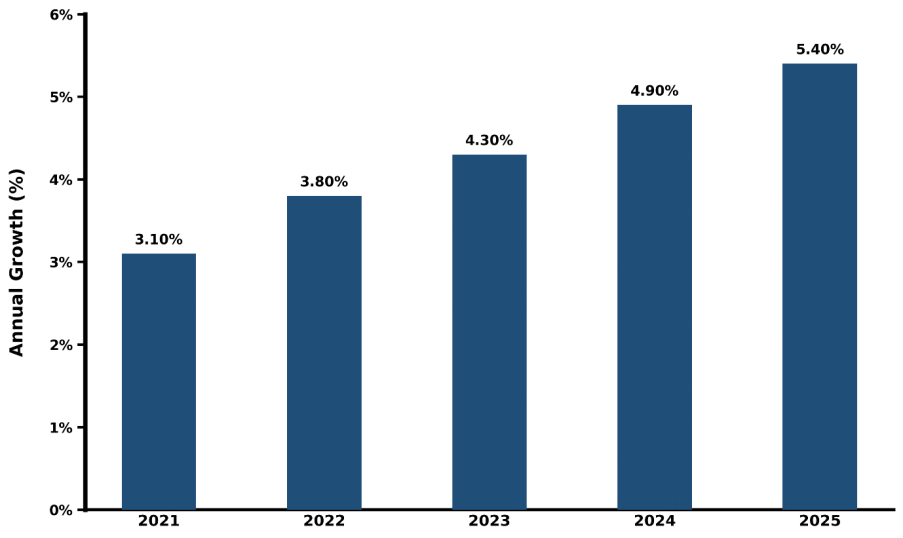
The table below presents the year-wise growth rates along with the key drivers influencing the market.
| Year | Est. Annual Growth (%) | Growth Drivers |
| 2021 | 3.1% | Rising adoption of AI-integrated digital imaging systems |
| 2022 | 3.8% | Increased government funding for precision medicine R&D |
| 2023 | 4.3% | Growing demand for minimally invasive surgical planning |
| 2024 | 4.9% | Expansion of private diagnostic imaging networks |
| 2025 | 5.4% | Integration of advanced 3D visualization software in clinics |
Topics Covered in the South Korea 3D Medical Imaging Devices Market Report
The South Korea 3D Medical Imaging Devices Market report thoroughly covers the market by Device Type, Application and End Use. The market report provides an unbiased and detailed analysis of ongoing market trends, opportunities/high growth areas, and market drivers, which help stakeholders devise and align their market strategies according to the current and future market dynamics.
South Korea 3D Medical Imaging Devices Market Highlights
| Report Name | South Korea 3D Medical Imaging Devices Market |
| Forecast period | 2026-2032 |
| CAGR | 5.8% |
| Growing Sector | Hospitals & Diagnostic Imaging Centers |
South Korea 3D Medical Imaging Devices Market Synopsis
South Korea 3D Medical Imaging Devices Market is set to experience significant growth owing to high demand for accurate diagnosis and improved medical infrastructure coupled with constant encouragement by the government for better technologies in the medical field. In essence, the use of 3D imaging devices, such as the high-resolution CT and MRI machines, enables clinicians to have an accurate view of the anatomy involved, thus improving both accuracy and speed of diagnosis. Moreover, there has been increased application of artificial intelligence in imaging software.
Evaluation of Growth Drivers in the South Korea 3D Medical Imaging Devices Market (2026-2032)
Below mentioned are some prominent drivers and their influence on the market dynamics:
| Drivers | Primary Segments Affected | Why it Matters (Evidence) |
| Integration of AI in Imaging | Software, CT Devices | Automated analysis reduces radiologist fatigue and increases detection speeds. |
| Rising Aging Population | Oncology, MRI Equipment | Higher prevalence of chronic conditions requires frequent, high-detail scans. |
| Regulatory Fast Track Approvals | All Types, Hospitals | Accelerated approval processes ensure faster delivery of innovative products. |
| Advances in 3-D Imaging | Software, Ultrasound | More efficient imaging results in improved surgical procedures. |
| Medical Tourism | All Types, Hospitals | The high degree of technological advancement is attracting overseas patients. |
South Korea 3D Medical Imaging Devices Market is expected to grow at the CAGR of 5.8% during the forecast period of 2026-2032. Growth is driven by the rapid adoption of digital healthcare solutions, the rising prevalence of chronic diseases requiring precise imaging, and government initiatives promoting medical device innovation. Additional contributions come from the expansion of specialised diagnostic clinics and continuous research into software-defined imaging technologies, which are collectively enhancing the country’s capability to provide high-quality, patient-centric diagnostic services nationwide.
Evaluation of Restraints in the South Korea 3D Medical Imaging Devices Market
Below mentioned are some major restraints and their influence on the market dynamics:
| Restraints | Primary Segments Affected | What This Means (Evidence) |
| High Implementation Costs | MRI, CT Scanners | Expensive capital equipment limits adoption in smaller, regional hospitals. |
| Cybersecurity Risks | Software, Cloud Systems | Concerns over sensitive patient data security hinder digital integration. |
| Lack of Specialist Workforce | Specialists, Diagnostic Centres | Difficulty in finding specialist radiologists who have experience with using sophisticated 3D imaging software. |
| Barriers to Regulatory Compliance | Hardware, Software | High safety requirements increase the time needed to introduce new equipment. |
| Incompatibility Issues | Software, Hybrid Equipment | Inability to transfer imaging data due to incompatible imaging systems. |
South Korea 3D Medical Imaging Devices Market Challenges
Irrespective of massive growth and development, the South Korea 3D Medical Imaging Devices Market Growth faces several challenges, such as the high capital expenditure required for advanced 3D hardware, complex data privacy regulations for imaging software, and a growing dependency on specialised technical maintenance. In addition to this, the challenge of integrating multi-vendor diagnostic software across different healthcare ecosystems, persistent shortages of expert radiologists proficient in 3D reconstruction, and economic constraints faced by secondary health facilities significantly reduce the rapid penetration of these advanced technological solutions.
South Korea 3D Medical Imaging Devices Market Trends
Key trends evaluating the landscape of the South Korea 3D Medical Imaging Devices Market are:
- AI-Driven Automated Reconstruction: Rapid deployment of deep-learning algorithms to automate 3D image reconstruction, significantly reducing post-processing time for radiologists.
- Expansion of Portable 3D Imaging: Increasing use of compact, high-performance 3D ultrasound systems in outpatient clinics for point-of-care diagnostics.
- Cloud-Based Diagnostic Collaboration: Shift toward cloud-integrated platforms allowing multidisciplinary teams to share and analyze 3D volumes remotely in real-time.
- Virtual Reality (VR) Surgery Planning: Rising trend of converting 3D medical scans into immersive VR environments for preoperative rehearsal by surgeons.
Investment Opportunities in the South Korea 3D Medical Imaging Devices Market
Some of the key investment areas in the South Korea 3D Medical Imaging Devices Market are:
- AI Software Development: Investments made towards building proprietary software that increases resolution and speed within already present 3D CT and MRI hardware systems.
- Regional Diagnostic Centers: Investment into centers dedicated solely to diagnostic imaging that fills the regional diagnostic imaging void.
- Tele-Radiology Systems: Investment into highly secured networks that enable the rapid transfer of large quantities of data through 3D imaging.
- Training Centers for Medical Personnel: Establishment of medical schools dedicated to training professionals in interpreting 3D images.
Top 5 Leading Players in the South Korea 3D Medical Imaging Devices Market
Some leading players operating in the South Korea 3D Medical Imaging Devices Market include:
1. Samsung Medison Co., Ltd.
| Company Name | Samsung Medison Co., Ltd. |
|---|---|
| Established Year | 1985 |
| Headquarters | Hongcheon, South Korea |
| Website | Click Here |
Samsung Medison is a global leader in high-end ultrasound systems, providing advanced 3D/4D imaging technologies widely used in obstetric, gynecological, and general diagnostic medical practices.
2. GE Healthcare
| Company Name | GE Healthcare |
|---|---|
| Established Year | 1994 |
| Headquarters | Chicago, USA |
| Website | Click Here |
GE Healthcare delivers a comprehensive suite of 3D-capable diagnostic imaging systems including MRI and CT scanners that drive efficiency in cancer and cardiovascular disease management.
3. Siemens Healthineers
| Company Name | Siemens Healthineers |
|---|---|
| Established Year | 1847 |
| Headquarters | Erlangen, Germany |
| Website | Click Here |
Siemens Healthineers provides state-of-the-art 3D imaging hardware and software solutions that improve diagnostic precision and clinical workflows for hospitals across the South Korean healthcare system.
4. Koninklijke Philips N.V.
| Company Name | Koninklijke Philips N.V. |
|---|---|
| Established Year | 1891 |
| Headquarters | Amsterdam, Netherlands |
| Website | Click Here |
Philips offers a robust portfolio of 3D imaging innovations, focusing on integrated solutions for cardiology and oncology that assist in early detection and personalized patient care.
5. Canon Medical Systems Corporation
| Company Name | Canon Medical Systems Corporation |
|---|---|
| Established Year | 1915 |
| Headquarters | Otawara, Japan |
| Website | Click Here |
Canon Medical provides advanced 3D imaging technologies, including high-definition CT and X-ray systems, known for their diagnostic clarity and ease of use in clinical settings.
Government Initiatives Being Implemented in the South Korea 3D Medical Imaging Devices Market
According to the South Korean Government Data, major initiatives that are being implemented are mentioned below:
- Strategic Initiative for Digital Healthcare Innovations: The government is investing more than USD 300 million in the creation of AI-powered medical devices by offering grants to facilitate research and development of advanced imaging technology.
- Immediate Market Access Initiative for Medical Technology: New regulations introduced in 2026 allow innovative 3D imaging technology that meets the set clinical criteria to enter the market three times quicker than previously.
- Smart Hospitals Infrastructure Development Initiative: Government funding to upgrade the infrastructure of existing hospitals through equipping them with smart diagnostic and surgical instruments featuring 3D imaging technology.
- National Initiative for Standardized Medical Imaging Data: Policy measures designed to promote standardization of medical data regarding image storage and exchange in all hospitals regardless of ownership.
Source: https://www.mohw.go.kr/
Future Insights of the South Korea 3D Medical Imaging Devices Market
South Korea 3D Medical Imaging Devices Industry outlook remains highly optimistic as the nation accelerates its digital transformation in the healthcare sector. The future trajectory will be primarily influenced by the seamless integration of AI-driven analytical tools with standard imaging hardware, a push toward ubiquitous telemedicine, and increased investments in high-fidelity 3D visualisation. This will be facilitated by the presence of strong regulatory backing along with a concentration on precision medicine, leading to the development of an efficient diagnostic environment and ensuring market sustainability in the long run.
Market Segmentation Analysis
The report offers a comprehensive study of the subsequent market segments and their leading categories:
By Device Type
According to Mona, Senior Research Analyst, 6Wresearch, Computed Tomography (CT) systems held the largest market share in 2025 at 36.2%. Driven by rising oncology cases and the need for rapid, high-resolution 3D scans, CT hardware is projected to maintain a strong growth momentum throughout the forecast period.
By Application
Oncology accounted for the dominant 41.5% share in 2025. The growth in 3D tumor mapping applications is expected to make this the most rapidly growing application due to its importance in the achievement of precision medical results within the South Korean health care system.
By End Use
The hospital market share in 2025 remained at 58.3%, where they functioned as the center hub for the advanced diagnostic technologies. The consistent investment in upgrading the radiology equipment with 3D capabilities guarantees their dominance in the market up to 2032.
Note: Market size estimations and growth projections presented in this report are based on 6Wresearch’s advanced forecasting approach, validated with industry datasets as of June 2026.
Key Attractiveness of the Report
- 10 Years of Market Numbers.
- Historical Data Starting from 2022 to 2025.
- Base Year: 2025.
- Forecast Data until 2032.
- Key Performance Indicators Impacting the Market.
- Major Upcoming Developments and Projects.
Key Highlights of the Report:
- South Korea 3D Medical Imaging Devices Market Outlook
- Market Size of South Korea 3D Medical Imaging Devices Market, 2025
- Forecast of South Korea 3D Medical Imaging Devices Market, 2032
- Historical Data and Forecast of South Korea 3D Medical Imaging Devices Revenues & Volume for the Period 2022-2032
- South Korea 3D Medical Imaging Devices Market Trend Evolution
- South Korea 3D Medical Imaging Devices Market Drivers and Challenges
- South Korea 3D Medical Imaging Devices Price Trends
- South Korea 3D Medical Imaging Devices Porter's Five Forces
- South Korea 3D Medical Imaging Devices Industry Life Cycle
- Historical Data and Forecast of South Korea 3D Medical Imaging Devices Market Revenues & Volume By Device Type for the Period 2022-2032
- Historical Data and Forecast of South Korea 3D Medical Imaging Devices Market Revenues & Volume By Hardware for the Period 2022-2032
- Historical Data and Forecast of South Korea 3D Medical Imaging Devices Market Revenues & Volume By X-ray Devices for the Period 2022-2032
- Historical Data and Forecast of South Korea 3D Medical Imaging Devices Market Revenues & Volume By CT Devices for the Period 2022-2032
- Historical Data and Forecast of South Korea 3D Medical Imaging Devices Market Revenues & Volume By Ultrasound Systems for the Period 2022-2032
- Historical Data and Forecast of South Korea 3D Medical Imaging Devices Market Revenues & Volume By MRI Equipment for the Period 2022 - 2032
- Historical Data and Forecast of South Korea 3D Medical Imaging Devices Market Revenues & Volume By Software for the Period 2022 - 2032
- Historical Data and Forecast of South Korea 3D Medical Imaging Devices Market Revenues & Volume By Application for the Period 2022-2032
- Historical Data and Forecast of South Korea 3D Medical Imaging Devices Market Revenues & Volume By Oncology for the Period 2022-2032
- Historical Data and Forecast of South Korea 3D Medical Imaging Devices Market Revenues & Volume By Cardiology for the Period 2022-2032
- Historical Data and Forecast of South Korea 3D Medical Imaging Devices Market Revenues & Volume By Orthopedic for the Period 2022-2032
- Historical Data and Forecast of South Korea 3D Medical Imaging Devices Market Revenues & Volume By Gynecology for the Period 2022-2032
- Historical Data and Forecast of South Korea 3D Medical Imaging Devices Market Revenues & Volume By Others for the Period 2022 - 2032
- Historical Data and Forecast of South Korea 3D Medical Imaging Devices Market Revenues & Volume By End Use for the Period 2022-2032
- Historical Data and Forecast of South Korea 3D Medical Imaging Devices Market Revenues & Volume By Hospitals for the Period 2022-2032
- Historical Data and Forecast of South Korea 3D Medical Imaging Devices Market Revenues & Volume By Diagnostic Imaging Centers for the Period 2022-2032
- Historical Data and Forecast of South Korea 3D Medical Imaging Devices Market Revenues & Volume By Others for the Period 2022-2032
- Historical Data and Forecast of South Korea 3D Medical Imaging Devices Market Revenues & Volume By Clinics for the Period 2022-2032
- South Korea 3D Medical Imaging Devices Import Export Trade Statistics
- Market Opportunity Assessment By Device Type
- Market Opportunity Assessment By Application
- Market Opportunity Assessment By End Use
- South Korea 3D Medical Imaging Devices Top Companies Market Share
- South Korea 3D Medical Imaging Devices Competitive Benchmarking By Technical and Operational Parameters
- South Korea 3D Medical Imaging Devices Company Profiles
- South Korea 3D Medical Imaging Devices Key Strategic Recommendations
Market Covered
The report offers a comprehensive study of the subsequent market segments:
By Device Type
- Hardware
- X-ray Devices
- CT Devices
- Ultrasound Systems
- MRI Equipment
- Software
By Application
- Oncology
- Cardiology
- Orthopedic
- Gynecology
- Others
By End Use
- Hospitals
- Diagnostic Imaging Centers
- Others
- Clinics
South Korea 3D Medical Imaging Devices Market (2026-2032): FAQs
South Korea 3D Medical Imaging Devices Market is projected to grow at a CAGR of 5.8% between 2026-2032.
Some of the dominant firms in the market include Samsung Medison, GE Healthcare, Siemens Healthineers, Philips, and Canon Medical Systems.
The competition is mainly because of consistent innovation in AI software, device performance improvement, and integration of cost-effective diagnostic workflow.
The market is increasingly shifting toward AI-assisted 3D visualization and the integration of cloud-based platforms for real-time surgical collaboration.
6Wresearch actively monitors the South Korea 3D Medical Imaging Devices Market and publishes its comprehensive annual report, highlighting emerging trends, growth drivers, revenue analysis, and forecast outlook. Our insights help businesses to make data-backed strategic decisions with ongoing market dynamics. Our analysts track relevent industries related to the South Korea 3D Medical Imaging Devices Market, allowing our clients with actionable intelligence and reliable forecasts tailored to emerging regional needs.
Yes, we provide customisation as per your requirements. To learn more, feel free to contact us on sales@6wresearch.com
| 1 Executive Summary |
| 2 Introduction |
| 2.1 Key Highlights of the Report |
| 2.2 Report Description |
| 2.3 Market Scope & Segmentation |
| 2.4 Research Methodology |
| 2.5 Assumptions |
| 3 South Korea 3D Medical Imaging Devices Market Overview |
| 3.1 South Korea Country Macro Economic Indicators |
| 3.2 South Korea 3D Medical Imaging Devices Market Revenues & Volume, 2022 & 2032F |
| 3.3 South Korea 3D Medical Imaging Devices Market - Industry Life Cycle |
| 3.4 South Korea 3D Medical Imaging Devices Market - Porter's Five Forces |
| 3.5 South Korea 3D Medical Imaging Devices Market Revenues & Volume Share, By Device Type, 2022 & 2032F |
| 3.6 South Korea 3D Medical Imaging Devices Market Revenues & Volume Share, By Application, 2022 & 2032F |
| 3.7 South Korea 3D Medical Imaging Devices Market Revenues & Volume Share, By End Use, 2022 & 2032F |
| 4 South Korea 3D Medical Imaging Devices Market Dynamics |
| 4.1 Impact Analysis |
| 4.2 Market Drivers |
| 4.2.1 Increasing demand for advanced diagnostic imaging technologies |
| 4.2.2 Growing prevalence of chronic diseases requiring detailed imaging for accurate diagnosis and treatment |
| 4.2.3 Technological advancements leading to improved imaging quality and diagnostic accuracy |
| 4.3 Market Restraints |
| 4.3.1 High cost associated with 3D medical imaging devices |
| 4.3.2 Limited reimbursement policies for advanced imaging procedures |
| 4.3.3 Regulatory challenges and compliance requirements for medical imaging devices |
| 5 South Korea 3D Medical Imaging Devices Market Trends |
| 6 South Korea 3D Medical Imaging Devices Market, By Types |
| 6.1 South Korea 3D Medical Imaging Devices Market, By Device Type |
| 6.1.1 Overview and Analysis |
| 6.1.2 South Korea 3D Medical Imaging Devices Market Revenues & Volume, By Device Type, 2022 - 2032F |
| 6.1.3 South Korea 3D Medical Imaging Devices Market Revenues & Volume, By Hardware, 2022 - 2032F |
| 6.1.4 South Korea 3D Medical Imaging Devices Market Revenues & Volume, By X-ray Devices, 2022 - 2032F |
| 6.1.5 South Korea 3D Medical Imaging Devices Market Revenues & Volume, By CT Devices, 2022 - 2032F |
| 6.1.6 South Korea 3D Medical Imaging Devices Market Revenues & Volume, By Ultrasound Systems, 2022 - 2032F |
| 6.1.7 South Korea 3D Medical Imaging Devices Market Revenues & Volume, By MRI Equipment, 2022 - 2032F |
| 6.1.8 South Korea 3D Medical Imaging Devices Market Revenues & Volume, By Software, 2022 - 2029F |
| 6.2 South Korea 3D Medical Imaging Devices Market, By Application |
| 6.2.1 Overview and Analysis |
| 6.2.2 South Korea 3D Medical Imaging Devices Market Revenues & Volume, By Oncology, 2022 - 2032F |
| 6.2.3 South Korea 3D Medical Imaging Devices Market Revenues & Volume, By Cardiology, 2022 - 2032F |
| 6.2.4 South Korea 3D Medical Imaging Devices Market Revenues & Volume, By Orthopedic, 2022 - 2032F |
| 6.2.5 South Korea 3D Medical Imaging Devices Market Revenues & Volume, By Gynecology, 2022 - 2032F |
| 6.2.6 South Korea 3D Medical Imaging Devices Market Revenues & Volume, By Others, 2022 - 2032F |
| 6.3 South Korea 3D Medical Imaging Devices Market, By End Use |
| 6.3.1 Overview and Analysis |
| 6.3.2 South Korea 3D Medical Imaging Devices Market Revenues & Volume, By Hospitals, 2022 - 2032F |
| 6.3.3 South Korea 3D Medical Imaging Devices Market Revenues & Volume, By Diagnostic Imaging Centers, 2022 - 2032F |
| 6.3.4 South Korea 3D Medical Imaging Devices Market Revenues & Volume, By Others, 2022 - 2032F |
| 6.3.5 South Korea 3D Medical Imaging Devices Market Revenues & Volume, By Clinics, 2022 - 2032F |
| 7 South Korea 3D Medical Imaging Devices Market Import-Export Trade Statistics |
| 7.1 South Korea 3D Medical Imaging Devices Market Export to Major Countries |
| 7.2 South Korea 3D Medical Imaging Devices Market Imports from Major Countries |
| 8 South Korea 3D Medical Imaging Devices Market Key Performance Indicators |
| 8.1 Adoption rate of 3D medical imaging devices in hospitals and diagnostic centers |
| 8.2 Average waiting time for patients to undergo 3D medical imaging procedures |
| 8.3 Percentage of healthcare professionals trained in operating and interpreting results from 3D medical imaging devices |
| 9 South Korea 3D Medical Imaging Devices Market - Opportunity Assessment |
| 9.1 South Korea 3D Medical Imaging Devices Market Opportunity Assessment, By Device Type, 2022 & 2032F |
| 9.2 South Korea 3D Medical Imaging Devices Market Opportunity Assessment, By Application, 2022 & 2032F |
| 9.3 South Korea 3D Medical Imaging Devices Market Opportunity Assessment, By End Use, 2022 & 2032F |
| 10 South Korea 3D Medical Imaging Devices Market - Competitive Landscape |
| 10.1 South Korea 3D Medical Imaging Devices Market Revenue Share, By Companies, 2025 |
| 10.2 South Korea 3D Medical Imaging Devices Market Competitive Benchmarking, By Operating and Technical Parameters |
| 11 Company Profiles |
| 12 Recommendations |
| 13 Disclaimer |
Global Go To Market Strategy - 2030
Export potential enables firms to identify high-growth global markets with greater confidence by combining advanced trade intelligence with a structured quantitative methodology. The framework analyzes emerging demand trends and country-level import patterns while integrating macroeconomic and trade datasets such as GDP and population forecasts, bilateral import–export flows, tariff structures, elasticity differentials between developed and developing economies, geographic distance, and import demand projections. Using weighted trade values from 2020–2024 as the base period to project country-to-country export potential for 2030, these inputs are operationalized through calculated drivers such as gravity model parameters, tariff impact factors, and projected GDP per-capita growth. Through an analysis of hidden potentials, demand hotspots, and market conditions that are most favorable to success, this method enables firms to focus on target countries, maximize returns, and global expansion with data, backed by accuracy.
By factoring in the projected importer demand gap that is currently unmet and could be potential opportunity, it identifies the potential for the Exporter (Country) among 190 countries, against the general trade analysis, which identifies the biggest importer or exporter.
To discover high-growth global markets and optimize your business strategy:
Click Here
Pricing
- Single User License$ 1,995
- Department License$ 2,400
- Site License$ 3,120
- Global License$ 3,795

Leadership Perspectives from Industry Events
Search
Thought Leadership and Analyst Meet





Our Clients








6WResearch In News
- India Air Conditioner Market Set for Strong Rebound in 2026 After Weather-Led Correction and GST-Driven Recovery: 6Wresearch
- ADAS in India: How Automatic Emergency Braking, Blind Spot Detection & Driver Monitoring are Transforming Road Safety
- Doha a strategic location for EV manufacturing hub: IPA Qatar
- Demand for luxury TVs surging in the GCC, says Samsung
- Empowering Growth: The Thriving Journey of Bangladesh’s Cable Industry
- Demand for luxury TVs surging in the GCC, says Samsung
Latest Reports
- Poland Fire Protection Systems Market (2026-2032)
- Cape Verde Portable Hand-Thrown Extinguisher Market (2026-2032)
- Canada Portable Hand-Thrown Extinguisher Market (2026-2032)
- Cameroon Portable Hand-Thrown Extinguisher Market (2026-2032)
- Burundi Portable Hand-Thrown Extinguisher Market (2026-2032)
- Burkina Faso Portable Hand-Thrown Extinguisher Market (2026-2032)
- Bulgaria Portable Hand-Thrown Extinguisher Market (2026-2032)
- Brunei Portable Hand-Thrown Extinguisher Market (2026-2032)
- Botswana Portable Hand-Thrown Extinguisher Market (2026-2032)
- Bosnia and Herzegovina Portable Hand-Thrown Extinguisher Market (2026-2032)
Industry Events and Analyst Meet

HIMTEX 2026

India Refining Summit 2026

India EV Show 2026

EV tech India Expo 2026

Auto Tech Asia 2026
Whitepaper
- Middle East & Africa Commercial Security Market Click here to view more.
- Middle East & Africa Fire Safety Systems & Equipment Market Click here to view more.
- GCC Drone Market Click here to view more.
- Middle East Lighting Fixture Market Click here to view more.
- GCC Physical & Perimeter Security Market Click here to view more.


