South Korea 3D Printed Eyewear Market (2026-2032) | Industry, Analysis, Share, Outlook, Segmentation, Drivers, Investment Trends, Competitive, Challenges, Growth, Consumer Insights, Value, Demand, Competition, Strategy, Opportunities, Trends, Restraints, Companies, Revenue, Size, Segments, Forecast, Strategic Insights, Pricing Analysis, Supply
Market Forecast By Material Type (Nylon, Metal, Resins, Others), By Technology (SLS, SLA, Multi Jet Fusion, DLP, FDM), By Application (Sunglasses, Optical Glasses, Sports Glasses, Safety glasses) And Competitive Landscape
| Product Code: ETC11537002 | Publication Date: Apr 2025 | Updated Date: Jun 2026 | Product Type: Market Research Report | |
| Publisher: 6Wresearch | Author: Bhawna Singh | No. of Pages: 70 | No. of Figures: 35 | No. of Tables: 5 |
South Korea 3D Printed Eyewear Market Growth Rate
According to 6Wresearch internal database and industry insights, the South Korea 3D Printed Eyewear Market is projected to grow at a compound annual growth rate (CAGR) of 10.2% during the forecast period (2026-2032).
South Korea 3D Eye Tracking Software Market Year-wise Growth Rate and Key Drivers
This graph illustrates the annual growth rates of the South Korea 3D Printed Eyewear Market from 2021 to 2032, highlighting a steady upward trajectory and projected market expansion over the forecast period.
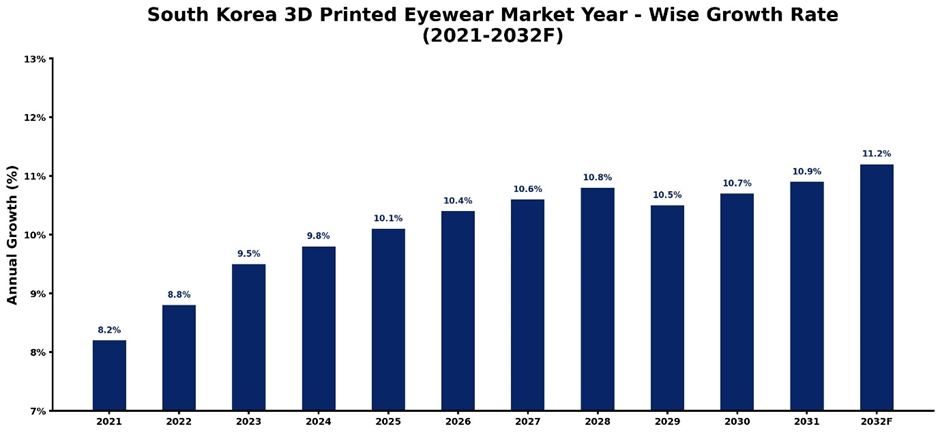
The following table summarizes the historical and forecasted growth rates of the South Korea 3D Printed Eyewear Market, along with the rationale behind each year’s performance.
| Year | Estimated Growth (%) | Market Rationale |
| 2021 | 8.2% | Early adoption phase; focus on prototyping and high-end niche designs. |
| 2022 | 8.8% | Rise in consumer awareness regarding personalized eyewear benefits. |
| 2023 | 9.5% | Increased integration of 3D scanning apps in retail eyewear stores. |
| 2024 | 9.8% | Expansion of local 3D-printed luxury brand portfolios. |
| 2025 | 10.1% | Growth in industrial additive manufacturing infrastructure investment. |
| 2026 | 10.4% | Scaling of domestic manufacturing capacity and improved supply chains. |
| 2027 | 10.6% | Integration of AI-driven biometric facial mapping for custom fits. |
| 2028 | 10.8% | Market maturation with wider adoption of sustainable bio-resins. |
| 2029 | 10.5% | Slight stabilization due to competitive pricing and market saturation. |
| 2030 | 10.7% | Introduction of advanced multi-material printing for complex frames. |
| 2031 | 10.9% | Expansion of government-led R&D and smart factory collaborations. |
| 2032 | 11.2% | Full-scale integration into mainstream national eyewear retail chains. |
Topics Covered in the South Korea 3D Printed Eyewear Market Report
The South Korea 3D Printed Eyewear Market report thoroughly covers the market by Material Type, Technology and Application. The market report provides an unbiased and detailed analysis of ongoing market trends, opportunities/high growth areas, and market drivers, which help stakeholders devise and align their market strategies according to the current and future market dynamics.
South Korea 3D Printed Eyewear Market Highlights
| Report Name | South Korea 3D Printed Eyewear Market |
| Forecast period | 2026-2032 |
| CAGR | 10.2% |
| Growing Sector | Optical Retailers & Specialty Fashion Boutiques |
South Korea 3D Printed Eyewear Market Synopsis
South Korea 3D Printed Eyewear Market is rapidly gaining momentum as consumers and brands embrace customization, lightweight designs, and innovative materials. Using 3D printing technology, eyewear manufacturers can create frames that are highly personalized, ergonomic, and stylish, while also reducing waste and production time compared to traditional methods. The market spans prescription glasses, sunglasses, and fashion eyewear, with materials including plastics, metal alloys, and bio-based polymers. Key drivers include rising demand for unique and tailor-made frames, the adoption of cutting-edge manufacturing technology, and the growing influence of e-commerce platforms that allow direct-to-consumer sales.
Evaluation of Growth Drivers in the South Korea 3D Printed Eyewear Market (2026-2032)
Below mentioned are some prominent drivers and their influence on the market dynamics:
| Drivers | Primary Segments Affected | Why it Matters (Evidence) |
| Demand for Personalization | Fashion & Optical | Consumers pay premiums for custom-fitted frames based on biometric data. |
| Advances in Additive Tech | All Types | Faster printing speeds and higher surface quality rival injection moulding. |
| Lightweight Material Usage | Metal & Nylon | The recently developed resin 3D printers, for speed and surface finish, are comparable to the injection moulding process. |
| Digital Scanning Integration | Hospitals & Retail | Smartphone apps allow instant 3D facial mapping for remote custom orders. |
| Government R&D Support | All Types | Funding for smart factories increases manufacturing efficiency and output. |
South Korea 3D Printed Eyewear Market is expected to grow at the CAGR of 10.2% during the forecast period of 2026-2032. Growth comes from quickly adopting tailor-made design tech, using fancy new materials like titanium alloys, and growing smart manufacturing spaces. Local eyeglass stores also chip in by adding 3D printing to their services. Plus, the government is helping with Industry 4.0 plans to upgrade factories, making sure the whole country produces top-notch, eco-friendlier eyewear efficiently.
Evaluation of Restraints in the South Korea 3D Printed Eyewear Market
Below mentioned are some major restraints and their influence on the market dynamics:
| Restraints | Primary Segments Affected | What This Means (Evidence) |
| High Initial Equipment Cost | Industrial Manufacturing | Expensive printers limit production for small-scale optical boutiques. |
| Limited Material Range | Resins & Polymers | Lack of diverse, skin-safe, and UV-resistant materials slows adoption. |
| Lack of Skilled Labor | Design & Software | Shortage of designers proficient in generative and CAD software. |
| High Cost of Customization | Consumer Sales | Premium pricing of custom products deters price-sensitive buyers. |
| Complex Supply Chains | Logistics | Dependency on specialized imported powders increases operational costs. |
South Korea 3D Printed Eyewear Market Challenges
South Korea 3D Printed Eyewear Industry faces several challenges, such as the high cost of industrial-grade 3D printers, dependency on expensive imported specialised materials, and limited technical expertise in complex generative design. In addition to this, the high price point of custom-fitted products compared to traditional mass-produced frames and the technical challenges in achieving mass-market scalability of complex designs continue to impact Market Growth and constrain broader consumer accessibility.
South Korea 3D Printed Eyewear Market Trends
Core Trends Currently Influencing the South Korea 3D Printed Eyewear Market:
- Generative Design Algorithms: Applying Artificial Intelligence-empowered Computer-Aided Design instruments for developing structurally efficient frames, which are capable of reducing the use of material by 25% while maintaining the same level of mechanical strength.
- Smartphone Facial Biometrics: The extensive implementation of smartphone-enabled 3D scanning is set to be a significant feature of the future: individuals will be able to identify more than 100 facial points for the production of highly accurate custom frames.
- Eco-Friendly Material Shift: The increasing recognition of the closet desire for sustainable, bio-based, and recycled nylon powders by consumers is exacerbating the second eco-friendly legislation for all the countries of the world.
- On-Demand Local Production: The transformation of optical retailers into becoming print centres for in-store or locally-based hubs with a view to reduced stocking and same-day delivery of customized products.
Investment Opportunities in the South Korea 3D Printed Eyewear Market
High-Potential Investment Frontiers in the South Korea 3D Printed Eyewear Market include:
- Advanced Diagnostic Hubs: Investing in high-precision 3D scanning facilities within major cities to provide data for custom eyewear manufacturing.
- Sustainable Material R&D: Our efforts are directed at the local development of high performance, skin-friendly, and UV-resistant resins and powders, which will help eliminate the need for costly imports.
- Software Training Academies: Setting up highly focused institutions to prepare designers in generative design and additive manufacturing in particular for the eyewear industry.
- Direct-to-Consumer Custom Platforms: Building online commercial platforms that are able to combine the remote recording of biometric data with the automated production and direct delivery to home.
Top 5 Leading Players in the South Korea 3D Printed Eyewear Market
Key Organizations Steering the South Korea 3D Printed Eyewear Market include:
1. Breezm
| Company Name | Breezm |
|---|---|
| Established Year | 2021 |
| Headquarters | Seoul, South Korea |
| Official Website | Click Here |
Breezm utilizes proprietary facial scanning technology to offer highly customized 3D-printed glasses, aiming to provide perfect-fit solutions through an innovative, data-driven retail experience.
2. EOS GmbH
| Company Name | EOS GmbH |
|---|---|
| Established Year | 1989 |
| Headquarters | Krailling, Germany |
| Official Website | Click Here |
EOS provides advanced industrial 3D printing systems, enabling high-precision production of titanium and polymer eyewear frames with exceptional structural integrity and lightweight properties.
3. Formlabs Inc.
| Company Name | Formlabs Inc. |
|---|---|
| Established Year | 2011 |
| Headquarters | Massachusetts, USA |
| Official Website | Click Here |
Formlabs offers specialized stereolithography (SLA) hardware and skin-safe, high-durability resins, facilitating the production of complex, high-resolution optical frames for the fashion-conscious consumer.
4. Materialise NV
| Company Name | Materialise NV |
|---|---|
| Established Year | 1990 |
| Headquarters | Leuven, Belgium |
| Official Website | Click Here |
Materialise provides essential 3D printing software and manufacturing services, enabling eyewear brands to scale designs and optimize production workflows for high-quality, customized products.
5. HP Inc.
| Company Name | HP Inc. |
|---|---|
| Established Year | 1939 |
| Headquarters | California, USA |
| Official Website | Click Here |
HP offers Multi Jet Fusion (MJF) technology that supports the high-speed production of durable, colorful, and lightweight nylon frames, suitable for meeting large-scale consumer fashion demands.
Government Initiatives Being Implemented in the South Korea 3D Printed Eyewear Market
According to South Korean Government Data, major initiatives being implemented are:
- Manufacturing Industry Innovation 3.0: The Ministry of Trade, Industry and Energy (MOTIE) plan to promote the use of smart factories and 3D printing technologies among small and medium manufacturers by offering them financial support.
- Digital Transformation Research Fund: The government has injected approximately $1.9 billion over several cycles to support SMEs' research into automated manufacturing, data collection and AI-based industrial software.
- Additive Manufacturing Standardization: Ministry of Science and ICT and international organizations have been working together to make domestic 3D printing standards consistent with global standards to produce better export quality.
- Smart Manufacturing Workforce Program: The government-financed education schemes that collaborate with technical schools to train 40,000 skilled workers in the operation and design of highly automated manufacturing systems.
Future Insights of the South Korea 3D Printed Eyewear Market
The outlook for the Market is promising due to the impact of improved manufacturing infrastructure, increasing support for the Additive Manufacturing Market through investments in 3D scanning technologies, professional training programs for industrial designers, and a focus on personalized consumer fashion trends. The integration of smart factory solutions and the shift toward sustainable local production will ultimately boost opportunities for the South Korea 3D Printed Eyewear Market Growth, ensuring the sector remains at the forefront of the global optical industry.
Market Segmentation Analysis
The report offers a comprehensive study of the subsequent market segments and their leading categories:
By Material Type
According to 6Wresearch, By material, Nylon dominated with 51.2% share of the South Korea 3D printed eyewear market in 2025, while Resins are projected to expand at a 12.5% CAGR during 2026–2032, driven by higher resolution and surface quality in professional retail applications.
By Technology
By technology, Selective Laser Sintering (SLS) dominated with 45.6% share in 2025, driven by its superior strength and industrial-grade finishing, while Multi Jet Fusion is projected to grow at an 11.4% CAGR during 2026–2032, fueled by its fast print cycles and high-volume production efficiency.
By Application
Optical Glasses led the market with a 58. 3% share in 2025, mainly due to the growing number of people requiring vision correction and the trend towards customized fit requirements.
However, Sports Glasses are expected to witness the fastest growth with a 13. 1% CAGR from 2026 to 2032, as more people are seeking not only lightweight but also high-performance and impact-resistant gear for sports.
Note: Market size estimations and growth projections presented in this report are based on 6Wresearch’s advanced forecasting approach, validated with industry datasets as of June 2026.
Key Attractiveness of the Report
- 10 Years of Market Numbers.
- Historical Data Starting from 2022 to 2025.
- Base Year: 2025.
- Forecast Data until 2032.
- Key Performance Indicators Impacting the Market.
- Major Upcoming Developments and Projects.
Key Highlights of the Report:
- South Korea 3D Printed Eyewear Market Outlook
- Market Size of South Korea 3D Printed Eyewear Market, 2025
- Forecast of South Korea 3D Printed Eyewear Market, 2032
- Historical Data and Forecast of South Korea 3D Printed Eyewear Revenues & Volume for the Period 2022-2032
- South Korea 3D Printed Eyewear Market Trend Evolution
- South Korea 3D Printed Eyewear Market Drivers and Challenges
- South Korea 3D Printed Eyewear Price Trends
- South Korea 3D Printed Eyewear Porter's Five Forces
- South Korea 3D Printed Eyewear Industry Life Cycle
- Historical Data and Forecast of South Korea 3D Printed Eyewear Market Revenues & Volume By Material Type for the Period 2022-2032
- Historical Data and Forecast of South Korea 3D Printed Eyewear Market Revenues & Volume By Nylon for the Period 2022-2032
- Historical Data and Forecast of South Korea 3D Printed Eyewear Market Revenues & Volume By Metal for the Period 2022-2032
- Historical Data and Forecast of South Korea 3D Printed Eyewear Market Revenues & Volume By Resins for the Period 2022-2032
- Historical Data and Forecast of South Korea 3D Printed Eyewear Market Revenues & Volume By Others for the Period 2022-2032
- Historical Data and Forecast of South Korea 3D Printed Eyewear Market Revenues & Volume By Technology for the Period 2022-2032
- Historical Data and Forecast of South Korea 3D Printed Eyewear Market Revenues & Volume By SLS for the Period 2022-2032
- Historical Data and Forecast of South Korea 3D Printed Eyewear Market Revenues & Volume By SLA for the Period 2022-2032
- Historical Data and Forecast of South Korea 3D Printed Eyewear Market Revenues & Volume By Multi Jet Fusion for the Period 2022-2032
- Historical Data and Forecast of South Korea 3D Printed Eyewear Market Revenues & Volume By DLP for the Period 2022-2032
- Historical Data and Forecast of South Korea 3D Printed Eyewear Market Revenues & Volume By FDM for the Period 2022 - 2032
- Historical Data and Forecast of South Korea 3D Printed Eyewear Market Revenues & Volume By Application for the Period 2022-2032
- Historical Data and Forecast of South Korea 3D Printed Eyewear Market Revenues & Volume By Sunglasses for the Period 2022-2032
- Historical Data and Forecast of South Korea 3D Printed Eyewear Market Revenues & Volume By Optical Glasses for the Period 2022-2032
- Historical Data and Forecast of South Korea 3D Printed Eyewear Market Revenues & Volume By Sports Glasses for the Period 2022-2032
- Historical Data and Forecast of South Korea 3D Printed Eyewear Market Revenues & Volume By Safety glasses for the Period 2022-2032
- South Korea 3D Printed Eyewear Import Export Trade Statistics
- Market Opportunity Assessment By Material Type
- Market Opportunity Assessment By Technology
- Market Opportunity Assessment By Application
- South Korea 3D Printed Eyewear Top Companies Market Share
- South Korea 3D Printed Eyewear Competitive Benchmarking By Technical and Operational Parameters
- South Korea 3D Printed Eyewear Company Profiles
- South Korea 3D Printed Eyewear Key Strategic Recommendations
Market Covered
The report offers a comprehensive study of the subsequent market segments:
By Material Type
- Nylon
- Metal
- Resins
- Others
By Technology
- SLS
- SLA
- Multi Jet Fusion
- DLP
- FDM
By Application
- Sunglasses
- Optical Glasses
- Sports Glasses
- Safety Glasses
South Korea 3D Printed Eyewear Market (2026-2032): FAQs
South Korea 3D Printed Eyewear Market is projected to grow at a CAGR of 10.2% between 2026-2032.
Leading companies operating in this market include Breezm, EOS GmbH, Formlabs, Materialise, and HP Inc.
Competition is primarily driven by technological innovation in 3D scanning, material diversity, and the ability of brands to provide rapid, custom-fitted products at scale.
The main barriers include the high capital expenditure required for high-grade 3D printing hardware and the limited pool of designers specialized in generative eyewear modeling.
6Wresearch actively monitors the South Korea 3D Printed Eyewear Market and publishes its comprehensive annual report, highlighting emerging trends, growth drivers, revenue analysis, and forecast outlook. Our insights help businesses to make data-backed strategic decisions with ongoing market dynamics. Our analysts track relevent industries related to the South Korea 3D Printed Eyewear Market, allowing our clients with actionable intelligence and reliable forecasts tailored to emerging regional needs.
Yes, we provide customisation as per your requirements. To learn more, feel free to contact us on sales@6wresearch.com
| 1 Executive Summary |
| 2 Introduction |
| 2.1 Key Highlights of the Report |
| 2.2 Report Description |
| 2.3 Market Scope & Segmentation |
| 2.4 Research Methodology |
| 2.5 Assumptions |
| 3 South Korea 3D Printed Eyewear Market Overview |
| 3.1 South Korea Country Macro Economic Indicators |
| 3.2 South Korea 3D Printed Eyewear Market Revenues & Volume, 2022 & 2032F |
| 3.3 South Korea 3D Printed Eyewear Market - Industry Life Cycle |
| 3.4 South Korea 3D Printed Eyewear Market - Porter's Five Forces |
| 3.5 South Korea 3D Printed Eyewear Market Revenues & Volume Share, By Material Type, 2022 & 2032F |
| 3.6 South Korea 3D Printed Eyewear Market Revenues & Volume Share, By Technology, 2022 & 2032F |
| 3.7 South Korea 3D Printed Eyewear Market Revenues & Volume Share, By Application, 2022 & 2032F |
| 4 South Korea 3D Printed Eyewear Market Dynamics |
| 4.1 Impact Analysis |
| 4.2 Market Drivers |
| 4.2.1 Increasing adoption of personalized and customized products among consumers |
| 4.2.2 Technological advancements in 3D printing technology for eyewear manufacturing |
| 4.2.3 Growing awareness about sustainability and eco-friendly production methods |
| 4.3 Market Restraints |
| 4.3.1 High initial costs associated with setting up 3D printing infrastructure |
| 4.3.2 Limited availability of skilled professionals in the field of 3D printing technology |
| 4.3.3 Regulatory challenges related to quality control and standards compliance |
| 5 South Korea 3D Printed Eyewear Market Trends |
| 6 South Korea 3D Printed Eyewear Market, By Types |
| 6.1 South Korea 3D Printed Eyewear Market, By Material Type |
| 6.1.1 Overview and Analysis |
| 6.1.2 South Korea 3D Printed Eyewear Market Revenues & Volume, By Material Type, 2022 - 2032F |
| 6.1.3 South Korea 3D Printed Eyewear Market Revenues & Volume, By Nylon, 2022 - 2032F |
| 6.1.4 South Korea 3D Printed Eyewear Market Revenues & Volume, By Metal, 2022 - 2032F |
| 6.1.5 South Korea 3D Printed Eyewear Market Revenues & Volume, By Resins, 2022 - 2032F |
| 6.1.6 South Korea 3D Printed Eyewear Market Revenues & Volume, By Others, 2022 - 2032F |
| 6.2 South Korea 3D Printed Eyewear Market, By Technology |
| 6.2.1 Overview and Analysis |
| 6.2.2 South Korea 3D Printed Eyewear Market Revenues & Volume, By SLS, 2022 - 2032F |
| 6.2.3 South Korea 3D Printed Eyewear Market Revenues & Volume, By SLA, 2022 - 2032F |
| 6.2.4 South Korea 3D Printed Eyewear Market Revenues & Volume, By Multi Jet Fusion, 2022 - 2032F |
| 6.2.5 South Korea 3D Printed Eyewear Market Revenues & Volume, By DLP, 2022 - 2032F |
| 6.2.6 South Korea 3D Printed Eyewear Market Revenues & Volume, By FDM, 2022 - 2032F |
| 6.3 South Korea 3D Printed Eyewear Market, By Application |
| 6.3.1 Overview and Analysis |
| 6.3.2 South Korea 3D Printed Eyewear Market Revenues & Volume, By Sunglasses, 2022 - 2032F |
| 6.3.3 South Korea 3D Printed Eyewear Market Revenues & Volume, By Optical Glasses, 2022 - 2032F |
| 6.3.4 South Korea 3D Printed Eyewear Market Revenues & Volume, By Sports Glasses, 2022 - 2032F |
| 6.3.5 South Korea 3D Printed Eyewear Market Revenues & Volume, By Safety glasses, 2022 - 2032F |
| 7 South Korea 3D Printed Eyewear Market Import-Export Trade Statistics |
| 7.1 South Korea 3D Printed Eyewear Market Export to Major Countries |
| 7.2 South Korea 3D Printed Eyewear Market Imports from Major Countries |
| 8 South Korea 3D Printed Eyewear Market Key Performance Indicators |
| 8.1 Adoption rate of 3D printed eyewear among consumers |
| 8.2 Rate of innovation in 3D printing technology for eyewear |
| 8.3 Percentage of 3D printed eyewear products meeting sustainability standards |
| 9 South Korea 3D Printed Eyewear Market - Opportunity Assessment |
| 9.1 South Korea 3D Printed Eyewear Market Opportunity Assessment, By Material Type, 2022 & 2032F |
| 9.2 South Korea 3D Printed Eyewear Market Opportunity Assessment, By Technology, 2022 & 2032F |
| 9.3 South Korea 3D Printed Eyewear Market Opportunity Assessment, By Application, 2022 & 2032F |
| 10 South Korea 3D Printed Eyewear Market - Competitive Landscape |
| 10.1 South Korea 3D Printed Eyewear Market Revenue Share, By Companies, 2025 |
| 10.2 South Korea 3D Printed Eyewear Market Competitive Benchmarking, By Operating and Technical Parameters |
| 11 Company Profiles |
| 12 Recommendations |
| 13 Disclaimer |
Global Go To Market Strategy - 2030
Export potential enables firms to identify high-growth global markets with greater confidence by combining advanced trade intelligence with a structured quantitative methodology. The framework analyzes emerging demand trends and country-level import patterns while integrating macroeconomic and trade datasets such as GDP and population forecasts, bilateral import–export flows, tariff structures, elasticity differentials between developed and developing economies, geographic distance, and import demand projections. Using weighted trade values from 2020–2024 as the base period to project country-to-country export potential for 2030, these inputs are operationalized through calculated drivers such as gravity model parameters, tariff impact factors, and projected GDP per-capita growth. Through an analysis of hidden potentials, demand hotspots, and market conditions that are most favorable to success, this method enables firms to focus on target countries, maximize returns, and global expansion with data, backed by accuracy.
By factoring in the projected importer demand gap that is currently unmet and could be potential opportunity, it identifies the potential for the Exporter (Country) among 190 countries, against the general trade analysis, which identifies the biggest importer or exporter.
To discover high-growth global markets and optimize your business strategy:
Click Here
Pricing
- Single User License$ 1,995
- Department License$ 2,400
- Site License$ 3,120
- Global License$ 3,795

Leadership Perspectives from Industry Events
Search
Thought Leadership and Analyst Meet





Our Clients








6WResearch In News
- India Export Attractiveness Tracker 2026
- India Air Conditioner Market Set for Strong Rebound in 2026 After Weather-Led Correction and GST-Driven Recovery: 6Wresearch
- ADAS in India: How Automatic Emergency Braking, Blind Spot Detection & Driver Monitoring are Transforming Road Safety
- Doha a strategic location for EV manufacturing hub: IPA Qatar
- Demand for luxury TVs surging in the GCC, says Samsung
- Empowering Growth: The Thriving Journey of Bangladesh’s Cable Industry
Latest Reports
- Nicaragua RPG Gaming Market (2026-2032)
- New Zealand RPG Gaming Market (2026-2032)
- Netherlands RPG Gaming Market (2026-2032)
- Nauru RPG Gaming Market (2026-2032)
- Namibia RPG Gaming Market (2026-2032)
- Mozambique RPG Gaming Market (2026-2032)
- Montenegro RPG Gaming Market (2026-2032)
- Mongolia RPG Gaming Market (2026-2032)
- Monaco RPG Gaming Market (2026-2032)
- Micronesia RPG Gaming Market (2026-2032)
Industry Events and Analyst Meet

EV India Expo 2026

HIMTEX 2026

India Refining Summit 2026

India EV Show 2026

EV tech India Expo 2026
Whitepaper
- Middle East & Africa Commercial Security Market Click here to view more.
- Middle East & Africa Fire Safety Systems & Equipment Market Click here to view more.
- GCC Drone Market Click here to view more.
- Middle East Lighting Fixture Market Click here to view more.
- GCC Physical & Perimeter Security Market Click here to view more.


