South Korea 3PL Market (2026-2032) | Opportunities, Strategy, Forecast, Size, Growth, Revenue, Strategic Insights, Supply, Pricing Analysis, Segmentation, Drivers, Competitive, Demand, Analysis, Industry, Challenges, Value, Companies, Share, Investment Trends, Consumer Insights, Competition, Trends, Restraints, Outlook, Segments
Market Forecast By Service type (Transportation, Warehousing, Distribution, Inventory Management, Packaging, Freight Forwarding, Cross-Docking, Others), By End user (Consumer Electronics, Healthcare, Telecommunication, Automotive, Retail, Food & Beverage, Industrial, Others) And Competitive Landscape
| Product Code: ETC11595562 | Publication Date: Apr 2025 | Updated Date: Jun 2026 | Product Type: Market Research Report | |
| Publisher: 6Wresearch | Author: Bhawna Singh | No. of Pages: 70 | No. of Figures: 35 | No. of Tables: 5 |
South Korea 3PL Market Growth Rate
According to 6Wresearch internal database and industry insights, the South Korea 3PL Market is projected to grow at a compound annual growth rate (CAGR) of 4.5% during the forecast period (2026-2032).
South Korea 3PL Market Year-wise Growth Rate and Key Drivers
This graph illustrates the annual growth rates of the South Korea 3PL Market from 2021 to 2032, highlighting a steady upward trajectory and projected market expansion over the forecast period.
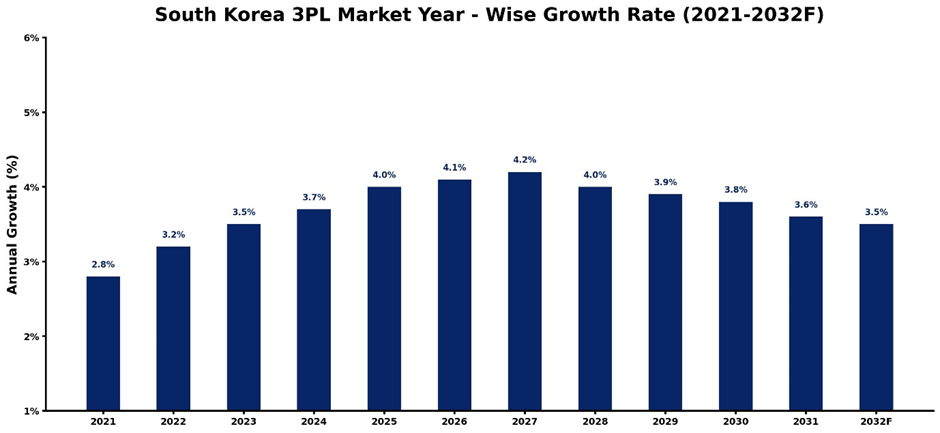
The following table summarizes the historical and forecasted growth rates of the South Korea 3PL Market, along with the rationale behind each year’s performance.
| Year | Estimated Growth | Market Rationale |
| 2021 | 2.8% | Post-COVID recovery begins; e-commerce rebound supports logistics demand |
| 2022 | 3.2% | Strong online retail expansion and supply chain normalization |
| 2023 | 3.5% | Growth in cross-border trade and warehouse automation adoption |
| 2024 | 3.7% | Rising demand for last-mile delivery and omnichannel retail logistics |
| 2025 | 4% | Expansion of e-commerce + cold-chain logistics + automotive exports |
| 2026 | 4.1% | AI-based warehouse systems and transport optimization adoption increases efficiency |
| 2027 | 4.2% | Strong international freight demand and trade integration across Asia |
| 2028 | 4% | Slight stabilization due to cost pressure and freight rate normalization |
| 2029 | 3.9% | Market maturity; efficiency-driven rather than expansion-led growth |
| 2030 | 3.8% | Sustainability regulations increase compliance cost but improve efficiency systems |
| 2031 | 3.6% | Mature logistics ecosystem; consolidation among major 3PL players |
| 2032 | 3.5% | Stable growth driven by automation, healthcare logistics, and smart supply chains |
Topics Covered in the South Korea 3PL Market Report
The South Korea 3PL Market report thoroughly covers the market by Service type and End user. The market report provides an unbiased and detailed analysis of ongoing market trends, opportunities/high growth areas, and market drivers, which help stakeholders devise and align their market strategies according to the current and future market dynamics.
South Korea 3PL Market Highlights
| Report Name | South Korea 3PL Market |
| Forecast period | 2026-2032 |
| CAGR | 4.5% |
| Growing Sector | Retail |
South Korea 3PL Market Synopsis
South Korea 3PL Market is showing huge momentum due to the increasing trend of digitization and the presence of an advanced e-commerce environment in the country. Third Party Logistics (3PL) refers to outsourcing warehousing, transportation, and logistics solutions to make the process of logistics easier and more efficient. The efforts made by the government to build smart logistics infrastructure in the country and increasing consumer preference for fast deliveries have forced businesses to adapt their logistics solutions, thereby improving efficiency.
Evaluation of Growth Drivers in the South Korea 3PL Market (2026-2032)
Below mentioned are some prominent drivers and their influence on the market dynamics:
| Drivers | Primary Segments Affected | Why it Matters (Evidence) |
| E-commerce Expansion | Warehousing, Distribution | Online retail growth necessitates high-velocity fulfilment services. |
| Smart Warehouse Tech | Inventory Management | AI and robotics improve throughput in high-density urban zones. |
| Cross-Border Trade | Freight Forwarding | Strong manufacturing exports require efficient global logistics. |
| Cold Chain Demand | Packaging, Distribution | Increasing need for temperature-controlled pharmaceutical transport. |
| Government Support | All Segments | Policies promoting smart logistics parks reduce operational costs. |
South Korea 3PL Market is expected to grow at the CAGR of 4.5% during the forecast period of 2026-2032, due to increased demand for automated supply chain management, development of distribution channels in the retail sector, and higher need for temperature control logistics. Other factors that contribute to the growth include government efforts to develop logistics centers and foreign collaborations that help improve cross-border logistics.
Evaluation of Restraints in the South Korea 3PL Market
Below mentioned are some major restraints and their influence on the market dynamics:
| Restraints | Primary Segments Affected | What This Means (Evidence) |
| High Urban Land Costs | Warehousing | Soaring real estate prices in Seoul limit facility expansion. |
| Skilled Labor Shortage | Inventory Management | Lack of tech-proficient staff hinders high-end automation. |
| Geopolitical Tensions | Freight Forwarding | Global trade disputes create uncertainty in supply routes. |
| Infrastructure Bottlenecks | Transportation | Port congestion delays impact lead times for critical imports. |
| Operational Overheads | Packaging, Others | Rising fuel and energy costs squeeze logistics profit margins. |
South Korea 3PL Market Challenges
Irrespective of massive growth and development, the South Korea 3PL Industry faces several challenges, such as soaring warehouse rental costs in prime metropolitan areas, dependency on volatile global trade routes, and difficulties in retaining tech-specialised labour. In addition to this, the market growth is further constrained by infrastructure bottlenecks at major ports and the high capital expenditure required for implementing advanced robotics, which necessitates strategic operational planning to maintain competitive pricing.
South Korea 3PL Market Trends
Key trends currently transforming the landscape of the South Korea 3PL Market are:
- Hyper-Automation: Increasing deployment of autonomous mobile robots (AMRs) in warehouses to manage peak e-commerce demand.
- Sustainable Logistics: Movement towards adopting green delivery fleets such as electric trucks to achieve carbon neutrality nationally.
- Real-Time Transparency: Broad usage of technologies based on blockchain and IoT to provide visibility regarding shipments throughout the entire process.
- Micro-Fulfilment Centers: Growing trend towards the use of small yet advanced sorting centers situated in cities for next-day delivery services.
Investment Opportunities in the South Korea 3PL Market
Investment routes that are being pursued in the South Korea 3PL Market include:
- Automation for Cold Storage: Creating advanced and temperature-controlled storage units catering to the growing demands of the health and fresh produce industries.
- Green Logistics Parks: Investment in logistics parks that will run on renewable energy resources to attract environmentally conscious customers.
- AI-based Analytics Tools: Investment in analytics platforms based on artificial intelligence to help route shipments effectively for bulk retail.
- Border Hubs: Development of border-specific freight stations to facilitate cross-border trade in Asia.
Top 5 Leading Players in the South Korea 3PL Market
Prominent industry leaders actively driving the South Korea 3PL Market include:
1. CJ Logistics
| Field | Details |
|---|---|
| Company Name | CJ Logistics |
| Headquarters | Seoul, South Korea |
| Established Year | 1930 |
| Official Website | Click Here |
CJ Logistics provides integrated logistics and supply chain solutions across retail and manufacturing sectors in South Korea.
2. Lotte Global Logistics
| Field | Details |
|---|---|
| Company Name | Lotte Global Logistics |
| Headquarters | Seoul, South Korea |
| Established Year | 1996 |
| Official Website | Click Here |
Lotte Global Logistics offers efficient parcel delivery and warehousing services for domestic and global markets.
3. Kuehne + Nagel International AG
| Field | Details |
|---|---|
| Company Name | Kuehne + Nagel International AG |
| Headquarters | Schindellegi, Switzerland |
| Established Year | 1890 |
| Official Website | Click Here |
Kuehne + Nagel provides global freight forwarding and contract logistics services supporting international trade.
4. DHL Supply Chain
| Field | Details |
|---|---|
| Company Name | DHL Supply Chain |
| Headquarters | Bonn, Germany |
| Established Year | 1969 |
| Official Website | Click Here |
DHL Supply Chain delivers warehousing and distribution solutions using advanced logistics technology.
5. Nippon Express Korea
| Field | Details |
|---|---|
| Company Name | Nippon Express Korea |
| Headquarters | Tokyo, Japan (Seoul Branch) |
| Established Year | 1962 |
| Official Website | Click Here |
Nippon Express Korea provides logistics and transportation services for industrial and high-tech sectors.
Government Initiatives Being Implemented in the South Korea 3PL Market
According to South Korean Government Data, major initiatives that are being implemented are mentioned below:
- Urban High-Tech Logistics Complex System (e-Logis Town): The government is promoting the creation of high-tech logistics hubs in urban areas to address surging demand for fast delivery. These zones integrate logistics, distribution, and commercial facilities with subsidized utility infrastructure.
- National Logistics Integrated Information System: This initiative promotes the digitization of the logistics industry by providing RFID-based tracking and comprehensive database portals, helping firms optimize route planning and reduce national logistics costs.
- Vocational Logistics Training: The government funds partnerships between technical academies and logistics firms to build a skilled workforce capable of operating modern automation and AI-driven warehouse systems.
Future Insights of the South Korea 3PL Market
The outlook for the Market is promising due to the impact of rapid technological advancements, increasing international trade integration, a persistent focus on high-speed delivery networks, and strategic government investments in smart infrastructure.
All these factors, coupled with the increasing trend towards sustainability and automation within logistics, will certainly contribute to growth prospects within the South Korea 3PL Market Growth in the coming years.
Market Segmentation Analysis
The report offers a comprehensive study of the subsequent market segments and their leading categories:
By Service Type- Transportation Leads Market, Warehousing Set for Rapid Expansion
According to Bhawna Singh, Assistant Manager, 6Wresearch, transportation services secured a dominant 38.50% of the South Korea 3PL market share in 2025, driven by the critical need for efficient last-mile delivery and high-frequency domestic distribution. Conversely, warehousing services are projected to advance at a stellar CAGR of 9.20% during 2026–2032, fueled by the increasing requirement for automated storage facilities and temperature-controlled environments to support growing e-commerce.
By End User- Retail Dominates Market, Healthcare Solutions Show Rapid Growth
By end user, the retail industry contributed 30.20% of South Korea’s revenue in the 3PL industry in 2025 due to the huge volume of transactions made via online platforms and need for quick and secure parcel services. At the same time, the healthcare industry is expected to grow at a remarkable CAGR of 9.45% up until 2032, driven by the increasing need for temperature-controlled logistics and speedy delivery of medicines.
Note: Market size estimations and growth projections presented in this report are based on 6Wresearch’s advanced forecasting approach, validated with industry datasets as of June 2026.
Key Attractiveness of the Report
- 10 Years of Market Numbers.
- Historical Data Starting from 2022 to 2025.
- Base Year: 2025.
- Forecast Data until 2032.
- Key Performance Indicators Impacting the Market.
- Major Upcoming Developments and Projects.
Key Highlights of the Report:
- South Korea 3PL Market Outlook
- Market Size of South Korea 3PL Market, 2025
- Forecast of South Korea 3PL Market, 2032
- Historical Data and Forecast of South Korea 3PL Revenues & Volume for the Period 2022-2032
- South Korea 3PL Market Trend Evolution
- South Korea 3PL Market Drivers and Challenges
- South Korea 3PL Price Trends
- South Korea 3PL Porter's Five Forces
- South Korea 3PL Industry Life Cycle
- Historical Data and Forecast of South Korea 3PL Market Revenues & Volume By Service type for the Period 2022-2032
- Historical Data and Forecast of South Korea 3PL Market Revenues & Volume By Transportation for the Period 2022-2032
- Historical Data and Forecast of South Korea 3PL Market Revenues & Volume By Warehousing for the Period 2022-2032
- Historical Data and Forecast of South Korea 3PL Market Revenues & Volume By Distribution for the Period 2022-2032
- Historical Data and Forecast of South Korea 3PL Market Revenues & Volume By Inventory Management for the Period 2022-2032
- Historical Data and Forecast of South Korea 3PL Market Revenues & Volume By Packaging for the Period 2022 - 2032
- Historical Data and Forecast of South Korea 3PL Market Revenues & Volume By Freight Forwarding for the Period 2022 - 2032
- Historical Data and Forecast of South Korea 3PL Market Revenues & Volume By Cross-Docking for the Period 2022 - 2032
- Historical Data and Forecast of South Korea Transportation 3PL Market Revenues & Volume By Others for the Period 2022 - 2032
- Historical Data and Forecast of South Korea 3PL Market Revenues & Volume By End user for the Period 2022-2032
- Historical Data and Forecast of South Korea 3PL Market Revenues & Volume By Consumer Electronics for the Period 2022-2032
- Historical Data and Forecast of South Korea 3PL Market Revenues & Volume By Healthcare for the Period 2022-2032
- Historical Data and Forecast of South Korea 3PL Market Revenues & Volume By Telecommunication for the Period 2022-2032
- Historical Data and Forecast of South Korea 3PL Market Revenues & Volume By Automotive for the Period 2022-2032
- Historical Data and Forecast of South Korea 3PL Market Revenues & Volume By Retail for the Period 2022 - 2032
- Historical Data and Forecast of South Korea 3PL Market Revenues & Volume By Food & Beverage for the Period 2022 - 2032
- Historical Data and Forecast of South Korea 3PL Market Revenues & Volume By Industrial for the Period 2022 - 2032
- Historical Data and Forecast of South Korea 3PL Market Revenues & Volume By Others for the Period 2022 - 2032
- South Korea 3PL Import Export Trade Statistics
- Market Opportunity Assessment By Service type
- Market Opportunity Assessment By End user
- South Korea 3PL Top Companies Market Share
- South Korea 3PL Competitive Benchmarking By Technical and Operational Parameters
- South Korea 3PL Company Profiles
- South Korea 3PL Key Strategic Recommendations
Market Covered
The report offers a comprehensive study of the subsequent market segments:
By Service type
- Transportation
- Warehousing
- Distribution
- Inventory Management
- Packaging
- Freight Forwarding
- Cross-Docking
- Others
By End user
- Consumer Electronics
- Healthcare
- Telecommunication
- Automotive
- Retail
- Food & Beverage
- Industrial
- Others
South Korea 3PL Market (2026-2032): FAQs
South Korea 3PL Market is projected to grow at a CAGR of 4.5% between 2026-2032.
Top firms operating in the market include CJ Logistics, Lotte Global Logistics, Kuehne + Nagel, DHL Supply Chain, and Nippon Express Korea.
The key demand driver in the market is attributed to the growing e-commerce market and the subsequent requirement for automated logistics service providers.
The main challenges that exist in the South Korea 3PL market are increased urban real estate prices and the unavailability of skilled workforce required to operate the automated warehouses.
6Wresearch actively monitors the South Korea 3PL Market and publishes its comprehensive annual report, highlighting emerging trends, growth drivers, revenue analysis, and forecast outlook. Our insights help businesses to make data-backed strategic decisions with ongoing market dynamics. Our analysts track relevent industries related to the South Korea 3PL Market, allowing our clients with actionable intelligence and reliable forecasts tailored to emerging regional needs.
Yes, we provide customisation as per your requirements. To learn more, feel free to contact us on sales@6wresearch.com
| 1 Executive Summary |
| 2 Introduction |
| 2.1 Key Highlights of the Report |
| 2.2 Report Description |
| 2.3 Market Scope & Segmentation |
| 2.4 Research Methodology |
| 2.5 Assumptions |
| 3 South Korea 3PL Market Overview |
| 3.1 South Korea Country Macro Economic Indicators |
| 3.2 South Korea 3PL Market Revenues & Volume, 2022 & 2032F |
| 3.3 South Korea 3PL Market - Industry Life Cycle |
| 3.4 South Korea 3PL Market - Porter's Five Forces |
| 3.5 South Korea 3PL Market Revenues & Volume Share, By Service type, 2022 & 2032F |
| 3.6 South Korea 3PL Market Revenues & Volume Share, By End user, 2022 & 2032F |
| 4 South Korea 3PL Market Dynamics |
| 4.1 Impact Analysis |
| 4.2 Market Drivers |
| 4.2.1 Increasing demand for efficient supply chain management solutions |
| 4.2.2 Growth of e-commerce industry leading to higher demand for 3PL services |
| 4.2.3 Focus on cost reduction and operational efficiency by companies |
| 4.3 Market Restraints |
| 4.3.1 Lack of skilled labor in the logistics industry |
| 4.3.2 High initial investment required for implementing advanced technology and automation |
| 4.3.3 Regulatory challenges and compliance issues in the logistics sector |
| 5 South Korea 3PL Market Trends |
| 6 South Korea 3PL Market, By Types |
| 6.1 South Korea 3PL Market, By Service type |
| 6.1.1 Overview and Analysis |
| 6.1.2 South Korea 3PL Market Revenues & Volume, By Service type, 2022-2032F |
| 6.1.3 South Korea 3PL Market Revenues & Volume, By Transportation, 2022-2032F |
| 6.1.4 South Korea 3PL Market Revenues & Volume, By Warehousing, 2022-2032F |
| 6.1.5 South Korea 3PL Market Revenues & Volume, By Distribution, 2022-2032F |
| 6.1.6 South Korea 3PL Market Revenues & Volume, By Inventory Management, 2022-2032F |
| 6.1.7 South Korea 3PL Market Revenues & Volume, By Packaging, 2022-2032F |
| 6.1.8 South Korea 3PL Market Revenues & Volume, By Freight Forwarding, 2022-2032F |
| 6.1.9 South Korea 3PL Market Revenues & Volume, By Others, 2022-2032F |
| 6.1.10 South Korea 3PL Market Revenues & Volume, By Others, 2022-2032F |
| 6.2 South Korea 3PL Market, By End user |
| 6.2.1 Overview and Analysis |
| 6.2.2 South Korea 3PL Market Revenues & Volume, By Consumer Electronics, 2022-2032F |
| 6.2.3 South Korea 3PL Market Revenues & Volume, By Healthcare, 2022-2032F |
| 6.2.4 South Korea 3PL Market Revenues & Volume, By Telecommunication, 2022-2032F |
| 6.2.5 South Korea 3PL Market Revenues & Volume, By Automotive, 2022-2032F |
| 6.2.6 South Korea 3PL Market Revenues & Volume, By Retail, 2022-2032F |
| 6.2.7 South Korea 3PL Market Revenues & Volume, By Food & Beverage, 2022-2032F |
| 6.2.8 South Korea 3PL Market Revenues & Volume, By Others, 2022-2032F |
| 6.2.9 South Korea 3PL Market Revenues & Volume, By Others, 2022-2032F |
| 7 South Korea 3PL Market Import-Export Trade Statistics |
| 7.1 South Korea 3PL Market Export to Major Countries |
| 7.2 South Korea 3PL Market Imports from Major Countries |
| 8 South Korea 3PL Market Key Performance Indicators |
| 8.1 On-time delivery performance |
| 8.2 Inventory turnover rate |
| 8.3 Customer satisfaction score |
| 8.4 Warehouse utilization rate |
| 8.5 Average order fulfillment time |
| 9 South Korea 3PL Market - Opportunity Assessment |
| 9.1 South Korea 3PL Market Opportunity Assessment, By Service type, 2022 & 2032F |
| 9.2 South Korea 3PL Market Opportunity Assessment, By End user, 2022 & 2032F |
| 10 South Korea 3PL Market - Competitive Landscape |
| 10.1 South Korea 3PL Market Revenue Share, By Companies, 2025 |
| 10.2 South Korea 3PL Market Competitive Benchmarking, By Operating and Technical Parameters |
| 11 Company Profiles |
| 12 Recommendations |
| 13 Disclaimer |
Global Go To Market Strategy - 2030
Export potential enables firms to identify high-growth global markets with greater confidence by combining advanced trade intelligence with a structured quantitative methodology. The framework analyzes emerging demand trends and country-level import patterns while integrating macroeconomic and trade datasets such as GDP and population forecasts, bilateral import–export flows, tariff structures, elasticity differentials between developed and developing economies, geographic distance, and import demand projections. Using weighted trade values from 2020–2024 as the base period to project country-to-country export potential for 2030, these inputs are operationalized through calculated drivers such as gravity model parameters, tariff impact factors, and projected GDP per-capita growth. Through an analysis of hidden potentials, demand hotspots, and market conditions that are most favorable to success, this method enables firms to focus on target countries, maximize returns, and global expansion with data, backed by accuracy.
By factoring in the projected importer demand gap that is currently unmet and could be potential opportunity, it identifies the potential for the Exporter (Country) among 190 countries, against the general trade analysis, which identifies the biggest importer or exporter.
To discover high-growth global markets and optimize your business strategy:
Click Here
Request Primary Research & Report
- Single User License$ 1,995
- Department License$ 2,400
- Site License$ 3,120
- Global License$ 3,795

Leadership Perspectives from Industry Events
Search
6Wresearch in the News
 Forbes
Citing 6Wresearch analytics to map global infrastructure and pharmaceutical industry trajectories.
 Bloomberg Law
Direct syndication of 6Wresearch's macro data points, capturing complex supply chain shifts.
 Reuters
Tracking industrial manufacturing adjustments and electronic security ecosystem scaling.
 Mint
Mint
Utilizing deep-tech sector market sizing to analyze global automation and robotics.
 The Economic Times
Anchoring features on industrial IoT growth metrics and connected smart-grid devices.
 Business Standard
Featuring strategic evaluations of Advanced Driver Assistance Systems (ADAS) and AI road safety.
 The Hindu
Spotlighting core commercial metrics ranging from unmanned aerial vehicles (UAVs) to consumer durables.
 Financial Express
Anchoring quarterly reviews on cross-border real estate tech and structural hardware manufacturing.
 Yahoo Finance
Syndicating the tracker's $30.1 billion untapped-market findings, spotlighting Japan, the US and China as India's top new-potential importers.
 India Today
Carrying the release on smartphones leading India's export potential to $94 billion by 2031, per 6WExportGTM data.
 Dailyhunt
Distributing the tracker findings to its regional readership, framing India's export diversification into Japan and Mexico.
 PR Newswire Original release
Publishing the full India Export Attractiveness Tracker 2026, detailing new trade corridors across iron ore, LCVs and pharmaceuticals.
 The Industrial
Highlighting the tracker's read on India's semiconductor ambitions and long-term chip-assembly export potential.
 PTI News
Reporting on the $66.81 billion pharmaceuticals export opportunity flagged in the tracker, amid looming US generic-drug tariffs.
 Tribune India
Covering the tracker's tariff-versus-regulation analysis across India's mature export markets in the US, China and UAE.
 ANI News
Amplifying the report's findings on polished diamonds, refined petroleum and medicines as India's core export engines.
 International Business Magazine
Covering the report's insight into how AEB, blind spot detection, and driver monitoring are reshaping India's ADAS market.
 Focus Gaming News
Highlighting the research forecast for Egypt's gambling market, projecting steady growth through 2032.
Thought Leadership and Analyst Meet





Our Clients








Latest Reports
- Austria X-ray Imaging Devices Market (2026-2032)
- Armenia X-ray Imaging Devices Market (2026-2032)
- Antigua and Barbuda X-ray Imaging Devices Market (2026-2032)
- Angola X-ray Imaging Devices Market (2026-2032)
- Andorra X-ray Imaging Devices Market (2026-2032)
- Albania X-ray Imaging Devices Market (2026-2032)
- Afghanistan X-ray Imaging Devices Market (2026-2032)
- United States (US) X-ray Imaging Devices Market (2026-2032)
- United Kingdom (UK) X-ray Imaging Devices Market (2026-2032)
- United Arab Emirates (UAE) X-ray Imaging Devices Market (2026-2032)
Industry Events and Analyst Meet

EV India Expo 2026

HIMTEX 2026

India Refining Summit 2026

India EV Show 2026

EV tech India Expo 2026
Whitepaper
- Middle East & Africa Commercial Security Market Click here to view more.
- Middle East & Africa Fire Safety Systems & Equipment Market Click here to view more.
- GCC Drone Market Click here to view more.
- Middle East Lighting Fixture Market Click here to view more.
- GCC Physical & Perimeter Security Market Click here to view more.


