South Korea 5G Infrastructure Equipment Market (2026-2032) | Strategy, Strategic Insights, Competitive, Segmentation, Opportunities, Value, Companies, Industry, Competition, Drivers, Demand, Pricing Analysis, Forecast, Consumer Insights, Segments, Revenue, Size, Analysis, Trends, Restraints, Outlook, Growth, Supply, Challenges, Share, Investment Trends
Market Forecast By Equipment Type (Macro Cell, Small Cell, RAN, Core Network), By Spectrum (Sub-6 GHz, mmWave), By Deployment Mode (Standalone, Non-Standalone), By End-Use (Telecom, Industrial, Enterprises) And Competitive Landscape
| Product Code: ETC11597482 | Publication Date: Apr 2025 | Updated Date: Jun 2026 | Product Type: Market Research Report | |
| Publisher: 6Wresearch | Author: Bhawna Singh | No. of Pages: 70 | No. of Figures: 35 | No. of Tables: 5 |
South Korea 5G Infrastructure Equipment Market Growth Rate
According to 6Wresearch internal database and industry insights, the South Korea 5G Infrastructure Equipment Market is projected to grow at a compound annual growth rate (CAGR) of 10.9% during the forecast period (2026-2032).
South Korea 5G Infrastructure Equipment Market Year-wise Growth Rate and Key Drivers
This graph illustrates the annual growth rates of the South Korea 5G Infrastructure Equipment Market from 2021 to 2032, highlighting a steady upward trajectory and projected market expansion over the forecast period.
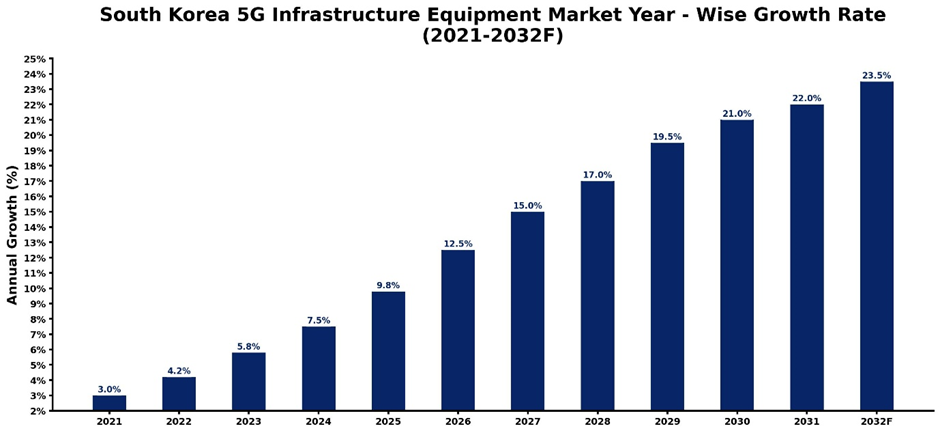
The following table summarizes the historical and forecasted growth rates of the South Korea 5G Infrastructure Equipment Market, along with the rationale behind each year’s performance.
| Year | Estimated Growth (%) | Market Rationale |
| 2021 | 3% | Strong initial 5G rollout; high infrastructure spending by telecom operators |
| 2022 | 4.2% | Expansion of 5G base stations and small cell deployment in urban areas |
| 2023 | 5.8% | Network densification and early standalone 5G upgrades |
| 2024 | 7.5% | Increased capex on cloud-native core networks and RAN modernization |
| 2025 | 9.8% | Peak infrastructure expansion phase; enterprise 5G demand rises |
| 2026 | 12.5% | Transition phase toward advanced 5G-Advanced architecture |
| 2027 | 15% | Strong adoption of Open RAN and virtualization technologies |
| 2028 | 17% | Infrastructure upgrades driven by AI-integrated telecom networks |
| 2029 | 19.5% | Early 6G preparation investments begin alongside 5G optimization |
| 2030 | 21% | Market stabilizes; focus shifts from expansion to efficiency |
| 2031 | 22% | Moderate upgrades and replacement cycles dominate spending |
| 2032 | 23.5% | Mature infrastructure ecosystem with incremental growth only |
Topics Covered in the South Korea 5G Infrastructure Equipment Market Report
The South Korea 5G Infrastructure Equipment Market report thoroughly covers the market by Equipment Type, Spectrum, Deployment Mode and End-Use. The market report provides an unbiased and detailed analysis of ongoing market trends, opportunities/high growth areas, and market drivers, which help stakeholders devise and align their market strategies according to the current and future market dynamics.
South Korea 5G Infrastructure Equipment Market Highlights
| Report Name | South Korea 5G Infrastructure Equipment Market |
| Forecast period | 2026-2032 |
| CAGR | 10.9% |
| Growing Sector | Industrial 5G Connectivity |
South Korea 5G Infrastructure Equipment Market Synopsis
South Korea 5G Infrastructure Equipment Market is anticipated to record notable growth due to early national adoption of high-speed connectivity, advanced industrial digitalization, and proactive government support. Specifically, the equipment segment, comprising base stations, RAN, and core network modules, enables high-capacity data transmission essential for modern digital services. The ongoing transition toward standalone networks and mmWave technology, supported by extensive public-private partnerships, continues to foster a dynamic ecosystem where infrastructure providers and telecom operators collaborate to maintain the country’s leading global position in next-generation telecommunications.
Evaluation of Growth Drivers in the South Korea 5G Infrastructure Equipment Market (2026-2032)
Below mentioned are some prominent drivers and their influence on the market dynamics:
| Drivers | Primary Segments Affected | Why it Matters (Evidence) |
| Industrial Automation (Industry 4.0) | RAN, Small Cell | High demand for ultra-reliable connectivity in smart factories. |
| Government "5G+ Strategy" | Core Network, Macro Cell | Funding and regulatory backing accelerate nationwide deployment. |
| Rising IoT Ecosystem | Core Network, Small Cell | Massive machine-type communication requires dense infrastructure. |
| Edge Computing Integration | Core Network, RAN | Low-latency processing necessitates localized infrastructure upgrades. |
| Smart City Initiatives | Macro Cell, mmWave | Urban transformation relies on ubiquitous high-bandwidth signals. |
South Korea 5G Infrastructure Equipment Market is expected to grow at the CAGR of 10.9% during the forecast period of 2026-2032. Growth is driven by the rapid industrial transition to 5G-enabled smart manufacturing, extensive government support for digital transformation, and the urgent need for dense, high-frequency network equipment. Additional contributions come from the nationwide expansion of standalone network architectures and the increasing deployment of private 5G systems for critical national defense and enterprise operational management.
Evaluation of Restraints in the South Korea 5G Infrastructure Equipment Market
Below mentioned are some major restraints and their influence on the market dynamics:
| Restraints | Primary Segments Affected | What This Means (Evidence) |
| High Deployment Costs | Macro Cell, mmWave | Capital-intensive infrastructure limits rapid rural expansion. |
| Technical Interoperability | RAN, Core Network | Challenges in integrating multi-vendor 5G components. |
| Spectrum Allocation Limits | mmWave, Sub-6 GHz | Limited bandwidth availability restricts peak network capacity. |
| Energy Consumption | Macro Cell, RAN | Power-intensive hardware increases operational overhead for ISPs. |
| Cybersecurity Risks | All Types, Core Network | Sophisticated threats necessitate expensive, complex security layers. |
South Korea 5G Infrastructure Equipment Market Challenges
Irrespective of massive growth and development, the industry faces several challenges such as the high cost of densifying networks with mmWave technology, complex regulatory compliance, and security vulnerabilities associated with IoT expansion. In addition to this, the technical burden of multi-vendor integration and the intensive power requirements of high-capacity hardware hinder rapid South Korea 5G Infrastructure Equipment Market Growth. These constraints require strategic investments in energy-efficient R&D and unified software-defined standards to ensure long-term stability and sustainable performance across the nation.
South Korea 5G Infrastructure Equipment Market Trends
Key trends evaluating the current technological and operational landscape of the South Korea 5G Infrastructure Equipment Market are:
- Open RAN Deployments: Move towards using open-source radio access networks to avoid vendor lock-in and optimize cost structures.
- Green Networking: Deployment of energy-efficient networking hardware and AI-driven energy management systems to ensure minimum carbon footprint from base stations.
- 5G Private Networks: Accelerated roll-out of dedicated local networks for private industrial campuses and public sector organizations.
- mmWave Roll-Out: Deployment of mmWave frequencies for super-fast connectivity use cases such as cloud gaming and augmented reality applications.
Investment Opportunities in the South Korea 5G Infrastructure Equipment Market
Prominent high-growth investment opportunities currently identified within the South Korea 5G Infrastructure Equipment Market include:
- Smart Factory Equipment Kits: Creating specialized modules of 5G technology equipment kits designed for small and medium-sized enterprises’ industrial automation.
- Edge Computing Centers: Building dedicated edge computing centers that support 5G technology for processing data.
- Software Layer of Security: Developing intelligent software that detects any possible threats in the 5G core networks.
- Power Infrastructure: Using sustainable energy sources for powering base stations and 5G radio units.
Top 5 Leading Players in the South Korea 5G Infrastructure Equipment Market
Key market participants and top-tier companies actively operating within the South Korea 5G Infrastructure Equipment Market include:
1. Samsung Electronics Co., Ltd.
| Company Name | Samsung Electronics Co., Ltd. |
|---|---|
| Established Year | 1969 |
| Headquarters | Suwon, South Korea |
| Official Website | Click Here |
Samsung leads with end-to-end 5G solutions, including radio units, core networks, and advanced chipsets for global infrastructure deployment.
2. SK Telecom Co., Ltd.
| Company Name | SK Telecom Co., Ltd. |
|---|---|
| Established Year | 1984 |
| Headquarters | Seoul, South Korea |
| Official Website | Click Here |
SK Telecom specializes in operational network management, pioneering 5G standalone commercialization and industrial IoT connectivity applications.
3. RFHIC Corporation
| Company Name | RFHIC Corporation |
|---|---|
| Established Year | 1999 |
| Headquarters | Anyang, South Korea |
| Official Website | Click Here |
RFHIC provides high-efficiency Gallium Nitride (GaN) power amplifiers essential for 5G base station signal transmission and network performance.
4. Sensorview Co., Ltd.
| Company Name | Sensorview Co., Ltd. |
|---|---|
| Established Year | 2015 |
| Headquarters | Seongnam, South Korea |
| Official Website | Click Here |
Sensorview designs ultra-low loss interconnect solutions and mmWave antennas that optimize signal integrity in high-frequency 5G environments.
5. KT Corporation
| Company Name | KT Corporation |
|---|---|
| Established Year | 1981 |
| Headquarters | Seongnam, South Korea |
| Official Website | Click Here |
KT focuses on digital transformation, providing secure 5G private network infrastructure and cloud-integrated solutions for enterprise clients.
Government Initiatives Being Implemented in the South Korea 5G Infrastructure Equipment Market
According to South Korean Government Data, major initiatives that are being implemented are mentioned below:
- 5G+ Strategy: The government has launched a multi-trillion won investment plan to establish the world’s leading 5G ecosystem, focusing on 10 strategic industries and 5 core services to boost productivity, exports, and high-quality job creation.
- Digital New Deal: This is a fast-track to the “data dam” effort which provides tax credits and grants for research into 5G technology related to self-driving car connectivity and artificial intelligence-enabled 5G equipment.
- Smart City Sandbox: Strategic areas are created whereby regulations are removed for those experimenting with new 5G technology, making the process of bringing this technology to market much quicker.
Future Insights of the South Korea 5G Infrastructure Equipment Market
South Korea 5G Infrastructure Equipment Industry outlook is exceptionally promising, driven by sustained commitments to early-stage 6G research and the continuous densification of 5G networks to support the nation’s advanced industrial landscape. Future growth will be catalyzed by widespread adoption of AI-native network architectures, increased private sector collaboration in defense and manufacturing, and the integration of sustainable power solutions within existing hardware, ultimately ensuring that the market maintains its status as a global benchmark for telecommunications innovation.
Market Segmentation Analysis
The report offers a comprehensive study of the subsequent market segments and their leading categories:
By Equipment Type – Macro Cell Dominates Market Revenue, Small Cell Sets for Rapid Expansion
According to Bhawna Singh, Assistant Manager, 6Wresearch, Macro cell equipment accounted for a dominant 42.5% of South Korea 5G infrastructure market share in 2025, providing the wide-area coverage needed for initial nationwide signal stabilisation and high-traffic density management. Meanwhile, small cell equipment is projected to grow at a stellar CAGR of 32.1% during 2026–2032, fueled by the urgent need for localized capacity in dense urban environments and specialized industrial smart-factory applications.
By End-Use – Telecom Operators Lead Market, Industrial Sector Shows Rapid Growth
Telecommunication operators had a leading market revenue share of 55.4%, which can be attributed to their role as the main reason behind the extensive investments in modernizing national radio access networks and core networks. In addition, the industrial end-use category is set to grow with an impressive CAGR of 33.6% during the period between 2022 and 2032 due to a huge transition to smart manufacturing and warehouses and real-time M2M communications.
Note: Market size estimations and growth projections presented in this report are based on 6Wresearch’s advanced forecasting approach, validated with industry datasets as of June 2026.
Key Attractiveness of the Report
- 10 Years of Market Numbers.
- Historical Data Starting from 2022 to 2025.
- Base Year: 2025.
- Forecast Data until 2032.
- Key Performance Indicators Impacting the Market.
- Major Upcoming Developments and Projects.
Key Highlights of the Report:
- South Korea 5G Infrastructure Equipment Market Outlook
- Market Size of South Korea 5G Infrastructure Equipment Market, 2025
- Forecast of South Korea 5G Infrastructure Equipment Market, 2032
- Historical Data and Forecast of South Korea 5G Infrastructure Equipment Revenues & Volume for the Period 2022-2032
- South Korea 5G Infrastructure Equipment Market Trend Evolution
- South Korea 5G Infrastructure Equipment Market Drivers and Challenges
- South Korea 5G Infrastructure Equipment Price Trends
- South Korea 5G Infrastructure Equipment Porter's Five Forces
- South Korea 5G Infrastructure Equipment Industry Life Cycle
- Historical Data and Forecast of South Korea 5G Infrastructure Equipment Market Revenues & Volume By Equipment Type for the Period 2022-2032
- Historical Data and Forecast of South Korea 5G Infrastructure Equipment Market Revenues & Volume By Macro Cell for the Period 2022-2032
- Historical Data and Forecast of South Korea 5G Infrastructure Equipment Market Revenues & Volume By Small Cell for the Period 2022-2032
- Historical Data and Forecast of South Korea 5G Infrastructure Equipment Market Revenues & Volume By RAN for the Period 2022-2032
- Historical Data and Forecast of South Korea 5G Infrastructure Equipment Market Revenues & Volume By Core Network for the Period 2022-2032
- Historical Data and Forecast of South Korea 5G Infrastructure Equipment Market Revenues & Volume By Spectrum for the Period 2022-2032
- Historical Data and Forecast of South Korea 5G Infrastructure Equipment Market Revenues & Volume By Sub-6 GHz for the Period 2022-2032
- Historical Data and Forecast of South Korea 5G Infrastructure Equipment Market Revenues & Volume By mmWave for the Period 2022-2032
- Historical Data and Forecast of South Korea 5G Infrastructure Equipment Market Revenues & Volume By Deployment Mode for the Period 2022-2032
- Historical Data and Forecast of South Korea 5G Infrastructure Equipment Market Revenues & Volume By Standalone for the Period 2022-2032
- Historical Data and Forecast of South Korea 5G Infrastructure Equipment Market Revenues & Volume By Non-Standalone for the Period 2022-2032
- Historical Data and Forecast of South Korea 5G Infrastructure Equipment Market Revenues & Volume By End-Use for the Period 2022-2032
- Historical Data and Forecast of South Korea 5G Infrastructure Equipment Market Revenues & Volume By Telecom for the Period 2022-2032
- Historical Data and Forecast of South Korea 5G Infrastructure Equipment Market Revenues & Volume By Industrial for the Period 2022-2032
- Historical Data and Forecast of South Korea 5G Infrastructure Equipment Market Revenues & Volume By Enterprises for the Period 2022-2032
- South Korea 5G Infrastructure Equipment Import Export Trade Statistics
- Market Opportunity Assessment By Equipment Type
- Market Opportunity Assessment By Spectrum
- Market Opportunity Assessment By Deployment Mode
- Market Opportunity Assessment By End-Use
- South Korea 5G Infrastructure Equipment Top Companies Market Share
- South Korea 5G Infrastructure Equipment Competitive Benchmarking By Technical and Operational Parameters
- South Korea 5G Infrastructure Equipment Company Profiles
- South Korea 5G Infrastructure Equipment Key Strategic Recommendations
Market Covered
The report offers a comprehensive study of the subsequent market segments:
By Equipment Type
- Macro Cell
- Small Cell
- RAN
- Core Network
By Spectrum
- Sub-6 GHz
- mmWave
By Deployment Mode
- Standalone
- Non-Standalone
By End-Use
- Telecom
- Industrial
- Enterprises
South Korea 5G Infrastructure Equipment Market (2026-2032): FAQs
The market is forecast to reach significant multi-billion dollar valuations by the end of the decade, reflecting a rapid and sustained upward growth trajectory.
The industry is expected to maintain robust expansion driven by the transition to standalone network architectures and deep integration with emerging AI-based industrial technologies.
Leading companies operating in this space include Samsung Electronics, SK Telecom, RFHIC Corporation, Sensorview, and KT Corporation.
The South Korea 5G Infrastructure Equipment Market is projected to grow at a CAGR of 10.9% between 2026-2032.
6Wresearch actively monitors the South Korea 5G Infrastructure Equipment Market and publishes its comprehensive annual report, highlighting emerging trends, growth drivers, revenue analysis, and forecast outlook. Our insights help businesses to make data-backed strategic decisions with ongoing market dynamics. Our analysts track relevent industries related to the South Korea 5G Infrastructure Equipment Market, allowing our clients with actionable intelligence and reliable forecasts tailored to emerging regional needs.
Yes, we provide customisation as per your requirements. To learn more, feel free to contact us on sales@6wresearch.com
| 1 Executive Summary |
| 2 Introduction |
| 2.1 Key Highlights of the Report |
| 2.2 Report Description |
| 2.3 Market Scope & Segmentation |
| 2.4 Research Methodology |
| 2.5 Assumptions |
| 3 South Korea 5G Infrastructure Equipment Market Overview |
| 3.1 South Korea Country Macro Economic Indicators |
| 3.2 South Korea 5G Infrastructure Equipment Market Revenues & Volume, 2022 & 2032F |
| 3.3 South Korea 5G Infrastructure Equipment Market - Industry Life Cycle |
| 3.4 South Korea 5G Infrastructure Equipment Market - Porter's Five Forces |
| 3.5 South Korea 5G Infrastructure Equipment Market Revenues & Volume Share, By Equipment Type, 2022 & 2032F |
| 3.6 South Korea 5G Infrastructure Equipment Market Revenues & Volume Share, By Spectrum, 2022 & 2032F |
| 3.7 South Korea 5G Infrastructure Equipment Market Revenues & Volume Share, By Deployment Mode, 2022 & 2032F |
| 3.8 South Korea 5G Infrastructure Equipment Market Revenues & Volume Share, By End-Use, 2022 & 2032F |
| 4 South Korea 5G Infrastructure Equipment Market Dynamics |
| 4.1 Impact Analysis |
| 4.2 Market Drivers |
| 4.2.1 Government initiatives and investments in 5G infrastructure development. |
| 4.2.2 Increasing demand for high-speed internet and data services. |
| 4.2.3 Growing adoption of IoT and smart devices driving the need for advanced infrastructure. |
| 4.3 Market Restraints |
| 4.3.1 High initial investment costs for deploying 5G infrastructure. |
| 4.3.2 Technological complexities and interoperability issues. |
| 4.3.3 Regulatory challenges and spectrum allocation constraints. |
| 5 South Korea 5G Infrastructure Equipment Market Trends |
| 6 South Korea 5G Infrastructure Equipment Market, By Types |
| 6.1 South Korea 5G Infrastructure Equipment Market, By Equipment Type |
| 6.1.1 Overview and Analysis |
| 6.1.2 South Korea 5G Infrastructure Equipment Market Revenues & Volume, By Equipment Type, 2022 - 2032F |
| 6.1.3 South Korea 5G Infrastructure Equipment Market Revenues & Volume, By Macro Cell, 2022 - 2032F |
| 6.1.4 South Korea 5G Infrastructure Equipment Market Revenues & Volume, By Small Cell, 2022 - 2032F |
| 6.1.5 South Korea 5G Infrastructure Equipment Market Revenues & Volume, By RAN, 2022 - 2032F |
| 6.1.6 South Korea 5G Infrastructure Equipment Market Revenues & Volume, By Core Network, 2022 - 2032F |
| 6.2 South Korea 5G Infrastructure Equipment Market, By Spectrum |
| 6.2.1 Overview and Analysis |
| 6.2.2 South Korea 5G Infrastructure Equipment Market Revenues & Volume, By Sub-6 GHz, 2022 - 2032F |
| 6.2.3 South Korea 5G Infrastructure Equipment Market Revenues & Volume, By mmWave, 2022 - 2032F |
| 6.3 South Korea 5G Infrastructure Equipment Market, By Deployment Mode |
| 6.3.1 Overview and Analysis |
| 6.3.2 South Korea 5G Infrastructure Equipment Market Revenues & Volume, By Standalone, 2022 - 2032F |
| 6.3.3 South Korea 5G Infrastructure Equipment Market Revenues & Volume, By Non-Standalone, 2022 - 2032F |
| 6.4 South Korea 5G Infrastructure Equipment Market, By End-Use |
| 6.4.1 Overview and Analysis |
| 6.4.2 South Korea 5G Infrastructure Equipment Market Revenues & Volume, By Telecom, 2022 - 2032F |
| 6.4.3 South Korea 5G Infrastructure Equipment Market Revenues & Volume, By Industrial, 2022 - 2032F |
| 6.4.4 South Korea 5G Infrastructure Equipment Market Revenues & Volume, By Enterprises, 2022 - 2032F |
| 7 South Korea 5G Infrastructure Equipment Market Import-Export Trade Statistics |
| 7.1 South Korea 5G Infrastructure Equipment Market Export to Major Countries |
| 7.2 South Korea 5G Infrastructure Equipment Market Imports from Major Countries |
| 8 South Korea 5G Infrastructure Equipment Market Key Performance Indicators |
| 8.1 Average network latency levels. |
| 8.2 Percentage of population covered by 5G network. |
| 8.3 Number of connected IoT devices per user. |
| 8.4 Average data consumption per user. |
| 8.5 Number of 5G base stations deployed. |
| 9 South Korea 5G Infrastructure Equipment Market - Opportunity Assessment |
| 9.1 South Korea 5G Infrastructure Equipment Market Opportunity Assessment, By Equipment Type, 2022 & 2032F |
| 9.2 South Korea 5G Infrastructure Equipment Market Opportunity Assessment, By Spectrum, 2022 & 2032F |
| 9.3 South Korea 5G Infrastructure Equipment Market Opportunity Assessment, By Deployment Mode, 2022 & 2032F |
| 9.4 South Korea 5G Infrastructure Equipment Market Opportunity Assessment, By End-Use, 2022 & 2032F |
| 10 South Korea 5G Infrastructure Equipment Market - Competitive Landscape |
| 10.1 South Korea 5G Infrastructure Equipment Market Revenue Share, By Companies, 2025 |
| 10.2 South Korea 5G Infrastructure Equipment Market Competitive Benchmarking, By Operating and Technical Parameters |
| 11 Company Profiles |
| 12 Recommendations |
| 13 Disclaimer |
Global Go To Market Strategy - 2030
Export potential enables firms to identify high-growth global markets with greater confidence by combining advanced trade intelligence with a structured quantitative methodology. The framework analyzes emerging demand trends and country-level import patterns while integrating macroeconomic and trade datasets such as GDP and population forecasts, bilateral import–export flows, tariff structures, elasticity differentials between developed and developing economies, geographic distance, and import demand projections. Using weighted trade values from 2020–2024 as the base period to project country-to-country export potential for 2030, these inputs are operationalized through calculated drivers such as gravity model parameters, tariff impact factors, and projected GDP per-capita growth. Through an analysis of hidden potentials, demand hotspots, and market conditions that are most favorable to success, this method enables firms to focus on target countries, maximize returns, and global expansion with data, backed by accuracy.
By factoring in the projected importer demand gap that is currently unmet and could be potential opportunity, it identifies the potential for the Exporter (Country) among 190 countries, against the general trade analysis, which identifies the biggest importer or exporter.
To discover high-growth global markets and optimize your business strategy:
Click Here
Request Primary Research & Report
- Single User License$ 1,995
- Department License$ 2,400
- Site License$ 3,120
- Global License$ 3,795

Leadership Perspectives from Industry Events
Search
6Wresearch in the News
 Forbes
Citing 6Wresearch analytics to map global infrastructure and pharmaceutical industry trajectories.
 Bloomberg Law
Direct syndication of 6Wresearch's macro data points, capturing complex supply chain shifts.
 Reuters
Tracking industrial manufacturing adjustments and electronic security ecosystem scaling.
 Mint
Mint
Utilizing deep-tech sector market sizing to analyze global automation and robotics.
 The Economic Times
Anchoring features on industrial IoT growth metrics and connected smart-grid devices.
 Business Standard
Featuring strategic evaluations of Advanced Driver Assistance Systems (ADAS) and AI road safety.
 The Hindu
Spotlighting core commercial metrics ranging from unmanned aerial vehicles (UAVs) to consumer durables.
 Financial Express
Anchoring quarterly reviews on cross-border real estate tech and structural hardware manufacturing.
 Yahoo Finance
Syndicating the tracker's $30.1 billion untapped-market findings, spotlighting Japan, the US and China as India's top new-potential importers.
 India Today
Carrying the release on smartphones leading India's export potential to $94 billion by 2031, per 6WExportGTM data.
 Dailyhunt
Distributing the tracker findings to its regional readership, framing India's export diversification into Japan and Mexico.
 PR Newswire Original release
Publishing the full India Export Attractiveness Tracker 2026, detailing new trade corridors across iron ore, LCVs and pharmaceuticals.
 The Industrial
Highlighting the tracker's read on India's semiconductor ambitions and long-term chip-assembly export potential.
 PTI News
Reporting on the $66.81 billion pharmaceuticals export opportunity flagged in the tracker, amid looming US generic-drug tariffs.
 Tribune India
Covering the tracker's tariff-versus-regulation analysis across India's mature export markets in the US, China and UAE.
 ANI News
Amplifying the report's findings on polished diamonds, refined petroleum and medicines as India's core export engines.
 International Business Magazine
Covering the report's insight into how AEB, blind spot detection, and driver monitoring are reshaping India's ADAS market.
 Focus Gaming News
Highlighting the research forecast for Egypt's gambling market, projecting steady growth through 2032.
Thought Leadership and Analyst Meet





Our Clients








Latest Reports
- Namibia Financial Asset Management Market (2026-2032)
- Mozambique Financial Asset Management Market (2026-2032)
- Montenegro Financial Asset Management Market (2026-2032)
- Mongolia Financial Asset Management Market (2026-2032)
- Monaco Financial Asset Management Market (2026-2032)
- Micronesia Financial Asset Management Market (2026-2032)
- Mauritius Financial Asset Management Market (2026-2032)
- Mauritania Financial Asset Management Market (2026-2032)
- Marshall Islands Financial Asset Management Market (2026-2032)
- Malta Financial Asset Management Market (2026-2032)
Industry Events and Analyst Meet

EV India Expo 2026

HIMTEX 2026

India Refining Summit 2026

India EV Show 2026

EV tech India Expo 2026
Whitepaper
- Middle East & Africa Commercial Security Market Click here to view more.
- Middle East & Africa Fire Safety Systems & Equipment Market Click here to view more.
- GCC Drone Market Click here to view more.
- Middle East Lighting Fixture Market Click here to view more.
- GCC Physical & Perimeter Security Market Click here to view more.


