South Korea Abscess Market Growth Rate
According to 6Wresearch internal database and industry insights, the South Korea Abscess Market is projected to grow at a compound annual growth rate (CAGR) of 7.8% during the forecast period (2026-2032).
South Korea Abscess Market Year-wise Growth Rate and Key Drivers (2022-2032)
This graph illustrates the annual growth rates of the South Korea Abscess Market from 2022 to 2032, highlighting a steady upward trajectory and projected market expansion over the forecast period.
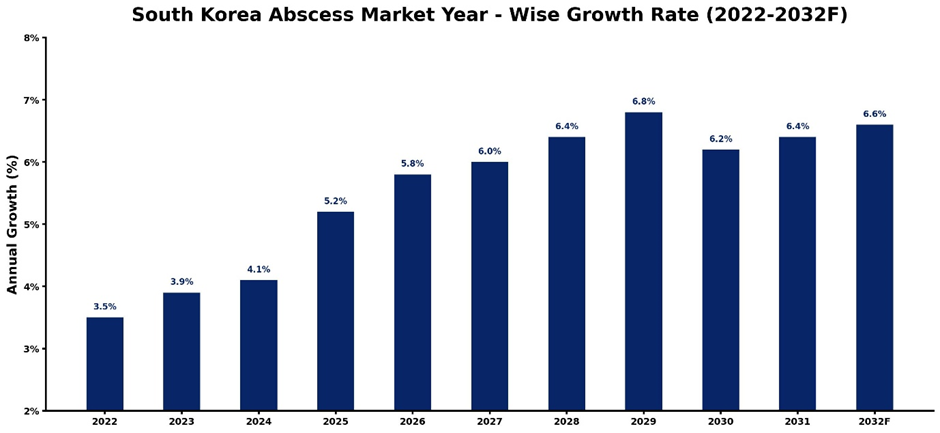
The following table summarizes the historical and forecasted growth rates of the South Korea Abscess Market, along with the rationale behind each year’s performance.
| Year | Estimated Growth (%) | Market Rationale |
| 2022 | 3.5% | Recovery in elective surgical procedures following hospital resource prioritization. |
| 2023 | 3.9% | Increased prevalence of skin and soft tissue infections due to lifestyle factors. |
| 2024 | 4.1% | Rising demand for advanced wound care and minimally invasive surgical drainage. |
| 2025 | 5.2% | Expansion of specialized outpatient clinics and improved diagnostic precision. |
| 2026 | 5.8% | Surge in hospital-acquired infection awareness and standardized treatment protocols. |
| 2027 | 6% | Growth in geriatric population leading to higher incidence of complex abscesses. |
| 2028 | 6.4% | Adoption of novel antibiotic therapies and localized drug delivery systems. |
| 2029 | 6.8% | Slight stabilization due to standardized preventive care and hygiene awareness. |
| 2030 | 6.2% | Continued focus on robotic-assisted surgical drainage in tertiary hospitals. |
| 2031 | 6.4% | Enhanced diagnostic imaging and integrated clinical management pathways. |
| 2032 | 6.6% | Widespread integration of AI-driven diagnostics for rapid infection identification. |
Topics Covered in the South Korea Abscess Market Report
The South Korea Abscess Market report thoroughly covers the market by Infection Type, Treatment Modality and Patient Demographic. The market report provides an unbiased and detailed analysis of ongoing market trends, opportunities/high growth areas, and market drivers, which help stakeholders devise and align their market strategies according to the current and future market dynamics.
South Korea Abscess Market Highlights
| Report Name | South Korea Abscess Market |
| Forecast period | 2026-2032 |
| CAGR | 7.8% |
| Growing Sector | Medical |
South Korea Abscess Market Synopsis
The South Korea Abscess Market is expected to witness significant development, fueled by the high prevalence of skin infections and a robust healthcare framework that emphasizes rapid clinical intervention. Abscesses, which are localized collections of pus resulting from tissue infection, are increasingly managed through advanced surgical drainage and targeted antibiotic therapies that reduce patient recovery time significantly. Furthermore, the nation’s advanced medical infrastructure and high health insurance coverage ensure that both urban and rural populations receive timely care, ultimately enhancing the long-term outlook for the South Korea Abscess Market Growth.
Evaluation of Growth Drivers in the South Korea Abscess Market (2026-2032)
Below mentioned are some prominent drivers and their influence on the market dynamics:
| Drivers | Primary Segments Affected | Why it Matters (Evidence) |
| Increasing Surgical Procedures | Post-Surgical Abscess | Higher volume of elective surgeries increases post-operative infection risks. |
| Technological Advancements | Minimally Invasive | Precision imaging allows for better targeting of deep-seated internal abscesses. |
| Aging Population | Elderly/Adult | Increased susceptibility to infections necessitates frequent clinical intervention. |
| Antibiotic Stewardship | Antibiotic Therapy | Programs ensure effective drug utilization for faster abscess resolution. |
| Healthcare Accessibility | Hospitals & Clinics | Widespread insurance coverage supports consistent diagnostic and treatment access. |
South Korea Abscess Market is expected to grow at a CAGR of 7.8% during the forecast period of 2026-2032. Growth is influenced by the rising prevalence of bacterial skin and soft tissue infections, increasing incidence of diabetes and other chronic diseases that elevate the risk of abscess formation, and a growing aging population requiring advanced wound care. The expansion of hospital infrastructure, greater availability of minimally invasive drainage procedures, and improved access to broad-spectrum antibiotics are further supporting market development. In addition, heightened awareness regarding early diagnosis and timely treatment, coupled with advancements in diagnostic imaging such as ultrasound and CT-guided abscess detection, are improving clinical outcomes.
Evaluation of Restraints in the South Korea Abscess Market
Below mentioned are some major restraints and their influence on the market dynamics:
| Restraints | Primary Segments Affected | What This Means (Evidence) |
| Antibiotic Resistance | Antibiotic Therapy | Growing resistance makes standard treatments less effective over time. |
| High Operational Costs | Surgical Drainage | Advanced surgical tools increase the cost of care for complex cases. |
| Delays in Diagnosis | Internal Abscess | The difficulty in diagnosing deep abscesses results in complications. |
| Regulatory Challenges | Medicines | Extensive processes in the development of new antibacterial agents cause delays in their use. |
| Comorbidity Risks | All Types | Health problems such as diabetes affect the healing process of patients. |
South Korea Abscess Market Challenges
Despite of stable development, the South Korea Abscess Industry faces several challenges such as the rising threat of multi-drug-resistant organisms, complex post-surgical recovery needs, and the high cost of advanced minimally invasive equipment. In addition to this, the shortage of specialized wound care nurses and the difficulty in timely identification of internal abscesses in asymptomatic patients significantly hinder treatment efficiency. Addressing these hurdles is crucial to ensure better clinical outcomes and sustained technological integration across the healthcare system.
South Korea Abscess Market Trends
Major trends influencing the South Korea Abscess Market include the following:
- AI Integration in Diagnostic Process: The use of machine learning techniques to interpret ultrasounds and CT scans to enable quick and precise identification of abscess.
- Minimally Invasive Treatment Preference: A preference for minimally invasive procedures such as percutaneous drainage over conventional surgery to reduce pain and duration of stay in hospitals.
- Tele-Wound Care Development: Introduction of remote monitoring devices that help specialists to monitor the healing process of patients suffering from chronic skin abscesses in their own homes.
- Use of Biocompatible Materials: An increased need for sophisticated surgical meshes and dressings to avoid infection and enhance tissue regeneration.
Investment Opportunities in the South Korea Abscess Market
Emerging investment opportunities in the South Korea Abscess Market include the following:
- Advanced Imaging Centers: Opening up specialized centers which use sophisticated imaging technology to quickly detect abscesses inside the body.
- Wound Care Clinics: Opening up specialized wound care clinics which can provide complete treatment of abscesses using advanced methods.
- Antimicrobial Agents: Financing research in innovative antimicrobial agents which can combat infections caused by resistant strains.
- Robotic-Assisted Drainage: Entering into partnerships with medical schools to train employees in robotic-assisted drainage procedure.
Top Players in the South Korea Abscess Market
A list of leading companies operating in the South Korea Abscess Market is presented below:
1. Daewoong Pharmaceutical Co., Ltd.
| Company Name | Daewoong Pharmaceutical Co., Ltd. |
|---|---|
| Established Year | 1945 |
| Headquarters | Seoul, South Korea |
| Official Website | Click Here |
Daewoong Pharmaceutical Co., Ltd. provides essential anti-infective medications and advanced wound-healing agents widely utilized in South Korean surgical protocols.
2. JW Pharmaceutical Corporation
| Company Name | JW Pharmaceutical Corporation |
|---|---|
| Established Year | 1945 |
| Headquarters | Seoul, South Korea |
| Official Website | Click Here |
JW Pharmaceutical Corporation supplies specialized intravenous antibiotics and fluid management solutions crucial for treating severe internal abscess cases.
3. Chong Kun Dang Pharmaceutical Corp.
| Company Name | Chong Kun Dang Pharmaceutical Corp. |
|---|---|
| Established Year | 1941 |
| Headquarters | Seoul, South Korea |
| Official Website | Click Here |
Chong Kun Dang Pharmaceutical Corp. manufactures a broad portfolio of broad-spectrum antibiotics necessary for controlling systemic bacterial infections in abscess patients.
4. Celltrion Inc.
| Company Name | Celltrion Inc. |
|---|---|
| Established Year | 2002 |
| Headquarters | Incheon, South Korea |
| Official Website | Click Here |
Celltrion Inc. focuses on biotechnological innovation, developing targeted therapeutic proteins and biosimilars for treating complex, treatment-resistant infections.
5. Genewel Co., Ltd.
| Company Name | Genewel Co., Ltd. |
|---|---|
| Established Year | 2000 |
| Headquarters | Seongnam, South Korea |
| Official Website | Click Here |
Genewel Co., Ltd. specializes in advanced wound care devices, including foam dressings and hydrogels designed to improve healing in chronic abscess cases.
Government Initiatives Being Implemented in the South Korea Abscess Market
According to South Korean Government Data, the “National Health Insurance Innovation Strategy 2030” is geared towards increasing insurance coverage for the less invasive surgery methods, which will greatly minimize costs incurred by patients with abscesses. In addition, the government has rolled out the “Antibiotic Stewardship Action Plan,” through which hospitals that have embraced diagnosis-driven prescriptions are offered incentives. Moreover, funding is going to be directed towards “Smart Healthcare Zones,” whereby digital health applications allow the remote monitoring of patients recovering from chronic infections.
Future Insights of the South Korea Abscess Market
The South Korea Abscess Market outlook is set to reach new heights as the sector increasingly shifts toward automated care models and advanced diagnostic integration. The emergence of personalized medicine, coupled with the rising use of telemedicine for follow-up consultations, will provide practitioners with greater insights into patient recovery patterns. By emphasizing technological innovation in both surgical drainage and antimicrobial therapies, the South Korea abscess market growth is expected to remain robust, fostering a more resilient and efficient healthcare environment for patients suffering from infectious complications.
Market Segmentation Analysis
This report presents a detailed analysis of the market segments along with their leading categories:
By Infection Type- Market Dominated by Skin Abscess, Internal Abscess Set for Rapid Expansion
According to Sachin Kumar Rai, Senior Research Analyst, 6Wresearch, skin abscesses accounted for a dominant 45.2% of the South Korea abscess market share in 2025, driven by high outpatient volumes and common bacterial infections. Conversely, internal abscesses are projected to advance at a stellar CAGR of 7.1% during 2026–2032, fueled by rising surgical procedure volumes and complex post-operative complications requiring imaging-guided drainage.
By Patient Demographic- Adult Segment Leads Market, Elderly Segment Shows Rapid Growth
The adult category accounted for the highest revenue share of 50.5% in 2025, owing to the significant presence of acute surgical infections among the working population. In addition to this, it has been predicted that the elderly demographic is projected to grow at the highest CAGR of 7.5% until 2032 due to the rising aging population in South Korea with diabetes abscesses.
Note: Market size estimations and growth projections presented in this report are based on 6Wresearch's proprietary forecasting methodology, utilizing the latest available industry data, government publications, and primary research inputs.
Key Attractiveness of the Report
- 10 Years of Market Numbers.
- Historical Data Starting from 2022 to 2025.
- Base Year: 2025.
- Forecast Data until 2032.
- Key Performance Indicators Impacting the Market.
- Major Upcoming Developments and Projects.
Key Highlights of the Report:
- South Korea Abscess Market Outlook
- Market Size of South Korea Abscess Market, 2025
- Forecast of South Korea Abscess Market, 2032
- Historical Data and Forecast of South Korea Abscess Revenues & Volume for the Period 2022-2032
- South Korea Abscess Market Trend Evolution
- South Korea Abscess Market Drivers and Challenges
- South Korea Abscess Price Trends
- South Korea Abscess Porter's Five Forces
- South Korea Abscess Industry Life Cycle
- Historical Data and Forecast of South Korea Abscess Market Revenues & Volume By Infection Type for the Period 2022-2032
- Historical Data and Forecast of South Korea Abscess Market Revenues & Volume By Skin Abscess for the Period 2022-2032
- Historical Data and Forecast of South Korea Abscess Market Revenues & Volume By Internal Abscess for the Period 2022-2032
- Historical Data and Forecast of South Korea Abscess Market Revenues & Volume By Post-Surgical Abscess for the Period 2022-2032
- Historical Data and Forecast of South Korea Abscess Market Revenues & Volume By Dental Abscess for the Period 2022-2032
- Historical Data and Forecast of South Korea Abscess Market Revenues & Volume By Treatment Modality for the Period 2022-2032
- Historical Data and Forecast of South Korea Abscess Market Revenues & Volume By Antibiotic Therapy for the Period 2022-2032
- Historical Data and Forecast of South Korea Abscess Market Revenues & Volume By Surgical Drainage for the Period 2022-2032
- Historical Data and Forecast of South Korea Abscess Market Revenues & Volume By Minimally Invasive for the Period 2022-2032
- Historical Data and Forecast of South Korea Abscess Market Revenues & Volume By Combination Therapy for the Period 2022-2032
- Historical Data and Forecast of South Korea Abscess Market Revenues & Volume By Patient Demographic for the Period 2022-2032
- Historical Data and Forecast of South Korea Abscess Market Revenues & Volume By Pediatric/Adult for the Period 2022-2032
- Historical Data and Forecast of South Korea Abscess Market Revenues & Volume By Adult for the Period 2022-2032
- Historical Data and Forecast of South Korea Abscess Market Revenues & Volume By Elderly for the Period 2022-2032
- Historical Data and Forecast of South Korea Abscess Market Revenues & Volume By All Ages for the Period 2022-2032
- South Korea Abscess Import Export Trade Statistics
- Market Opportunity Assessment By Infection Type
- Market Opportunity Assessment By Treatment Modality
- Market Opportunity Assessment By Patient Demographic
- South Korea Abscess Top Companies Market Share
- South Korea Abscess Competitive Benchmarking By Technical and Operational Parameters
- South Korea Abscess Company Profiles
- South Korea Abscess Key Strategic Recommendations
Market Covered
The report offers a comprehensive study of the subsequent market segments:
By Infection Type
- Skin Abscess
- Internal Abscess
- Post-Surgical Abscess
- Dental Abscess
By Treatment Modality
- Antibiotic Therapy
- Surgical Drainage
- Minimally Invasive
- Combination Therapy
By Patient Demographic
- Pediatric / Adult
- Adult
- Elderly
- All Ages






































