South Korea Advanced Protective Gear and Armour Market Size & Growth Rate
According to 6Wresearch internal database and industry insights, the South Korea Advanced Protective Gear and Armour Market was valued at USD 116.3 million in 2025 and is projected to reach USD 191.69 million by 2032, growing at a CAGR of approximately 7.4% during 2026–2032.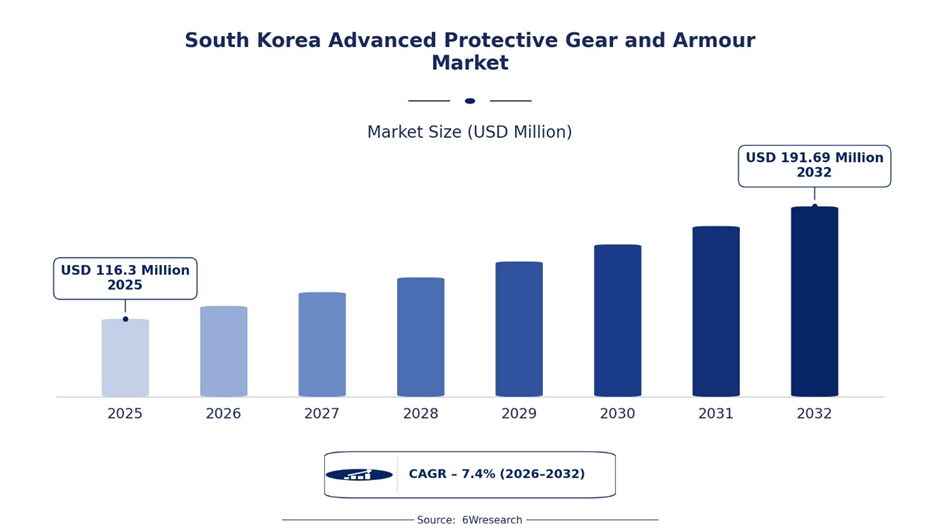
South Korea Advanced Protective Gear and Armour Market Highlights
| Report Metric | Details |
| Report Name | South Korea Advanced Protective Gear and Armour Market |
| Market Size 2025 | USD 116.3 Million |
| Market Size 2032 | USD 191.69 Million |
| Absolute Growth 2025–2032 | USD 75.39 Million |
| CAGR 2026–2032 | 7.4% |
| Peak Annual Growth | 10.2% (2029) |
| Forecast Period | 2026–2032 |
| Historical Data | 2022–2025 |
| Base Year | 2025 |
| Leading Product Type, 2025 | Body Armor (48% share) |
| Leading Material, 2025 | Aramid Fiber (45% share) |
| Leading End User, 2025 | Defense & Military (54% share) |
| Fastest-Growing Product Type | Helmets (8.1% CAGR) |
| Fastest-Growing Material | Composite (9.2% CAGR) |
| Fastest-Growing End User | Industrial (9.6% CAGR) |
| Growing Sector | Industrial Worker Protection and Police Tactical Equipment |
| Key End Users | Armed Forces, National Police, Coast Guard, Shipbuilding and Construction Employers, Heavy Manufacturers |
South Korea Advanced Protective Gear and Armour Market Year-wise Growth Rate and Key Drivers (2022–2032)
This graph illustrates the annual growth rates of the market from 2022 to 2032, highlighting a steady upward trajectory and projected market expansion over the forecast period.
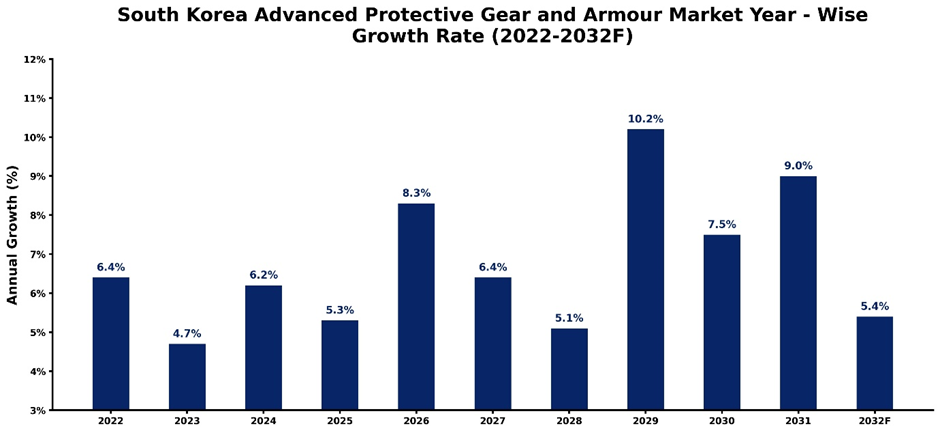
The following table presents the estimated annual growth rate for each year together with the principal factor influencing market performance.
| Year | Estimated Annual Growth (%) | Market Rationale |
| 2022 | 6.4% | Russia’s February 2022 invasion of Ukraine renewed attention to individual soldier protection and prompted early replacement of ageing ballistic equipment. |
| 2023 | 4.7% | Record-low fertility of 0.72 shrank the conscript intake, reduced bulk issuance volumes and slowed standard-issue equipment replacement. |
| 2024 | 6.2% | North Korea’s balloon launches and troop deployment to Russia in 2024 raised security concerns and replacement demand. |
| 2025 | 5.3% | Political transition after the June 2025 presidential election delayed several procurement decisions and moderated order flow. |
| 2026 | 8.3% | A larger 2026 defence budget is expected to fund replacement of ageing individual protective equipment across the armed forces. |
| 2027 | 6.4% | Budget re-prioritisation towards large platforms such as fighter aircraft and missile defence is expected to temper spending on individual equipment. |
| 2028 | 5.1% | Higher import costs for ceramic and polyethylene inputs are expected to constrain margins and delay supplier capacity additions. |
| 2029 | 10.2% | The next mid-term defence plan cycle and wider introduction of lightweight, sensor-integrated soldier systems are expected to drive peak procurement. |
| 2030 | 7.5% | Initial fielding of the new-generation kits is expected to be completed, easing orders as demand moves to replacement. |
| 2031 | 9% | Growing export orders and international certification of domestic products are expected to lift volumes and diversify revenue. |
| 2032 | 5.4% | Industrial safety demand is expected to reach saturation among large employers, moderating growth to a lower sustained rate. |
South Korea Advanced Protective Gear and Armour Market Synopsis
The South Korea Advanced Protective Gear and Armour Market spans personal protection solutions engineered to mitigate ballistic threats, blunt-force impacts and occupational hazards, including reinforced vests, combat helmets and protective shields made from aramid fibres, steel and advanced composites. Procurement activity is influenced by military equipment renewal, efforts to improve individual soldier survivability and continued investment in domestic defence manufacturing. South Korea’s established aramid supply base, including production capabilities associated with Kolon Industries and Taekwang Industrial, provides an important foundation for local protective equipment manufacturing.
Market Dynamics Impact Analysis (2026–2032)
| Factor | Type | Impact | Primary Segment Affected |
| Rising defence acquisition budgets | Driver | High | Body Armor |
| Workplace safety accountability | Driver | High | Industrial |
| Export-oriented lightweight hybrid armour | Opportunity | High | Composite |
| Integrated helmet systems | Opportunity | Medium | Helmets |
| Import dependence for polyethylene and ceramics | Restraint | High | Composite |
| Shrinking conscript pool | Restraint | Medium | Defense & Military |
| Long qualification cycles | Challenge | Medium | Helmets |
| Currency-driven input cost volatility | Challenge | Medium | Aramid Fiber |
Evaluation of Drivers in South Korea Advanced Protective Gear and Armour Market (2026–2032)
Below mentioned are some major drivers and their influence on market dynamics:
| Drivers | Primary Segment Affected | Why It Matters (Evidence) |
| Rising defence acquisition budgets | Body Armor | Larger budgets let procurement agencies replace ageing individual equipment on multi-year cycles, and the 2026 defence budget of KRW 66.3 trillion rose 8.2%. |
| Soldier modernisation programmes | Helmets | Initiatives such as the Army’s Tiger 4.0 add communications, night-vision and sensor interfaces to helmets, raising content and value per unit. |
| Police riot control and counter-terror readiness | Shields | Regular shield and vest replacement is needed for tactical units, and the National Police Agency has roughly 130,000 officers who draw on this equipment. |
| Alliance interoperability | Helmets | Alignment with allied equipment standards keeps specifications current and supports certification, with about 28,500 United States troops stationed in the country for joint exercises. |
| Employer liability for workplace fatalities | Industrial | Executive liability pushes employers to buy certified protective equipment, as the Serious Accidents Punishment Act took effect in January 2022 and reached firms with five or more workers in 2024. |
The development of South Korea Advanced Protective Gear and Armour Market is propelled by country’s deep advanced-materials base, where established chemical, polymer and ceramics producers supply high-performance inputs at scale and shorten development cycles for lighter protective products. National research and development spending of roughly 5% of gross domestic product, with private firms funding over 75% of it, sustains continuous testing of new laminates and ceramic formulations. Rising private capital in precision manufacturing and additive production is improving yield and consistency of moulded components. Strong technology-licensing ties with global supplier’s speed access to certified processes, while a dense network of testing laboratories and engineering clusters allows faster design iteration and quality assurance.
Evaluation of Restraints in South Korea Advanced Protective Gear and Armour Market
Below mentioned are some major restraints and their influence on market dynamics:
| Market Restraint | Primary Segment Affected | Why It Matters (Evidence) |
| Import dependence for polyethylene and ceramic inputs | Composite | Ultra-high-molecular-weight polyethylene and advanced ceramic strike faces are largely sourced from producers in the Netherlands, the United States and Japan, exposing buyers to price swings and lead times. |
| Shrinking conscript pool | Body Armor | Fewer conscripts reduce bulk issuance of standard equipment, as total fertility fell to 0.72 in 2023 before edging up to 0.75 in 2024. |
| Weight and mobility limits of heavy plates | Steel | Steel plates are heavier than polyethylene or ceramic alternatives, and a full-protection carrier set can exceed 7 kg, which limits adoption among mobile units. |
| Competing spending on large platforms | Defense & Military | Large programmes absorb the biggest share of acquisition budgets, and the KF-21 fighter entered series production with 20 aircraft ordered in 2024, leaving individual protection with lower priority. |
| Fragmented public tendering | Law Enforcement | Police and coast guard buyers purchase through the national e-procurement system KONEPS, where price-led awards and small batch orders fragment volumes and limit supplier scale. |
South Korea Advanced Protective Gear and Armour Market Challenges
The South Korea Advanced Protective Gear and Armour Industry faces several challenges that may constrain its growth and limit opportunities for new entrants. The time frame involved in product certification continues to be lengthy, as there is the need for multi-level military testing of the ballistic protection products which may take longer than 12 months. The volatility of the currency rate, with the South Korean won being higher than KRW 1,400 against the US dollar at the end of 2024, makes the cost of imported materials higher. Additionally, the availability of unrated imported vests among private security buyers who rarely verify Level III or Level IV certification undermines pricing discipline and creates competitive pressure on certified manufacturers. A shortage of skilled composite laminators in industrial clusters such as Gumi further restricts production scalability, limiting suppliers’ ability to expand capacity and meet rising demand.
South Korea Advanced Protective Gear and Armour Market Trends
Some of the trends shaping the South Korea Advanced Protective Gear and Armour Market growth are mentioned below:
- Shift from Heavy Steel Plates to Lightweight Hybrid Armour: Procurement specifications in South Korea increasingly stress weight reduction, because a smaller conscript force must carry more communications and sensor equipment over longer operations. Suppliers are responding with polyethylene and ceramic-composite inserts that meet Level III and IV protection at lower weight.
- Transition from Standalone Helmets to Integrated Head Protection Systems: Korean helmet requirements now extend beyond ballistic shells to rails for night-vision devices, communications headsets and sensors, reflecting the Army’s digital soldier modernisation. Korea’s electronics and optics firms are well positioned to join supply chains alongside armour makers.
- Shift from Reactive to Compliance-Led Industrial Safety Purchasing: Employers in shipbuilding, construction and heavy manufacturing are moving from basic hard hats to certified impact-resistant helmets and cut-resistant equipment, as executives now face personal liability after fatal accidents. Labour ministry inspections reinforce this behaviour.
Investment Opportunities in the South Korea Advanced Protective Gear and Armour Market
Some of the investment opportunities in the South Korea Advanced Protective Gear and Armour Market are mentioned below.
- Lightweight Hybrid Armour Plate Manufacturing: Demand for lighter inserts is rising as soldier carrying loads increase. Investors can set up polyethylene and ceramic plate lamination lines close to industrial clusters such as Gumi and Changwon, supplying certified Level III and IV inserts.
- Helmet Shell Moulding Capacity: Helmet shell moulding capacity can be expanded to serve both armed forces and police needs, so investors can add autoclave and press-moulding lines with prepreg cutting for aramid-based shells.
- Police and Coast Guard Tactical Equipment: Riot-control and tactical units need shields, vests and helmets that meet national standards, and readiness requirements keep replacement needs steady. Investors can manufacture polycarbonate and ballistic shields and lightweight vests for the National Police Agency and Korea Coast Guard.
Top Players in the South Korea Advanced Protective Gear and Armour Market
A comprehensive listing of prominent companies in the South Korea Advanced Protective Gear and Armour Market is provided below:
1. DuPont
|
Company Name |
DuPont |
|---|---|
|
Established Year |
1802 |
|
Headquarters |
Wilmington, United States |
|
Official Website |
DuPont supplies high-performance para-aramid fibres for ballistic vests and helmets, supporting South Korean protective equipment manufacturers with advanced materials and technology solutions.
2. Teijin
|
Company Name |
Teijin |
|---|---|
|
Established Year |
1918 |
|
Headquarters |
Tokyo, Japan |
|
Official Website |
Teijin supplies high-performance aramid fibres for ballistic protection, supporting South Korean body armour and helmet manufacturers through advanced fibre technologies and composite materials.
3. Kolon Industries
|
Company Name |
Kolon Industries |
|---|---|
|
Established Year |
1957 |
|
Headquarters |
Seoul, South Korea |
|
Official Website |
Kolon Industries manufactures para-aramid fibres for protective applications, serving as a domestic materials supplier to South Korean manufacturers of ballistic armour and protective helmets.
4. Honeywell
|
Company Name |
Honeywell |
|---|---|
|
Established Year |
1906 |
|
Headquarters |
Charlotte, United States |
|
Official Website |
Honeywell supplies ultra-high-molecular-weight polyethylene fibres used in lightweight ballistic armour and helmets, supporting protective equipment manufacturers through advanced materials and global supply capabilities.
Government Initiatives in the South Korea Advanced Protective Gear and Armour Market
The South Korea Advanced Protective Gear and Armour Market is supported by government initiatives focused on defence modernization, military procurement, workplace safety, and export competitiveness. The Ministry of National Defense’s 2021–2025 Mid-term Defense Plan committed KRW 315.2 trillion to force improvement and operations, with annual spending growth averaging 5.3%.
Defense Reform 2.0, announced in 2018, set a target of 500,000 troops by 2022 and prioritised higher-quality individual equipment for a smaller force. For workplaces, the Serious Accidents Punishment Act, effective January 2022 and extended to firms with five or more employees in January 2024, obliges employers to strengthen safety measures, including protective equipment.
Implementation rests with the Defense Acquisition Program Administration, established in 2006, which manages procurement of individual protective items through competitive tenders. The Defense Agency for Technology and Quality conducts ballistic quality assurance, while Korea’s defence exports of USD 17.3 billion in 2022 have encouraged suppliers to certify products to international standards. The National Police Agency and Korea Coast Guard equip riot and tactical units through annual tenders.
Future Insight of the South Korea Advanced Protective Gear and Armour Market
The South Korea Advanced Protective Gear and Armour Market is expected to evolve through export-oriented industrial strategies, technological innovation, and continued defence modernization. Domestic manufacturers are likely to strengthen their international competitiveness by expanding production capabilities, obtaining international certifications, and targeting overseas defence procurement programmes.
Furthermore, advances in lightweight ceramics, ultra-high-molecular-weight polymers and sensor-integrated designs will raise the performance and value of protective systems. Public modernisation programmes will keep replacing legacy individual equipment with modular, networked kits, and wider, better-equipped testing capacity will support faster product certification. Along with this, defence exports of USD 14.7 billion in 2024 and the Tiger 4.0 initiative launched in 2023 point to rising supplier capability and steady public demand for advanced equipment.
Market Segmentation Analysis
The report offers a comprehensive study of the market across its key segments. The chart below highlights the leading segment by market share in 2025 and the fastest-growing segment by CAGR over 2026–2032, followed by a detailed analysis of each segment.
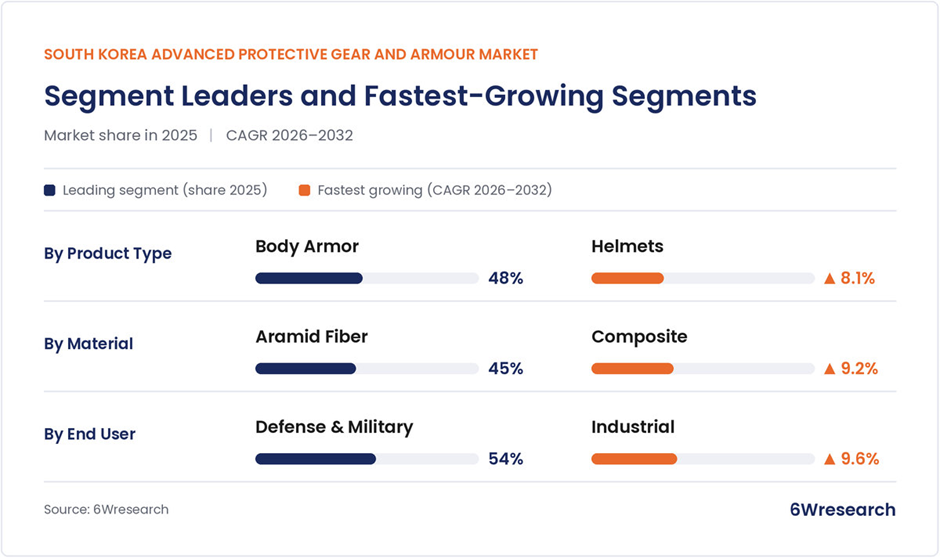
By Product Type – Body Armor Leads, Helmets Expected to Grow Fastest
According to Bhawna Singh, Research Assistant Manager at 6Wresearch, Body Armor leads the market with a 48% share in 2025, as the Army’s replacement of ageing individual kit and the size of the conscript and reserve force sustain high-volume procurement. In contrast, Helmets are expected to grow fastest at a CAGR of 8.1% during 2026–2032, as integrated helmet systems with communication and night-vision mounts raise unit values across armed forces and police.
By Material – Aramid Fiber Leads, Composite Expected to Grow Fastest
Aramid Fiber accounts for the largest share at 45% in 2025, supported by a domestic aramid production base and its established use in soft body armour and helmet shells. Alternatively, Composite is expected to grow fastest at a CAGR of 9.2% during 2026–2032, as hybrid polyethylene and ceramic laminates meet demand for lighter, higher-protection equipment.
By End User – Defense & Military Leads, Industrial Expected to Grow Fastest
Defense & Military commands 54% of 2025 demand, as a standing force facing North Korea requires continuous issuance and replacement of protective equipment. Conversely, Industrial users are expected to record the fastest CAGR of 9.6% during 2026–2032, as shipbuilding, construction and heavy manufacturing employers upgrade certified protective equipment under stricter workplace accountability rules.
Note: Market size estimations and growth projections presented in this report are based on 6Wresearch’s proprietary forecasting methodology, utilizing the latest available industry data, government publications, and primary research inputs.
Key Attractiveness of the Report
- 10 Years of Market Numbers
- Historical Data Starting from 2022 to 2025
- Base Year 2025
- Forecast Data until 2032
- Key Performance Indicators Impacting the Market
- Major Upcoming Developments and Projects
Key Highlights of the Report:
- South Korea Advanced Protective Gear and Armour Market Outlook
- Market Size of South Korea Advanced Protective Gear and Armour Market, 2025
- Forecast of South Korea Advanced Protective Gear and Armour Market, 2032
- Historical Data and Forecast of South Korea Advanced Protective Gear and Armour Revenues & Volume for the Period 2022-2032
- South Korea Advanced Protective Gear and Armour Market Trend Evolution
- South Korea Advanced Protective Gear and Armour Market Drivers and Challenges
- South Korea Advanced Protective Gear and Armour Price Trends
- South Korea Advanced Protective Gear and Armour Porter's Five Forces
- South Korea Advanced Protective Gear and Armour Industry Life Cycle
- Historical Data and Forecast of South Korea Advanced Protective Gear and Armour Market Revenues & Volume By Product Type for the Period 2022-2032
- Historical Data and Forecast of South Korea Advanced Protective Gear and Armour Market Revenues & Volume By Body Armor for the Period 2022-2032
- Historical Data and Forecast of South Korea Advanced Protective Gear and Armour Market Revenues & Volume By Helmets for the Period 2022-2032
- Historical Data and Forecast of South Korea Advanced Protective Gear and Armour Market Revenues & Volume By Shields for the Period 2022-2032
- Historical Data and Forecast of South Korea Advanced Protective Gear and Armour Market Revenues & Volume By Material for the Period 2022-2032
- Historical Data and Forecast of South Korea Advanced Protective Gear and Armour Market Revenues & Volume By Aramid Fiber for the Period 2022-2032
- Historical Data and Forecast of South Korea Advanced Protective Gear and Armour Market Revenues & Volume By Steel for the Period 2022-2032
- Historical Data and Forecast of South Korea Advanced Protective Gear and Armour Market Revenues & Volume By Composite for the Period 2022-2032
- Historical Data and Forecast of South Korea Advanced Protective Gear and Armour Market Revenues & Volume By End User for the Period 2022-2032
- Historical Data and Forecast of South Korea Advanced Protective Gear and Armour Market Revenues & Volume By Defense & Military for the Period 2022-2032
- Historical Data and Forecast of South Korea Advanced Protective Gear and Armour Market Revenues & Volume By Law Enforcement for the Period 2022-2032
- Historical Data and Forecast of South Korea Advanced Protective Gear and Armour Market Revenues & Volume By Industrial for the Period 2022-2032
- South Korea Advanced Protective Gear and Armour Import Export Trade Statistics
- Market Opportunity Assessment By Product Type
- Market Opportunity Assessment By Material
- Market Opportunity Assessment By End User
- South Korea Advanced Protective Gear and Armour Top Companies Market Share
- South Korea Advanced Protective Gear and Armour Competitive Benchmarking By Technical and Operational Parameters
- South Korea Advanced Protective Gear and Armour Company Profiles
- South Korea Advanced Protective Gear and Armour Key Strategic Recommendations
Market Covered
The report offers an extensive study of the following market segments.
By Product Type
- Body Armor
- Helmets
- Shields
By Mate
- Aramid Fiber
- Steel
- Composite
By End User
- Defense & Military
- Law Enforcement
- Industrial































