South Korea Printed Circuit Boards Market Summary
The south korea printed circuit boards market was estimated at USD 296 Million in 2025 and is projected to reach USD 395 Million by 2032, growing at a CAGR of 4.9% from 2026 to 2032.
South Korea Printed Circuit Boards Market Year-wise Growth Rate and Key Drivers
This graph highlights how the South Korea Printed Circuit Boards Market has steadily grown over the past five years, supported by major growth factors.
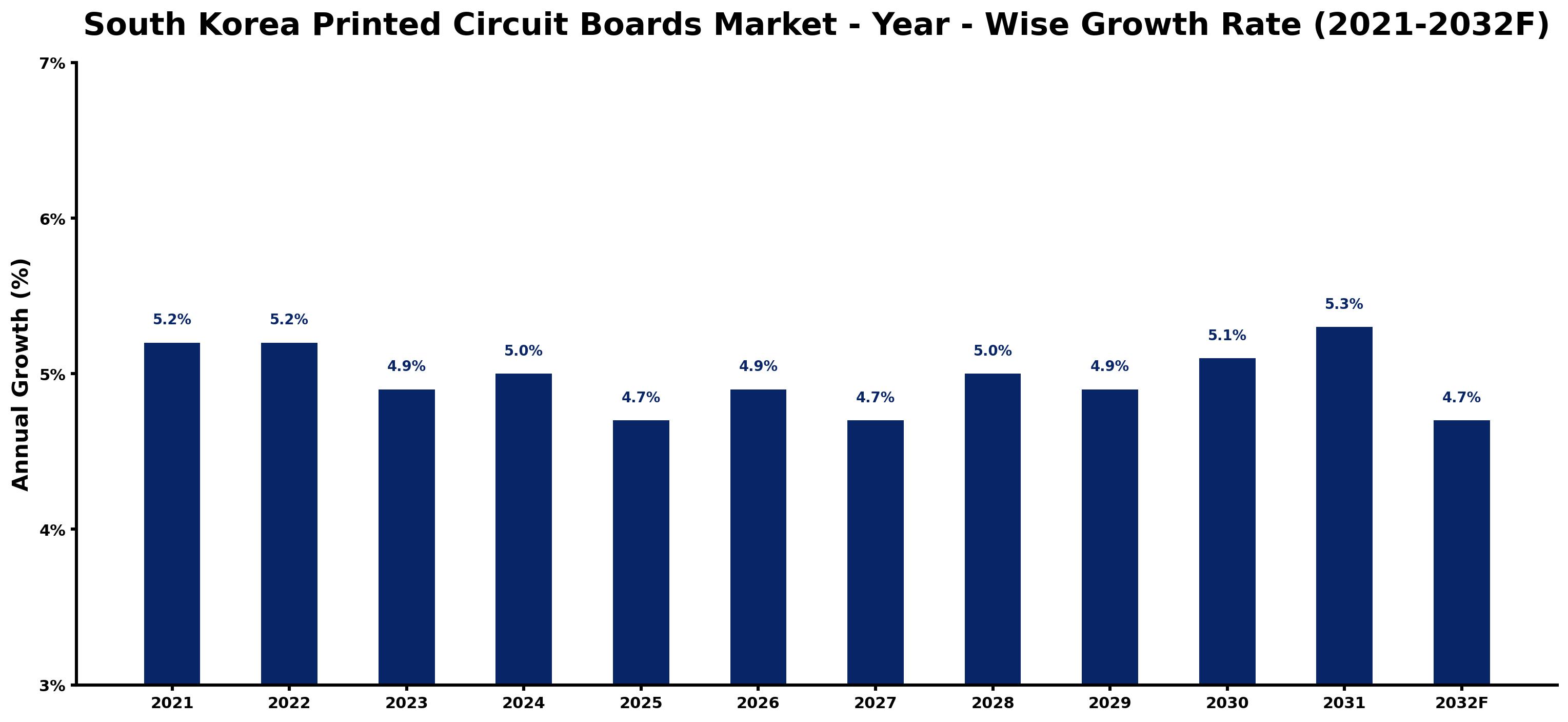
The table below presents the year wise growth rates along with the key drivers influencing the market
| Year | Growth Rate | Major Drivers |
| 2021 | 5.2% | Post-lockdown electronic demand accelerated, particularly in consumer electronics and automotive sectors. |
| 2022 | 5.2% | Manufacturing relocations from China emphasized the need for local PCB production capabilities. |
| 2023 | 4.9% | Technological innovations in IoT devices necessitated more advanced PCB designs and manufacturing. |
| 2024 | 5.0% | Expansion of 5G infrastructure contributed to increased demand for high-frequency PCBs. |
| 2025 | 4.7% | Automotive electrification trends underscored the importance of reliable PCB performance in EVs. |
| 2026 | 4.9% | Competition among tech firms spurred investments in more efficient PCB manufacturing technologies. |
| 2027 | 4.7% | Emergence of smart home solutions required flexible PCBs tailored for diverse applications. |
| 2028 | 5.0% | Increased focus on sustainability drove demand for eco-friendly PCB materials and processes. |
| 2029 | 4.9% | Collaboration between tech companies and universities enhanced research in next-gen PCB technologies. |
| 2030 | 5.1% | Shift towards miniaturization in electronics called for more compact and efficient PCB designs. |
| 2031 | 5.3% | Growing cybersecurity concerns in connected devices influenced the demand for secure PCB solutions. |
| 2032 | 4.7% | Market consolidation among PCB manufacturers led to improved economies of scale and innovation. |
Note - Market size estimations and growth projections presented in this report are based on 6Wresearch's advanced forecasting approach, validated with industry datasets as of June 2026.
South Korea Printed Circuit Boards Market Synopsis
The South Korea Printed Circuit Boards Market is projected to reach 4.9% and witness significant growth during the forecast period (2026-2032). This growth trajectory is primarily driven by the escalating demand for printed circuit boards (PCBs) in a myriad of applications including consumer electronics, automotive systems, industrial automation, and communication technologies. The robust expansion of the Internet of Things (IoT) in South Korea is poised to unlock new opportunities for PCB manufacturers, fostering an environment conducive to innovation and growth.
South Korea Printed Circuit Boards Market Growth Drivers
Several factors are contributing to the positive outlook of the South Korea Printed Circuit Boards Market. First and foremost, the surging demand for consumer electronics, which represents a significant segment of PCB applications, is pushing manufacturers to innovate and enhance their production capabilities. This heightened demand is particularly evident in devices like smartphones, laptops, and wearables.
- The automotive sector is increasingly adopting advanced electronic systems, thereby necessitating the integration of high-performance PCBs into vehicles. This trend reflects a broader shift towards electric and autonomous vehicles.
- Industrial automation is experiencing a renaissance, with smart factories seeking reliable and efficient PCBs to support their sophisticated machinery and communication networks.
- Communication systems, driven by the rise of 5G technology, are demanding high-speed PCBs that can support increased data transmission rates while maintaining signal integrity.
- The IoT proliferation is also a critical growth factor, as an expanding number of connected devices require specialized PCBs, thereby enhancing manufacturers' opportunities for innovation.
South Korea Printed Circuit Boards Market Technological Advancements
Technological advancements are redefining the landscape of the South Korea Printed Circuit Boards Market. Innovations in material science have led to the development of high-speed dielectrics, which offer superior performance metrics such as low insertion loss and enhanced signal integrity. This technological evolution not only improves the efficiency of PCBs but also allows for the miniaturization of electronic components, catering to the growing demand for compact devices.
- Research and development in flexible and rigid-flex PCBs are gaining traction, supporting the design of ultra-thin devices that require flexible electronics.
- Advancements in surface mount technology (SMT) and integration techniques are optimizing manufacturing processes, resulting in reduced production costs and improved quality control.
- Sustainability efforts in PCB production, including the use of eco-friendly materials and manufacturing processes, are appealing to environmentally conscious consumers and businesses alike.
- Enhanced reliability and durability standards are driving demand for high-performance PCBs in critical applications across various sectors.
- Digital transformation initiatives within manufacturing are streamlining production workflows, enabling manufacturers to respond more rapidly to market demands.
South Korea Printed Circuit Boards Market Government Investment and Initiatives
The South Korean government is playing a pivotal role in shaping the landscape of the printed circuit boards market through various investment initiatives and policy frameworks. Significant investments are directed towards research and development programs aimed at fostering innovation within the electronics sector. These initiatives seek to enhance the global competitiveness of South Korean PCB manufacturers.
- Government incentives for technology adoption are being offered to encourage PCB manufacturers to integrate advanced manufacturing technologies, ensuring they remain competitive in an evolving market.
- Sustainability regulations are being enforced to ensure that manufacturers meet environmental compliance standards, promoting eco-friendly production practices.
- Public funding is being allocated to support industry collaboration between public institutions and private companies, facilitating knowledge sharing and innovation.
- Investment in infrastructure development, including the establishment of specialized industrial complexes, is providing PCB manufacturers access to state-of-the-art facilities and resources.
- Policies aimed at workforce development are enhancing the skill sets of workers in the electronics industry, thereby addressing labor shortages and increasing productivity.
South Korea Printed Circuit Boards Market Latest Developments (May 2025 - June 2026)
Recent developments within the South Korea Printed Circuit Boards Market indicate a focus on enhancing production capabilities and adopting new technologies. Manufacturers are increasingly investing in automation and smart manufacturing practices to bolster efficiency and meet rising demand. Additionally, the industry is witnessing a surge in collaborations between technology providers and PCB manufacturers, which is fostering innovation and accelerating product development timelines.
- New eco-friendly PCB materials are being introduced in response to market demand for sustainable electronics, demonstrating a commitment to minimizing environmental impact.
- Emerging technologies such as 5G are prompting manufacturers to innovate and adapt their product offerings to meet the specific needs of high-speed communication devices.
- Industry stakeholders are actively participating in global trade shows and exhibitions, showcasing advancements and reinforcing South Korea's position as a leader in PCB technology.
- Strategic partnerships are being formed to explore new business opportunities in international markets, thereby expanding the reach of South Korean PCB products.
- Investment in talent acquisition and training programs is being emphasized to ensure that the workforce is equipped with the necessary skills to support ongoing technological advancements.
South Korea Printed Circuit Boards Market - Key Attractiveness of the Report
- 10 Years of Market Numbers
- Historical Data Starting from 2022 to 2025
- Base Year: 2025
- Forecast Data until 2032
- Key Performance Indicators Impacting the Market
- Major Upcoming Developments and Projects
Key Highlights of the Report:
- South Korea Printed Circuit Boards Market Outlook
- Market Size of South Korea Printed Circuit Boards Market, 2025
- Forecast of South Korea Printed Circuit Boards Market, 2032F
- Historical Data and Forecast of South Korea Printed Circuit Boards Revenues & Volume for the Period 2022-2032F
- South Korea Printed Circuit Boards Market Trend Evolution
- South Korea Printed Circuit Boards Market Drivers and Challenges
- South Korea Printed Circuit Boards Price Trends
- South Korea Printed Circuit Boards Porter's Five Forces
- South Korea Printed Circuit Boards Industry Life Cycle
- Historical Data and Forecast of South Korea Printed Circuit Boards Market Revenues & Volume By Types for the Period 2022-2032F
- Historical Data and Forecast of South Korea Printed Circuit Boards Market Revenues & Volume By Single Sided for the Period 2022-2032F
- Historical Data and Forecast of South Korea Printed Circuit Boards Market Revenues & Volume By Double Sided for the Period 2022-2032F
- Historical Data and Forecast of South Korea Printed Circuit Boards Market Revenues & Volume By Multi-Layer for the Period 2022-2032F
- Historical Data and Forecast of South Korea Printed Circuit Boards Market Revenues & Volume By HDI for the Period 2022-2032F
- Historical Data and Forecast of South Korea Printed Circuit Boards Market Revenues & Volume By Substrate for the Period 2022-2032F
- Historical Data and Forecast of South Korea Printed Circuit Boards Market Revenues & Volume By Rigid for the Period 2022-2032F
- Historical Data and Forecast of South Korea Printed Circuit Boards Market Revenues & Volume By Flexible for the Period 2022-2032F
- Historical Data and Forecast of South Korea Printed Circuit Boards Market Revenues & Volume By Rigid-Flex for the Period 2022-2032F
- Historical Data and Forecast of South Korea Printed Circuit Boards Market Revenues & Volume By End-users for the Period 2022-2032F
- Historical Data and Forecast of South Korea Printed Circuit Boards Market Revenues & Volume By Industrial Electronics for the Period 2022-2032F
- Historical Data and Forecast of South Korea Printed Circuit Boards Market Revenues & Volume By Healthcare for the Period 2022-2032F
- Historical Data and Forecast of South Korea Printed Circuit Boards Market Revenues & Volume By Aerospace & Defense for the Period 2022-2032F
- Historical Data and Forecast of South Korea Printed Circuit Boards Market Revenues & Volume By Automotive for the Period 2022-2032F
- Historical Data and Forecast of South Korea Printed Circuit Boards Market Revenues & Volume By IT & Telecom for the Period 2022-2032F
- Historical Data and Forecast of South Korea Printed Circuit Boards Market Revenues & Volume By Consumer Electronics for the Period 2022-2032F
- Historical Data and Forecast of South Korea Printed Circuit Boards Market Revenues & Volume By Others for the Period 2022-2032F
- South Korea Printed Circuit Boards Import Export Trade Statistics
- Market Opportunity Assessment By Types
- Market Opportunity Assessment By Substrate
- Market Opportunity Assessment By End-users
- South Korea Printed Circuit Boards Top Companies Market Share
- South Korea Printed Circuit Boards Competitive Benchmarking By Technical and Operational Parameters
- South Korea Printed Circuit Boards Company Profiles
- South Korea Printed Circuit Boards Key Strategic Recommendations






































