Taiwan Data Center Market Growth Rate
According to 6Wresearch internal databases and industry insights, the Taiwan Data Center Market is projected to grow at a steady compound annual growth rate (CAGR) of 19.3% during the forecast period 2026–2032.
Taiwan Data Center Market Year-wise Growth Rate and Key Drivers (2022-2032)
This graph illustrates the annual growth rates of the Taiwan Data Center Market from 2022 to 2032, highlighting a steady upward trajectory and projected market expansion over the forecast period.
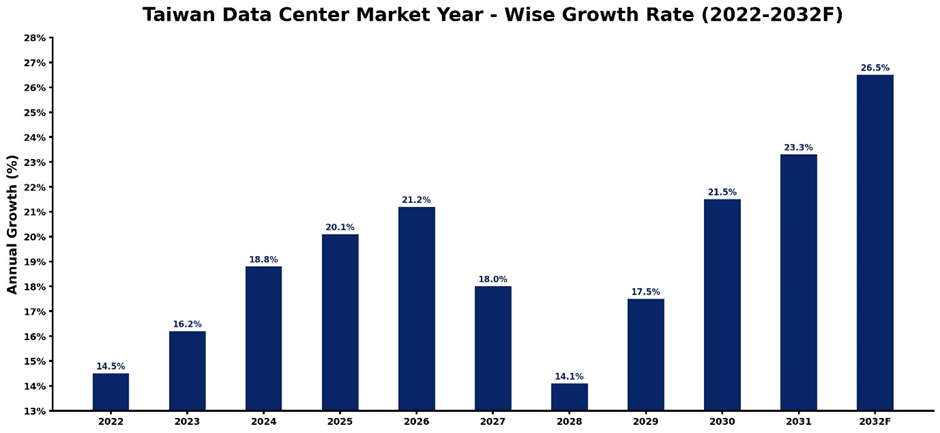
The following table summarizes the historical and forecasted growth rates of Taiwan Data Center Market, along with the rationale behind each year’s performance.
| Year | Growth Rate (%) | Key Market Rationale |
| 2022 | 14.5% | Post-pandemic digital acceleration, enterprise cloud migration begins |
| 2023 | 16.2% | Hybrid cloud adoption expands across BFSI and telecom sectors |
| 2024 | 18.8% | Early AI workloads emerge; hyperscale planning increases |
| 2025 | 20.1% | Strong AI, GPU infrastructure demand; hyperscalers expand footprint |
| 2026 | 21.2% | AI training clusters scale up; Taiwan strengthens APAC cloud hub role |
| 2027 | 18% | Hyperscale expansion continues; edge data centers grow in industrial zones |
| 2028 | 14.1% | Growth moderates due to energy constraints and infrastructure saturation |
| 2029 | 17.5% | Power grid limitations and land scarcity slow expansion pace |
| 2030 | 21.5% | Rising operational costs and regulatory pressure impact growth |
| 2031 | 23.3% | AI infrastructure super-cycle drives massive hyperscale reinvestment |
| 2032 | 26.5% | AI inference boom + edge computing + 5G integration accelerate demand |
Topics Covered in the Taiwan Data Center Market Report
The Taiwan Data Center Industry report covers the market by component and vertical. The report provides a detailed analysis of ongoing market trends, investment opportunities/high-growth areas, and key growth drivers which helps stakeholders align strategies based on current and future data infrastructure demand in Taiwan.
Taiwan Data Center Market Highlights
| Report Name | Taiwan Data Center Market |
| Forecast period | 2026-2032 |
| CAGR | 19.3% |
| Growing Sector |
Digital Infrastructure and Cloud Computing |
Taiwan Data Center Market Synopsis
Taiwan Data Center Market is projected for strong structural expansion during the forecast period due to rapid growth in AI workloads, increasing hyperscale cloud adoption, and rising demand for high-performance computing infrastructure. The market is further supported by Taiwan’s strategic position in the global semiconductor supply chain, expansion of submarine cable connectivity, and increasing deployment of edge computing infrastructure. Continuous investments from global cloud service providers and growing enterprise digital transformation initiatives are key drivers shaping market growth.
Evaluation of Growth Drivers in Taiwan Data Center Market (2026–2032)
Below are some major drivers and their influence on the market dynamics:
| Drivers | Primary Segment Affected | Why It Matters (Evidence) |
| Rising AI & Machine Learning Workloads | Hyperscale & Enterprise Data Centers | GPU-intensive computing increases demand for high-density data center infrastructure |
| Hyperscale Cloud Expansion | Colocation & Hyperscale Facilities | Global cloud providers expand regional infrastructure to support latency-sensitive workloads |
| Semiconductor Industry Ecosystem Growth | High-Performance Computing (HPC) Centers | Taiwan’s chip manufacturing leadership drives demand for compute-heavy workloads |
| Growth of Edge Computing | Edge Data Centers | Low-latency applications (5G, IoT, smart manufacturing) require decentralized infrastructure |
| Increasing Data Traffic & Digitalization | Enterprise Data Centers | Rapid digital transformation across BFSI, telecom, and manufacturing sectors |
Taiwan Data Center Market Share is estimated to grow at a CAGR of 19.3% during the forecast period (2026–2032). The transition from traditional colocation facilities toward AI-optimized, high-density, and energy-efficient data centers is accelerating market expansion. Rising installations of GPU clusters, rising demand for real-time analytics, and growing cloud-native workloads are further accelerating market growth. In spite of, infrastructure constraints such as power availability and land limitations continue to shape expansion strategies.
Evaluation of Restraints in Taiwan Data Center Market
Below are some major restraints and their influence on the market dynamics:
| Restraints | Primary Segment Affected | What This Means (Evidence) |
| Power Supply Constraints | Hyperscale Data Centers | Limited electricity availability restricts large-scale expansion |
| Land Scarcity in Urban Areas | Colocation Facilities | High real estate costs in Taipei and Kaohsiung limit new builds |
| High Capital Investment | New Data Center Projects | Significant upfront cost for construction and cooling infrastructure |
| Environmental Regulations | All Data Center Types | Carbon neutrality requirements increase compliance costs |
| Skilled Workforce Shortage | Operations & Maintenance | Limited availability of specialized data center engineers |
Taiwan Data Center Market Challenges
Despite rapid market expansion due to increasing cloud adoption and rising AI infrastructure demand, the market is facing critical challenges such as power grid limitations, rising operational costs, and severe land constraints in major urban hubs. Also, balancing high-performance computing requirements with strict energy efficiency targets remains a key technical bottleneck for operators. For sustained Taiwan Data Center Market growth, data center operators must prioritize renewable energy integration, advanced liquid cooling technologies, and modular, scalable data center designs optimized.
Taiwan Data Center Market Trends
Major trends responsible for Taiwan Data Center Market growth include:
- AI-Driven Data Center Expansion: To support AI model training across multiple enterprise and cloud environments globally, there is fast adaption of GPU-based infrastructure.
- Rise of Edge Data Centers: Deployment of decentralized facilities closer to industrial and 5G network nodes for low-latency applications across urban digital ecosystems.
- Green Data Center Development: Increasing focus on carbon reduction strategies aligned with global ESG compliance and sustainability targets for long-term operational efficiency improvements.
- Hyperscale Cloud Growth: Widespread global cloud providers building massive regional infrastructure in Taiwan to support growing digital workloads from enterprise and government sectors.
Taiwan Data Center Market Investment Opportunities
Below are the investment opportunities available in Taiwan Data Center Market:
- AI-Optimized Data Center Infrastructure: To support next-generation computing applications, funding needed in high-density GPU clusters and AI-ready server environments design.
- Edge Data Center Expansion: Rising need for localized computing infrastructure which enables faster data processing, reduced latency, and improved operational responsiveness.
- Green Energy-Powered Facilities: Possibilities in solar, wind, and hybrid energy-powered data centers leads to reduced long-term operational costs and environmental impact significantly.
- Liquid Cooling and Advanced Thermal Management: Enhanced efficient heat dissipation and improved system reliability by investing in next-generation cooling technologies.
Top 4 Leading Players in Taiwan Data Center Market
Below are some of the leading companies in the Taiwan Data Center Market:
1. Chunghwa Telecom (CHT)
| Company Name | Chunghwa Telecom (CHT) |
|---|---|
| Established Year | 1996 |
| Headquarters | Taipei, Taiwan |
| Official Website | Click Here |
Chunghwa Telecom is Taiwan’s largest telecommunications provider. It delivers advanced Tier-3 and Tier-4 colocation services supported by strong nationwide fiber connectivity.
2. Taiwan Mobile
| Company Name | Taiwan Mobile |
|---|---|
| Established Year | 1997 |
| Headquarters | Taipei, Taiwan |
| Official Website | Click Here |
Taiwan Mobile is a leading telecom and digital services provider offering secure enterprise-grade cloud infrastructure and integrated IDC solutions across Taiwan.
3. Chief Telecom
| Company Name | Chief Telecom |
|---|---|
| Established Year | 1991 |
| Headquarters | Taipei, Taiwan |
| Official Website | Click Here |
Chief Telecom is a major carrier-neutral data center and internet infrastructure provider operating CHIEF IDC facilities in Taipei.
4. Far EasTone Telecommunications (FET)
| Company Name | Far EasTone Telecommunications (FET) |
|---|---|
| Established Year | 1997 |
| Headquarters | Taipei, Taiwan |
| Official Website | Click Here |
Far EasTone Telecommunications operates advanced IDC facilities integrated with 5G networks, cloud services, and enterprise IT solutions.
Government Initiatives being implemented in the Taiwan Data Center Market
According to the Taiwanese government data, the market is actively shaping its data center through strategic policy initiatives designed to balance rapid AI growth with sustainability. To expand the Taiwan Data Center Market size, government has prioritized infrastructure expansion, which includes securing reliable energy through new gas-fired power plants and long-term grid development to meet intense demands of AI. In addition to, national digital transformation plans foster a stable, competitive environment that attracts significant foreign and domestic infrastructure capital.
Future Insights of the Taiwan Data Center Market
The market is projected to grow significantly during the forecast period, driven by its evolution into a specialized hub for AI and high-performance computing (HPC). The industry is shifting from traditional enterprise designs to modular, GPU-ready campuses, due to semiconductor leadership, resulting in increased demand for ultra-dense, liquid-cooled infrastructure. To raise the Taiwan Data Center Market revenue, operators are actively prioritizing energy-efficient thermal management and integrated renewable power strategies to navigate grid constraints and meet ambitious net-zero commitments.
Market Segmentation Analysis
The report offers a comprehensive study of the following market segments and their leading categories:
By Component- Electrical Led the Market and Mechanical Set for Rapid Growth
According to Ravi Bhandari, Senior Research Analyst, 6Wresearch, by component, in 2025, the Electrical component commanded the Taiwan data center market with a 64.2% share, due to widespread enterprise adoption of software-defined infrastructure and cloud management platforms. However, by 2032, Mechanical (cooling) infrastructure is projected to lead the market with a CAGR of 10%, owned by the critical need for advanced liquid cooling and high-voltage power distribution.
By Vertical - IT & Telecom Dominated the Market and Manufacturing Set for Rapid Expansion
By Vertical, the IT & Telecom vertical captured 40% share of the Taiwan data center market in 2025, due to rapid 5G deployment and the dominance of major telecommunications providers in infrastructure hosting. Meanwhile, by 2032, the Manufacturing vertical is projected to dominate the market, with a CAGR of 12%, drive by deep digital transformation of the industry.
Note: Market size estimations and growth projections presented in this report are based on 6Wresearch’s advanced forecasting approach, validated with industry datasets as of June 2026.
Key Attractiveness of the Report:
- 10 Years of Market Numbers
- Historical Data Starting from 2022 to 2025
- Base Year: 2025
- Forecast Data until 2032
- Key Performance Indicators Impacting the Market
- Major Upcoming Developments and Projects
Key Highlights of the Report:
- Taiwan Data Center Market Outlook
- Market Size of Taiwan Data Center Market, 2025
- Forecast of Taiwan Data Center Market, 2032
- Historical Data and Forecast of Taiwan Data Center Revenues & Volume for the Period 2022-2032
- Taiwan Data Center Market Trend Evolution
- Taiwan Data Center Market Drivers and Challenges
- Taiwan Data Center Price Trends
- Taiwan Data Center Porter`s Five Forces
- Taiwan Data Center Industry Life Cycle
- Historical Data and Forecast of Taiwan Data Center Market Revenues & Volume By Component for the Period 2022-2032
- Historical Data and Forecast of Taiwan Data Center Market Revenues & Volume By Electrical for the Period 2022-2032
- Historical Data and Forecast of Taiwan Data Center Market Revenues & Volume By Mechanical for the Period 2022-2032
- Historical Data and Forecast of Taiwan Data Center Market Revenues & Volume By Networking for the Period 2022-2032
- Historical Data and Forecast of Taiwan Data Center Market Revenues & Volume By Racks for the Period 2022-2032
- Historical Data and Forecast of Taiwan Data Center Market Revenues & Volume By Security Systems for the Period 2022-2032
- Historical Data and Forecast of Taiwan Data Center Market Revenues & Volume By Fire Systems for the Period 2022-2032
- Historical Data and Forecast of Taiwan Data Center Market Revenues & Volume By Vertical for the Period 2022-2032
- Historical Data and Forecast of Taiwan Data Center Market Revenues & Volume By Banking Financial Services & Insurance (BFSI) for the Period 2022-2032
- Historical Data and Forecast of Taiwan Data Center Market Revenues & Volume By Government for the Period 2022-2032
- Historical Data and Forecast of Taiwan Data Center Market Revenues & Volume By IT & Telecom for the Period 2022-2032
- Historical Data and Forecast of Taiwan Data Center Market Revenues & Volume By Media for the Period 2022-2032
- Historical Data and Forecast of Taiwan Data Center Market Revenues & Volume By Retail for the Period 2022-2032
- Historical Data and Forecast of Taiwan Data Center Market Revenues & Volume By Manufacturing for the Period 2022-2032
- Historical Data and Forecast of Taiwan Data Center Market Revenues & Volume By Others for the Period 2022-2032
- Taiwan Data Center Import Export Trade Statistics
- Market Opportunity Assessment By Component
- Market Opportunity Assessment By Vertical
- Taiwan Data Center Top Companies Market Share
- Taiwan Data Center Competitive Benchmarking By Technical and Operational Parameters
- Taiwan Data Center Company Profiles
- Taiwan Data Center Key Strategic Recommendations
Market Covered
The report offers an extensive study of the following market segments:
By Component
- Electrical
- Mechanical
- Networking
- Rack
- Security Systems
- Fire Systems
By Vertical
- Banking Financial Services & Insurance (BFSI)
- Government
- IT & Telecom
- Media
- Retail
- Manufacturing
- Others






































