Tajikistan Leather Market Summary
The tajikistan leather market was estimated at USD 192 Million in 2025 and is projected to reach USD 259 Million by 2032, growing at a CAGR of 5.2% from 2026 to 2032.
Tajikistan Leather Market Year-wise Growth Rate and Key Drivers
This graph highlights how the Tajikistan Leather Market has steadily grown over the past five years, supported by major growth factors.
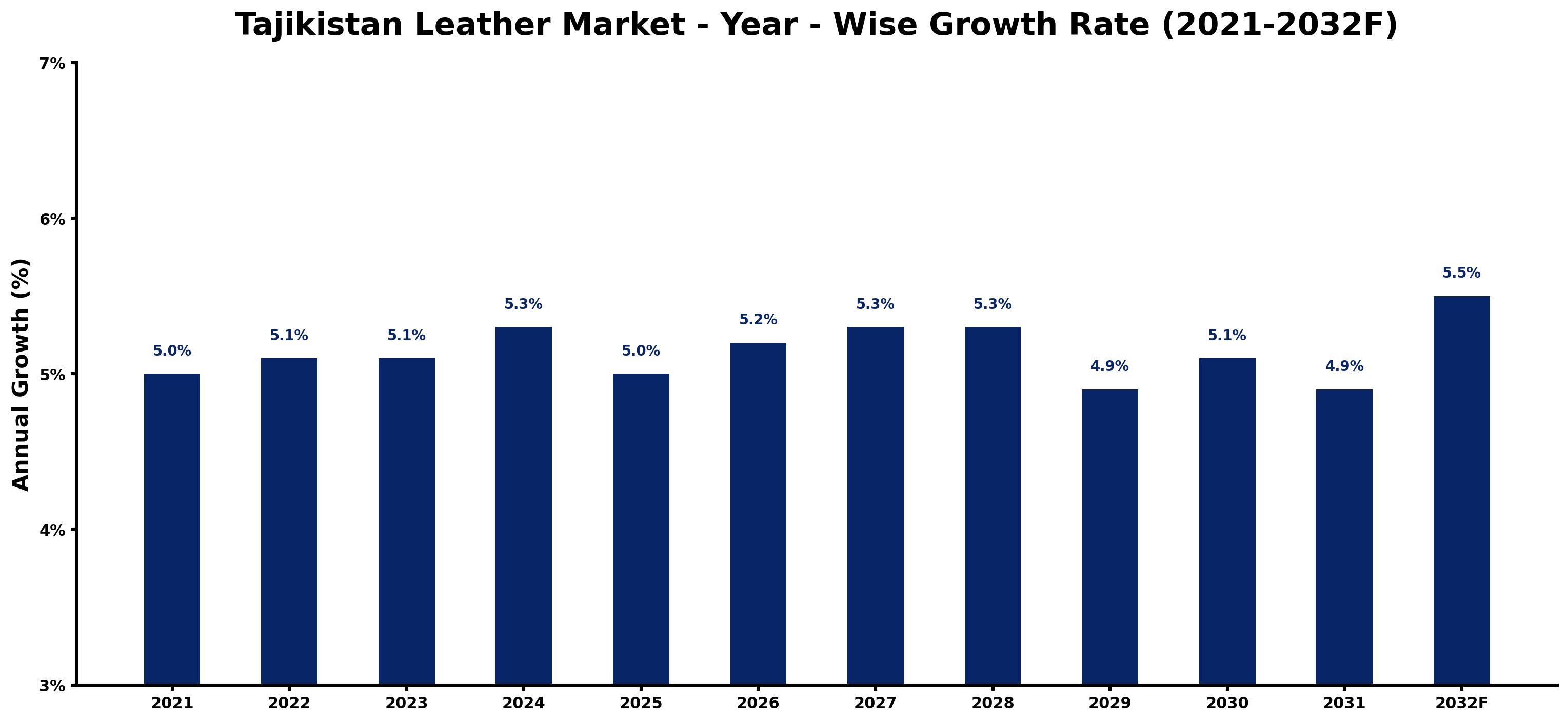
The table below presents the year wise growth rates along with the key drivers influencing the market
| Year | Growth Rate | Major Drivers |
| 2021 | 5.0% | Post-pandemic recovery fueled a resurgence in local artisan craftsmanship and exports. |
| 2022 | 5.1% | Increased global interest in sustainable fashion highlighted Tajikistan's eco-friendly leather production. |
| 2023 | 5.1% | Local fashion brands emerged, showcasing Tajik leather in regional and international markets. |
| 2024 | 5.3% | Expanding tourism sector encouraged demand for high-quality leather goods and accessories. |
| 2025 | 5.0% | Investments in processing facilities improved production efficiency and product quality significantly. |
| 2026 | 5.2% | Collaborations with international designers enhanced brand visibility and market reach for artisans. |
| 2027 | 5.3% | Growth in e-commerce platforms enabled wider distribution of Tajik leather products. |
| 2028 | 5.3% | Consumer preferences shifted towards locally-sourced, handmade goods, boosting artisanal leather demand. |
| 2029 | 4.9% | Economic diversification efforts promoted entrepreneurship in the leather goods sector across Tajikistan. |
| 2030 | 5.1% | Regional trade agreements facilitated easier export routes for Tajik leather products abroad. |
| 2031 | 4.9% | Innovative marketing strategies increased brand awareness and consumer engagement in the leather market. |
| 2032 | 5.5% | Emergence of sustainable practices in the sector attracted environmentally-conscious consumers and investors. |
Note - Market size estimations and growth projections presented in this report are based on 6Wresearch's advanced forecasting approach, validated with industry datasets as of June 2026.
Tajikistan Leather Market Synopsis
The Tajikistan Leather Market is projected to reach 5.2% and witness significant growth during the forecast period (2026-2032). This growth trajectory is primarily fueled by the escalating demand for leather products within both domestic and international markets. The increasing consumer spending power, coupled with advancements in infrastructure and improved accessibility to credit, are pivotal factors contributing to the market's expansion. Additionally, government initiatives aimed at bolstering local production, such as the "Made In Tajikistan" program, have substantially boosted the industry.
Tajikistan Leather Market Growth Drivers
The growth of the Tajikistan Leather Market is underpinned by several critical drivers that facilitate its expansion. First and foremost, the rising disposable income among consumers is leading to greater expenditure on luxury and premium leather goods. This shift in consumer behavior is creating an enhanced market demand.
- Increased local production capabilities have led to a surge in the variety and quality of leather products available in the market, which further attracts consumers.
- The burgeoning tourism sector in Tajikistan is enhancing the market, as tourists often seek authentic, locally produced leather goods as souvenirs.
- Growing urbanization is resulting in shifts in lifestyle and consumer preferences, with leather products becoming a symbol of status and quality.
- The influence of social media and online retailing is driving new market segments to seek out leather products, enhancing overall market access.
- Ongoing improvements in transportation and logistics infrastructure are ensuring that leather products reach broader markets, both domestically and internationally.
Tajikistan Leather Market Challenges and Restraints
While the Tajikistan Leather Market exhibits promising growth potential, it also faces several challenges and restraints that could impede progress. Among these challenges, the availability of high-quality raw materials remains a crucial concern. Additionally, competition from synthetic leather products poses a significant threat to the traditional leather market.
- Environmental regulations related to leather processing may create compliance costs that impact profit margins.
- Limited access to financing for small-scale producers can restrict their operational capabilities and hinder growth.
- The fluctuating prices of raw materials can lead to instability in production costs, affecting pricing strategies.
- Cultural perceptions regarding leather usage may influence consumer preferences, particularly in rural areas.
- The potential volatility in international markets could affect export opportunities for Tajik leather products.
Tajikistan Leather Market Investment Opportunities
The evolving dynamics of the Tajikistan Leather Market present numerous investment opportunities for stakeholders. Investors are increasingly recognizing the potential within this market, particularly in the realms of production innovation and sustainable practices. The following investment avenues are worth exploring:
- Investments in modern tanning and processing technologies can enhance product quality and reduce environmental impact.
- Entering into collaborations with local artisans to develop unique product lines that cater to niche markets can yield significant returns.
- Establishing training programs for local communities can help elevate craftsmanship standards and product offerings.
- Enhancing supply chain efficiencies through logistics investments can optimize distribution channels for faster market reach.
- Supporting initiatives for eco-friendly production methods could attract environmentally conscious consumers, expanding market appeal.
Tajikistan Leather Market Government Investment and Initiatives
The Tajik government has implemented several initiatives aimed at revitalizing and promoting the leather industry. These initiatives include the "Made In Tajikistan" program, which emphasizes the importance of local production and quality craftsmanship. By providing support to local manufacturers, the government is fostering an environment conducive to growth in the leather sector.
- Public investments in infrastructure projects specifically targeting leather producers are aimed at improving logistics and accessibility.
- Tax incentives for local producers serve as motivation to enhance production capabilities and invest in equipment.
- Government-sponsored workshops and training initiatives are focused on elevating the skills of workers in the leather sector.
- Policy frameworks that encourage sustainable practices in leather production are being developed to align with global standards.
- Collaborations with international organizations are being explored to expand market access and share best practices.
Tajikistan Leather Market Latest Developments (May 2025 - June 2026)
Recent developments within the Tajikistan Leather Market reflect a proactive approach by stakeholders to adapt to changing market conditions and consumer demands. During this period, there has been a notable increase in the establishment of local production units, aimed at enhancing the quality and variety of leather goods. Efforts to promote Tajik leather products at international trade shows have also gained traction, thereby enabling local manufacturers to access broader markets.
- The growing collaboration between artisans and designers has led to innovative product developments, diversifying the overall offering.
- Efforts to establish sustainable practices in production are gaining prominence, aligning with global consumer preferences for eco-friendly products.
- Increased participation of women in the leather production workforce has been observed, contributing to community development and economic empowerment.
- Expansion of e-commerce platforms dedicated to local leather products has facilitated improved market access for small producers.
- Government support for training and skill development is resulting in a more proficient workforce, equipped to meet market demands.
Tajikistan Leather Market - Key Attractiveness of the Report
- 10 Years of Market Numbers
- Historical Data Starting from 2022 to 2025
- Base Year: 2025
- Forecast Data until 2032
- Key Performance Indicators Impacting the Market
- Major Upcoming Developments and Projects
Key Highlights of the Report:
- Tajikistan Leather Market Outlook
- Market Size of Tajikistan Leather Market, 2025
- Forecast of Tajikistan Leather Market, 2032F
- Historical Data and Forecast of Tajikistan Leather Revenues & Volume for the Period 2022-2032F
- Tajikistan Leather Market Trend Evolution
- Tajikistan Leather Market Drivers and Challenges
- Tajikistan Leather Price Trends
- Tajikistan Leather Porter's Five Forces
- Tajikistan Leather Industry Life Cycle
- Historical Data and Forecast of Tajikistan Leather Market Revenues & Volume By Type for the Period 2022-2032F
- Historical Data and Forecast of Tajikistan Leather Market Revenues & Volume By Luggage for the Period 2022-2032F
- Historical Data and Forecast of Tajikistan Leather Market Revenues & Volume By Footwear for the Period 2022-2032F
- Historical Data and Forecast of Tajikistan Leather Market Revenues & Volume By Accessories for the Period 2022-2032F
- Historical Data and Forecast of Tajikistan Leather Market Revenues & Volume By Distribution Channel for the Period 2022-2032F
- Historical Data and Forecast of Tajikistan Leather Market Revenues & Volume By Online for the Period 2022-2032F
- Historical Data and Forecast of Tajikistan Leather Market Revenues & Volume By Offline for the Period 2022-2032F
- Tajikistan Leather Import Export Trade Statistics
- Market Opportunity Assessment By Type
- Market Opportunity Assessment By Distribution Channel
- Tajikistan Leather Top Companies Market Share
- Tajikistan Leather Competitive Benchmarking By Technical and Operational Parameters
- Tajikistan Leather Company Profiles
- Tajikistan Leather Key Strategic Recommendations






































