Thailand Advanced Persistent Threat Market Size & Growth Rate
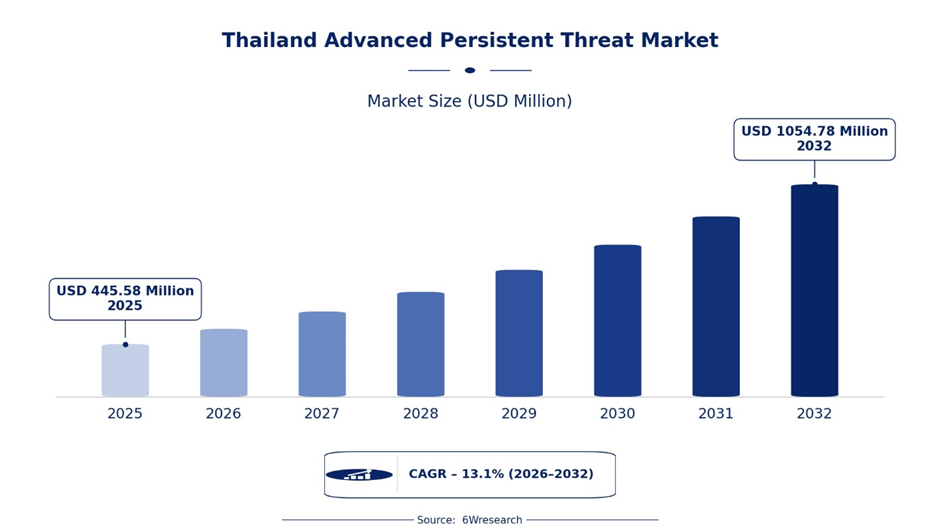
According to 6Wresearch internal database and industry insights, the Thailand Advanced Persistent Threat Market was valued at USD 445.58 million in 2025 and is projected to reach USD 1,054.78 million by 2032, growing at a CAGR of approximately 13.1% during 2026–2032.
Thailand Advanced Persistent Threat Market Highlights
| Report Metric | Details |
| Report Name | Thailand Advanced Persistent Threat Market (2026-2032) |
| Market Size 2025 | USD 445.58 million |
| Market Size 2032 | USD 1,054.78 million |
| Absolute Growth 2025–2032 | USD 609.20 million |
| CAGR 2026–2032 | 13.1% |
| Peak Annual Growth | 14.9% in 2029 |
| Forecast Period | 2026–2032 |
| Historical Data | 2022–2025 |
| Base Year | 2025 |
| Leading Threat Type, 2025 | Malware (41% share) |
| Fastest-Growing Threat Type | Phishing (14.6% CAGR) |
| Leading End User, 2025 | Enterprises (46% share) |
| Fastest-Growing End User | SMEs (16.2% CAGR) |
| Leading Industry, 2025 | BFSI (36% share) |
| Fastest-Growing Industry | Healthcare (15.8% CAGR) |
| Growing Sector | Managed detection and response services |
| Key End Users | Government agencies, banks and payment providers, telecom operators, hospitals, large manufacturers and small and medium-sized businesses |
Thailand Advanced Persistent Threat Market Year-wise Growth Rate and Key Drivers (2022–2032)
This graph illustrates the annual growth rates of the Thailand Advanced Persistent Threat Market from 2022 to 2032, highlighting gradual market development in the historical period and stronger expansion during the forecast period.
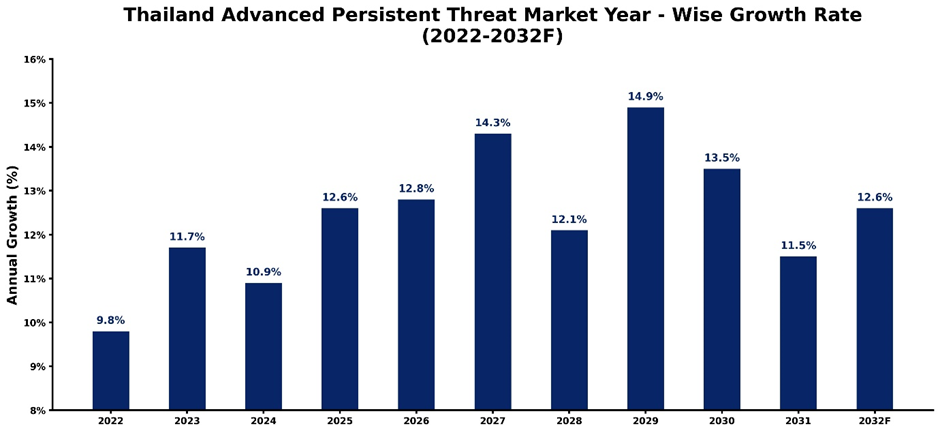
The following table presents the estimated annual growth rate for each year together with the principal factor influencing market performance. The values are intended to highlight year-specific drivers rather than to provide a direct comparison between individual years.
| Year | Estimated Annual Growth (%) | Market Rationale |
| 2022 | 9.8% | Reopening of borders in 2022 restored tourism and trade activity, allowing deferred security projects to restart from a modest base. |
| 2023 | 11.7% | The April 2023 emergency decree on technology crimes raised scrutiny of online fraud and drove higher spending on threat monitoring. |
| 2024 | 10.9% | Delayed passage of the fiscal 2024 national budget slowed public sector security procurement, moderating growth despite rising attack volumes. |
| 2025 | 12.6% | Heightened attention to cross-border cyber fraud after early 2025 enforcement against Myanmar-based scam networks accelerated detection investments. |
| 2026 | 12.8% | Implementation of the National Cybersecurity Strategy 2022–2027 and tighter critical infrastructure oversight is expected to lift detection and response contracts. |
| 2027 | 14.3% | Industrial IoT and 5G rollout in the Eastern Economic Corridor is expected to enlarge targets for persistent intrusion campaigns. |
| 2028 | 12.1% | Early procurement cycles are expected to mature as buyers consolidate vendors, normalising growth after the preceding surge. |
| 2029 | 14.9% | Legacy security stack refresh and wider AI-assisted detection are expected to trigger the strongest spending wave of the period. |
| 2030 | 13.5% | Wider automation of triage and response is expected to lower service hours per incident, tempering incremental spending growth. |
| 2031 | 11.5% | Maturity among enterprises and base effects from a larger revenue pool are expected to slow growth to the forecast low. |
| 2032 | 12.6% | Post-quantum cryptography migration and regional digital integration are expected to create a fresh round of security upgrades and renewed growth. |
Note: Market size estimations and growth projections presented in this report are based on 6Wresearch’s proprietary forecasting methodology, utilizing the latest available industry data, government publications, and primary research inputs.
Thailand Advanced Persistent Threat Market Synopsis
Thailand Advanced Persistent Threat Market growth is driven by various factors, such as enforcement of the Personal Data Protection Act from June 2022, expanding digital payments, the digitalisation of public services and increasingly targeted intrusion campaigns against Thai organisations. An advanced persistent threat (APT) is a stealthy, long-term cyberattack in which an unauthorized intruder gains access to a network and stays hidden for months or years to steal data or spy on systems. However, a shortage of skilled analysts and fragmented security budgets among smaller organisations continue to restrict wider deployment.
Market Dynamics Impact Analysis (2026–2032)
| Factor | Type | Impact | Primary Segment Affected |
| Rising targeted intrusion activity against critical operators | Driver | High | Malware |
| Compliance obligations for critical information infrastructure | Driver | High | Enterprises |
| Demand for managed detection and response among smaller firms | Opportunity | High | SMEs |
| Digitalisation of hospital records and connected medical devices | Opportunity | Medium | Healthcare |
| Shortage of experienced threat hunters and responders | Restraint | High | Enterprises |
| Limited security budgets in small organisations | Restraint | Medium | SMEs |
| Integration with legacy and operational technology systems | Challenge | Medium | IT & Telecom |
| Alert fatigue and reactive buying behaviour | Challenge | Medium | Phishing |
Evaluation of Drivers in Thailand Advanced Persistent Threat Market (2026–2032)
Below mentioned are some major drivers and their influence on market dynamics.
| Drivers | Primary Segment Affected | Why It Matters (Evidence) |
| Rising targeted intrusion activity | Malware | Sustained campaigns against critical operators push organisations from periodic audits to continuous detection and hunting, and the 2021 Bangkok Airways ransomware breach that exposed passenger data showed the cost of late detection. |
| Compulsory compliance for critical infrastructure | Enterprises | The Cybersecurity Act B.E. 2562 (2019) requires operators of critical information infrastructure to maintain monitoring and incident response, converting security from discretionary to compulsory spending. |
| Growth of real-time digital payments | BFSI | PromptPay, launched in 2017, moved retail transfers onto real-time rails, which attracts financially motivated actors and raises bank spending on fraud and intrusion detection. |
| Hyperscale cloud and data centre build-out | IT & Telecom | The Amazon Web Services Asia Pacific (Bangkok) Region, launched in January 2025, brought large workloads into the country and created demand for workload protection and network detection. |
| Wide internet and mobile use | Phishing | Internet use above 85% of the population creates a large base of users exposed to social engineering, which supplies the initial access that persistent campaigns need and drives demand for email and identity defences. |
Demand of this market is supported by rising enterprise technology spending as organisations digitise operations and widen their connected asset base. Manufacturing contributes roughly a quarter of national output, and the electronics and automotive clusters that anchor it are adopting connected industrial systems that require dedicated threat monitoring. An increasing number of certified security professionals is lifting domestic capacity to deploy and manage advanced protection tools. Wider use of artificial intelligence in security operations improves detection of low-signal intrusions, which raises the value of continuous monitoring. Hybrid working has multiplied endpoints and identity touchpoints, thus protection spending extends beyond the corporate perimeter.
Evaluation of Restraints in Thailand Advanced Persistent Threat Market
Below mentioned are some major restraints and their influence on market dynamics.
| Market Restraint | Primary Segment Affected | Why It Matters (Evidence) |
| Shortage of experienced threat hunters and incident responders | Enterprises | Persistent intrusions need analysts who can link weak signals across weeks, and most specialists are concentrated in the Bangkok metropolitan region, leaving provincial organisations reliant on remote support and slower response. |
| Limited security budgets among small organisations | SMEs | Small firms account for more than 99% of registered enterprises in Thailand, and tight IT budgets keep them on basic antivirus rather than detection and response services. |
| Dollar-priced imported platforms | Enterprises | Most advanced platforms are supplied by foreign vendors and priced in US dollars, thus baht movements change the effective cost of multi-year contracts and complicate budget approvals. |
| Lengthy public procurement cycles | Government | Public purchases follow the Public Procurement and Supplies Administration Act B.E. 2560 (2017), whose formal bidding stages lengthen sales cycles and delay adoption of advanced tools. |
| Constrained hospital technology budgets | Healthcare | Public hospitals operate under the capitated Universal Coverage Scheme, in place since 2002, which leaves limited headroom for security tooling beyond clinical systems. |
Thailand Advanced Persistent Threat Market Challenges
There are a number of challenges such as integration remains difficult as many plants and utilities operate control systems installed more than 10 years ago, where new sensors risk interrupting production and therefore face resistance from operators. Alert fatigue adds pressure, since mid-sized security teams often triage over 100 alerts a day and can overlook the low-signal activity persistent actors depend on. Buyer behaviour is largely reactive, and with budgets fixed annually from 1 October, a missed window can defer a purchase by up to 12 months. Price competition from regional managed providers narrows margins on local contracts, while imported detection content frequently misses Thai-language lures and local business processes.
Trends in the Thailand Advanced Persistent Threat Market
Below mentioned are some of the trends shaping the Thailand Advanced Persistent Threat Market growth.
- Shift from Signature-Based Antivirus to Behaviour-Led Detection: Large Thai banks, telecom operators and manufacturers are replacing signature scanners with endpoint and network analytics that identify abnormal behaviour, as stolen credentials and fileless techniques bypass legacy tools.
- Transition from In-House Monitoring to Managed Detection and Response: Organisations with small security teams are outsourcing round-the-clock monitoring to providers operating security operations centres in Bangkok, including those backed by telecom groups. Outsourcing converts fixed staffing costs into predictable service fees and gives access to scarce threat hunters. It rewards providers with Thai-speaking analysts and fast onboarding.
- Zero Trust Architecture Prioritised over Perimeter Defence: Cloud adoption, supported by the 2020 cloud-first policy for public agencies, and wider use of mobile access have dissolved the traditional network boundary. Organisations are therefore investing in identity controls, multi-factor authentication and micro-segmentation to limit lateral movement by intruders. Vendors able to combine identity, endpoint and network telemetry are best placed to win these projects.
Investment Opportunities in the Thailand Advanced Persistent Threat Market
Some of the investment opportunities in the Thailand Advanced Persistent Threat Market are mentioned below.
- Managed Detection and Response Services for Mid-Sized Firms: Mid-sized firms face the same intrusion risks as large groups but cannot staff round-the-clock teams. Investors can build a Bangkok-based security operations centre with Thai-speaking analysts, offering monitoring, threat hunting and incident response on subscription. Entry is fastest through partnerships with telecom operators and system integrators, supported by ISO/IEC 27001 certification.
- Localised Threat Intelligence and Hunting Platforms: Imported intelligence feeds often miss regional actors and domestic fraud tactics, creating room for specialised content. Investment is best directed to sector-specific detection rules, analyst tooling and curated feeds covering Southeast Asian campaigns. Suppliers can enter through information-sharing links with ThaiCERT, university research centres and established security distributors that already serve local buyers.
- Security for Data Centre and Cloud Workloads: New data centre campuses around Bangkok, Chonburi and Rayong are bringing sensitive workloads into the country and creating demand for workload protection, network detection and identity monitoring. Investors can supply these tools as managed offerings bundled with hosting. Entry is through colocation operators and cloud resellers that need differentiated security services for tenants.
Leading Players in Thailand Advanced Persistent Threat Market
Stated below are some of the leading companies contributing significantly to the Thailand Advanced Persistent Threat Market share.
1. Palo Alto Networks
|
Company Name |
Palo Alto Networks |
|---|---|
|
Established Year |
2005 |
|
Headquarters |
Santa Clara, United States |
|
Official Website |
Palo Alto Networks provides network, cloud and security operations platforms with integrated threat prevention and analytics. It serves large Thai organisations through regional channel partners and local security integrators.
2. Fortinet
|
Company Name |
Fortinet |
|---|---|
|
Established Year |
2000 |
|
Headquarters |
Sunnyvale, United States |
|
Official Website |
Fortinet supplies firewalls, endpoint protection and threat detection solutions built on an integrated security fabric. It has an established distributor and partner network across Thailand serving enterprises and service providers.
3. CrowdStrike
|
Company Name |
CrowdStrike |
|---|---|
|
Established Year |
2011 |
|
Headquarters |
Austin, United States |
|
Official Website |
CrowdStrike offers cloud-delivered endpoint protection, threat intelligence and managed threat hunting services. It supports Thai organisations seeking advanced detection and incident response capability through regional partners.
4. Trend Micro
|
Company Name |
Trend Micro |
|---|---|
|
Established Year |
1988 |
|
Headquarters |
Tokyo, Japan |
|
Official Website |
Trend Micro develops endpoint, network and cloud security products with extended detection and response capability. It maintains a long-standing presence in Thailand supported by local channel partners and regional research teams.
Government Initiatives in the Thailand Advanced Persistent Threat Market
Various initiatives have been taken to support the market development, such as the Cybersecurity Act B.E. 2562 (2019) created the National Cyber Security Agency and obliges operators of critical information infrastructure to maintain monitoring and incident response. The Personal Data Protection Act B.E. 2562 (2019) became fully enforceable in June 2022, and the national cybersecurity policy and plan for 2022–2027 sets priorities for infrastructure protection, workforce development and international cooperation.
The National Cyber Security Agency leads implementation, while ThaiCERT under the Electronic Transactions Development Agency coordinates incident response and information sharing. The Digital Government Development Agency delivers shared platforms under the Digital Government Development Plan 2023–2027, and the Eastern Economic Corridor Digital Park in Chonburi, planned on about 700 rai, hosts data centre and cybersecurity-related investment projects under the Board of Investment’s incentive framework.
Future Insight of the Thailand Advanced Persistent Threat Market
Future demand will be supported by continued expansion of data centre and subsea connectivity capacity, which widens the base of infrastructure requiring advanced protection. Wider use of artificial intelligence in security operations will shorten detection times and encourage sustained automation spending across security teams. Additional digital platform and data governance rules are expected to keep compliance-led purchasing active. Thailand’s 5G network already covers over 90% of the population and the national plan targets a 30% GDP contribution from the digital economy by 2027, which will sustain demand for monitoring technologies.
Market Segmentation Analysis
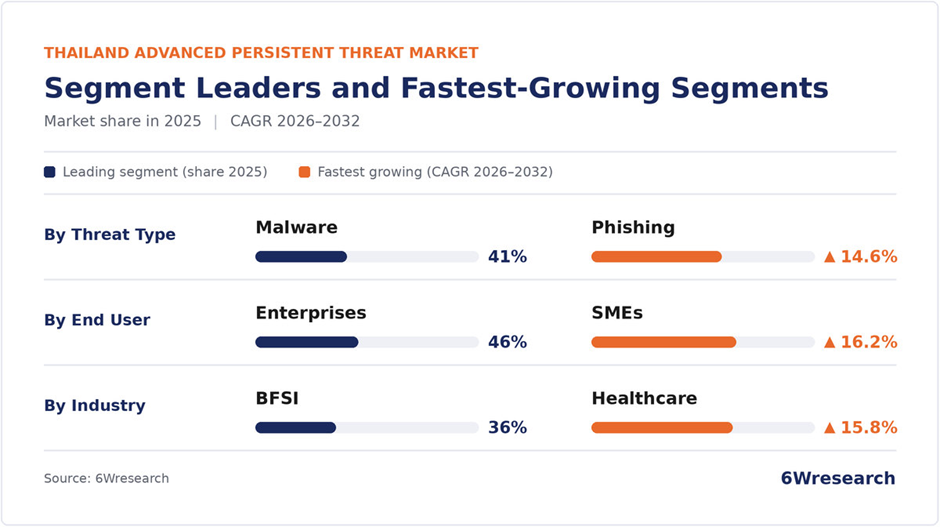
The report offers a comprehensive study of the market across its key segments. The chart below highlights the leading segment by market share in 2025 and the fastest-growing segment by CAGR over 2026–2032, followed by a detailed analysis of each segment.
By Threat Type – Malware Leads, Phishing Expected to Grow Fastest
According to Bhawna Singh, Assistant Manager at 6Wresearch, Malware accounted for 41% of the market in 2025, as ransomware and espionage tooling used in persistent campaigns continue to target Thai banks, manufacturers and public bodies. Phishing is expected to grow fastest at a CAGR of 14.6% during 2026–2032, driven by wide use of mobile banking and messaging platforms such as LINE, which supports credential-harvesting campaigns delivered in Thai.
By End User – Enterprises Lead, SMEs Expected to Grow Fastest
Enterprises held a 46% share in 2025, supported by large banks, telecom operators and manufacturers that maintain dedicated security operations and carry compliance obligations under national data and cybersecurity laws. SMEs are projected to record the highest CAGR of 16.2% during 2026–2032, as affordable managed detection services and rising exposure through digital payments and supply chain links bring advanced protection within reach of smaller firms.
By Industry – BFSI Leads, Healthcare Expected to Grow Fastest
BFSI led the industry mix with a 36% share in 2025, as real-time payment rails and online banking make financial institutions prime targets for persistent, financially motivated actors. Healthcare is set to expand fastest at a CAGR of 15.8% during 2026–2032, as hospitals digitalise patient records and connect medical devices, creating high-value data that attracts sustained intrusion attempts.
Key Attractiveness of the Report
- 10 Years of Market Numbers
- Historical Data Starting from 2022 to 2025
- Base Year 2025
- Forecast Data until 2032
- Key Performance Indicators Impacting the Market
- Major Upcoming Developments and Projects
Key Highlights of the Report:
- Thailand Advanced Persistent Threat Market Outlook
- Market Size of Thailand Advanced Persistent Threat Market, 2025
- Forecast of Thailand Advanced Persistent Threat Market, 2032
- Historical Data and Forecast of Thailand Advanced Persistent Threat Revenues & Volume for the Period 2022-2032
- Thailand Advanced Persistent Threat Market Trend Evolution
- Thailand Advanced Persistent Threat Market Drivers and Challenges
- Thailand Advanced Persistent Threat Price Trends
- Thailand Advanced Persistent Threat Porter's Five Forces
- Thailand Advanced Persistent Threat Industry Life Cycle
- Historical Data and Forecast of Thailand Advanced Persistent Threat Market Revenues & Volume By Threat Type for the Period 2022-2032
- Historical Data and Forecast of Thailand Advanced Persistent Threat Market Revenues & Volume By Malware for the Period 2022-2032
- Historical Data and Forecast of Thailand Advanced Persistent Threat Market Revenues & Volume By Phishing for the Period 2022-2032
- Historical Data and Forecast of Thailand Advanced Persistent Threat Market Revenues & Volume By Denial-of-Service for the Period 2022-2032
- Historical Data and Forecast of Thailand Advanced Persistent Threat Market Revenues & Volume By Others for the Period 2022-2032
- Historical Data and Forecast of Thailand Advanced Persistent Threat Market Revenues & Volume By End User for the Period 2022-2032
- Historical Data and Forecast of Thailand Advanced Persistent Threat Market Revenues & Volume By Government for the Period 2022-2032
- Historical Data and Forecast of Thailand Advanced Persistent Threat Market Revenues & Volume By Enterprises for the Period 2022-2032
- Historical Data and Forecast of Thailand Advanced Persistent Threat Market Revenues & Volume By SMEs for the Period 2022-2032
- Historical Data and Forecast of Thailand Advanced Persistent Threat Market Revenues & Volume By Others for the Period 2022-2032
- Historical Data and Forecast of Thailand Advanced Persistent Threat Market Revenues & Volume By Industry for the Period 2022-2032
- Historical Data and Forecast of Thailand Advanced Persistent Threat Market Revenues & Volume By BFSI for the Period 2022-2032
- Historical Data and Forecast of Thailand Advanced Persistent Threat Market Revenues & Volume By Healthcare for the Period 2022-2032
- Historical Data and Forecast of Thailand Advanced Persistent Threat Market Revenues & Volume By IT & Telecom for the Period 2022-2032
- Historical Data and Forecast of Thailand Advanced Persistent Threat Market Revenues & Volume By Others for the Period 2022-2032
- Thailand Advanced Persistent Threat Import Export Trade Statistics
- Market Opportunity Assessment By Threat Type
- Market Opportunity Assessment By End User
- Market Opportunity Assessment By Industry
- Thailand Advanced Persistent Threat Top Companies Market Share
- Thailand Advanced Persistent Threat Competitive Benchmarking By Technical and Operational Parameters
- Thailand Advanced Persistent Threat Company Profiles
- Thailand Advanced Persistent Threat Key Strategic Recommendations
Market Covered
The report offers an extensive study of the following market segments.
By Threat Type
- Malware
- Phishing
- Denial-of-Service
- Others
By End User
- Government
- Enterprises
- SMEs
- Others
By Industry
- BFSI
- Healthcare
- IT & Telecom
- Others































