Tunisia Sponge Iron Market Size, Share & Growth Rate
The Tunisia Sponge Iron Market was estimated at USD 394 Million in 2025 and is projected to reach USD 559 Million by 2032, growing at a CAGR of 5.1% from 2026 to 2032. This growth trajectory is primarily driven by the escalating demand for sponge iron from the construction and manufacturing sectors. Infrastructure development and urbanization initiatives across Tunisia are fueling this demand, underpinned by the government's push towards bolstering domestic manufacturing capabilities.
Tunisia Sponge Iron Market Year-wise Growth Rate and Key Drivers
This graph highlights how the Tunisia Sponge Iron Market has steadily grown over the years, supported by major growth factors.
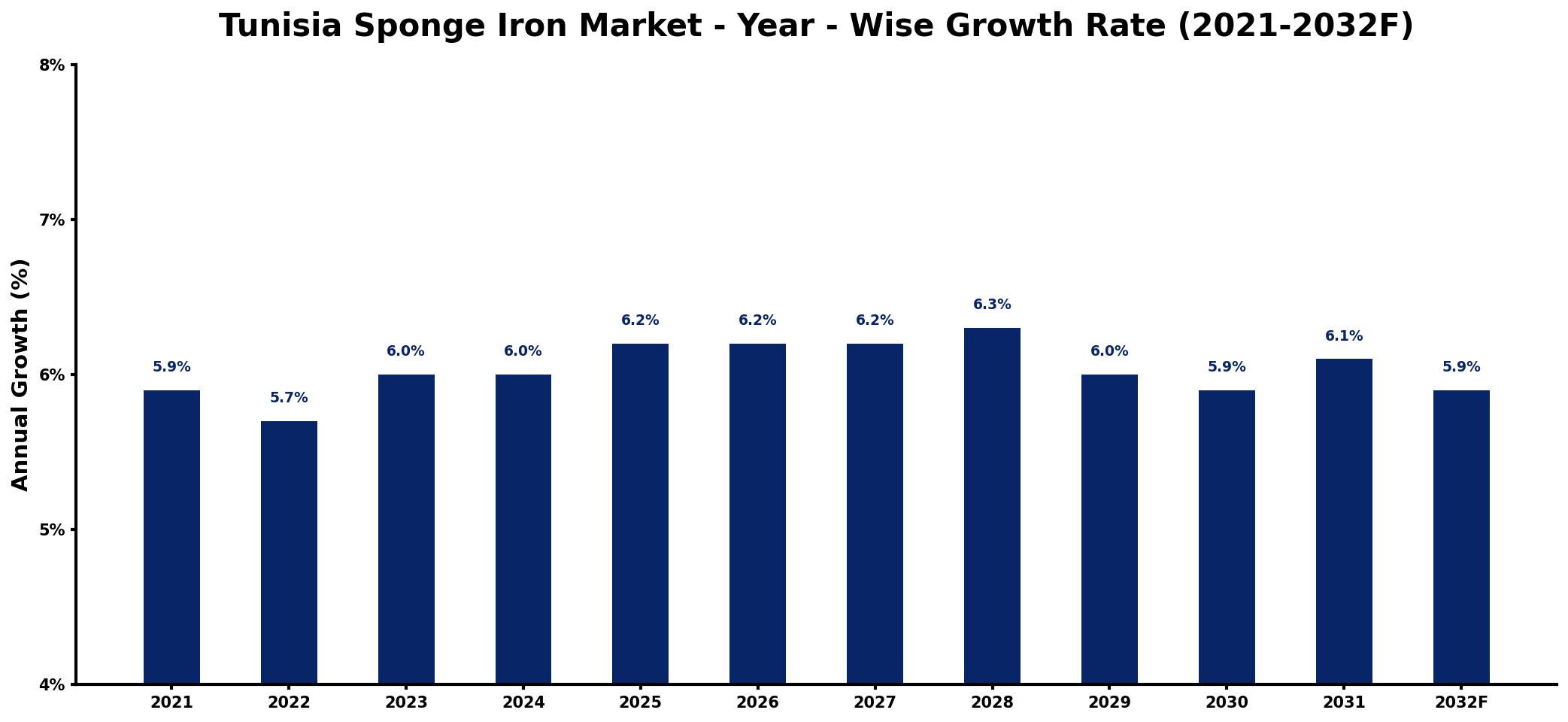
The table below presents the year‑wise growth rates along with the key drivers influencing the market
| Year | Growth Rate | Major Drivers |
| 2021 | 5.9% | Rising construction sector investments |
| 2022 | 5.7% | Increased automotive manufacturing demand |
| 2023 | 6.0% | Expansion in renewable energy projects |
| 2024 | 6.0% | Growth in infrastructure development |
| 2025 | 6.2% | Boost in export opportunities |
| 2026 | 6.2% | Higher demand from electronics industry |
| 2027 | 6.2% | Increase in domestic manufacturing capacity |
| 2028 | 6.3% | Surge in urbanization trends |
| 2029 | 6.0% | Growing demand for infrastructure repairs |
| 2030 | 5.9% | Expansion of industrial applications |
| 2031 | 6.1% | Rising demand for construction materials |
| 2032 | 5.9% | Increased investment in sustainable technologies |
Note: Market size estimations and growth projections presented in this report are based on 6Wresearch's proprietary forecasting methodology, utilizing the latest available industry data, government publications, and primary research inputs.
Tunisia Sponge Iron Market Synopsis
In recent years, the Tunisia Sponge Iron Market has shown consistent growth, reflecting a robust demand from the construction and automotive industries. Sponge iron, or direct-reduced iron (DRI), serves as a crucial input in steel production, especially through electric arc furnaces, making it a pivotal component of the steel manufacturing process.
As Tunisia embarks on significant infrastructure projects, the demand for sponge iron is expected to surge. With local manufacturers ramping up production capacities and international firms exploring opportunities within the Tunisian market, the landscape for sponge iron is becoming increasingly competitive and promising.
Tunisia Sponge Iron Market Key Takeaways
- The market is set to benefit from increased demand stemming from ongoing infrastructure and construction projects.
- Government initiatives are geared towards enhancing local manufacturing capabilities and reducing import dependency.
- Technological advancements are facilitating greater production efficiency and sustainability in sponge iron production.
- Environmental considerations are driving a shift towards sponge iron as a more sustainable raw material for steel production.
- Growing urbanization in Tunisia creates a favorable environment for investments in the sponge iron sector.
Evaluation of Restraints in Tunisia Sponge Iron Market
Despite its potential, the Tunisia Sponge Iron Market faces significant challenges that could hinder growth. Fluctuating global iron ore prices directly affect production costs, making it difficult for producers to maintain competitive pricing. The reliance on natural gas for the direct reduction process presents vulnerabilities, especially in light of geopolitical tensions or disruptions in the supply chain. Furthermore, the limited domestic market demand compels many manufacturers to focus on export markets, which can expose them to economic uncertainties and various trade barriers. Regulatory hurdles and infrastructure deficiencies also pose challenges that must be navigated carefully by businesses operating in this sector.
Tunisia Sponge Iron Market Trends
A notable trend in the Tunisia Sponge Iron Market is the increasing adoption of sponge iron in the manufacturing of steel products due to its cost-saving potential and lower carbon emissions compared to traditional methods. Technological innovations are also playing a pivotal role, with advancements aimed at improving the efficiency and quality of sponge iron production. There is a growing emphasis on sustainability within the sector, reflecting a global shift towards environmentally friendly manufacturing practices. These trends suggest that the market is not only evolving in response to domestic demand but also aligning with broader global sustainability goals.
Tunisia Sponge Iron Market Opportunities
The Tunisia Sponge Iron Market presents several lucrative investment opportunities, particularly for those willing to capitalize on the increasing demand for steel across various sectors. The government's commitment to infrastructure development creates a favorable climate for establishing sponge iron production facilities. With the local availability of essential raw materials, such as iron ore and natural gas, prospective investors can find conducive conditions for growth. Moreover, integrating advanced technologies to create efficient, sustainable sponge iron plants can provide a distinct competitive advantage in an increasingly eco-conscious market.
Government Initiatives in the Tunisia Sponge Iron Market
The Tunisian government has been proactive in implementing policies to foster the growth of the Sponge Iron Market. Incentives such as tax breaks and subsidies for new projects are designed to attract investments in this sector. Additionally, environmental regulations have been established to ensure that sponge iron production is environmentally sustainable, promoting cleaner manufacturing methods. The government is also supportive of research and development initiatives aimed at enhancing the competitiveness and innovative capacities of local manufacturers, reflecting a broader strategy to nurture the domestic industry.
Future Insights of the Tunisia Sponge Iron Market
Looking forward to the period between 2026 and 2032, the Tunisia Sponge Iron Market is expected to sustain its growth momentum. The ongoing industrialization and urban expansion initiatives will likely keep the demand for sponge iron robust, particularly in the construction and automotive sectors. Government efforts to attract foreign investment and promote local manufacturing are poised to further invigorate the market. With a focus on technological advancements and environmental sustainability, the future outlook remains positive, providing ample opportunities for both domestic players and international stakeholders.
Tunisia Sponge Iron Market Latest Developments (2025 - 2026)
In the recent past, the Tunisia Sponge Iron Market has seen a shift towards modernization, with several initiatives aimed at enhancing production capabilities. There is a growing trend of integrating smart technologies within production facilities, which is expected to boost efficiency and reduce environmental impact. Additionally, various public-private partnerships are being explored to further invest in infrastructure projects, facilitating an improved supply chain for sponge iron. The emphasis on sustainability is increasingly evident as stakeholders align their practices with global environmental standards.
Tunisia Sponge Iron Market - Key Attractiveness of the Report
- 10 Years of Market Numbers
- Historical Data Starting from 2022 to 2025
- Base Year: 2025
- Forecast Data until 2032
- Key Performance Indicators Impacting the Market
- Major Upcoming Developments and Projects
Key Highlights of the Report:
- Tunisia Sponge Iron Market Outlook
- Market Size of Tunisia Sponge Iron Market, 2025
- Forecast of Tunisia Sponge Iron Market, 2032
- Historical Data and Forecast of Tunisia Sponge Iron Revenues & Volume for the Period 2022-2032F
- Tunisia Sponge Iron Market Trend Evolution
- Tunisia Sponge Iron Market Drivers and Challenges
- Tunisia Sponge Iron Price Trends
- Tunisia Sponge Iron Porter's Five Forces
- Tunisia Sponge Iron Industry Life Cycle
- Historical Data and Forecast of Tunisia Sponge Iron Market Revenues & Volume By Types for the Period 2022-2032F
- Historical Data and Forecast of Tunisia Sponge Iron Market Revenues & Volume By Gas Based Technology for the Period 2022-2032F
- Historical Data and Forecast of Tunisia Sponge Iron Market Revenues & Volume By Coal-Based Technology for the Period 2022-2032F
- Historical Data and Forecast of Tunisia Sponge Iron Market Revenues & Volume By Applications for the Period 2022-2032F
- Historical Data and Forecast of Tunisia Sponge Iron Market Revenues & Volume By Metallurgical Industry for the Period 2022-2032F
- Historical Data and Forecast of Tunisia Sponge Iron Market Revenues & Volume By Steel Industry for the Period 2022-2032F
- Historical Data and Forecast of Tunisia Sponge Iron Market Revenues & Volume By Achitechive for the Period 2022-2032F
- Historical Data and Forecast of Tunisia Sponge Iron Market Revenues & Volume By Others for the Period 2022-2032F
- Tunisia Sponge Iron Import Export Trade Statistics
- Market Opportunity Assessment By Types
- Market Opportunity Assessment By Applications
- Tunisia Sponge Iron Top Companies Market Share
- Tunisia Sponge Iron Competitive Benchmarking By Technical and Operational Parameters
- Tunisia Sponge Iron Company Profiles
- Tunisia Sponge Iron Key Strategic Recommendations






































