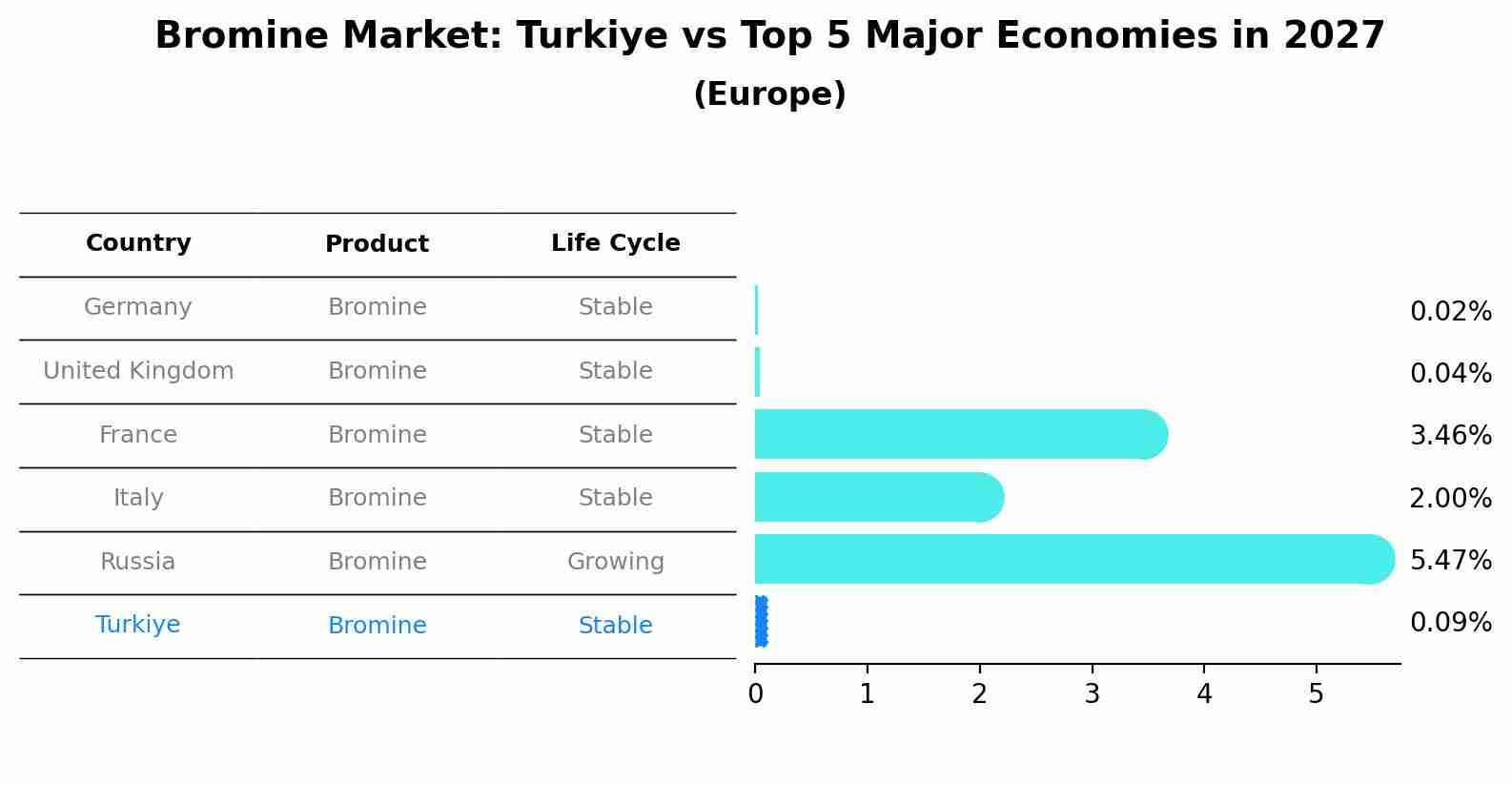
Bromine Market: Turkiye vs Top 5 Major Economies in 2027 (Europe)
The Bromine market in Turkiye is projected to grow at a stable growth rate of 0.09% by 2027, highlighting the country's increasing focus on advanced technologies within the Europe region, where Germany holds the dominant position, followed closely by United Kingdom, France, Italy and Russia, shaping overall regional demand.
Turkey Bromine Market Overview
The Turkey Bromine market is witnessing steady growth driven by increasing demand from various industries such as flame retardants, oil & gas drilling, and chemical synthesis. Bromine, a versatile element, is primarily used in the production of flame retardants due to its high effectiveness in preventing the spread of fire. The oil & gas industry also utilizes bromine compounds for drilling fluids to improve wellbore stability and control formation pressure. In addition, bromine is used in the manufacturing of pharmaceuticals, fumigants, and water treatment chemicals. The market is influenced by factors such as regulatory policies, technological advancements, and fluctuating raw material prices. Key players in the Turkey Bromine market include Albemarle Corporation, Israel Chemicals Ltd., and Jordan Bromine Company among others.
Turkey Bromine Market Trends
The Turkey Bromine Market is experiencing steady growth driven by increasing demand from various industries such as flame retardants, oil and gas drilling, and pharmaceuticals. With the growing emphasis on fire safety regulations in construction materials, the demand for bromine-based flame retardants is on the rise. Additionally, the expansion of oil and gas exploration activities in the region is driving the demand for bromine compounds used in drilling fluids. The pharmaceutical industry is also a key consumer of bromine for the production of various drugs. The market is witnessing a shift towards environmentally friendly bromine compounds to meet regulatory requirements. Overall, the Turkey Bromine Market is expected to continue growing due to these diverse applications and increasing awareness of fire safety standards.
Turkey Bromine Market Challenges
In the Turkey Bromine Market, some of the key challenges include fluctuations in raw material prices, increasing competition from alternative flame retardants, and regulatory pressures related to environmental concerns. The volatility in raw material prices can impact the profitability of bromine manufacturers and pose challenges in managing production costs. Additionally, the emergence of alternative flame retardants, such as phosphorus-based compounds, presents competition to bromine-based products. Moreover, the tightening regulations on brominated flame retardants due to their potential environmental and health impacts require companies to invest in research and development for more sustainable solutions. Overall, navigating these challenges requires companies in the Turkey Bromine Market to adapt quickly to market dynamics, innovate their product offerings, and ensure compliance with evolving regulations.
Turkey Bromine Market Investment Opportunities
The Turkey Bromine Market presents promising investment opportunities due to increasing demand from various industries such as flame retardants, oil and gas drilling, and pharmaceuticals. With Turkey being one of the leading producers of bromine globally, investing in Turkish bromine companies can provide exposure to a growing market. Additionally, the country`s strategic location between Europe and Asia offers opportunities for export to neighboring regions. As regulations on flame retardants become stricter globally, the demand for bromine-based products is expected to rise, driving further growth in the market. Furthermore, ongoing research and development efforts in the pharmaceutical sector for new applications of bromine compounds offer potential for future expansion and innovation in the Turkey Bromine Market, making it an attractive investment opportunity for discerning investors.
Turkey Bromine Market Government Policy
Government policies related to the Turkey Bromine Market focus on environmental regulations, health and safety standards, and import/export restrictions. The Turkish government has implemented regulations to ensure safe handling and disposal of bromine, as it is a hazardous substance. Additionally, there are strict guidelines in place to protect workers in bromine production facilities and monitor emissions to prevent environmental pollution. Import and export regulations are also enforced to control the flow of bromine in and out of the country. Overall, the government`s policies aim to balance economic growth in the bromine industry with environmental and public health concerns, ensuring sustainable development and compliance with international standards.
Turkey Bromine Market Future Outlook
The Turkey Bromine Market is poised for steady growth in the coming years due to increasing demand from various industries such as flame retardants, oil & gas, and pharmaceuticals. The market is expected to be driven by the growth in construction activities, particularly in the residential and commercial sectors, which require bromine-based flame retardants for building materials. Additionally, the expanding oil & gas sector in Turkey is likely to boost the demand for bromine-based chemicals used in drilling fluids and completion fluids. With ongoing technological advancements and investments in research and development, the Turkey Bromine Market is anticipated to witness continuous innovation in product offerings and applications, further fueling its growth prospects in the foreseeable future.
Key Highlights of the Report:
- Turkey Bromine Market Outlook
- Market Size of Turkey Bromine Market, 2021
- Forecast of Turkey Bromine Market, 2027
- Historical Data and Forecast of Turkey Bromine Revenues & Volume for the Period 2018 - 2027
- Turkey Bromine Market Trend Evolution
- Turkey Bromine Market Drivers and Challenges
- Turkey Bromine Price Trends
- Turkey Bromine Porter's Five Forces
- Turkey Bromine Industry Life Cycle
- Historical Data and Forecast of Turkey Bromine Market Revenues & Volume By Derivative for the Period 2018 - 2027
- Historical Data and Forecast of Turkey Bromine Market Revenues & Volume By Organobromine for the Period 2018 - 2027
- Historical Data and Forecast of Turkey Bromine Market Revenues & Volume By Clear Brine Fluids for the Period 2018 - 2027
- Historical Data and Forecast of Turkey Bromine Market Revenues & Volume By Hydrogen Bromide for the Period 2018 - 2027
- Historical Data and Forecast of Turkey Bromine Market Revenues & Volume By Application for the Period 2018 - 2027
- Historical Data and Forecast of Turkey Bromine Market Revenues & Volume By Flame Retardants for the Period 2018 - 2027
- Historical Data and Forecast of Turkey Bromine Market Revenues & Volume By Oil & Gas Drilling for the Period 2018 - 2027
- Historical Data and Forecast of Turkey Bromine Market Revenues & Volume By PTA Synthesis for the Period 2018 - 2027
- Historical Data and Forecast of Turkey Bromine Market Revenues & Volume By Water Treatment & Biocides for the Period 2018 - 2027
- Historical Data and Forecast of Turkey Bromine Market Revenues & Volume By Pesticides for the Period 2018 - 2027
- Historical Data and Forecast of Turkey Bromine Market Revenues & Volume By HBr Flow Batteries for the Period 2018 - 2027
- Historical Data and Forecast of Turkey Bromine Market Revenues & Volume By Pharmaceuticals for the Period 2018 - 2027
- Historical Data and Forecast of Turkey Bromine Market Revenues & Volume By Others for the Period 2018 - 2027
- Turkey Bromine Import Export Trade Statistics
- Market Opportunity Assessment By Derivative
- Market Opportunity Assessment By Application
- Turkey Bromine Top Companies Market Share
- Turkey Bromine Competitive Benchmarking By Technical and Operational Parameters
- Turkey Bromine Company Profiles
- Turkey Bromine Key Strategic Recommendations






































