United Arab Emirates (UAE) Electric Locomotives Market Size, Share & Growth Rate
The United Arab Emirates (UAE) Electric Locomotives Market was estimated at USD 748 Million in 2025 and is projected to reach USD 1062 Million by 2032, growing at a CAGR of 5.1% from 2026 to 2032. This promising trajectory is largely fueled by the UAE's ongoing commitment to developing a world-class railway infrastructure and promoting sustainable transportation solutions. The growing urbanization coupled with increased freight and passenger transport requirements reinforces the demand for efficient electric locomotives.
United Arab Emirates (UAE) Electric Locomotives Market Year-wise Growth Rate and Key Drivers
This graph highlights how the United Arab Emirates (UAE) Electric Locomotives Market has steadily grown over the years, supported by major growth factors.
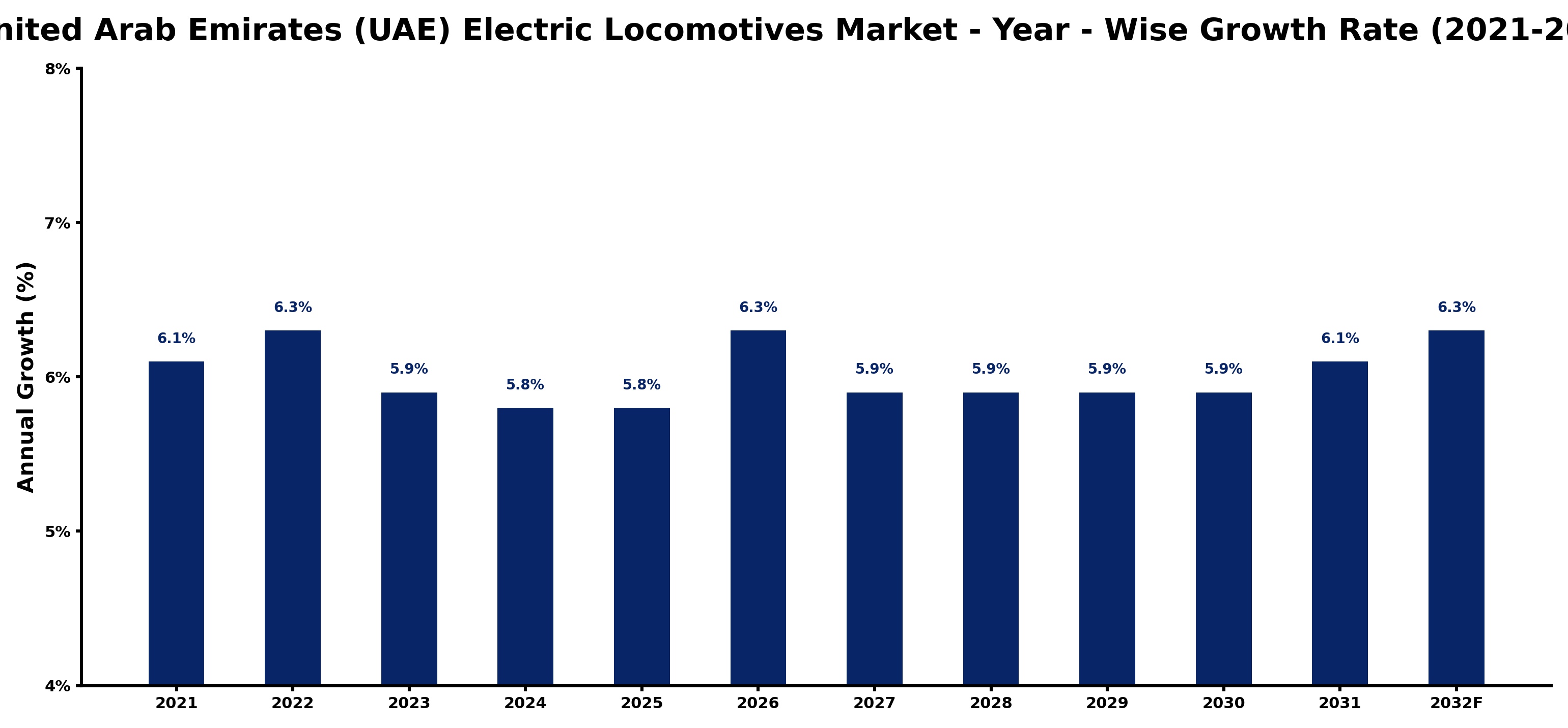
The table below presents the year‑wise growth rates along with the key drivers influencing the market
| Year | Growth Rate | Major Drivers |
| 2021 | 6.1% | Growing urbanization and commercial development |
| 2022 | 6.3% | Growing urbanization and commercial development |
| 2023 | 5.9% | Increasing industrial infrastructure investments |
| 2024 | 5.8% | Expansion of manufacturing activities |
| 2025 | 5.8% | Growing urbanization and commercial development |
| 2026 | 6.3% | Growing renewable energy integration projects |
| 2027 | 5.9% | Increasing industrial automation investments |
| 2028 | 5.9% | Increasing adoption of advanced technologies |
| 2029 | 5.9% | Expansion of commercial construction activities |
| 2030 | 5.9% | Expansion of manufacturing activities |
| 2031 | 6.1% | Increasing adoption of advanced technologies |
| 2032 | 6.3% | Expansion of manufacturing activities |
Note - Market size estimations and growth projections presented in this report are based on 6Wresearch's advanced forecasting approach, validated with industry datasets as of June 2026.
United Arab Emirates (UAE) Electric Locomotives Market Synopsis
Electric locomotives have become essential to the UAE's modernization initiatives, significantly contributing to the transportation landscape. As the country strives to enhance its connectivity through rail systems, the demand for energy-efficient electric locomotives has surged, aligning with the national goals of sustainability and reduced carbon footprints.
The UAE's strategic focus on smart urban development has expedited the transition from diesel to electric-powered trains. With both governmental and private sector investments pouring into the electrification of the existing railway framework, the market is set for considerable growth, tapping into the benefits of reduced operational costs and increased service efficiency.
United Arab Emirates (UAE) Electric Locomotives Market Key Takeaways
- The UAE's electric locomotives market is experiencing significant growth due to ongoing infrastructure projects.
- Government initiatives aimed at sustainability are driving the shift from diesel to electric locomotives.
- Urbanization and population growth in the UAE are leading to higher demand for reliable public transportation.
- Electric locomotives offer economic advantages, including lower operational costs and enhanced energy efficiency.
- The market's expansion is supported by robust investments in electrified railway networks.
Evaluation of Restraints in United Arab Emirates (UAE) Electric Locomotives Market
Despite the promising growth of the electric locomotives market, certain restraints hinder progress. The initial capital expenditure required for transitioning from traditional diesel systems to electrified railways is substantial, presenting a barrier to entry for some operators. Additionally, the integration of electric locomotives into an existing predominantly diesel-based network necessitates careful planning and resource allocation. The harsh climatic conditions in the UAE further complicate the operational efficiency and maintenance of electric locomotives, necessitating innovative solutions to overcome these environmental challenges.
United Arab Emirates (UAE) Electric Locomotives Market Trends
Several key trends are currently shaping the UAE electric locomotives market. There is a notable shift towards advanced technologies such as automated systems and predictive maintenance, aimed at optimizing operational efficiency and reducing downtime. Furthermore, the increasing demand for high-speed rail connections is prompting investments in cutting-edge electric locomotives designed for faster and more reliable transport. Sustainability initiatives are also fostering innovations, with manufacturers focusing on reducing the carbon footprint of their products while enhancing energy efficiency.
United Arab Emirates (UAE) Electric Locomotives Market Opportunities
The transition towards electrified railways presents numerous growth opportunities in the UAE market. As urban centers expand, there is a pressing need for enhanced public transport solutions, positioning electric locomotives as a favorable choice. Additionally, the government's push for green technology and infrastructure development opens doors for innovative financing and partnership arrangements. Companies focusing on research and development for next-generation electric locomotives can capitalize on this momentum, positioning themselves as leaders in a rapidly evolving market.
Government Initiatives in the United Arab Emirates (UAE) Electric Locomotives Market
The UAE government has launched several initiatives to promote the electrification of its railway systems, emphasizing sustainability and smart city development. Public spending on transportation infrastructure is at an all-time high, with strategic plans outlined in national frameworks to develop integrated public transport networks. Incentives for adopting green technologies in the transportation sector further support the shift towards electric locomotives, ensuring a conducive environment for growth and investment.
Future Insights of the United Arab Emirates (UAE) Electric Locomotives Market
Looking ahead to 2026-2032, the UAE electric locomotives market is poised for significant advancements, driven by continuous infrastructure investments and the country's commitment to sustainable practices. The increasing integration of artificial intelligence and machine learning in locomotive operations will likely enhance efficiency and safety. Moreover, as environmental regulations tighten, electric locomotives will increasingly become the transportation mode of choice for both freight and passenger services, creating a paradigm shift in the regional transport landscape.
United Arab Emirates (UAE) Electric Locomotives Market Latest Developments (May 2025 - June 2026)
Recent developments in the UAE electric locomotives market indicate a strong momentum towards electrification, with new partnerships formed for infrastructure enhancements. Additionally, advancements in technology are being prioritized, focusing on smart locomotives equipped with innovative tracking and efficiency-monitoring systems. Furthermore, government agencies continue to support initiatives that facilitate the seamless integration of electric locomotives into the existing transport frameworks, propelling the market forward.
United Arab Emirates (UAE) Electric Locomotives Market - Key Attractiveness of the Report
- 10 Years of Market Numbers
- Historical Data Starting from 2022 to 2025
- Base Year: 2025
- Forecast Data until 2032
- Key Performance Indicators Impacting the Market
- Major Upcoming Developments and Projects
Key Highlights of the Report:
- United Arab Emirates (UAE) Electric Locomotives Market Outlook
- Market Size of United Arab Emirates (UAE) Electric Locomotives Market, 2025
- Forecast of United Arab Emirates (UAE) Electric Locomotives Market, 2032
- Historical Data and Forecast of United Arab Emirates (UAE) Electric Locomotives Revenues & Volume for the Period 2022-2032F
- United Arab Emirates (UAE) Electric Locomotives Market Trend Evolution
- United Arab Emirates (UAE) Electric Locomotives Market Drivers and Challenges
- United Arab Emirates (UAE) Electric Locomotives Price Trends
- United Arab Emirates (UAE) Electric Locomotives Porter's Five Forces
- United Arab Emirates (UAE) Electric Locomotives Industry Life Cycle
- Historical Data and Forecast of United Arab Emirates (UAE) Electric Locomotives Market Revenues & Volume By Energy Transfer for the Period 2022-2032F
- Historical Data and Forecast of United Arab Emirates (UAE) Electric Locomotives Market Revenues & Volume By Overhead Lines for the Period 2022-2032F
- Historical Data and Forecast of United Arab Emirates (UAE) Electric Locomotives Market Revenues & Volume By Third Rail for the Period 2022-2032F
- Historical Data and Forecast of United Arab Emirates (UAE) Electric Locomotives Market Revenues & Volume By On-board Energy Storage for the Period 2022-2032F
- Historical Data and Forecast of United Arab Emirates (UAE) Electric Locomotives Market Revenues & Volume By Technology for the Period 2022-2032F
- Historical Data and Forecast of United Arab Emirates (UAE) Electric Locomotives Market Revenues & Volume By IGBT Module for the Period 2022-2032F
- Historical Data and Forecast of United Arab Emirates (UAE) Electric Locomotives Market Revenues & Volume By GTO Thyristor for the Period 2022-2032F
- Historical Data and Forecast of United Arab Emirates (UAE) Electric Locomotives Market Revenues & Volume By SiC Module for the Period 2022-2032F
- Historical Data and Forecast of United Arab Emirates (UAE) Electric Locomotives Market Revenues & Volume By Traction Units for the Period 2022-2032F
- Historical Data and Forecast of United Arab Emirates (UAE) Electric Locomotives Market Revenues & Volume By AC Traction Units for the Period 2022-2032F
- Historical Data and Forecast of United Arab Emirates (UAE) Electric Locomotives Market Revenues & Volume By DC Traction Units for the Period 2022-2032F
- Historical Data and Forecast of United Arab Emirates (UAE) Electric Locomotives Market Revenues & Volume By Multi System Units for the Period 2022-2032F
- Historical Data and Forecast of United Arab Emirates (UAE) Electric Locomotives Market Revenues & Volume By Application for the Period 2022-2032F
- Historical Data and Forecast of United Arab Emirates (UAE) Electric Locomotives Market Revenues & Volume By Passenger Transport for the Period 2022-2032F
- Historical Data and Forecast of United Arab Emirates (UAE) Electric Locomotives Market Revenues & Volume By Freight Transport for the Period 2022-2032F
- United Arab Emirates (UAE) Electric Locomotives Import Export Trade Statistics
- Market Opportunity Assessment By Energy Transfer
- Market Opportunity Assessment By Technology
- Market Opportunity Assessment By Traction Units
- Market Opportunity Assessment By Application
- United Arab Emirates (UAE) Electric Locomotives Top Companies Market Share
- United Arab Emirates (UAE) Electric Locomotives Competitive Benchmarking By Technical and Operational Parameters
- United Arab Emirates (UAE) Electric Locomotives Company Profiles
- United Arab Emirates (UAE) Electric Locomotives Key Strategic Recommendations






































