United Arab Emirates (UAE) Inorganic Chemicals Market Size, Share & Growth Rate
The United Arab Emirates (UAE) Inorganic Chemicals Market was estimated at USD 197 Million in 2025 and is projected to reach USD 267 Million by 2032, growing at a CAGR of 4.4% from 2026 to 2032. This growth is largely attributed to the UAE's ambitious industrial diversification strategy, which encourages investment across various sectors. The increasing demand for inorganic chemicals in construction, automotive, and electronics continues to shape market dynamics, solidifying the UAE's position as a regional manufacturing hub.
United Arab Emirates (UAE) Inorganic Chemicals Market Year-wise Growth Rate and Key Drivers
This graph highlights how the United Arab Emirates (UAE) Inorganic Chemicals Market has steadily grown over the years, supported by major growth factors.
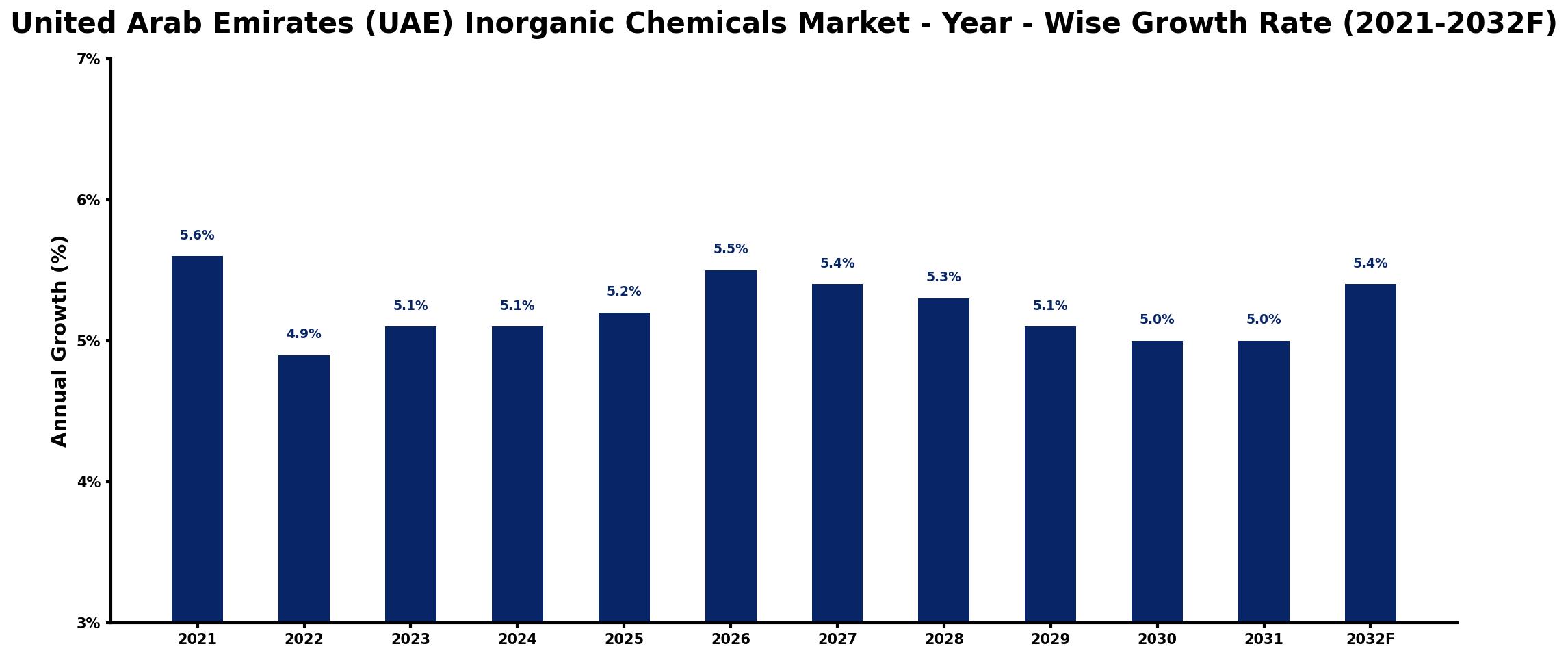
The table below presents the year‑wise growth rates along with the key drivers influencing the market
| Year | Growth Rate | Major Drivers |
| 2021 | 5.6% | increased construction sector activities |
| 2022 | 4.9% | growing demand from manufacturing |
| 2023 | 5.1% | expansion of agricultural applications |
| 2024 | 5.1% | rising investments in infrastructure |
| 2025 | 5.2% | enhanced energy sector requirements |
| 2026 | 5.5% | development of new technologies |
| 2027 | 5.4% | increased export opportunities abroad |
| 2028 | 5.3% | growing focus on sustainability |
| 2029 | 5.1% | rising consumer goods production |
| 2030 | 5.0% | rising demand from electronics |
| 2031 | 5.0% | rising end-use demand growth |
| 2032 | 5.4% | increased focus on renewable energy |
Note: Market size estimations and growth projections presented in this report are based on 6Wresearch's proprietary forecasting methodology, utilizing the latest available industry data, government publications, and primary research inputs.
United Arab Emirates (UAE) Inorganic Chemicals Market Synopsis
The UAE inorganic chemicals market is thriving, fueled by rapid industrialization and economic diversification. The market is characterized by a diverse range of products essential for several industries, reflecting the UAE's strategic initiatives to enhance its manufacturing capabilities.
From agriculture to pharmaceuticals, the applications of inorganic chemicals are expanding, driven by evolving consumer needs and technological advancements. This versatility positions the market for sustained growth, highlighting its importance in the UAEs industrial ecosystem.
United Arab Emirates (UAE) Inorganic Chemicals Market Key Takeaways
- The market is set for continuous expansion due to industrial diversification efforts.
- Strong demand is observed from the construction, automotive, and pharmaceutical sectors.
- Supply chain disruptions during the COVID-19 pandemic highlighted the need for resilience in the market.
- Innovations in sustainable manufacturing practices are becoming crucial.
- The UAE's strategic location enhances its role as a hub for chemical manufacturing and distribution.
Evaluation of Restraints in United Arab Emirates (UAE) Inorganic Chemicals Market
Despite its promising outlook, the UAE inorganic chemicals market faces significant restraints that could hinder growth. A pressing concern is the need for sustainable practices amid increasing environmental scrutiny. Manufacturers are required to invest in technologies that comply with stringent regulations, which can be a financial burden. Additionally, fluctuations in energy costs and volatile raw material prices pose challenges for profitability. The competitive landscape further demands continuous innovation, as companies strive to differentiate their products in an increasingly crowded market.
United Arab Emirates (UAE) Inorganic Chemicals Market Trends
Key trends shaping the UAE inorganic chemicals market include an increasing focus on eco-friendly and sustainable chemical formulations. As industries become more environmentally conscious, theres a notable shift towards using recycled materials and less harmful compounds. Moreover, technological advancements in manufacturing processes, including automation, are improving production efficiencies and reducing costs. The rise of digitalization in supply chain management also offers companies the ability to optimize operations and enhance customer service.
United Arab Emirates (UAE) Inorganic Chemicals Market Opportunities
The market presents several promising growth opportunities, particularly in niche applications such as specialty chemicals for high-tech industries. As the UAE focuses on diversifying its economy, sectors like renewable energy and advanced manufacturing are emerging as potential growth areas for inorganic chemicals. Investments in research and development could lead to innovative products tailored for specific industrial needs, thereby expanding market reach. Furthermore, collaborations between government and private sectors can foster advancements in sustainability and technology integration.
Government Initiatives in the United Arab Emirates (UAE) Inorganic Chemicals Market
The UAE government has implemented various policies aimed at promoting the growth of the inorganic chemicals market. Initiatives focusing on industrial development and sustainability are crucial for supporting manufacturers in adopting best practices. Programs encouraging research and innovation further drive technological advancements within the sector. Moreover, investments in infrastructure and logistics are bolstering the UAE's strategic position as a key player in the regional chemical market, enhancing connectivity for export and distribution.
Future Insights of the United Arab Emirates (UAE) Inorganic Chemicals Market
Looking forward to 2026-2032, the UAE inorganic chemicals market is expected to witness robust growth driven by ongoing industrial diversification efforts. As sectors such as construction and automotive continue to expand, the demand for inorganic chemicals will rise correspondingly. The market is likely to see increased investments in sustainable practices, as companies seek to meet regulatory requirements and cater to environmentally conscious consumers. Overall, the trajectory suggests a vibrant and evolving landscape, ripe with opportunities for innovative solutions.
United Arab Emirates (UAE) Inorganic Chemicals Market Latest Developments (2025 - 2026)
Recent developments in the UAE inorganic chemicals market indicate a strong focus on sustainability and innovation. Companies are increasingly investing in eco-friendly product lines in response to market demand. Additionally, advancements in manufacturing technologies are being adopted to enhance productivity and efficiency. Collaborative efforts between academic institutions and industry stakeholders are fostering research that could lead to breakthroughs in product applications and sustainable practices.
United Arab Emirates (UAE) Inorganic Chemicals Market - Key Attractiveness of the Report
- 10 Years of Market Numbers
- Historical Data Starting from 2022 to 2025
- Base Year: 2025
- Forecast Data until 2032
- Key Performance Indicators Impacting the Market
- Major Upcoming Developments and Projects
Key Highlights of the Report:
- United Arab Emirates (UAE) Inorganic Chemicals Market Outlook
- Market Size of United Arab Emirates (UAE) Inorganic Chemicals Market, 2025
- Forecast of United Arab Emirates (UAE) Inorganic Chemicals Market, 2032
- Historical Data and Forecast of United Arab Emirates (UAE) Inorganic Chemicals Revenues & Volume for the Period 2022-2032F
- United Arab Emirates (UAE) Inorganic Chemicals Market Trend Evolution
- United Arab Emirates (UAE) Inorganic Chemicals Market Drivers and Challenges
- United Arab Emirates (UAE) Inorganic Chemicals Price Trends
- United Arab Emirates (UAE) Inorganic Chemicals Porter's Five Forces
- United Arab Emirates (UAE) Inorganic Chemicals Industry Life Cycle
- Historical Data and Forecast of United Arab Emirates (UAE) Inorganic Chemicals Market Revenues & Volume By Type for the Period 2022-2032F
- Historical Data and Forecast of United Arab Emirates (UAE) Inorganic Chemicals Market Revenues & Volume By Ammonia for the Period 2022-2032F
- Historical Data and Forecast of United Arab Emirates (UAE) Inorganic Chemicals Market Revenues & Volume By Chlor alkali for the Period 2022-2032F
- Historical Data and Forecast of United Arab Emirates (UAE) Inorganic Chemicals Market Revenues & Volume By Ammonium nitrate for the Period 2022-2032F
- Historical Data and Forecast of United Arab Emirates (UAE) Inorganic Chemicals Market Revenues & Volume By Ammonium sulfate for the Period 2022-2032F
- Historical Data and Forecast of United Arab Emirates (UAE) Inorganic Chemicals Market Revenues & Volume By Inorganic acid for the Period 2022-2032F
- Historical Data and Forecast of United Arab Emirates (UAE) Inorganic Chemicals Market Revenues & Volume By Sodium hydroxide for the Period 2022-2032F
- Historical Data and Forecast of United Arab Emirates (UAE) Inorganic Chemicals Market Revenues & Volume By Hydrogen peroxide for the Period 2022-2032F
- Historical Data and Forecast of United Arab Emirates (UAE) Ammonia Inorganic Chemicals Market Revenues & Volume By Oxygen for the Period 2022-2032F
- United Arab Emirates (UAE) Inorganic Chemicals Import Export Trade Statistics
- Market Opportunity Assessment By Type
- United Arab Emirates (UAE) Inorganic Chemicals Top Companies Market Share
- United Arab Emirates (UAE) Inorganic Chemicals Competitive Benchmarking By Technical and Operational Parameters
- United Arab Emirates (UAE) Inorganic Chemicals Company Profiles
- United Arab Emirates (UAE) Inorganic Chemicals Key Strategic Recommendations






































