United Arab Emirates (UAE) Magnesium Metal Market Size, Share & Growth Rate
The United Arab Emirates (UAE) Magnesium Metal Market was estimated at USD 150 Million in 2025 and is projected to reach USD 204 Million by 2032, growing at a CAGR of 4.5% from 2026 to 2032. This growth trajectory is largely fueled by the robust expansion of the automotive and aerospace sectors, where magnesium's lightweight and strength characteristics are increasingly sought after. Additionally, the UAE's ongoing economic diversification efforts play a significant role, driving demand across various industries that utilize magnesium in their processes.
United Arab Emirates (UAE) Magnesium Metal Market Year-wise Growth Rate and Key Drivers
This graph highlights how the United Arab Emirates (UAE) Magnesium Metal Market has steadily grown over the years, supported by major growth factors.
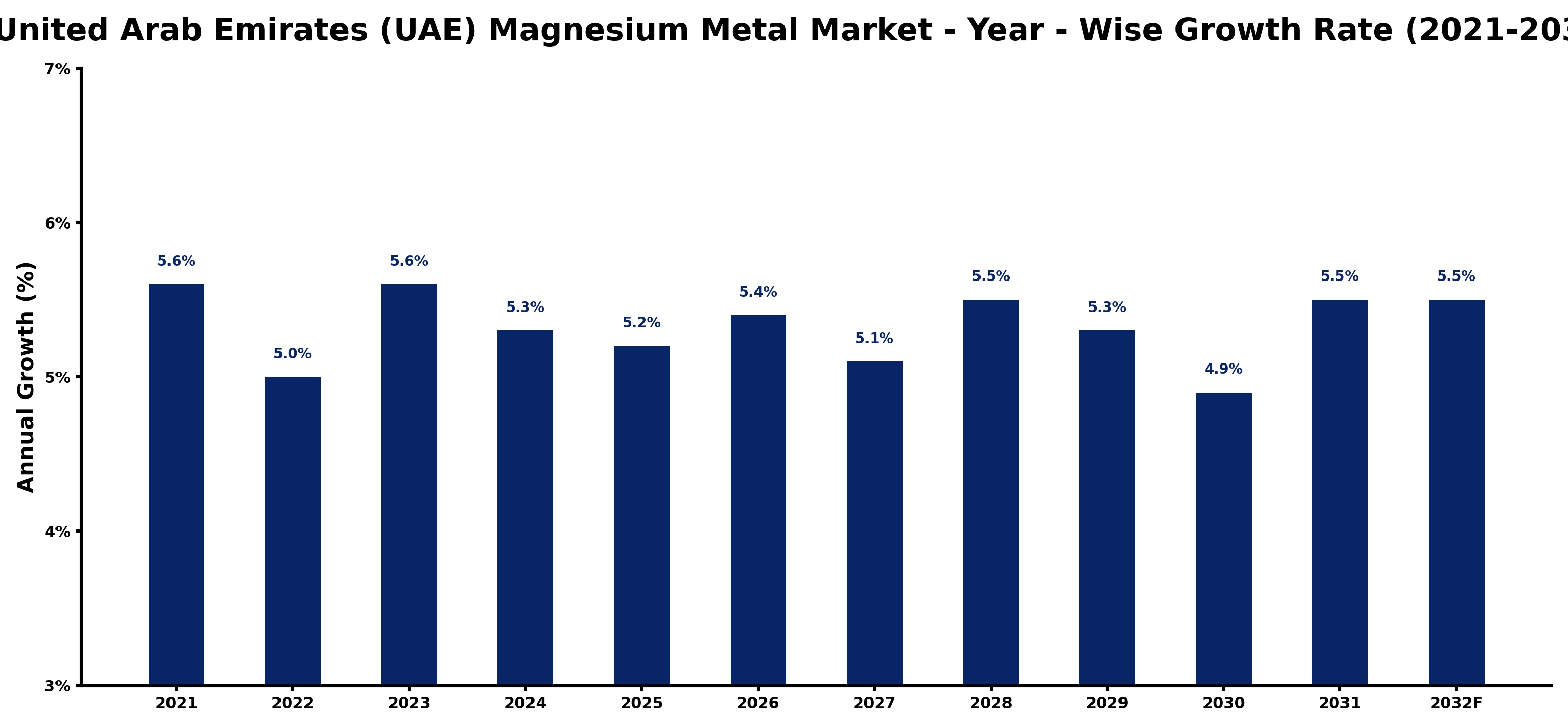
The table below presents the year‑wise growth rates along with the key drivers influencing the market
| Year | Growth Rate | Major Drivers |
| 2021 | 5.6% | Construction sector demand increased significantly |
| 2022 | 5.0% | Automotive industry growth drove demand |
| 2023 | 5.6% | Aerospace applications expanded market reach |
| 2024 | 5.3% | Electronics manufacturing boosted consumption |
| 2025 | 5.2% | Renewable energy projects enhanced usage |
| 2026 | 5.4% | Medical applications broadened market scope |
| 2027 | 5.1% | Lightweight materials trend gained traction |
| 2028 | 5.5% | Recycling initiatives improved sustainability focus |
| 2029 | 5.3% | Technological advancements enhanced production efficiency |
| 2030 | 4.9% | Consumer awareness of benefits rose |
| 2031 | 5.5% | Export opportunities expanded significantly |
| 2032 | 5.5% | Strategic partnerships increased market presence |
Note - Market size estimations and growth projections presented in this report are based on 6Wresearch's advanced forecasting approach, validated with industry datasets as of June 2026.
United Arab Emirates (UAE) Magnesium Metal Market Synopsis
The UAE magnesium metal market is characterized by its dynamic growth, influenced by both local industrial activities and global market trends. The versatility of magnesium allows it to be integrated into numerous applications, reinforcing its significance in high-tech and innovative sectors.
As the UAE prioritizes sustainability and the adoption of advanced manufacturing practices, magnesium is becoming an increasingly vital material. Its properties support not only the automotive and aerospace industries but also electronics and construction, underscoring the metal's critical role in the region's industrial ecosystem.
United Arab Emirates (UAE) Magnesium Metal Market Key Takeaways
- The market is poised for consistent growth, reflecting ongoing industrial diversification in the UAE.
- Magnesium's lightweight nature enhances fuel efficiency in the automotive sector, driving demand.
- Environmental considerations necessitate responsible sourcing and processing practices in magnesium production.
- Key industry players are focused on innovation and sustainability to meet evolving market needs.
- The impact of technological advancements requires manufacturers to remain agile and adaptable.
Evaluation of Restraints in United Arab Emirates (UAE) Magnesium Metal Market
While the UAE magnesium metal market is on a positive growth path, it faces certain constraints that could hinder its full potential. The extraction and processing of magnesium are inherently complex, given the metal's reactivity and associated environmental risks. Ensuring sustainable practices throughout the supply chain is paramount, as non-compliance could lead to regulatory challenges and reputational damage. Moreover, fluctuating global market conditions and technological advancements require local manufacturers to continuously adapt, further complicating operational strategies.
United Arab Emirates (UAE) Magnesium Metal Market Trends
Several trends are shaping the UAE magnesium metal market, notably a strong shift towards lightweight materials in manufacturing. As industries strive to enhance energy efficiency, there is growing interest in magnesium's application in electric vehicles and renewable energy technologies. Additionally, advancements in production techniques, including recycling and sustainable sourcing, are becoming increasingly prevalent, appealing to environmentally conscious consumers and businesses.
United Arab Emirates (UAE) Magnesium Metal Market Opportunities
The market holds promising growth and investment opportunities driven by the rising demand for lightweight materials in automotive and aerospace applications. Furthermore, there is potential for expanding into emerging sectors such as renewable energy, where magnesium can play a critical role in enhancing the efficiency of storage systems and components. Strategic partnerships and technological innovations can also unlock new applications and foster a robust supply chain, enhancing the overall market landscape.
Government Initiatives in the United Arab Emirates (UAE) Magnesium Metal Market
The UAE government has been proactive in promoting industrial development through various initiatives and policies aimed at enhancing local manufacturing capabilities. Investments in infrastructure and incentives for sustainable practices are fostering a conducive environment for the magnesium metal market. Additionally, public funding for research and development supports innovation in extraction and processing methods, aligning with the nation's vision for economic diversification and technological advancement.
Future Insights of the United Arab Emirates (UAE) Magnesium Metal Market
Looking ahead to 2026-2032, the UAE magnesium metal market is anticipated to grow in tandem with advancements in automotive technologies and aerospace innovations. The increasing focus on lightweight materials will continue to drive demand, especially as industries embrace new materials to enhance performance and sustainability. Furthermore, as companies strive to comply with stricter environmental regulations, the emphasis on responsible sourcing and recycling practices will likely shape the market landscape, positioning it for a resilient future.
United Arab Emirates (UAE) Magnesium Metal Market Latest Developments (May 2025 - June 2026)
In recent months, the UAE magnesium metal market has seen increased collaboration between industry stakeholders to develop advanced manufacturing technologies. This includes initiatives to improve the efficiency of magnesium extraction processes and reduce waste. Concurrently, local firms are investing in sustainable practices to align with global trends towards greener production. These developments signify a strategic pivot aimed at enhancing competitiveness while addressing environmental concerns.
United Arab Emirates (UAE) Magnesium Metal Market - Key Attractiveness of the Report
- 10 Years of Market Numbers
- Historical Data Starting from 2022 to 2025
- Base Year: 2025
- Forecast Data until 2032
- Key Performance Indicators Impacting the Market
- Major Upcoming Developments and Projects
Key Highlights of the Report:
- United Arab Emirates (UAE) Magnesium Metal Market Outlook
- Market Size of United Arab Emirates (UAE) Magnesium Metal Market, 2025
- Forecast of United Arab Emirates (UAE) Magnesium Metal Market, 2032
- Historical Data and Forecast of United Arab Emirates (UAE) Magnesium Metal Revenues & Volume for the Period 2022-2032F
- United Arab Emirates (UAE) Magnesium Metal Market Trend Evolution
- United Arab Emirates (UAE) Magnesium Metal Market Drivers and Challenges
- United Arab Emirates (UAE) Magnesium Metal Price Trends
- United Arab Emirates (UAE) Magnesium Metal Porter's Five Forces
- United Arab Emirates (UAE) Magnesium Metal Industry Life Cycle
- Historical Data and Forecast of United Arab Emirates (UAE) Magnesium Metal Market Revenues & Volume By Application for the Period 2022-2032F
- Historical Data and Forecast of United Arab Emirates (UAE) Magnesium Metal Market Revenues & Volume By Die Casting for the Period 2022-2032F
- Historical Data and Forecast of United Arab Emirates (UAE) Magnesium Metal Market Revenues & Volume By Aluminum Alloys for the Period 2022-2032F
- Historical Data and Forecast of United Arab Emirates (UAE) Magnesium Metal Market Revenues & Volume By Titanium Reduction for the Period 2022-2032F
- Historical Data and Forecast of United Arab Emirates (UAE) Magnesium Metal Market Revenues & Volume By Iron & Steel Making for the Period 2022-2032F
- Historical Data and Forecast of United Arab Emirates (UAE) Magnesium Metal Market Revenues & Volume By Others for the Period 2022-2032F
- Historical Data and Forecast of United Arab Emirates (UAE) Magnesium Metal Market Revenues & Volume By End-user Industry for the Period 2022-2032F
- Historical Data and Forecast of United Arab Emirates (UAE) Magnesium Metal Market Revenues & Volume By Automotive for the Period 2022-2032F
- Historical Data and Forecast of United Arab Emirates (UAE) Magnesium Metal Market Revenues & Volume By Aerospace for the Period 2022-2032F
- Historical Data and Forecast of United Arab Emirates (UAE) Magnesium Metal Market Revenues & Volume By Electronics for the Period 2022-2032F
- Historical Data and Forecast of United Arab Emirates (UAE) Magnesium Metal Market Revenues & Volume By Sports for the Period 2022-2032F
- Historical Data and Forecast of United Arab Emirates (UAE) Magnesium Metal Market Revenues & Volume By Medical for the Period 2022-2032F
- Historical Data and Forecast of United Arab Emirates (UAE) Magnesium Metal Market Revenues & Volume By Others for the Period 2022-2032F
- United Arab Emirates (UAE) Magnesium Metal Import Export Trade Statistics
- Market Opportunity Assessment By Application
- Market Opportunity Assessment By End-user Industry
- United Arab Emirates (UAE) Magnesium Metal Top Companies Market Share
- United Arab Emirates (UAE) Magnesium Metal Competitive Benchmarking By Technical and Operational Parameters
- United Arab Emirates (UAE) Magnesium Metal Company Profiles
- United Arab Emirates (UAE) Magnesium Metal Key Strategic Recommendations






































