United Arab Emirates (UAE) Mineral Oil Market Size, Share & Growth Rate
The United Arab Emirates (UAE) Mineral Oil Market was estimated at USD 448 Million in 2025 and is projected to reach USD 615 Million by 2032, growing at a CAGR of 4.6% from 2026 to 2032. This growth trajectory is largely driven by the booming industrial sector, which has seen substantial investments in manufacturing processes. Moreover, the expanding pharmaceutical and cosmetic industries are increasingly relying on mineral oil for their formulations, further propelling market demand.
United Arab Emirates (UAE) Mineral Oil Market Growth Rate Analysis (2021-2032)
The mineral oil market in the United Arab Emirates has shown promising stability and growth, with annual increases around 5.5% in 2021, slightly dipping to 5.1% in 2022 before rebounding to 5.6% in 2023. This growth can be attributed to a surge in consumer demand driven by the expansion of various industrial sectors, including petrochemicals and manufacturing. Investments in energy infrastructure and advancements in refining technologies have further bolstered supply capabilities. Despite a slight fluctuation to 5.2% in 2024, the market is forecasted to maintain its momentum, with growth rates remaining consistently above 5% through 2032, supported by ongoing digitalization and the UAE's strategic energy transition initiatives.
United Arab Emirates (UAE) Mineral Oil Market Year-wise Growth Rate and Key Drivers
This graph highlights how the United Arab Emirates (UAE) Mineral Oil Market has steadily grown over the past five years, supported by major growth factors.
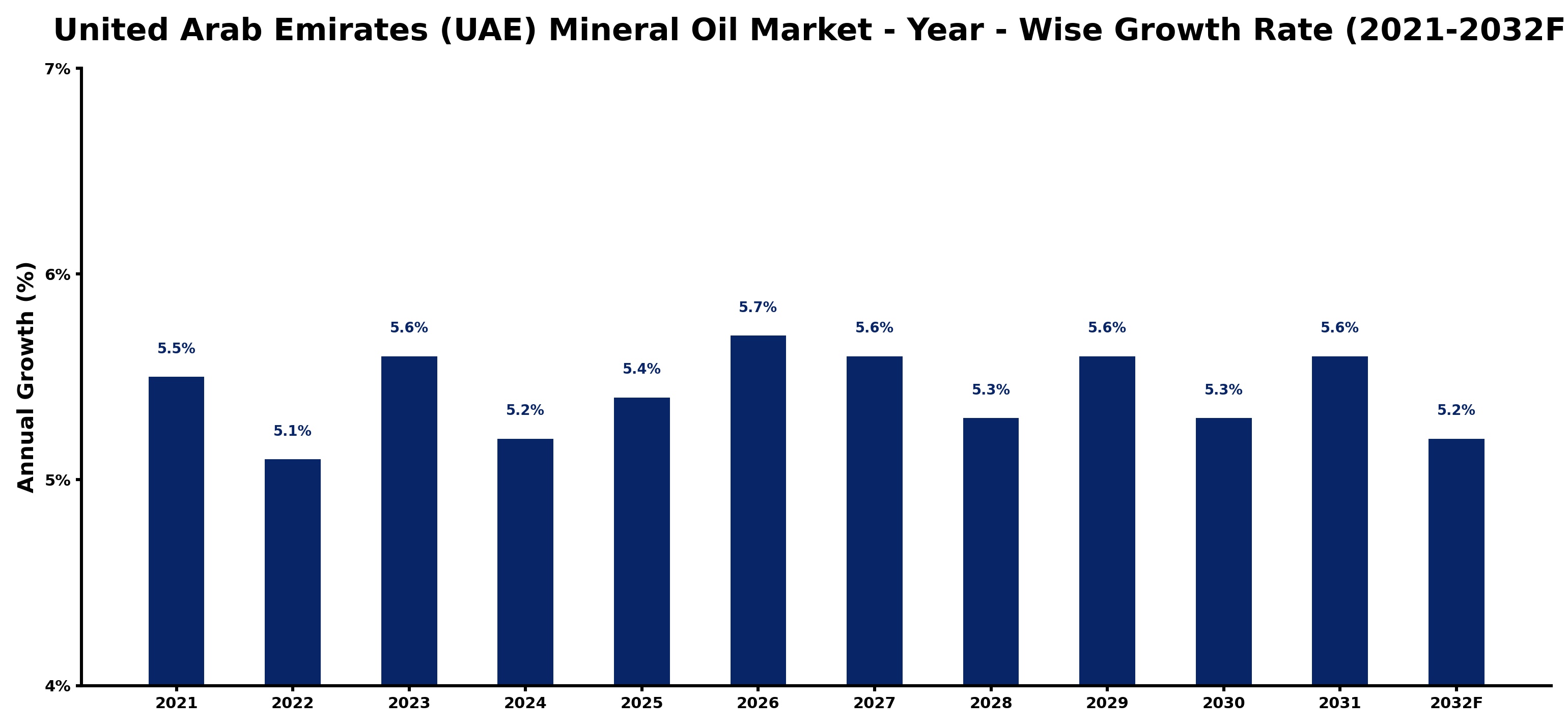
The table below presents the year‑wise growth rates along with the key drivers influencing the market
| Year | Growth Rate | Major Drivers |
| 2021 | 5.5% | Increasing industrial infrastructure investments |
| 2022 | 5.1% | Increasing adoption of advanced technologies |
| 2023 | 5.6% | Expansion of manufacturing activities |
| 2024 | 5.2% | Rising electricity demand across industries |
| 2025 | 5.4% | Growing renewable energy integration projects |
| 2026 | 5.7% | Rising electricity demand across industries |
| 2027 | 5.6% | Rising electricity demand across industries |
| 2028 | 5.3% | Increasing industrial infrastructure investments |
| 2029 | 5.6% | Rising electricity demand across industries |
| 2030 | 5.3% | Rising electricity demand across industries |
| 2031 | 5.6% | Increasing industrial infrastructure investments |
| 2032 | 5.2% | Expansion of commercial construction activities |
Note - Market size estimations and growth projections presented in this report are based on 6Wresearch's advanced forecasting approach, validated with industry datasets as of June 2026.
United Arab Emirates (UAE) Mineral Oil Market Synopsis
The UAE mineral oil market has experienced consistent growth, supported by its applications across a wide spectrum of industries. As industrial activities ramp up, particularly in manufacturing and construction, the reliance on mineral oil as a vital component is becoming more pronounced. However, the market is poised to evolve, grappling with environmental pressures and regulatory challenges while seeking sustainable alternatives.
Looking forward, the burgeoning pharmaceutical and personal care sectors are anticipated to sustain demand for mineral oil, despite competition from eco-friendly substitutes. The UAE's strategic position as a global trading hub will continue to enhance its role in the mineral oil supply chain, connecting manufacturers with diverse markets throughout the region.
United Arab Emirates (UAE) Mineral Oil Market Key Takeaways
- Steady growth anticipated in the mineral oil market driven by industrial and manufacturing sector expansion.
- Pharmaceutical and cosmetic industries are critical drivers of mineral oil demand, fueling innovations in formulations.
- Environmental concerns necessitate increased focus on sustainable practices and greener alternatives.
- The UAE's geographic advantage strengthens its role as a key trading hub for mineral oil distribution in the Middle East.
- Investment in research and development is essential for addressing the challenges posed by fluctuating crude oil prices.
Evaluation of Restraints in United Arab Emirates (UAE) Mineral Oil Market
Despite the positive outlook for the mineral oil market, several restraints are at play. Fluctuating crude oil prices pose a significant risk, impacting production costs and the overall pricing strategy for mineral oil. Additionally, the shift towards sustainable alternatives challenges traditional production methods, requiring manufacturers to innovate continuously. Compliance with increasingly stringent regulatory frameworks regarding product safety and environmental impact also poses hurdles for businesses looking to maintain quality while adapting to new standards.
United Arab Emirates (UAE) Mineral Oil Market Trends
Several emerging trends are shaping the landscape of the UAE mineral oil market. Notably, there is a growing preference for high-purity mineral oils, particularly in the pharmaceutical sector, where stringent quality standards are paramount. Additionally, advancements in refining technology are driving down production costs and enhancing product quality. The trend toward sustainability is fostering innovation, with research into bio-based alternatives gaining traction as a response to environmental concerns.
United Arab Emirates (UAE) Mineral Oil Market Opportunities
The UAE mineral oil market presents numerous opportunities for growth and investment. Expanding the pharmaceutical and cosmetic sectors offers a ripe avenue for manufacturers to innovate and diversify their product offerings. Furthermore, the increasing demand for specialty lubricants in various industries indicates a potential niche market for high-performance mineral oils. With the government pushing for sustainable development, there's also an opportunity to invest in greener alternatives, potentially capturing a new customer base concerned with environmental impact.
Government Initiatives in the United Arab Emirates (UAE) Mineral Oil Market
The UAE government is actively promoting initiatives aimed at boosting the mineral oil market. Through various policies and investments in infrastructure, the government is enhancing the capabilities of the manufacturing sector. Public spending in research and development for sustainable practices is also gaining momentum, encouraging manufacturers to explore eco-friendly alternatives. Additionally, compliance with safety regulations is being prioritized, ensuring that market players adhere to international standards while fostering a competitive business environment.
Future Insights of the United Arab Emirates (UAE) Mineral Oil Market
From 2026 to 2032, the UAE mineral oil market is expected to experience significant transformation. As industrial activities continue to expand, particularly in manufacturing and construction, the demand for mineral oil is likely to intensify. Companies that pivot towards sustainable practices and invest in R&D for innovative products will likely be well-positioned to capitalize on market opportunities. Furthermore, strategic partnerships and collaborations across industries could enhance market resilience and adaptability in the face of regulatory challenges and environmental pressures.
United Arab Emirates (UAE) Mineral Oil Market Latest Developments (May 2025 - June 2026)
Recent developments in the UAE mineral oil market indicate a shift towards improved sustainability measures and enhanced quality standards. Companies are increasingly prioritizing eco-friendly practices, driven by both consumer demand and regulatory requirements. Additionally, innovation in product formulations is becoming more common, particularly within the pharmaceutical and cosmetics sectors. The market is also seeing a gradual recovery following the Covid-19 pandemic, with industrial activities rebounding and demand for mineral oil rising accordingly.
United Arab Emirates (UAE) Mineral Oil Market - Key Attractiveness of the Report
- 10 Years of Market Numbers
- Historical Data Starting from 2022 to 2025
- Base Year: 2025
- Forecast Data until 2032
- Key Performance Indicators Impacting the Market
- Major Upcoming Developments and Projects
Key Highlights of the Report:
- United Arab Emirates (UAE) Mineral Oil Market Outlook
- Market Size of United Arab Emirates (UAE) Mineral Oil Market, 2025
- Forecast of United Arab Emirates (UAE) Mineral Oil Market, 2032F
- Historical Data and Forecast of United Arab Emirates (UAE) Mineral Oil Revenues & Volume for the Period 2022-2032F
- United Arab Emirates (UAE) Mineral Oil Market Trend Evolution
- United Arab Emirates (UAE) Mineral Oil Market Drivers and Challenges
- United Arab Emirates (UAE) Mineral Oil Price Trends
- United Arab Emirates (UAE) Mineral Oil Porter's Five Forces
- United Arab Emirates (UAE) Mineral Oil Industry Life Cycle
- Historical Data and Forecast of United Arab Emirates (UAE) Mineral Oil Market Revenues & Volume By Grade for the Period 2022-2032F
- Historical Data and Forecast of United Arab Emirates (UAE) Mineral Oil Market Revenues & Volume By Technical Oil for the Period 2022-2032F
- Historical Data and Forecast of United Arab Emirates (UAE) Mineral Oil Market Revenues & Volume By White Oil for the Period 2022-2032F
- Historical Data and Forecast of United Arab Emirates (UAE) Mineral Oil Market Revenues & Volume By Application for the Period 2022-2032F
- Historical Data and Forecast of United Arab Emirates (UAE) Mineral Oil Market Revenues & Volume By Baby Oil for the Period 2022-2032F
- Historical Data and Forecast of United Arab Emirates (UAE) Mineral Oil Market Revenues & Volume By Cosmetics for the Period 2022-2032F
- Historical Data and Forecast of United Arab Emirates (UAE) Mineral Oil Market Revenues & Volume By Skin Care Products for the Period 2022-2032F
- Historical Data and Forecast of United Arab Emirates (UAE) Mineral Oil Market Revenues & Volume By Hair Care Products for the Period 2022-2032F
- Historical Data and Forecast of United Arab Emirates (UAE) Mineral Oil Market Revenues & Volume By Consumer Goods for the Period 2022-2032F
- Historical Data and Forecast of United Arab Emirates (UAE) Mineral Oil Market Revenues & Volume By Others for the Period 2022-2032F
- United Arab Emirates (UAE) Mineral Oil Import Export Trade Statistics
- Market Opportunity Assessment By Grade
- Market Opportunity Assessment By Application
- United Arab Emirates (UAE) Mineral Oil Top Companies Market Share
- United Arab Emirates (UAE) Mineral Oil Competitive Benchmarking By Technical and Operational Parameters
- United Arab Emirates (UAE) Mineral Oil Company Profiles
- United Arab Emirates (UAE) Mineral Oil Key Strategic Recommendations






































