United Arab Emirates (UAE) Point Of Sale Terminals Market Size, Share & Growth Rate
The United Arab Emirates (UAE) Point Of Sale Terminals Market was estimated at USD 262 Million in 2025 and is projected to reach USD 342 Million by 2032, growing at a CAGR of 3.9% from 2026 to 2032. This robust growth trajectory is fueled by the UAE's booming retail sector, which is increasingly leaning towards technological advancements to streamline operations. Additionally, the rising acceptance of digital payment options among consumers and the influx of tourists who prefer cashless transactions further bolster the demand for advanced POS solutions.
United Arab Emirates (UAE) Point Of Sale Terminals Market Year-wise Growth Rate and Key Drivers
This graph highlights how the United Arab Emirates (UAE) Point Of Sale Terminals Market has steadily grown over the years, supported by major growth factors.
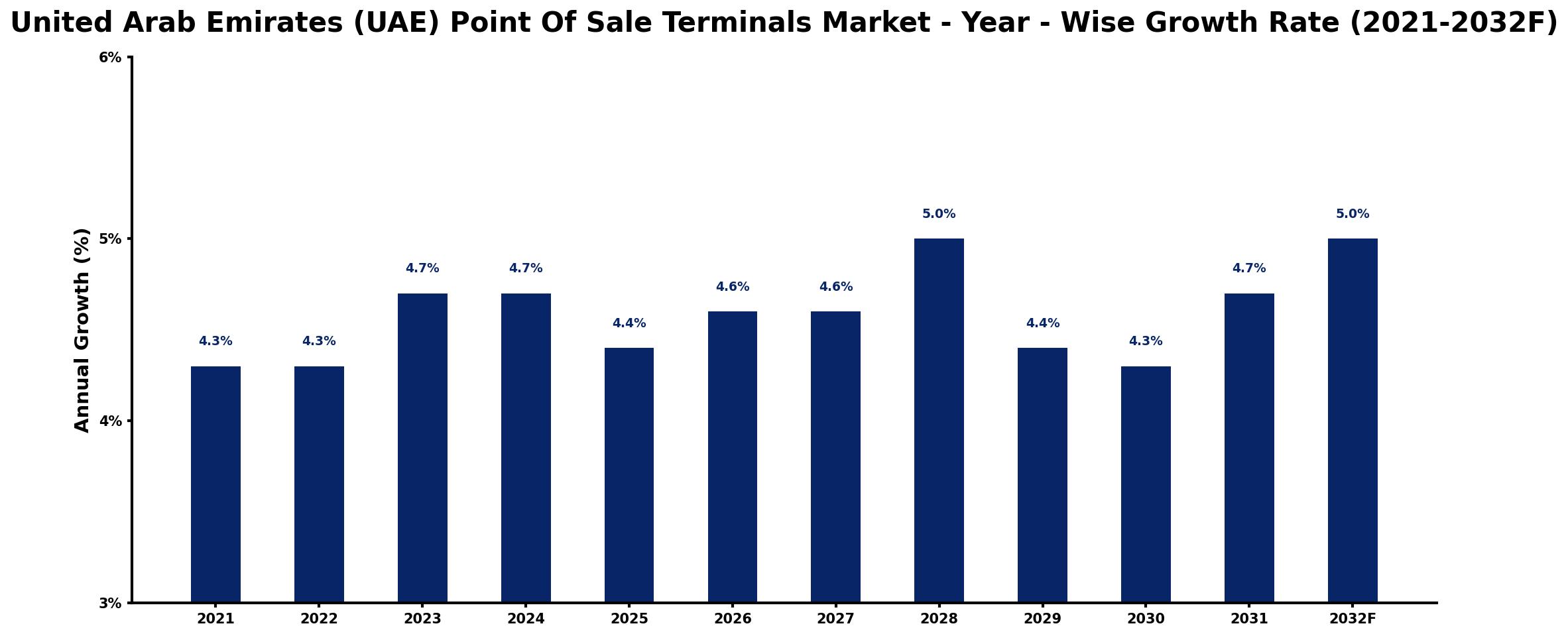
The table below presents the year‑wise growth rates along with the key drivers influencing the market
| Year | Growth Rate | Major Drivers |
| 2021 | 4.3% | Increased digital payment adoption |
| 2022 | 4.3% | Expansion of retail sector investments |
| 2023 | 4.7% | Growth in e-commerce transactions |
| 2024 | 4.7% | Rise in contactless payment options |
| 2025 | 4.4% | Enhancement of customer experience technologies |
| 2026 | 4.6% | Increased demand for mobile payments |
| 2027 | 4.6% | rising demand from electronics |
| 2028 | 5.0% | improved processing technologies adoption |
| 2029 | 4.4% | Increase in small business digitization |
| 2030 | 4.3% | increased domestic production output |
| 2031 | 4.7% | strengthening underlying market demand |
| 2032 | 5.0% | Increased government digital initiatives |
Note: Market size estimations and growth projections presented in this report are based on 6Wresearch's proprietary forecasting methodology, utilizing the latest available industry data, government publications, and primary research inputs.
United Arab Emirates (UAE) Point Of Sale Terminals Market Synopsis
In recent years, the UAE Point Of Sale Terminals Market has experienced remarkable momentum, largely driven by shifts in consumer behavior and technological advancements. As businesses in the retail and hospitality sectors adapt to a digitally savvy clientele, the demand for efficient and secure payment solutions continues to grow.
Looking ahead, the market is poised for further expansion, primarily due to continuous innovations in payment technologies, including enhanced features like contactless payments and integrated inventory management systems. Such advancements cater to the evolving needs of businesses seeking to improve customer experience and operational efficiency.
United Arab Emirates (UAE) Point Of Sale Terminals Market Key Takeaways
- The market is experiencing sustained growth driven by the retail sector's expansion and increasing tourist influx.
- Adoption of contactless payment solutions is reshaping consumer interactions at retail and hospitality points.
- Technological advancements are fostering the integration of inventory management systems into POS terminals.
- Security concerns regarding digital transactions are prompting innovations in cybersecurity measures.
- Compatibility challenges with various payment methods necessitate ongoing technological adaptations.
Evaluation of Restraints in United Arab Emirates (UAE) Point Of Sale Terminals Market
The UAE Point Of Sale Terminals Market faces significant constraints, particularly concerning cybersecurity and compatibility. As reliance on digital payment systems heightens, ensuring the safety and integrity of transactions becomes paramount for stakeholders. Furthermore, achieving seamless compatibility with a diverse array of payment methods and software platforms proves complex, creating barriers for businesses looking to modernize their payment solutions. These challenges necessitate continuous investments in technology and training to stay competitive in a rapidly evolving landscape.
United Arab Emirates (UAE) Point Of Sale Terminals Market Trends
Several key trends are shaping the UAE Point Of Sale Terminals Market. A prominent shift towards contactless payments is gaining traction, especially among health-conscious consumers post-pandemic. Moreover, the integration of mobile wallets and digital banking solutions into POS systems is becoming increasingly prevalent, enhancing user convenience. Retailers are also focusing on customer engagement through personalized services enabled by data analytics provided by advanced POS terminals, fostering brand loyalty in an increasingly competitive market.
United Arab Emirates (UAE) Point Of Sale Terminals Market Opportunities
Opportunities for growth in the UAE Point Of Sale Terminals Market are plentiful. As the retail sector pivots towards embracing technology, businesses that invest in next-generation POS systems stand to benefit significantly. The rise of e-commerce also presents a unique avenue, with brick-and-mortar stores integrating online platforms into their payment solutions. Furthermore, the increasing number of startups and small businesses in the region provides a fertile ground for innovative POS technologies, as these entities seek efficient, cost-effective payment solutions.
Government Initiatives in the United Arab Emirates (UAE) Point Of Sale Terminals Market
The UAE government has been proactive in fostering a favorable environment for digital payment solutions, including POS terminals. Initiatives aimed at enhancing financial inclusion and encouraging the transition to a cashless economy are evident through various programs and public investments. Regulatory frameworks are evolving to support the integration of advanced technologies in payment processing, further positioning the UAE as a leader in digital finance within the region.
Future Insights of the United Arab Emirates (UAE) Point Of Sale Terminals Market
From 2026 to 2032, the UAE Point Of Sale Terminals Market is expected to witness a transformative phase. As retailers and hospitality businesses increasingly prioritize customer experiences, the demand for cutting-edge POS solutions will continue to surge. This period will likely see intensified competition among technology providers as they strive to innovate and deliver enhanced security features. Moreover, collaborations among fintech companies, retailers, and government bodies will play a crucial role in shaping the future landscape of payment processing in the UAE.
United Arab Emirates (UAE) Point Of Sale Terminals Market Latest Developments (2025 - 2026)
In the latest developments, the UAE Point Of Sale Terminals Market is witnessing a significant shift towards integrating AI and machine learning technologies to enhance transaction security and customer insights. These advancements aim to not only streamline payment processes but also to provide businesses with valuable analytics for better decision-making. Additionally, there is a growing emphasis on partnerships between traditional POS providers and emerging tech startups to facilitate the adoption of advanced payment solutions across various sectors.
United Arab Emirates (UAE) Point Of Sale Terminals Market - Key Attractiveness of the Report
- 10 Years of Market Numbers
- Historical Data Starting from 2022 to 2025
- Base Year: 2025
- Forecast Data until 2032
- Key Performance Indicators Impacting the Market
- Major Upcoming Developments and Projects
Key Highlights of the Report:
- United Arab Emirates (UAE) Point Of Sale Terminals Market Outlook
- Market Size of United Arab Emirates (UAE) Point Of Sale Terminals Market, 2025
- Forecast of United Arab Emirates (UAE) Point Of Sale Terminals Market, 2032
- Historical Data and Forecast of United Arab Emirates (UAE) Point Of Sale Terminals Revenues & Volume for the Period 2022-2032F
- United Arab Emirates (UAE) Point Of Sale Terminals Market Trend Evolution
- United Arab Emirates (UAE) Point Of Sale Terminals Market Drivers and Challenges
- United Arab Emirates (UAE) Point Of Sale Terminals Price Trends
- United Arab Emirates (UAE) Point Of Sale Terminals Porter's Five Forces
- United Arab Emirates (UAE) Point Of Sale Terminals Industry Life Cycle
- Historical Data and Forecast of United Arab Emirates (UAE) Point Of Sale Terminals Market Revenues & Volume By Product for the Period 2022-2032F
- Historical Data and Forecast of United Arab Emirates (UAE) Point Of Sale Terminals Market Revenues & Volume By Fixed for the Period 2022-2032F
- Historical Data and Forecast of United Arab Emirates (UAE) Point Of Sale Terminals Market Revenues & Volume By Mobile for the Period 2022-2032F
- Historical Data and Forecast of United Arab Emirates (UAE) Point Of Sale Terminals Market Revenues & Volume By Component for the Period 2022-2032F
- Historical Data and Forecast of United Arab Emirates (UAE) Point Of Sale Terminals Market Revenues & Volume By Hardware for the Period 2022-2032F
- Historical Data and Forecast of United Arab Emirates (UAE) Point Of Sale Terminals Market Revenues & Volume By Software for the Period 2022-2032F
- Historical Data and Forecast of United Arab Emirates (UAE) Point Of Sale Terminals Market Revenues & Volume By Services for the Period 2022-2032F
- Historical Data and Forecast of United Arab Emirates (UAE) Point Of Sale Terminals Market Revenues & Volume By Deployment for the Period 2022-2032F
- Historical Data and Forecast of United Arab Emirates (UAE) Point Of Sale Terminals Market Revenues & Volume By Cloud for the Period 2022-2032F
- Historical Data and Forecast of United Arab Emirates (UAE) Point Of Sale Terminals Market Revenues & Volume By On-premise for the Period 2022-2032F
- Historical Data and Forecast of United Arab Emirates (UAE) Point Of Sale Terminals Market Revenues & Volume By End Use for the Period 2022-2032F
- Historical Data and Forecast of United Arab Emirates (UAE) Point Of Sale Terminals Market Revenues & Volume By Restaurants for the Period 2022-2032F
- Historical Data and Forecast of United Arab Emirates (UAE) Point Of Sale Terminals Market Revenues & Volume By Retail for the Period 2022-2032F
- Historical Data and Forecast of United Arab Emirates (UAE) Point Of Sale Terminals Market Revenues & Volume By Hospitality for the Period 2022-2032F
- Historical Data and Forecast of United Arab Emirates (UAE) Point Of Sale Terminals Market Revenues & Volume By Healthcare for the Period 2022-2032F
- Historical Data and Forecast of United Arab Emirates (UAE) Point Of Sale Terminals Market Revenues & Volume By Warehouse for the Period 2022-2032F
- Historical Data and Forecast of United Arab Emirates (UAE) Point Of Sale Terminals Market Revenues & Volume By Entertainment for the Period 2022-2032F
- Historical Data and Forecast of United Arab Emirates (UAE) Point Of Sale Terminals Market Revenues & Volume By Others for the Period 2022-2032F
- United Arab Emirates (UAE) Point Of Sale Terminals Import Export Trade Statistics
- Market Opportunity Assessment By Product
- Market Opportunity Assessment By Component
- Market Opportunity Assessment By Deployment
- Market Opportunity Assessment By End Use
- United Arab Emirates (UAE) Point Of Sale Terminals Top Companies Market Share
- United Arab Emirates (UAE) Point Of Sale Terminals Competitive Benchmarking By Technical and Operational Parameters
- United Arab Emirates (UAE) Point Of Sale Terminals Company Profiles
- United Arab Emirates (UAE) Point Of Sale Terminals Key Strategic Recommendations






































