United Kingdom (UK) Auto Parts And Accessories Market Size, Share & Growth Rate
The United Kingdom (UK) Auto Parts And Accessories Market was estimated at USD 491 Million in 2025 and is projected to reach USD 608 Million by 2032, growing at a CAGR of 3.1% from 2026 to 2032. This growth trajectory is primarily driven by the increasing vehicle ownership, ongoing technological advancements, and rising consumer demand for customization. The shift towards electric vehicles (EVs) further energizes market growth, as manufacturers innovate to meet new standards and preferences.
United Kingdom (UK) Auto Parts And Accessories Market Year-wise Growth Rate and Key Drivers
This graph highlights how the United Kingdom (UK) Auto Parts And Accessories Market has steadily grown over the years, supported by major growth factors.
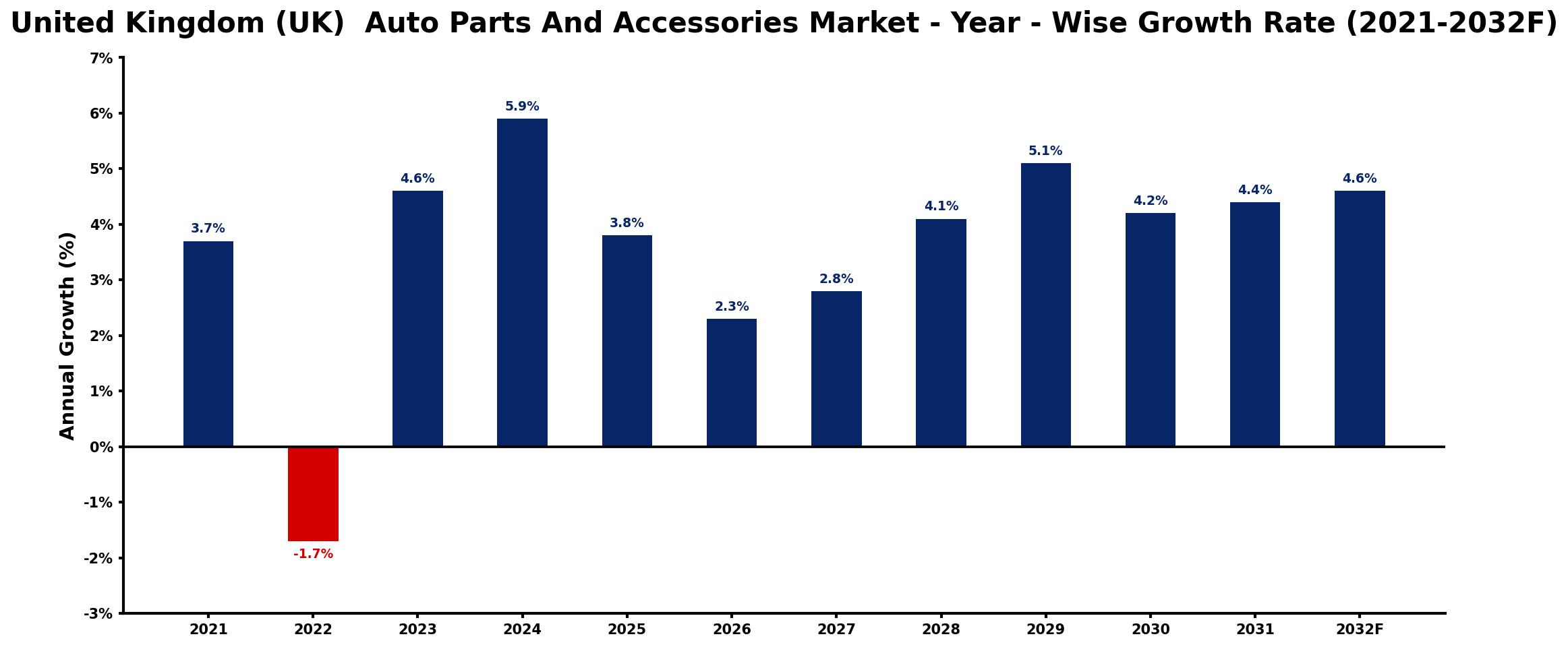
The table below presents the year‑wise growth rates along with the key drivers influencing the market
| Year | Growth Rate | Major Drivers |
| 2021 | 3.7% | Increased consumer spending on repairs |
| 2022 | -1.7% | Decreased manufacturing output and demand |
| 2023 | 4.6% | Rising electric vehicle adoption rates |
| 2024 | 5.9% | Expansion of online retail platforms |
| 2025 | 3.8% | expanding manufacturing base activity |
| 2026 | 2.3% | Enhanced focus on sustainability practices |
| 2027 | 2.8% | Improved supply chain efficiencies observed |
| 2028 | 4.1% | Surge in vehicle ownership trends |
| 2029 | 5.1% | Technological advancements in vehicle safety |
| 2030 | 4.2% | Increased demand for aftermarket services |
| 2031 | 4.4% | Growth in fleet management solutions |
| 2032 | 4.6% | Rising interest in performance upgrades |
Note: Market size estimations and growth projections presented in this report are based on 6Wresearch's proprietary forecasting methodology, utilizing the latest available industry data, government publications, and primary research inputs.
United Kingdom (UK) Auto Parts And Accessories Market Synopsis
A notable characteristic of the UK auto parts market is its dynamic response to consumer trends, particularly in the aftermarket segment. The desire for personalization is prompting consumers to seek tailored solutions, creating a burgeoning demand for aftermarket enhancements and performance upgrades.
Furthermore, the integration of e-commerce platforms is transforming the landscape of auto parts distribution. As consumers increasingly opt for online purchasing, the convenience and expanded selection available through digital channels are reshaping how products are sold and perceived in the market.
United Kingdom (UK) Auto Parts And Accessories Market Key Takeaways
- The market is evolving towards eco-friendly products as consumer consciousness about sustainability rises.
- Technological advancements in automotive components are driving demand, particularly for electric vehicles.
- Online retailing is becoming a dominant sales channel, reshaping the purchasing habits of consumers.
- Customization and personalization of vehicles are increasingly popular, influencing product offerings.
- Competitive pressures from domestic and international players necessitate continuous innovation.
Evaluation of Restraints in United Kingdom (UK) Auto Parts And Accessories Market
Despite the promising growth potential, the UK auto parts and accessories market is contending with several significant restraints. Notably, the competition is fierce, with numerous suppliers vying for market share, which often leads to price wars that can impact profit margins. Additionally, fluctuations in raw material costs pose a challenge for manufacturers, forcing them to navigate a complex supply landscape. The impact of Brexit introduces further uncertainty regarding trade agreements and regulatory changes, complicating sourcing and distribution strategies. As consumer preferences shift rapidly, companies must continuously adapt to remain relevant and address the evolving market needs.
United Kingdom (UK) Auto Parts And Accessories Market Trends
Several key trends are influencing the UK auto parts and accessories market today. A growing emphasis on sustainability is driving demand for eco-friendly parts, particularly as consumers lean towards electric vehicles and green alternatives. E-commerce continues to rise, with many consumers preferring the convenience of online shopping for auto components. Additionally, technological innovations are fostering interest in advanced automotive solutions such as driver-assistance systems and connected car technologies. Lastly, there is an increasing trend towards customization, as consumers seek to personalize their vehicles to reflect individual tastes and preferences.
United Kingdom (UK) Auto Parts And Accessories Market Opportunities
Investment opportunities abound in the UK auto parts and accessories market, particularly for firms focused on innovative solutions. With the transition to electric vehicles, companies that specialize in EV components and sustainable materials are well-positioned for growth. The surge in online retail creates additional avenues for e-commerce platforms and digital marketing strategies that cater specifically to the automotive sector. Moreover, investing in research and development to explore advancements in connected vehicle technologies and autonomous systems will likely yield significant returns as the automotive landscape evolves.
Government Initiatives in the United Kingdom (UK) Auto Parts And Accessories Market
Government policies in the UK are increasingly focused on fostering innovation and sustainability in the auto parts and accessories market. The government encourages investments in research and development to stimulate technological advancements and facilitate the transition to electric vehicles. Regulatory frameworks are established to ensure product safety and quality, as well as to promote environmentally responsible practices like recycling and waste management. Additionally, there is ongoing support for domestic manufacturing to enhance supply chain resilience in light of global challenges.
Future Insights of the United Kingdom (UK) Auto Parts And Accessories Market
Looking ahead, the UK auto parts and accessories market is poised for sustained growth from 2026 to 2032. Factors such as rising vehicle ownership, ongoing technological advancements, and a growing trend towards customization will continue to propel the market forward. The shift towards electric vehicles will drive demand for specialized components and innovative solutions, while the expansion of online retail channels will enhance accessibility for consumers. However, stakeholders should remain vigilant of Brexit-related uncertainties and evolving consumer preferences, which could impact the trajectory of the market.
United Kingdom (UK) Auto Parts And Accessories Market Latest Developments (2025 - 2026)
Recent developments in the UK auto parts and accessories market indicate a robust focus on sustainability and innovation. Companies are actively exploring partnerships to enhance their supply chain resilience and improve product offerings. The rise of electric vehicles is prompting manufacturers to introduce more eco-friendly components to their portfolios. Additionally, advancements in digital retail are enabling a seamless shopping experience, making it easier for consumers to access a wide range of auto parts and accessories online. These trends reflect an industry that is rapidly adapting to meet the evolving demands of the automotive landscape.
United Kingdom (UK) Auto Parts And Accessories Market - Key Attractiveness of the Report
- 10 Years of Market Numbers
- Historical Data Starting from 2022 to 2025
- Base Year: 2025
- Forecast Data until 2032
- Key Performance Indicators Impacting the Market
- Major Upcoming Developments and Projects
Key Highlights of the Report:
- United Kingdom (UK) Auto Parts And Accessories Market Outlook
- Market Size of United Kingdom (UK) Auto Parts And Accessories Market, 2025
- Forecast of United Kingdom (UK) Auto Parts And Accessories Market, 2032
- Historical Data and Forecast of United Kingdom (UK) Auto Parts And Accessories Revenues & Volume for the Period 2022-2032F
- United Kingdom (UK) Auto Parts And Accessories Market Trend Evolution
- United Kingdom (UK) Auto Parts And Accessories Market Drivers and Challenges
- United Kingdom (UK) Auto Parts And Accessories Price Trends
- United Kingdom (UK) Auto Parts And Accessories Porter's Five Forces
- United Kingdom (UK) Auto Parts And Accessories Industry Life Cycle
- Historical Data and Forecast of United Kingdom (UK) Auto Parts And Accessories Market Revenues & Volume By Product for the Period 2022-2032F
- Historical Data and Forecast of United Kingdom (UK) Auto Parts And Accessories Market Revenues & Volume By Driveline & Powertrain for the Period 2022-2032F
- Historical Data and Forecast of United Kingdom (UK) Auto Parts And Accessories Market Revenues & Volume By Interiors & Exteriors for the Period 2022-2032F
- Historical Data and Forecast of United Kingdom (UK) Auto Parts And Accessories Market Revenues & Volume By Electronics for the Period 2022-2032F
- Historical Data and Forecast of United Kingdom (UK) Auto Parts And Accessories Market Revenues & Volume By Bodies & Chassis for the Period 2022-2032F
- Historical Data and Forecast of United Kingdom (UK) Auto Parts And Accessories Market Revenues & Volume By Wheel & Tires for the Period 2022-2032F
- Historical Data and Forecast of United Kingdom (UK) Auto Parts And Accessories Market Revenues & Volume By Others for the Period 2022-2032F
- Historical Data and Forecast of United Kingdom (UK) Auto Parts And Accessories Market Revenues & Volume By Application for the Period 2022-2032F
- Historical Data and Forecast of United Kingdom (UK) Auto Parts And Accessories Market Revenues & Volume By OEMs for the Period 2022-2032F
- Historical Data and Forecast of United Kingdom (UK) Auto Parts And Accessories Market Revenues & Volume By Aftermarket for the Period 2022-2032F
- United Kingdom (UK) Auto Parts And Accessories Import Export Trade Statistics
- Market Opportunity Assessment By Product
- Market Opportunity Assessment By Application
- United Kingdom (UK) Auto Parts And Accessories Top Companies Market Share
- United Kingdom (UK) Auto Parts And Accessories Competitive Benchmarking By Technical and Operational Parameters
- United Kingdom (UK) Auto Parts And Accessories Company Profiles
- United Kingdom (UK) Auto Parts And Accessories Key Strategic Recommendations






































