Qatar Auto Parts And Accessories Market Size, Share & Growth Rate
The Qatar Auto Parts And Accessories Market was estimated at USD 274 Million in 2025 and is projected to reach USD 367 Million by 2032, growing at a CAGR of 4.3% from 2026 to 2032. This growth is fueled by an increase in vehicle ownership, thanks to a burgeoning population and a robust economy that encourages consumer spending. Additionally, government initiatives aimed at enhancing the transportation infrastructure are creating a favorable landscape for auto parts and accessories suppliers.
Qatar Auto Parts And Accessories Market Year-wise Growth Rate and Key Drivers
This graph highlights how the Qatar Auto Parts And Accessories Market has steadily grown over the years, supported by major growth factors.
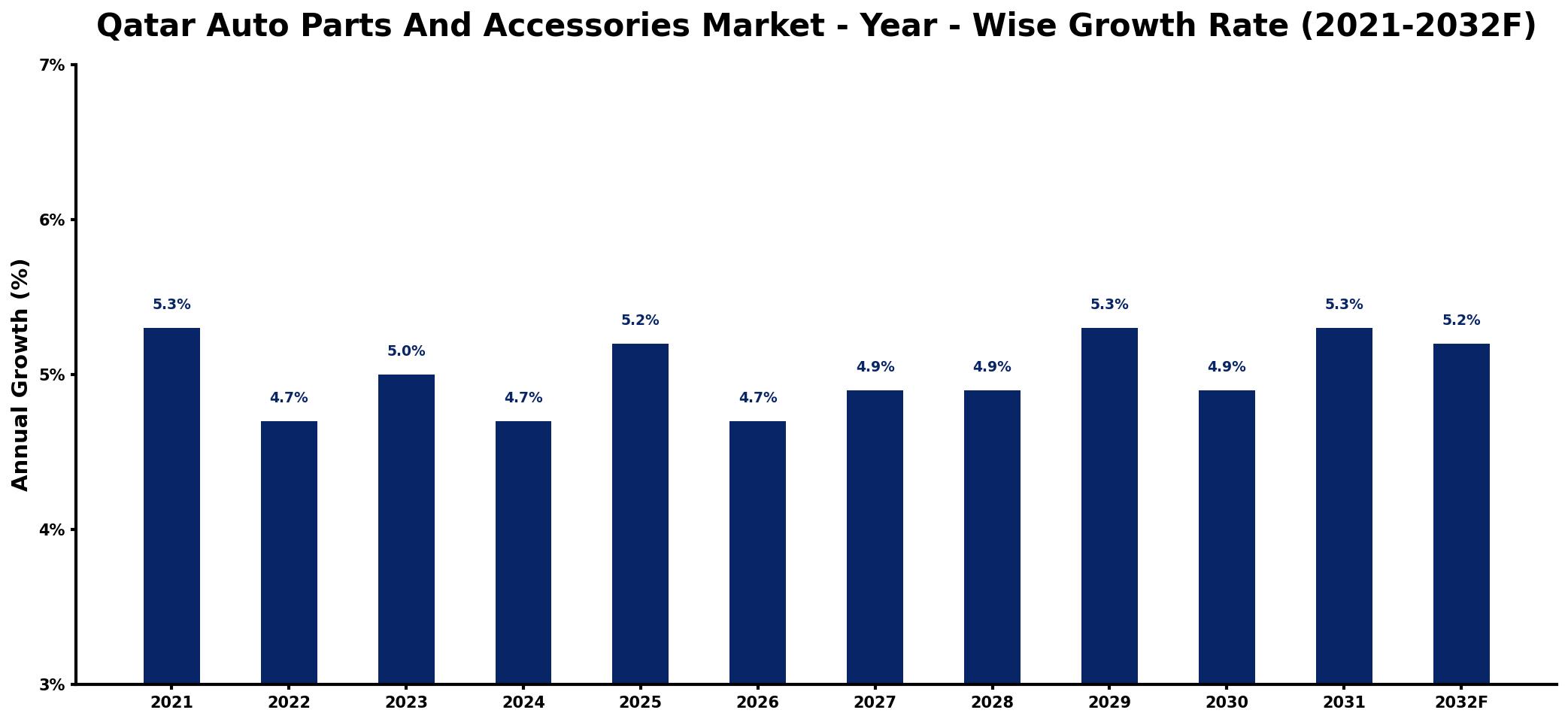
The table below presents the year‑wise growth rates along with the key drivers influencing the market
| Year | Growth Rate | Major Drivers |
| 2021 | 5.3% | Increased consumer vehicle ownership |
| 2022 | 4.7% | Growth in e-commerce platforms |
| 2023 | 5.0% | Rising demand for electric vehicles |
| 2024 | 4.7% | Expansion of logistics networks |
| 2025 | 5.2% | Investment in renewable energy |
| 2026 | 4.7% | Surge in urbanization trends |
| 2027 | 4.9% | Development of smart infrastructure |
| 2028 | 4.9% | Enhancement of supply chain efficiency |
| 2029 | 5.3% | Growing interest in sustainability |
| 2030 | 4.9% | Technological advancements in manufacturing |
| 2031 | 5.3% | Emergence of alternative fuels |
| 2032 | 5.2% | Increased focus on vehicle safety |
Note: Market size estimations and growth projections presented in this report are based on 6Wresearch's proprietary forecasting methodology, utilizing the latest available industry data, government publications, and primary research inputs.
Qatar Auto Parts And Accessories Market Synopsis
In Qatar, the demand for high-quality auto parts and accessories is steadily rising, driven by a population that leans toward premium vehicle ownership. This trend, coupled with a strong focus on vehicle maintenance, positions local suppliers to cater to an increasingly discerning customer base.
Moreover, the dynamic automotive industry landscape in Qatar, underpinned by ongoing government transportation projects, presents lucrative opportunities for both local and international players. As the market expands, the emphasis on genuine parts ensures that suppliers are prioritizing quality to meet consumer expectations.
Qatar Auto Parts And Accessories Market Key Takeaways
- Consistent growth in vehicle ownership is driving demand for replacement parts and accessories.
- The affluent population's preference for high-end vehicles significantly influences market dynamics.
- Government infrastructure development projects are creating new avenues for market expansion.
- The emphasis on quality and genuine products is critical for maintaining consumer trust.
- The market is gradually recovering post-COVID-19, with renewed consumer spending projected.
Evaluation of Restraints in Qatar Auto Parts And Accessories Market
Despite the positive growth outlook, the Qatar auto parts and accessories market faces significant challenges. The prevalence of counterfeit and substandard products remains a critical issue, potentially compromising vehicle safety and performance. Additionally, the dependence on global supply chains for genuine parts can create vulnerabilities, making it essential for suppliers to establish robust sourcing strategies. Ensuring the availability of high-quality products while navigating these challenges is vital for market players to maintain competitiveness.
Qatar Auto Parts And Accessories Market Trends
Several current and emerging trends are shaping the Qatar auto parts and accessories market. The shift towards electric vehicles is gaining traction, prompting a demand for specialized components and accessories tailored for electric and hybrid models. Furthermore, customization has become a key consumer preference, leading to an increasing variety of aftermarket parts that cater to individual tastes and requirements. Lastly, digitalization in sales channels is evolving, with online platforms becoming crucial in reaching consumers.
Qatar Auto Parts And Accessories Market Opportunities
The market presents genuine opportunities for growth, especially in the realm of electric vehicle components, where technological advancements are rapidly transforming the landscape. Additionally, the increasing preference for customized automotive solutions opens up avenues for suppliers to innovate and diversify their product lines. Furthermore, as the government continues to invest in infrastructure, there is a need for enhanced vehicle maintenance, thereby propelling the demand for quality auto parts.
Government Initiatives in the Qatar Auto Parts And Accessories Market
Qatar's government has undertaken several initiatives aimed at enhancing the automotive sector, including investments in infrastructure development and transportation projects. These initiatives not only improve the overall automotive landscape but also create a conducive environment for businesses in the auto parts and accessories market. Public spending in transportation and urban development plays a significant role in stimulating demand for vehicle maintenance and, consequently, auto parts.
Future Insights of the Qatar Auto Parts And Accessories Market
Looking ahead to 2026-2032, the Qatar auto parts and accessories market is poised for sustainable growth. As the economy rebounds and consumer confidence improves, demand for both standard and premium auto parts will likely increase. The anticipated rise in electric vehicle adoption and the continuous focus on vehicle maintenance and quality assurance will redefine market dynamics. Additionally, innovations in technology and digital platforms will further drive efficiency in the supply chain and enhance customer engagement.
Qatar Auto Parts And Accessories Market Latest Developments (2025 - 2026)
Recent developments in the Qatar auto parts and accessories market indicate a shift towards sustainability and technological advancement. Initiatives aimed at promoting electric vehicle infrastructure are gaining momentum, leading to new partnerships and product offerings focused on energy-efficient solutions. Furthermore, a surge in online retailing is reshaping how consumers interact with auto parts suppliers, emphasizing the need for companies to adapt to changing consumer preferences.
Qatar Auto Parts And Accessories Market - Key Attractiveness of the Report
- 10 Years of Market Numbers
- Historical Data Starting from 2022 to 2025
- Base Year: 2025
- Forecast Data until 2032
- Key Performance Indicators Impacting the Market
- Major Upcoming Developments and Projects
Key Highlights of the Report:
- Qatar Auto Parts And Accessories Market Outlook
- Market Size of Qatar Auto Parts And Accessories Market, 2025
- Forecast of Qatar Auto Parts And Accessories Market, 2032
- Historical Data and Forecast of Qatar Auto Parts And Accessories Revenues & Volume for the Period 2022-2032F
- Qatar Auto Parts And Accessories Market Trend Evolution
- Qatar Auto Parts And Accessories Market Drivers and Challenges
- Qatar Auto Parts And Accessories Price Trends
- Qatar Auto Parts And Accessories Porter's Five Forces
- Qatar Auto Parts And Accessories Industry Life Cycle
- Historical Data and Forecast of Qatar Auto Parts And Accessories Market Revenues & Volume By Product for the Period 2022-2032F
- Historical Data and Forecast of Qatar Auto Parts And Accessories Market Revenues & Volume By Driveline & Powertrain for the Period 2022-2032F
- Historical Data and Forecast of Qatar Auto Parts And Accessories Market Revenues & Volume By Interiors & Exteriors for the Period 2022-2032F
- Historical Data and Forecast of Qatar Auto Parts And Accessories Market Revenues & Volume By Electronics for the Period 2022-2032F
- Historical Data and Forecast of Qatar Auto Parts And Accessories Market Revenues & Volume By Bodies & Chassis for the Period 2022-2032F
- Historical Data and Forecast of Qatar Auto Parts And Accessories Market Revenues & Volume By Wheel & Tires for the Period 2022-2032F
- Historical Data and Forecast of Qatar Auto Parts And Accessories Market Revenues & Volume By Others for the Period 2022-2032F
- Historical Data and Forecast of Qatar Auto Parts And Accessories Market Revenues & Volume By Application for the Period 2022-2032F
- Historical Data and Forecast of Qatar Auto Parts And Accessories Market Revenues & Volume By OEMs for the Period 2022-2032F
- Historical Data and Forecast of Qatar Auto Parts And Accessories Market Revenues & Volume By Aftermarket for the Period 2022-2032F
- Qatar Auto Parts And Accessories Import Export Trade Statistics
- Market Opportunity Assessment By Product
- Market Opportunity Assessment By Application
- Qatar Auto Parts And Accessories Top Companies Market Share
- Qatar Auto Parts And Accessories Competitive Benchmarking By Technical and Operational Parameters
- Qatar Auto Parts And Accessories Company Profiles
- Qatar Auto Parts And Accessories Key Strategic Recommendations






































