United States (US) Auto Parts And Accessories Market Size, Share & Growth Rate
The United States (US) Auto Parts And Accessories Market was estimated at USD 109 Million in 2025 and is projected to reach USD 129 Million by 2032, growing at a CAGR of 2.4% from 2026 to 2032. This growth trajectory is supported by several factors, including a significant rise in vehicle sales and an increasing demand for customization and upgrades among consumers. Additionally, the market is bolstered by technological advancements that enhance vehicle performance and safety, making auto parts and accessories an essential component of modern vehicle ownership.
United States (US) Auto Parts And Accessories Market Year-wise Growth Rate and Key Drivers
This graph highlights how the United States (US) Auto Parts And Accessories Market has steadily grown over the years, supported by major growth factors.
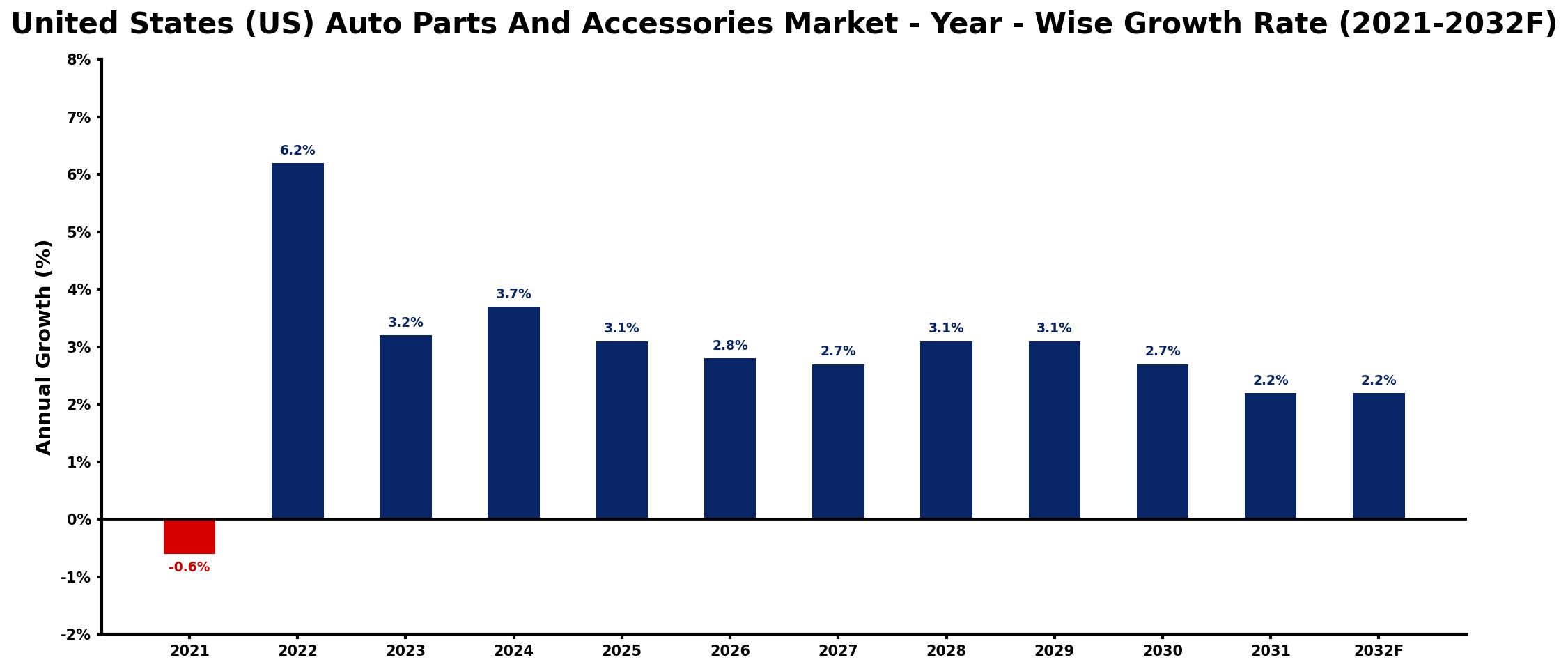
The table below presents the year‑wise growth rates along with the key drivers influencing the market
| Year | Growth Rate | Major Drivers |
| 2021 | -0.6% | decreased consumer spending on vehicles |
| 2022 | 6.2% | increased demand for electric vehicles |
| 2023 | 3.2% | growing popularity of online shopping |
| 2024 | 3.7% | rising investment in technology |
| 2025 | 3.1% | expanding vehicle maintenance services |
| 2026 | 2.8% | higher demand for customization options |
| 2027 | 2.7% | increased focus on sustainability practices |
| 2028 | 3.1% | strengthening underlying market demand |
| 2029 | 3.1% | increased use of advanced materials |
| 2030 | 2.7% | rising trend of vehicle ownership |
| 2031 | 2.2% | growing emerging market penetration |
| 2032 | 2.2% | growing influence of digital platforms |
Note: Market size estimations and growth projections presented in this report are based on 6Wresearch's proprietary forecasting methodology, utilizing the latest available industry data, government publications, and primary research inputs.
United States (US) Auto Parts And Accessories Market Synopsis
In the United States, the auto parts and accessories market is characterized by a diverse range of products, catering to both essential maintenance needs and aftermarket enhancements. Consumers are increasingly seeking high-quality engine parts, performance upgrades, and aesthetically pleasing accessories that reflect their personal style.
As the average age of vehicles on the road rises, the demand for replacement parts continues to expand, prompting consumers to invest in high-quality auto accessories. The growing adoption of e-commerce has transformed the buying experience, providing easy access to a wide variety of products and competitive pricing, further fueling market growth.
United States (US) Auto Parts And Accessories Market Key Takeaways
- The market is driven by increasing vehicle sales and a growing appetite for customization.
- Technological advancements in automotive parts enhance performance and safety, boosting consumer interest.
- E-commerce channels significantly impact purchasing behavior, offering convenience and price comparison.
- Environmental consciousness is shaping product offerings, with a rising demand for sustainable auto parts.
- The shift towards electric vehicles introduces new opportunities for innovative parts and accessories.
Evaluation of Restraints in United States (US) Auto Parts And Accessories Market
Despite the market's growth prospects, several factors pose challenges. Increased competition from online retailers has intensified pricing pressures on traditional brick-and-mortar stores, forcing them to adapt rapidly. Moreover, evolving consumer preferences toward eco-friendly products demand significant investments in sustainable practices and technologies, which may strain resources for some companies. Fluctuations in raw material prices and supply chain disruptions further complicate inventory management, necessitating strategic planning and adaptability within the market.
United States (US) Auto Parts And Accessories Market Trends
Several trends are currently shaping the US auto parts and accessories market. The increasing demand for electric vehicle (EV) components reflects the growing popularity of sustainable transportation options, leading to a surge in EV-related parts such as charging stations and specialized batteries. Additionally, the convenience of online shopping is driving consumers to seek out e-commerce platforms for their auto parts needs. Furthermore, the desire for vehicle personalization is gaining traction, as consumers are eager to invest in unique aftermarket products that reflect their individuality and enhance their driving experience.
United States (US) Auto Parts And Accessories Market Opportunities
The United States auto parts and accessories market presents numerous investment opportunities. With the ongoing trend of increasing vehicle longevity, companies focusing on replacement parts stand to benefit significantly. Additionally, the rise of electric vehicles opens avenues for innovation in specialized EV parts and accessories. Investments in connected car technologies, sustainable materials, and digital retail platforms are poised to provide competitive advantages as the market evolves and adapts to new consumer demands.
Government Initiatives in the United States (US) Auto Parts And Accessories Market
The landscape of the US auto parts and accessories market is influenced by a range of government policies aimed at ensuring consumer safety and environmental standards. The National Highway Traffic Safety Administration (NHTSA) establishes regulations for vehicle safety that directly impact auto parts manufacturing and design. Meanwhile, the Environmental Protection Agency (EPA) enforces emissions standards, prompting the development of eco-friendly automotive components. Trade policies and regulations on imports also shape competitive dynamics within the market, affecting both local manufacturers and international suppliers.
Future Insights of the United States (US) Auto Parts And Accessories Market
Looking ahead to the 2026-2032 period, the US auto parts and accessories market is poised for steady growth. Consumer preferences for vehicle customization and the increasing age of existing vehicles will continue to drive demand. Moreover, the proliferation of electric vehicles, along with advancements in technology, will create fresh opportunities for innovative products. While challenges such as supply chain issues and material cost fluctuations may arise, the overall market outlook remains optimistic, as evolving trends favor technological integration and sustainable practices.
United States (US) Auto Parts And Accessories Market Latest Developments (2025 - 2026)
Recent developments in the US auto parts and accessories market indicate a strong pivot towards sustainability and technological innovation. Many companies are investing in eco-friendly materials and processes, reflecting growing consumer demand for greener options. Additionally, advancements in vehicle connectivity and performance technologies are influencing product design and offerings, while the shift towards e-commerce continues to reshape the landscape of how consumers purchase auto parts.
United States (US) Auto Parts And Accessories Market - Key Attractiveness of the Report
- 10 Years of Market Numbers
- Historical Data Starting from 2022 to 2025
- Base Year: 2025
- Forecast Data until 2032
- Key Performance Indicators Impacting the Market
- Major Upcoming Developments and Projects
Key Highlights of the Report:
- United States (US) Auto Parts And Accessories Market Outlook
- Market Size of United States (US) Auto Parts And Accessories Market, 2025
- Forecast of United States (US) Auto Parts And Accessories Market, 2032
- Historical Data and Forecast of United States (US) Auto Parts And Accessories Revenues & Volume for the Period 2022-2032F
- United States (US) Auto Parts And Accessories Market Trend Evolution
- United States (US) Auto Parts And Accessories Market Drivers and Challenges
- United States (US) Auto Parts And Accessories Price Trends
- United States (US) Auto Parts And Accessories Porter's Five Forces
- United States (US) Auto Parts And Accessories Industry Life Cycle
- Historical Data and Forecast of United States (US) Auto Parts And Accessories Market Revenues & Volume By Product for the Period 2022-2032F
- Historical Data and Forecast of United States (US) Auto Parts And Accessories Market Revenues & Volume By Driveline & Powertrain for the Period 2022-2032F
- Historical Data and Forecast of United States (US) Auto Parts And Accessories Market Revenues & Volume By Interiors & Exteriors for the Period 2022-2032F
- Historical Data and Forecast of United States (US) Auto Parts And Accessories Market Revenues & Volume By Electronics for the Period 2022-2032F
- Historical Data and Forecast of United States (US) Auto Parts And Accessories Market Revenues & Volume By Bodies & Chassis for the Period 2022-2032F
- Historical Data and Forecast of United States (US) Auto Parts And Accessories Market Revenues & Volume By Wheel & Tires for the Period 2022-2032F
- Historical Data and Forecast of United States (US) Auto Parts And Accessories Market Revenues & Volume By Others for the Period 2022-2032F
- Historical Data and Forecast of United States (US) Auto Parts And Accessories Market Revenues & Volume By Application for the Period 2022-2032F
- Historical Data and Forecast of United States (US) Auto Parts And Accessories Market Revenues & Volume By OEMs for the Period 2022-2032F
- Historical Data and Forecast of United States (US) Auto Parts And Accessories Market Revenues & Volume By Aftermarket for the Period 2022-2032F
- United States (US) Auto Parts And Accessories Import Export Trade Statistics
- Market Opportunity Assessment By Product
- Market Opportunity Assessment By Application
- United States (US) Auto Parts And Accessories Top Companies Market Share
- United States (US) Auto Parts And Accessories Competitive Benchmarking By Technical and Operational Parameters
- United States (US) Auto Parts And Accessories Company Profiles
- United States (US) Auto Parts And Accessories Key Strategic Recommendations






































