Brazil Auto Parts And Accessories Market Size, Share & Growth Rate
The Brazil Auto Parts And Accessories Market was estimated at USD 229 Million in 2025 and is projected to reach USD 273 Million by 2032, growing at a CAGR of 2.5% from 2026 to 2032. This growth trajectory is primarily driven by the robust automotive manufacturing sector in Brazil, which is one of the largest globally. As vehicle ownership continues to rise, consumers increasingly seek to personalize their vehicles, fueling demand for various auto parts and accessories such as performance upgrades and interior enhancements.
Brazil Auto Parts And Accessories Market Year-wise Growth Rate and Key Drivers
This graph highlights how the Brazil Auto Parts And Accessories Market has steadily grown over the years, supported by major growth factors.
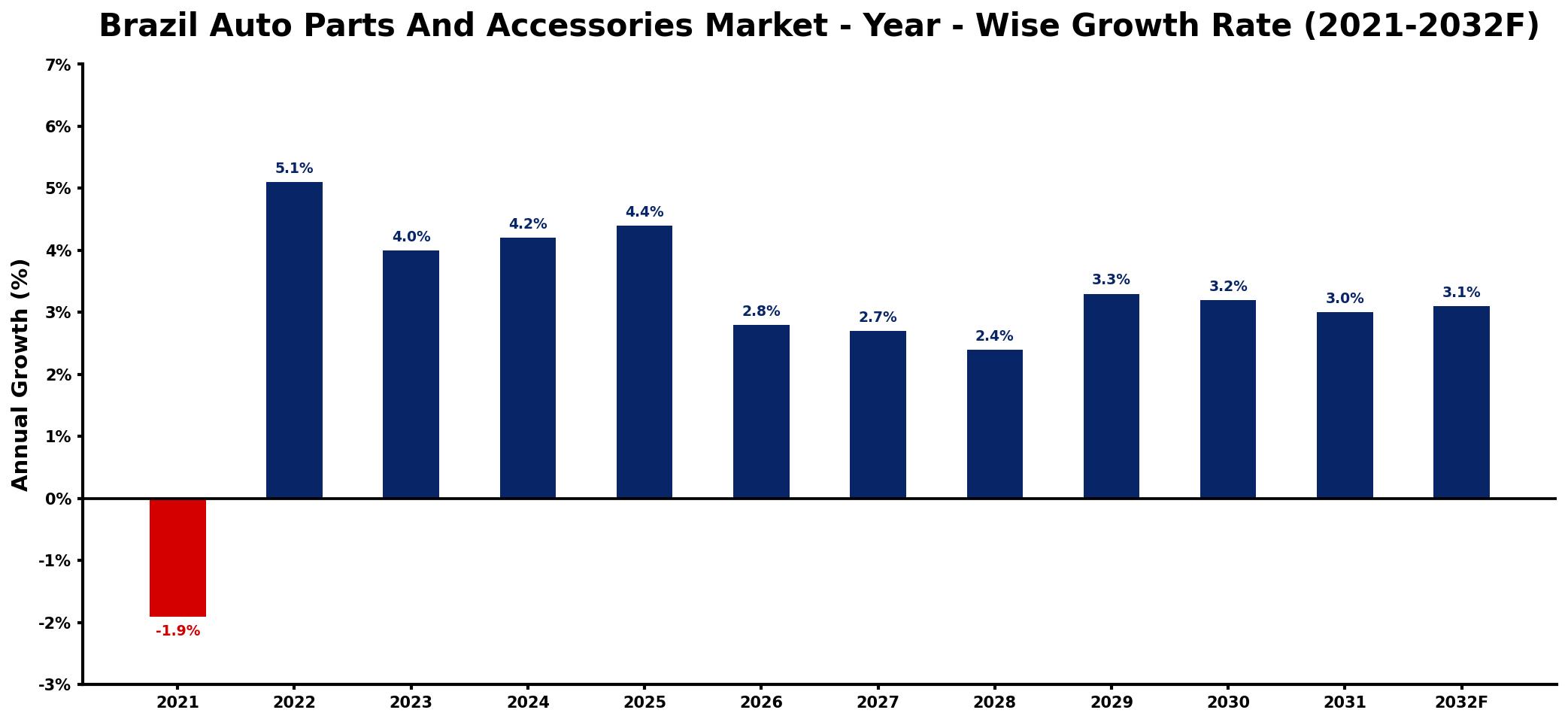
The table below presents the year‑wise growth rates along with the key drivers influencing the market
| Year | Growth Rate | Major Drivers |
| 2021 | -1.9% | Supply chain disruptions impact production |
| 2022 | 5.1% | Rising consumer demand for vehicles |
| 2023 | 4.0% | Technological advancements drive innovation |
| 2024 | 4.2% | Increased investment in infrastructure projects |
| 2025 | 4.4% | Growing popularity of electric vehicles |
| 2026 | 2.8% | Expansion of e-commerce sales channels |
| 2027 | 2.7% | Strengthening of local manufacturing capabilities |
| 2028 | 2.4% | Surge in vehicle ownership rates |
| 2029 | 3.3% | Enhanced focus on sustainability practices |
| 2030 | 3.2% | Development of smart transportation solutions |
| 2031 | 3.0% | Rising disposable income among consumers |
| 2032 | 3.1% | Growing demand for aftermarket services |
Note: Market size estimations and growth projections presented in this report are based on 6Wresearch's proprietary forecasting methodology, utilizing the latest available industry data, government publications, and primary research inputs.
Brazil Auto Parts And Accessories Market Synopsis
A significant force shaping the Brazil Auto Parts and Accessories Market is the growing trend of vehicle personalization. As consumers desire unique modifications and enhancements, the market is witnessing an expansion in offerings, ranging from cosmetic upgrades to advanced performance parts. This trend presents ample opportunities for suppliers aiming to cater to an increasingly diverse consumer base.
Additionally, safety and sustainability are becoming critical considerations in consumer purchasing decisions. The emphasis on these aspects is driving demand for innovative and environmentally friendly auto parts. Manufacturers who can integrate technology with sustainability stand to gain a competitive edge in this evolving landscape.
Brazil Auto Parts And Accessories Market Key Takeaways
- The market is driven by rising vehicle ownership and an increasing appetite for vehicle customization.
- Safety and environmental sustainability are becoming pivotal in shaping consumer choices.
- Opportunities for innovation abound, particularly in eco-friendly and high-performance products.
- Government incentives are fostering a favorable environment for domestic production and investment.
- Supply chain efficiencies are crucial for maintaining competitiveness amidst global disruptions.
Evaluation of Restraints in Brazil Auto Parts And Accessories Market
Despite the promising outlook, the Brazil Auto Parts and Accessories Market faces several restraints. Supply chain disruptions, particularly those stemming from global events, can lead to delays and increased costs of auto parts. Furthermore, the fierce competition in the market requires manufacturers to continuously innovate and streamline production processes, which can be a daunting task. Additionally, fluctuations in raw material prices may further exacerbate these challenges, impacting profit margins across the industry.
Brazil Auto Parts And Accessories Market Trends
The market is currently witnessing several key trends that are shaping demand. The rise of electric vehicles (EVs) is leading to a shift in the types of auto parts that are in demand, with a growing interest in components that enhance battery life and energy efficiency. Additionally, technological advancements such as IoT integration in auto parts for enhanced functionality and diagnostics are becoming increasingly popular.
Moreover, the customization trend is leading to a surge in aftermarket enhancements, particularly among younger consumers who value unique aesthetics and performance. Retailers are increasingly focusing on digital platforms to reach this tech-savvy demographic, leveraging e-commerce strategies to cater to consumer needs.
Brazil Auto Parts And Accessories Market Opportunities
With the rise of electric and hybrid vehicles, there are substantial growth opportunities in the development of specific auto parts designed to improve energy efficiency and overall vehicle performance. Companies that can innovate and offer specialized components for these new vehicle types stand to benefit significantly. Additionally, the growing trend of online shopping presents a lucrative channel for businesses to expand their reach and enhance customer engagement.
Government Initiatives in the Brazil Auto Parts And Accessories Market
The Brazilian government is actively implementing policies to stimulate the auto parts and accessories market. Efforts are focused on enhancing domestic production capabilities through tax incentives and facilitating foreign investments. Programs aimed at improving supply chain efficiency and fostering innovation in automotive technologies are also in place. Such initiatives are crucial in bolstering the competitiveness of the Brazilian automotive sector and ensuring sustainable growth.
Future Insights of the Brazil Auto Parts And Accessories Market
Looking ahead to the period from 2026 to 2032, the Brazil Auto Parts and Accessories Market is positioned for steady growth driven by technological advancements and consumer preferences leaning towards sustainability. As the automotive landscape evolves, we expect to see a greater focus on enhancing vehicle efficiency and safety, with an emphasis on smart technologies. Manufacturers who invest in research and development to create innovative, eco-friendly products will likely lead the market in this promising future.
Brazil Auto Parts And Accessories Market Latest Developments (2025 - 2026)
In the latest industry developments, the Brazil Auto Parts and Accessories Market is seeing significant movements towards integrating advanced technologies into products. Companies are actively exploring partnerships and collaborations to enhance their offerings with smart features that cater to modern consumer expectations. Furthermore, there is an increasing shift towards online platforms for sales and distribution, enabling retailers to better engage with customers and streamline the buying process.
Brazil Auto Parts And Accessories Market - Key Attractiveness of the Report
- 10 Years of Market Numbers
- Historical Data Starting from 2022 to 2025
- Base Year: 2025
- Forecast Data until 2032
- Key Performance Indicators Impacting the Market
- Major Upcoming Developments and Projects
Key Highlights of the Report:
- Brazil Auto Parts And Accessories Market Outlook
- Market Size of Brazil Auto Parts And Accessories Market, 2025
- Forecast of Brazil Auto Parts And Accessories Market, 2032
- Historical Data and Forecast of Brazil Auto Parts And Accessories Revenues & Volume for the Period 2022-2032F
- Brazil Auto Parts And Accessories Market Trend Evolution
- Brazil Auto Parts And Accessories Market Drivers and Challenges
- Brazil Auto Parts And Accessories Price Trends
- Brazil Auto Parts And Accessories Porter's Five Forces
- Brazil Auto Parts And Accessories Industry Life Cycle
- Historical Data and Forecast of Brazil Auto Parts And Accessories Market Revenues & Volume By Product for the Period 2022-2032F
- Historical Data and Forecast of Brazil Auto Parts And Accessories Market Revenues & Volume By Driveline & Powertrain for the Period 2022-2032F
- Historical Data and Forecast of Brazil Auto Parts And Accessories Market Revenues & Volume By Interiors & Exteriors for the Period 2022-2032F
- Historical Data and Forecast of Brazil Auto Parts And Accessories Market Revenues & Volume By Electronics for the Period 2022-2032F
- Historical Data and Forecast of Brazil Auto Parts And Accessories Market Revenues & Volume By Bodies & Chassis for the Period 2022-2032F
- Historical Data and Forecast of Brazil Auto Parts And Accessories Market Revenues & Volume By Wheel & Tires for the Period 2022-2032F
- Historical Data and Forecast of Brazil Auto Parts And Accessories Market Revenues & Volume By Others for the Period 2022-2032F
- Historical Data and Forecast of Brazil Auto Parts And Accessories Market Revenues & Volume By Application for the Period 2022-2032F
- Historical Data and Forecast of Brazil Auto Parts And Accessories Market Revenues & Volume By OEMs for the Period 2022-2032F
- Historical Data and Forecast of Brazil Auto Parts And Accessories Market Revenues & Volume By Aftermarket for the Period 2022-2032F
- Brazil Auto Parts And Accessories Import Export Trade Statistics
- Market Opportunity Assessment By Product
- Market Opportunity Assessment By Application
- Brazil Auto Parts And Accessories Top Companies Market Share
- Brazil Auto Parts And Accessories Competitive Benchmarking By Technical and Operational Parameters
- Brazil Auto Parts And Accessories Company Profiles
- Brazil Auto Parts And Accessories Key Strategic Recommendations






































