Mexico Auto Parts And Accessories Market Size, Share & Growth Rate
The Mexico Auto Parts And Accessories Market was estimated at USD 240 Million in 2025 and is projected to reach USD 279 Million by 2032, growing at a CAGR of 2.2% from 2026 to 2032. This growth is primarily driven by the increasing vehicle production rates in the region, alongside a rising consumer demand for aftermarket products and components. As the automotive sector continues to expand, innovations and technological advancements further solidify Mexico's standing as a key player in the global auto parts industry.
Mexico Auto Parts And Accessories Market Year-wise Growth Rate and Key Drivers
This graph highlights how the Mexico Auto Parts And Accessories Market has steadily grown over the years, supported by major growth factors.
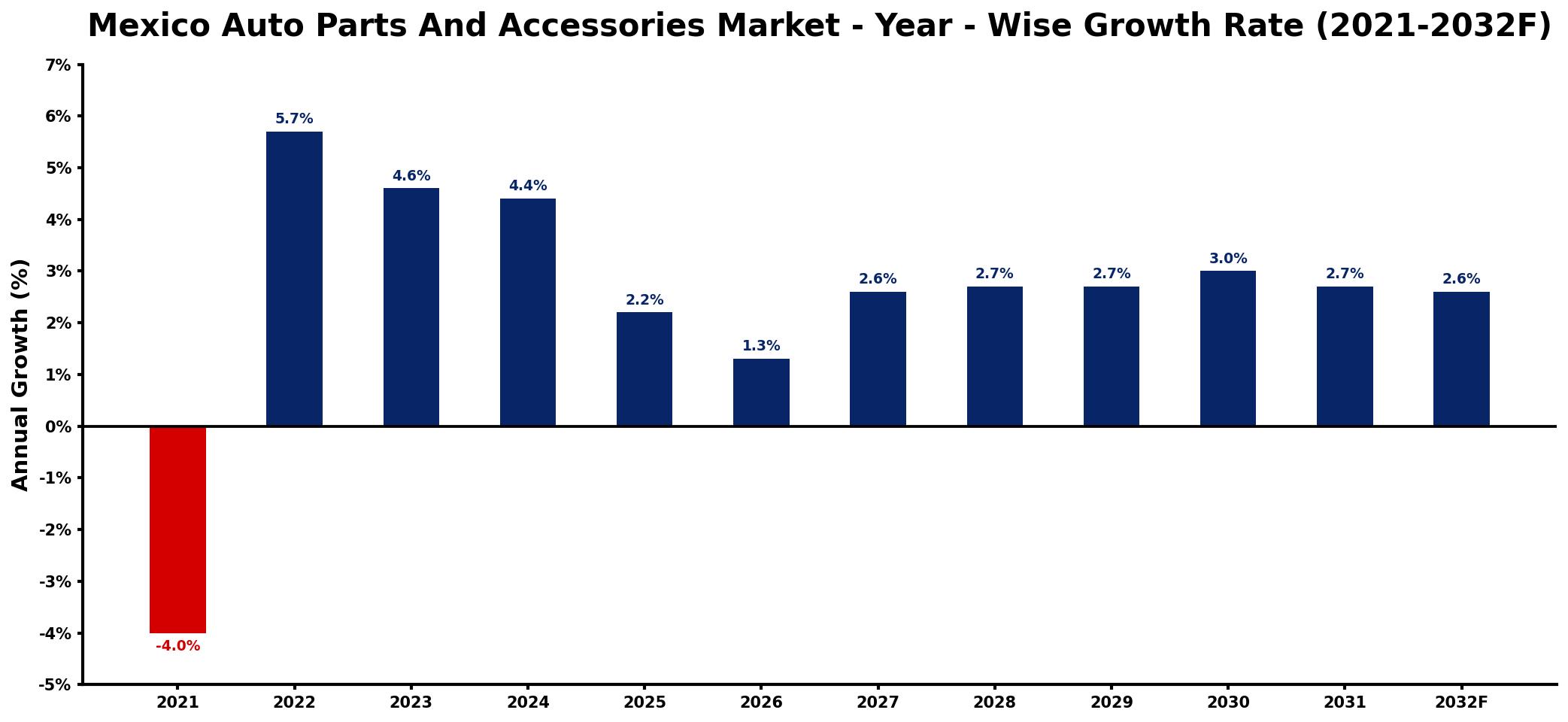
The table below presents the year‑wise growth rates along with the key drivers influencing the market
| Year | Growth Rate | Major Drivers |
| 2021 | -4.0% | supply chain disruptions impact production |
| 2022 | 5.7% | increased consumer spending on vehicles |
| 2023 | 4.6% | growing electric vehicle adoption trends |
| 2024 | 4.4% | expansion of online retail platforms |
| 2025 | 2.2% | rising demand for sustainable solutions |
| 2026 | 1.3% | investments in manufacturing technologies rise |
| 2027 | 2.6% | enhanced vehicle safety regulations implemented |
| 2028 | 2.7% | growing interest in vehicle customization |
| 2029 | 2.7% | increased focus on fuel efficiency |
| 2030 | 3.0% | increased capital investment inflows |
| 2031 | 2.7% | rising export shipment volumes |
| 2032 | 2.6% | rising popularity of shared transportation |
Note: Market size estimations and growth projections presented in this report are based on 6Wresearch's proprietary forecasting methodology, utilizing the latest available industry data, government publications, and primary research inputs.
Mexico Auto Parts And Accessories Market Synopsis
The market is experiencing a noteworthy shift towards electric vehicle (EV) components and accessories, in line with Mexico's commitment to sustainable transportation solutions. This transition opens new avenues for both manufacturers and suppliers, stimulating an active demand for specialized products tailored to emerging automotive technologies.
Moreover, a growing trend towards customization in vehicle accessories has emerged, as consumers seek unique enhancements for their automobiles. This demand for personalization propels the need for a diverse range of aftermarket products, ensuring that the Mexico Auto Parts and Accessories Market remains vibrant and competitive.
Mexico Auto Parts And Accessories Market Key Takeaways
- The market is on a stable growth trajectory, supported by increasing vehicle production and consumer interest in aftermarket parts.
- Technological advancements, particularly in EV and smart automotive solutions, are reshaping the competitive landscape.
- Growing demand for customization in vehicles presents significant opportunities for aftermarket product innovation.
- Mexico's favorable trade agreements enhance its attractiveness for foreign investments in the auto parts sector.
- Environmental regulations are driving manufacturers to focus on sustainability and compliance within the automotive industry.
Evaluation of Restraints in Mexico Auto Parts And Accessories Market
Despite its growth prospects, the Mexico Auto Parts and Accessories Market contends with several restraints. Intense competition from both local and international manufacturers often leads to pricing pressures, potentially eroding profit margins for many companies. Additionally, fluctuations in currency exchange rates can impact the cost of imported components, creating financial uncertainty. Compliance with varying regional regulations also poses challenges, requiring market players to navigate complex legislative landscapes while striving to remain competitive. A focus on continuous innovation and investment in research and development is essential for companies aiming to address these obstacles effectively.
Mexico Auto Parts And Accessories Market Trends
Several key trends are emerging in the Mexico Auto Parts and Accessories Market. The increasing adoption of electric vehicles is a significant driver, leading to rising demand for specialized components aimed at reducing emissions. Furthermore, the integration of advanced technologies, such as telematics and connected car solutions, is reshaping consumer preferences. The rise of e-commerce platforms has also significantly impacted purchasing habits, with a notable shift towards online procurement of auto parts and accessories. This evolution is complemented by consumer desires for personalization, resulting in a burgeoning market for bespoke automotive products.
Mexico Auto Parts And Accessories Market Opportunities
The Mexico Auto Parts and Accessories Market offers numerous investment opportunities driven by the nations robust automotive sector. Establishing manufacturing facilities for auto parts can be a sound investment, leveraging competitive labor costs and efficient supply chain infrastructures. Additionally, the growing consumer inclination for vehicle enhancement and personalization is creating a fertile ground for high-quality aftermarket products. With Mexico's focus on modernizing its automotive landscape, investments in innovative technologies, particularly in electric vehicle components and connected car devices, hold significant promise for substantial returns.
Government Initiatives in the Mexico Auto Parts And Accessories Market
The Mexican government is actively fostering the growth of the auto parts and accessories market through various initiatives. Policies promoting local production and foreign investments are implemented under programs like the Mexico Automotive Sector Promotion Program (PROAUTO). Trade agreements, such as the USMCA, have been established to facilitate favorable trading conditions for automotive products among Mexico, the United States, and Canada. Additionally, there is a strong governmental emphasis on sustainability, which encourages companies to innovate and comply with environmental regulations, thus creating an attractive landscape for both domestic and international players.
Future Insights of the Mexico Auto Parts And Accessories Market
Looking ahead to the 2026-2032 period, the Mexico Auto Parts and Accessories Market is expected to see steady growth propelled by a combination of rising vehicle production and increasing disposable incomes. The expansion of the automotive industry, fueled by both domestic consumption and export opportunities, is anticipated to provide a solid foundation for market growth. Furthermore, advancements in technology—particularly in electric and autonomous vehicles—are likely to open new avenues for auto parts manufacturers and suppliers, positioning the market favorably for future innovations and developments.
Mexico Auto Parts And Accessories Market Latest Developments (2025 - 2026)
In recent months, the Mexico Auto Parts and Accessories Market has witnessed a flurry of activity as industry players adapt to evolving consumer preferences and technological advancements. The focus on electric vehicle infrastructure has intensified, with several companies exploring new partnerships to develop EV components. The rise of e-commerce continues to transform retail dynamics, prompting traditional manufacturers to enhance their online presence and distribution strategies. Overall, the market is navigating a rapidly changing landscape, paving the way for innovative solutions and competitive differentiation.
Mexico Auto Parts And Accessories Market - Key Attractiveness of the Report
- 10 Years of Market Numbers
- Historical Data Starting from 2022 to 2025
- Base Year: 2025
- Forecast Data until 2032
- Key Performance Indicators Impacting the Market
- Major Upcoming Developments and Projects
Key Highlights of the Report:
- Mexico Auto Parts And Accessories Market Outlook
- Market Size of Mexico Auto Parts And Accessories Market, 2025
- Forecast of Mexico Auto Parts And Accessories Market, 2032
- Historical Data and Forecast of Mexico Auto Parts And Accessories Revenues & Volume for the Period 2022-2032F
- Mexico Auto Parts And Accessories Market Trend Evolution
- Mexico Auto Parts And Accessories Market Drivers and Challenges
- Mexico Auto Parts And Accessories Price Trends
- Mexico Auto Parts And Accessories Porter's Five Forces
- Mexico Auto Parts And Accessories Industry Life Cycle
- Historical Data and Forecast of Mexico Auto Parts And Accessories Market Revenues & Volume By Product for the Period 2022-2032F
- Historical Data and Forecast of Mexico Auto Parts And Accessories Market Revenues & Volume By Driveline & Powertrain for the Period 2022-2032F
- Historical Data and Forecast of Mexico Auto Parts And Accessories Market Revenues & Volume By Interiors & Exteriors for the Period 2022-2032F
- Historical Data and Forecast of Mexico Auto Parts And Accessories Market Revenues & Volume By Electronics for the Period 2022-2032F
- Historical Data and Forecast of Mexico Auto Parts And Accessories Market Revenues & Volume By Bodies & Chassis for the Period 2022-2032F
- Historical Data and Forecast of Mexico Auto Parts And Accessories Market Revenues & Volume By Wheel & Tires for the Period 2022-2032F
- Historical Data and Forecast of Mexico Auto Parts And Accessories Market Revenues & Volume By Others for the Period 2022-2032F
- Historical Data and Forecast of Mexico Auto Parts And Accessories Market Revenues & Volume By Application for the Period 2022-2032F
- Historical Data and Forecast of Mexico Auto Parts And Accessories Market Revenues & Volume By OEMs for the Period 2022-2032F
- Historical Data and Forecast of Mexico Auto Parts And Accessories Market Revenues & Volume By Aftermarket for the Period 2022-2032F
- Mexico Auto Parts And Accessories Import Export Trade Statistics
- Market Opportunity Assessment By Product
- Market Opportunity Assessment By Application
- Mexico Auto Parts And Accessories Top Companies Market Share
- Mexico Auto Parts And Accessories Competitive Benchmarking By Technical and Operational Parameters
- Mexico Auto Parts And Accessories Company Profiles
- Mexico Auto Parts And Accessories Key Strategic Recommendations






































