Venezuela Auto Parts And Accessories Market Size, Share & Growth Rate
The Venezuela Auto Parts And Accessories Market was estimated at USD 1150 Million in 2025 and is projected to reach USD 1644 Million by 2032, growing at a CAGR of 5.2% from 2026 to 2032. This growth trajectory is largely fueled by the increasing demand for cost-effective aftermarket parts as consumers prioritize vehicle maintenance over new purchases amid economic difficulties. Additionally, the rise of online shopping platforms has facilitated greater access to a wider array of affordable auto parts, aligning with consumer preferences for convenience and value.
Venezuela Auto Parts And Accessories Market Year-wise Growth Rate and Key Drivers
This graph highlights how the Venezuela Auto Parts And Accessories Market has steadily grown over the years, supported by major growth factors.
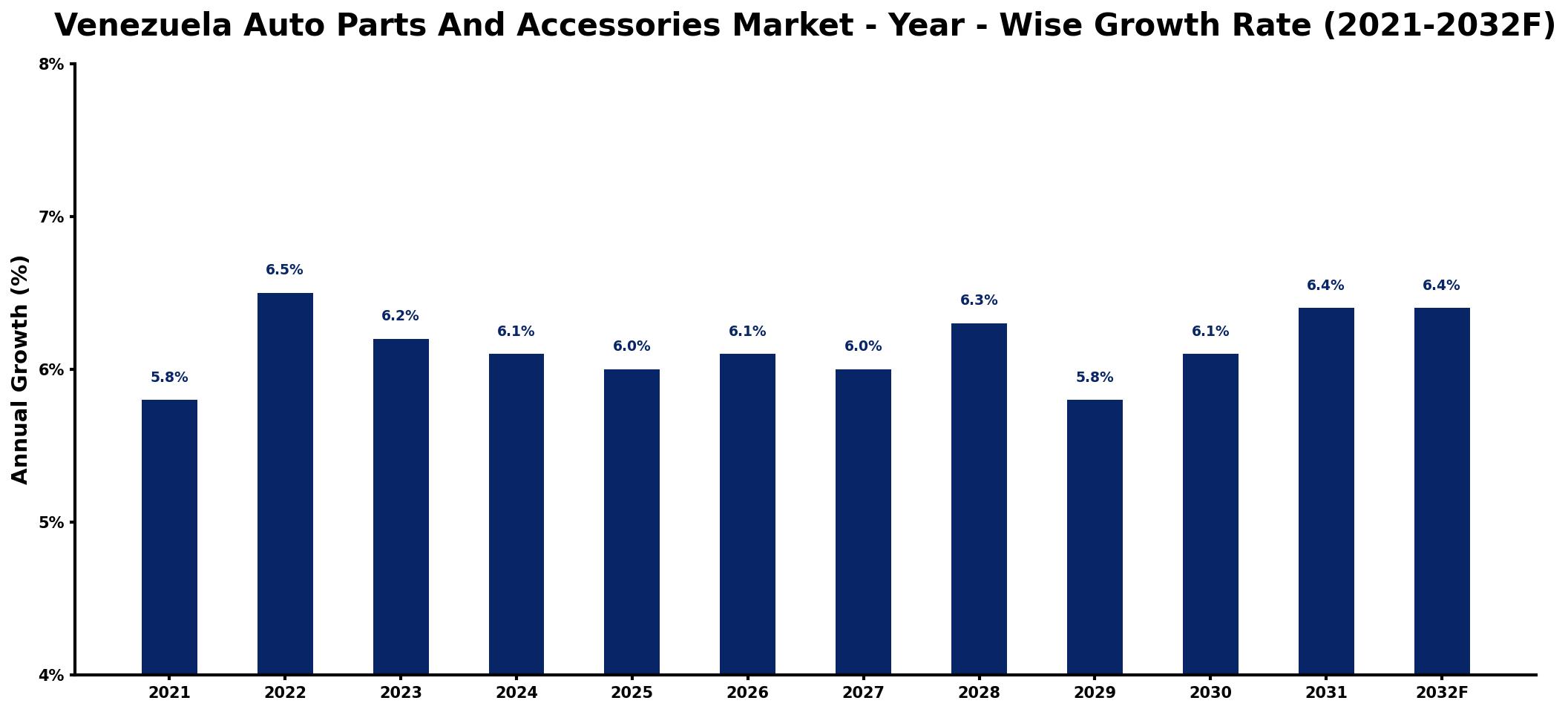
The table below presents the year‑wise growth rates along with the key drivers influencing the market
| Year | Growth Rate | Major Drivers |
| 2021 | 5.8% | Rising demand from transportation sector |
| 2022 | 6.5% | Increased investments in infrastructure projects |
| 2023 | 6.2% | Growing popularity of electric vehicles |
| 2024 | 6.1% | Expansion of local manufacturing capabilities |
| 2025 | 6.0% | Strengthening of supply chain networks |
| 2026 | 6.1% | rising export shipment volumes |
| 2027 | 6.0% | Surge in vehicle ownership rates |
| 2028 | 6.3% | Technological advancements in vehicle systems |
| 2029 | 5.8% | Enhanced government support initiatives |
| 2030 | 6.1% | Growing consumer preference for quality |
| 2031 | 6.4% | Increased focus on sustainability practices |
| 2032 | 6.4% | improved raw material availability |
Note: Market size estimations and growth projections presented in this report are based on 6Wresearch's proprietary forecasting methodology, utilizing the latest available industry data, government publications, and primary research inputs.
Venezuela Auto Parts And Accessories Market Synopsis
The current landscape of the Venezuela auto parts and accessories market reflects a complex interplay of constraints and evolving consumer behavior. While the economic crisis has significantly hindered new vehicle sales, it has simultaneously spurred a surge in demand for affordable replacement parts, leading to a more vibrant aftermarket sector.
Looking ahead, the market faces uncertainty due to persistent economic instability and regulatory challenges. However, opportunities exist for agile businesses to adapt to these conditions, particularly by catering to the needs of consumers who are increasingly reliant on their existing vehicles.
Venezuela Auto Parts And Accessories Market Key Takeaways
- Demand for affordable aftermarket auto parts is on the rise as consumers prioritize vehicle maintenance over new purchases.
- Online retail channels are gaining traction, enhancing accessibility and product variety for consumers.
- The aging vehicle fleet presents opportunities for the growth of the aftermarket segment.
- Economic instability and government regulations continue to pose challenges for market players.
- Investment potential exists through partnerships and technological advancements tailored to the Venezuelan market.
Evaluation of Restraints in Venezuela Auto Parts And Accessories Market
The Venezuela auto parts and accessories market is heavily constrained by economic instability, which reduces consumer purchasing power and thus impacts demand. High inflation rates and fluctuations in currency further complicate the ability of businesses to import essential goods, leading to increased costs and supply chain disruptions. Additionally, stringent government regulations and import restrictions limit the availability of quality foreign products, hindering overall market competitiveness.
Venezuela Auto Parts And Accessories Market Trends
A notable trend in the Venezuela auto parts and accessories market is the growing preference for non-OEM products, as consumers seek value without compromising on quality. Furthermore, the shift towards digital channels for purchasing auto parts is transforming the retail landscape, enabling more efficient access to a diverse product range. Concurrently, awareness of counterfeit products poses challenges, prompting both consumers and businesses to prioritize authenticity and reliability.
Venezuela Auto Parts And Accessories Market Opportunities
Significant opportunities lie in the aftermarket segment, driven by an aging vehicle fleet and rising vehicle ownership rates. Investors can explore partnerships with local distributors to effectively penetrate the market and address consumer demand. Additionally, modernization efforts within the sector offer prospects for technological innovations and advancements, making them attractive areas for investment. A nuanced understanding of the local landscape will be essential for capitalizing on these opportunities.
Government Initiatives in the Venezuela Auto Parts And Accessories Market
Government policies impacting the Venezuela auto parts and accessories market include stringent import regulations and high tariffs designed to protect local industries. Efforts to promote domestic production, while aiming to stabilize the economy, have constrained the availability of foreign products, making it challenging for consumers to access quality auto parts. Navigating these policies will be critical for stakeholders looking to succeed in this complex environment.
Future Insights of the Venezuela Auto Parts And Accessories Market
The outlook for the Venezuela auto parts and accessories market remains cautious, largely dependent on the resolution of ongoing economic and political instability. As inflation and currency volatility persist, the market is expected to face continued pressures, hindering robust recovery. However, adapting to cost-effective solutions and fostering strategic partnerships will be vital for businesses aiming to thrive. A gradual recovery is anticipated, contingent on successful economic reforms and improved market conditions.
Venezuela Auto Parts And Accessories Market Latest Developments (2025 - 2026)
In recent months, the Venezuela auto parts and accessories market has shown tentative signs of growth, driven by consumer shifts towards more affordable maintenance solutions. The rise of online retail has been notable, with more businesses establishing digital platforms to meet the demands of tech-savvy consumers. At the same time, efforts to combat counterfeit products have gained momentum, with stakeholders focusing on improving product authenticity and consumer education.
Venezuela Auto Parts And Accessories Market - Key Attractiveness of the Report
- 10 Years of Market Numbers
- Historical Data Starting from 2022 to 2025
- Base Year: 2025
- Forecast Data until 2032
- Key Performance Indicators Impacting the Market
- Major Upcoming Developments and Projects
Key Highlights of the Report:
- Venezuela Auto Parts And Accessories Market Outlook
- Market Size of Venezuela Auto Parts And Accessories Market, 2025
- Forecast of Venezuela Auto Parts And Accessories Market, 2032
- Historical Data and Forecast of Venezuela Auto Parts And Accessories Revenues & Volume for the Period 2022-2032F
- Venezuela Auto Parts And Accessories Market Trend Evolution
- Venezuela Auto Parts And Accessories Market Drivers and Challenges
- Venezuela Auto Parts And Accessories Price Trends
- Venezuela Auto Parts And Accessories Porter's Five Forces
- Venezuela Auto Parts And Accessories Industry Life Cycle
- Historical Data and Forecast of Venezuela Auto Parts And Accessories Market Revenues & Volume By Product for the Period 2022-2032F
- Historical Data and Forecast of Venezuela Auto Parts And Accessories Market Revenues & Volume By Driveline & Powertrain for the Period 2022-2032F
- Historical Data and Forecast of Venezuela Auto Parts And Accessories Market Revenues & Volume By Interiors & Exteriors for the Period 2022-2032F
- Historical Data and Forecast of Venezuela Auto Parts And Accessories Market Revenues & Volume By Electronics for the Period 2022-2032F
- Historical Data and Forecast of Venezuela Auto Parts And Accessories Market Revenues & Volume By Bodies & Chassis for the Period 2022-2032F
- Historical Data and Forecast of Venezuela Auto Parts And Accessories Market Revenues & Volume By Wheel & Tires for the Period 2022-2032F
- Historical Data and Forecast of Venezuela Auto Parts And Accessories Market Revenues & Volume By Others for the Period 2022-2032F
- Historical Data and Forecast of Venezuela Auto Parts And Accessories Market Revenues & Volume By Application for the Period 2022-2032F
- Historical Data and Forecast of Venezuela Auto Parts And Accessories Market Revenues & Volume By OEMs for the Period 2022-2032F
- Historical Data and Forecast of Venezuela Auto Parts And Accessories Market Revenues & Volume By Aftermarket for the Period 2022-2032F
- Venezuela Auto Parts And Accessories Import Export Trade Statistics
- Market Opportunity Assessment By Product
- Market Opportunity Assessment By Application
- Venezuela Auto Parts And Accessories Top Companies Market Share
- Venezuela Auto Parts And Accessories Competitive Benchmarking By Technical and Operational Parameters
- Venezuela Auto Parts And Accessories Company Profiles
- Venezuela Auto Parts And Accessories Key Strategic Recommendations






































