Kuwait Auto Parts And Accessories Market Size, Share & Growth Rate
The Kuwait Auto Parts And Accessories Market was estimated at USD 614 Million in 2025 and is projected to reach USD 1035 Million by 2032, growing at a CAGR of 7.7% from 2026 to 2032. This impressive trajectory is primarily fueled by a soaring vehicle ownership rate and an increasing demand for both maintenance and customization services. As the automotive industry expands in Kuwait, consumers are seeking innovative, high-quality products to enhance vehicle performance and longevity.
Kuwait Auto Parts And Accessories Market Year-wise Growth Rate and Key Drivers
This graph highlights how the Kuwait Auto Parts And Accessories Market has steadily grown over the years, supported by major growth factors.
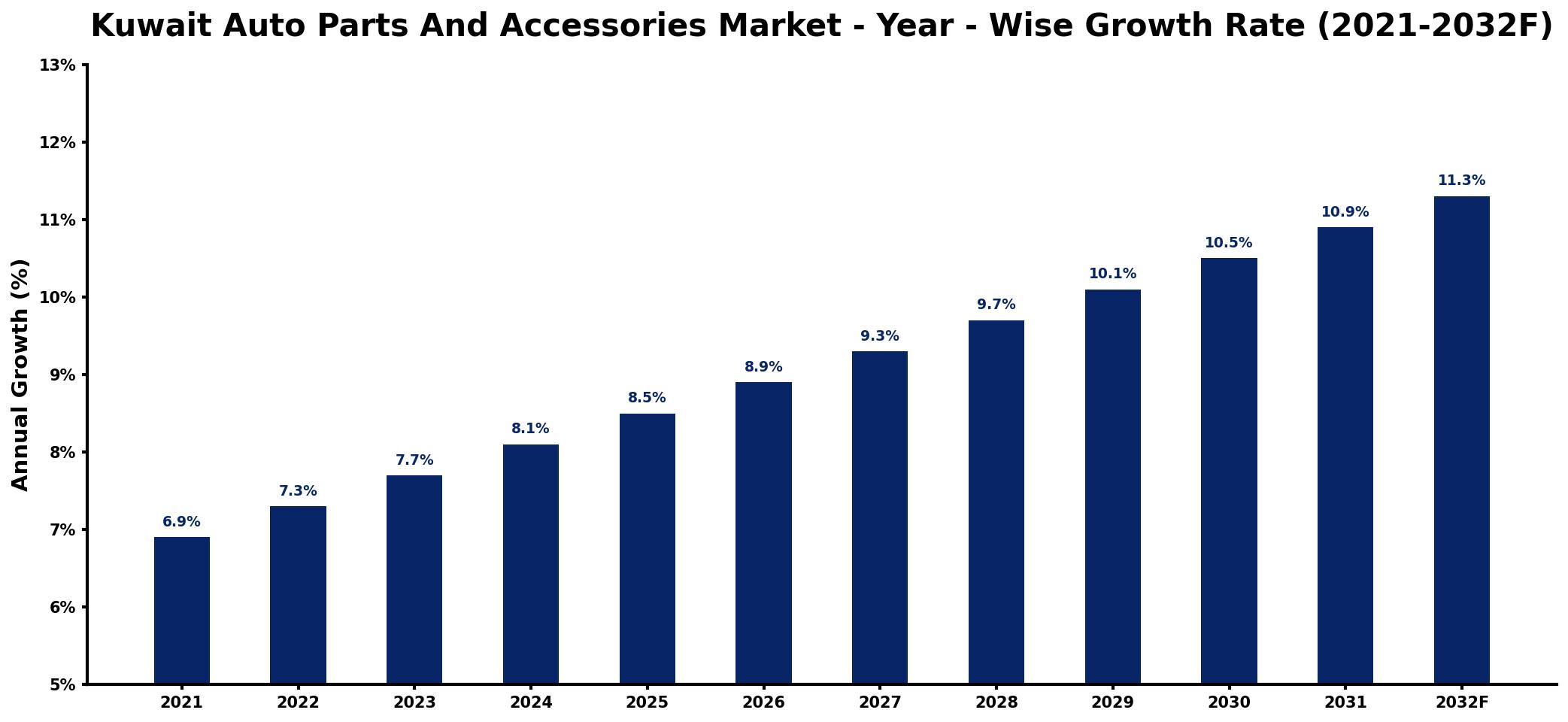
The table below presents the year‑wise growth rates along with the key drivers influencing the market
| Year | Growth Rate | Major Drivers |
| 2021 | 6.9% | Rising consumer vehicle ownership |
| 2022 | 7.3% | Increased urbanization driving demand |
| 2023 | 7.7% | Growth in e-commerce platforms |
| 2024 | 8.1% | Expansion of local manufacturing facilities |
| 2025 | 8.5% | Investment in renewable energy vehicles |
| 2026 | 8.9% | Technological advancements in vehicles |
| 2027 | 9.3% | Government incentives for modernization |
| 2028 | 9.7% | Surge in vehicle leasing options |
| 2029 | 10.1% | Growing interest in customization |
| 2030 | 10.5% | Rising disposable income levels |
| 2031 | 10.9% | Enhanced distribution network efficiencies |
| 2032 | 11.3% | Focus on sustainability initiatives |
Note: Market size estimations and growth projections presented in this report are based on 6Wresearch's proprietary forecasting methodology, utilizing the latest available industry data, government publications, and primary research inputs.
Kuwait Auto Parts And Accessories Market Synopsis
The Kuwait Auto Parts and Accessories Market is a dynamic and evolving sector, characterized by a diverse range of products including engine components, electrical parts, tires, and performance upgrades. Local and international manufacturers compete to offer consumers an extensive selection, fostering a robust retail environment that thrives on quality and variety.
With an increasing number of vehicles on the roads of Kuwait, the market for auto parts and accessories is witnessing a significant uplift. Demand is not just driven by repairs but is also significantly influenced by a consumer trend towards personalization and eco-consciousness, making it a fertile ground for innovation and quality enhancement.
Kuwait Auto Parts And Accessories Market Key Takeaways
- The market is projected to grow at a CAGR of 7.7%, reaching USD 1035 Million by 2032.
- Rising vehicle ownership and maintenance needs are key drivers of market growth.
- There is a noticeable shift towards e-commerce platforms for purchasing auto parts.
- Consumer preferences are leaning towards high-quality and genuine parts for improved vehicle performance.
- Government regulations play a crucial role in maintaining market integrity and consumer safety.
Evaluation of Restraints in Kuwait Auto Parts And Accessories Market
The Kuwait Auto Parts and Accessories Market faces several challenges that could hinder its growth. Counterfeit products pose a significant threat, undermining consumer trust and affecting overall vehicle safety. Limited availability of genuine parts can lead to delays in repair services, further frustrating consumers. Moreover, the lack of standardized regulations creates inconsistencies in product quality, leading to a challenging business environment for suppliers. Addressing these issues is crucial for fostering a more reliable marketplace.
Kuwait Auto Parts And Accessories Market Trends
The market is undergoing a transformation with a strong emphasis on online purchasing, allowing consumers easy access to a wide array of products. Additionally, eco-friendly and sustainable auto parts are becoming increasingly popular, driven by growing environmental awareness. The integration of advanced technology, such as smart diagnostics and connected car features, is also gaining traction, enhancing user experience and product reliability. Customization options are flourishing as consumers seek to tailor their vehicles to fit personal styles.
Kuwait Auto Parts And Accessories Market Opportunities
Significant investment opportunities lie in developing high-quality automotive components, particularly as the vehicle landscape in Kuwait evolves. The rising trend towards electric and hybrid vehicles opens new avenues for specialized parts production. Moreover, focusing on eco-friendly and sustainable product offerings aligns with current consumer preferences, positioning businesses favorably for future growth. Engaging in thorough market research to understand specific consumer needs will be critical for any investor looking to capitalize on these trends.
Government Initiatives in the Kuwait Auto Parts And Accessories Market
The Kuwaiti government has implemented various measures to ensure the safety and quality of auto parts in the market. Regulations governing the import and sale of auto parts are in place to safeguard consumers from counterfeit goods while promoting local manufacturing. Standards for the disposal of used parts reflect a commitment to environmental sustainability, and tariffs on imports aim to bolster domestic industry growth. These initiatives support market stability and protect consumer interests, ensuring a healthy competitive environment.
Future Insights of the Kuwait Auto Parts And Accessories Market
Looking ahead to 2026-2032, the Kuwait Auto Parts and Accessories Market is poised for steady growth fueled by increasing vehicle sales and rising disposable incomes. With the automotive industry expanding, there's a growing focus on vehicle maintenance and personalization that will bolster demand. The transition towards electric and hybrid vehicles is set to reshape market dynamics, necessitating specialized components and creating new opportunities for innovation. Overall, the market's future is bright, driven by quality, technology, and evolving consumer preferences.
Kuwait Auto Parts And Accessories Market Latest Developments (2025 - 2026)
Recently, the Kuwait Auto Parts and Accessories Market has shown a notable shift towards digital transformation, with several retailers enhancing their online platforms to facilitate e-commerce. There's an increased focus on partnerships with reputable suppliers to mitigate issues related to counterfeit products. Furthermore, as environmental concerns rise, manufacturers are beginning to introduce more sustainable product lines, aligning their offerings with current consumer expectations. This strategic direction not only addresses market challenges but also paves the way for enhanced competitiveness.
Kuwait Auto Parts And Accessories Market - Key Attractiveness of the Report
- 10 Years of Market Numbers
- Historical Data Starting from 2022 to 2025
- Base Year: 2025
- Forecast Data until 2032
- Key Performance Indicators Impacting the Market
- Major Upcoming Developments and Projects
Key Highlights of the Report:
- Kuwait Auto Parts And Accessories Market Outlook
- Market Size of Kuwait Auto Parts And Accessories Market, 2025
- Forecast of Kuwait Auto Parts And Accessories Market, 2032
- Historical Data and Forecast of Kuwait Auto Parts And Accessories Revenues & Volume for the Period 2022-2032F
- Kuwait Auto Parts And Accessories Market Trend Evolution
- Kuwait Auto Parts And Accessories Market Drivers and Challenges
- Kuwait Auto Parts And Accessories Price Trends
- Kuwait Auto Parts And Accessories Porter's Five Forces
- Kuwait Auto Parts And Accessories Industry Life Cycle
- Historical Data and Forecast of Kuwait Auto Parts And Accessories Market Revenues & Volume By Product for the Period 2022-2032F
- Historical Data and Forecast of Kuwait Auto Parts And Accessories Market Revenues & Volume By Driveline & Powertrain for the Period 2022-2032F
- Historical Data and Forecast of Kuwait Auto Parts And Accessories Market Revenues & Volume By Interiors & Exteriors for the Period 2022-2032F
- Historical Data and Forecast of Kuwait Auto Parts And Accessories Market Revenues & Volume By Electronics for the Period 2022-2032F
- Historical Data and Forecast of Kuwait Auto Parts And Accessories Market Revenues & Volume By Bodies & Chassis for the Period 2022-2032F
- Historical Data and Forecast of Kuwait Auto Parts And Accessories Market Revenues & Volume By Wheel & Tires for the Period 2022-2032F
- Historical Data and Forecast of Kuwait Auto Parts And Accessories Market Revenues & Volume By Others for the Period 2022-2032F
- Historical Data and Forecast of Kuwait Auto Parts And Accessories Market Revenues & Volume By Application for the Period 2022-2032F
- Historical Data and Forecast of Kuwait Auto Parts And Accessories Market Revenues & Volume By OEMs for the Period 2022-2032F
- Historical Data and Forecast of Kuwait Auto Parts And Accessories Market Revenues & Volume By Aftermarket for the Period 2022-2032F
- Kuwait Auto Parts And Accessories Import Export Trade Statistics
- Market Opportunity Assessment By Product
- Market Opportunity Assessment By Application
- Kuwait Auto Parts And Accessories Top Companies Market Share
- Kuwait Auto Parts And Accessories Competitive Benchmarking By Technical and Operational Parameters
- Kuwait Auto Parts And Accessories Company Profiles
- Kuwait Auto Parts And Accessories Key Strategic Recommendations






































