United Kingdom (UK) Automotive Drive Shaft Market Size, Share & Growth Rate
The United Kingdom (UK) Automotive Drive Shaft Market was estimated at USD 373 Million in 2025 and is projected to reach USD 458 Million by 2032, growing at a CAGR of 3.0% from 2026 to 2032. This growth trajectory is largely fueled by the increasing demand for vehicles in the UK, particularly electric vehicles, which require specialized drive shafts. The market is also benefiting from advancements in automotive technology, leading to the development of more efficient and durable drive shafts tailored to meet stringent regulatory standards.
United Kingdom (UK) Automotive Drive Shaft Market Year-wise Growth Rate and Key Drivers
This graph highlights how the United Kingdom (UK) Automotive Drive Shaft Market has steadily grown over the years, supported by major growth factors.
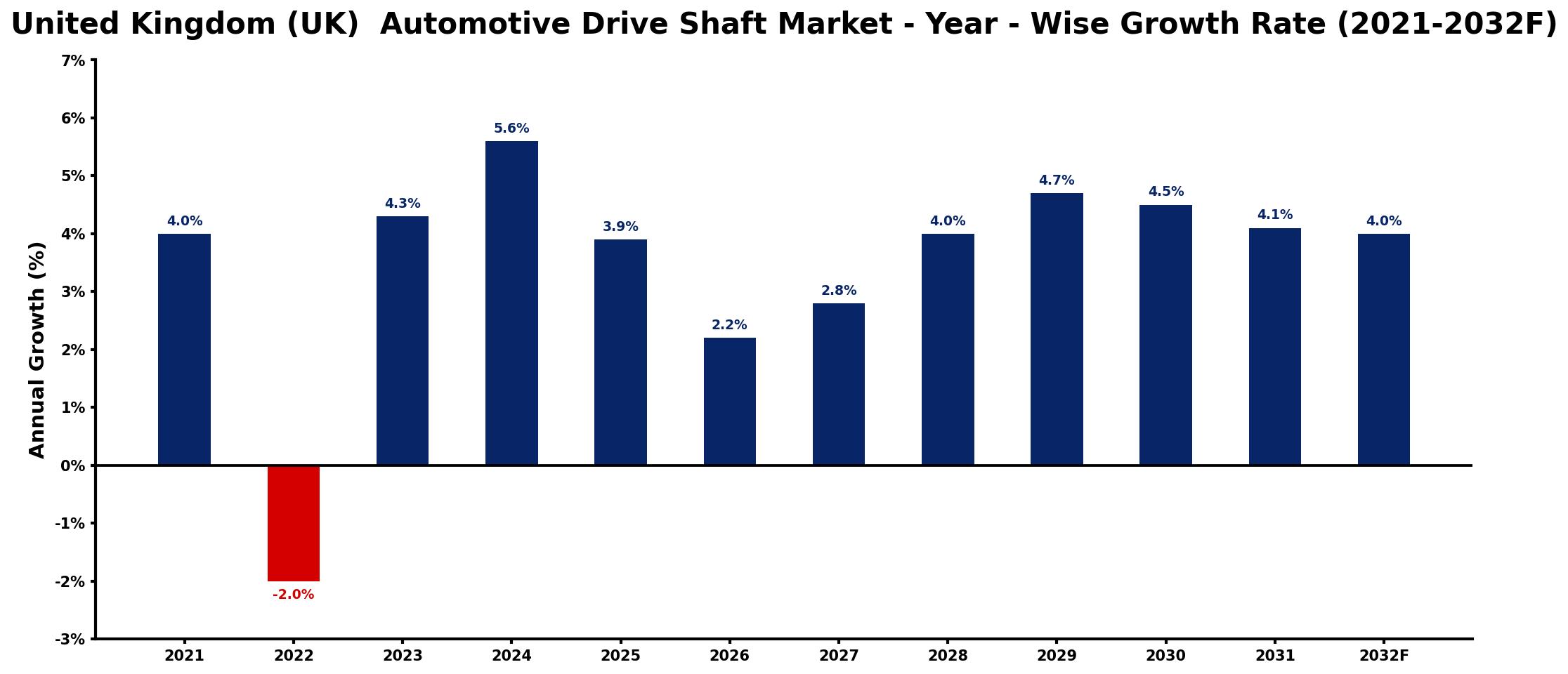
The table below presents the year‑wise growth rates along with the key drivers influencing the market
| Year | Growth Rate | Major Drivers |
| 2021 | 4.0% | Rising consumer vehicle purchases |
| 2022 | -2.0% | Decreased industrial production output |
| 2023 | 4.3% | Increased electric vehicle adoption |
| 2024 | 5.6% | Growing demand for lightweight materials |
| 2025 | 3.9% | Expansion of manufacturing facilities |
| 2026 | 2.2% | Surge in aftermarket services |
| 2027 | 2.8% | Higher investments in technology |
| 2028 | 4.0% | Increasing global trade activities |
| 2029 | 4.7% | Boost in renewable energy initiatives |
| 2030 | 4.5% | Demand for urban mobility solutions |
| 2031 | 4.1% | Strengthening supply chain partnerships |
| 2032 | 4.0% | Growth in vehicle electrification trends |
Note: Market size estimations and growth projections presented in this report are based on 6Wresearch's proprietary forecasting methodology, utilizing the latest available industry data, government publications, and primary research inputs.
United Kingdom (UK) Automotive Drive Shaft Market Synopsis
The UK automotive drive shaft market is experiencing significant transformation as manufacturers adapt to the evolving landscape of the automotive sector. With a keen focus on sustainability, the industry is moving towards lighter and more fuel-efficient drive shaft solutions that cater to the growing electric vehicle segment.
As UK-based manufacturers align their strategies with global trends, there is an increased emphasis on innovative materials and designs to enhance vehicle performance. This proactive approach not only meets consumer demands but also addresses the regulatory push for lower emissions and improved fuel economy.
United Kingdom (UK) Automotive Drive Shaft Market Key Takeaways
- The market is primarily driven by the rising demand for vehicles, especially in the electric vehicle segment.
- Technological advancements are leading to the development of lighter and more efficient drive shafts.
- Government regulations focused on emissions are driving innovation in drive shaft technologies.
- Competitive pressures are prompting local manufacturers to innovate continuously.
- The focus on sustainability presents new avenues for eco-friendly drive shaft solutions.
Evaluation of Restraints in United Kingdom (UK) Automotive Drive Shaft Market
While the UK automotive drive shaft market is poised for growth, it faces several constraints that could impede progress. One notable challenge is the heightened competition from international manufacturers, which has intensified the pressure on local firms to innovate and offer differentiated products. Additionally, fluctuating prices of essential raw materials, such as steel and aluminum, can adversely affect production costs and profit margins. Furthermore, adherence to stringent regulatory standards regarding emissions and safety is a continuous challenge for manufacturers. Effectively navigating these barriers requires a steadfast focus on cost-efficient manufacturing and technological advancements.
United Kingdom (UK) Automotive Drive Shaft Market Trends
The UK automotive drive shaft market is witnessing a shift towards lightweight materials, including carbon fiber and aluminum, to enhance vehicle fuel efficiency and minimize emissions. Additionally, the growth of electric vehicles is driving demand for specialized drive shafts that meet the unique requirements of EV powertrains. The emergence of autonomous vehicles is also influencing the market, necessitating the development of drive shafts with superior durability to handle increased operational demands. Moreover, the industry is increasingly focused on eco-friendly manufacturing practices, aligning product development with sustainability goals.
United Kingdom (UK) Automotive Drive Shaft Market Opportunities
There are promising investment opportunities within the UK automotive drive shaft market, particularly driven by the rising demand for electric and hybrid vehicles. Companies that can innovate lightweight materials and advanced manufacturing techniques will find substantial growth potential. Furthermore, as the UK government continues to phase out internal combustion engines, the market for electric vehicle components—including drive shafts—will become increasingly lucrative. Investors and manufacturers alike should pay close attention to companies leading technological advancements that align with sustainability and performance enhancements.
Government Initiatives in the United Kingdom (UK) Automotive Drive Shaft Market
The UK government has instituted various policies to support the automotive drive shaft market, particularly those aimed at reducing carbon emissions and encouraging the adoption of electric vehicles. Through funding programs, the government promotes research and development initiatives that enhance innovation in drive shaft manufacturing. Furthermore, trade policies are being implemented to facilitate international collaboration and ensure the competitiveness of UK automotive manufacturers in the global market, thereby fostering growth across the sector.
Future Insights of the United Kingdom (UK) Automotive Drive Shaft Market
Looking ahead to 2026-2032, the UK automotive drive shaft market is set to experience steady growth driven by increasing vehicle production and technological advancements. The transition towards electric vehicles will be a significant catalyst, as specialized drive shafts become integral to their powertrains. Additionally, the drive for carbon emission reductions will compel traditional combustion engine vehicles to adopt lightweight and durable drive shaft technologies. Market participants must remain agile and innovative to address these evolving demands effectively.
United Kingdom (UK) Automotive Drive Shaft Market Latest Developments (2025 - 2026)
In recent months, the UK automotive drive shaft market has seen a flurry of activity as manufacturers ramp up production in response to the growing demand for electric vehicles. Research and development initiatives focusing on lightweight materials and advanced manufacturing techniques are becoming prominent. Additionally, partnerships between local manufacturers and technology firms are emerging, aimed at enhancing the sustainability and performance of drive shaft solutions, signaling a strong commitment to innovation in this sector.
United Kingdom (UK) Automotive Drive Shaft Market - Key Attractiveness of the Report
- 10 Years of Market Numbers
- Historical Data Starting from 2022 to 2025
- Base Year: 2025
- Forecast Data until 2032
- Key Performance Indicators Impacting the Market
- Major Upcoming Developments and Projects
Key Highlights of the Report:
- United Kingdom (UK) Automotive Drive Shaft Market Outlook
- Market Size of United Kingdom (UK) Automotive Drive Shaft Market, 2025
- Forecast of United Kingdom (UK) Automotive Drive Shaft Market, 2032
- Historical Data and Forecast of United Kingdom (UK) Automotive Drive Shaft Revenues & Volume for the Period 2022-2032F
- United Kingdom (UK) Automotive Drive Shaft Market Trend Evolution
- United Kingdom (UK) Automotive Drive Shaft Market Drivers and Challenges
- United Kingdom (UK) Automotive Drive Shaft Price Trends
- United Kingdom (UK) Automotive Drive Shaft Porter's Five Forces
- United Kingdom (UK) Automotive Drive Shaft Industry Life Cycle
- Historical Data and Forecast of United Kingdom (UK) Automotive Drive Shaft Market Revenues & Volume By Design Type for the Period 2022-2032F
- Historical Data and Forecast of United Kingdom (UK) Automotive Drive Shaft Market Revenues & Volume By Hollow Shaft for the Period 2022-2032F
- Historical Data and Forecast of United Kingdom (UK) Automotive Drive Shaft Market Revenues & Volume By Solid Shaft for the Period 2022-2032F
- Historical Data and Forecast of United Kingdom (UK) Automotive Drive Shaft Market Revenues & Volume By Position Type for the Period 2022-2032F
- Historical Data and Forecast of United Kingdom (UK) Automotive Drive Shaft Market Revenues & Volume By Rear Axle for the Period 2022-2032F
- Historical Data and Forecast of United Kingdom (UK) Automotive Drive Shaft Market Revenues & Volume By Front Axle for the Period 2022-2032F
- Historical Data and Forecast of United Kingdom (UK) Automotive Drive Shaft Market Revenues & Volume By Vehicle Type for the Period 2022-2032F
- Historical Data and Forecast of United Kingdom (UK) Automotive Drive Shaft Market Revenues & Volume By Passenger Cars for the Period 2022-2032F
- Historical Data and Forecast of United Kingdom (UK) Automotive Drive Shaft Market Revenues & Volume By Commercial Vehicles for the Period 2022-2032F
- United Kingdom (UK) Automotive Drive Shaft Import Export Trade Statistics
- Market Opportunity Assessment By Design Type
- Market Opportunity Assessment By Position Type
- Market Opportunity Assessment By Vehicle Type
- United Kingdom (UK) Automotive Drive Shaft Top Companies Market Share
- United Kingdom (UK) Automotive Drive Shaft Competitive Benchmarking By Technical and Operational Parameters
- United Kingdom (UK) Automotive Drive Shaft Company Profiles
- United Kingdom (UK) Automotive Drive Shaft Key Strategic Recommendations






































